
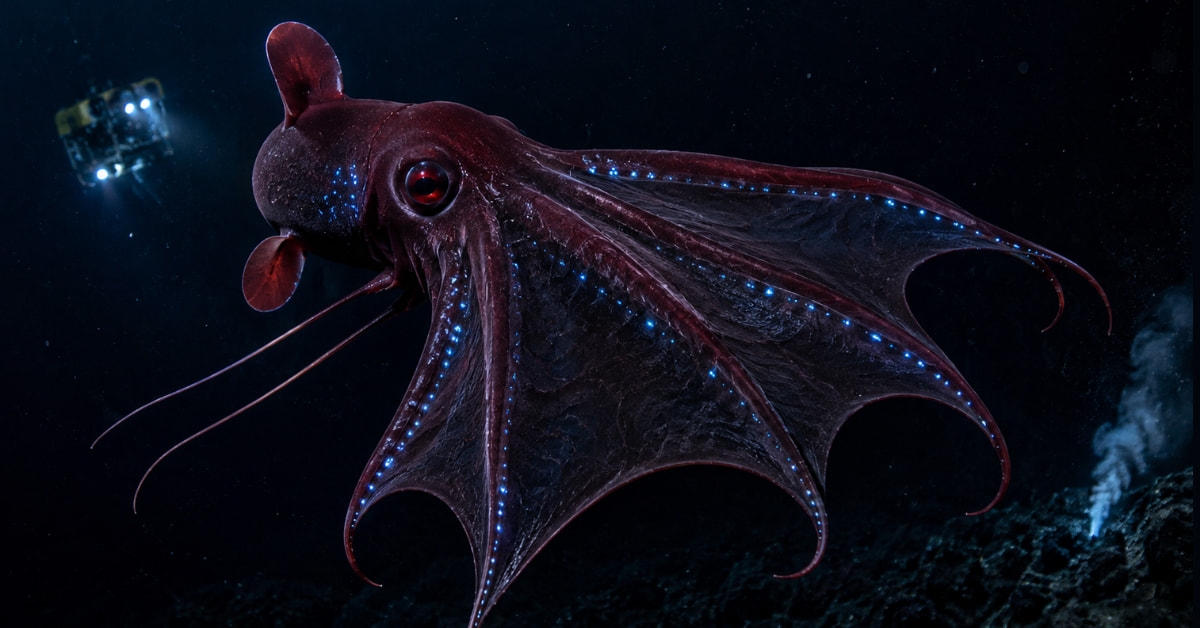
Nine hundred meters down, in water with almost no oxygen and no sunlight, something drifts past a research submersible with its arms turned inside out like an umbrella caught in a storm. Its eyes glow red, and its body looks like a deflated balloon wearing a cape. For most of the twentieth century, nobody agreed on what to call it: an octopus, a squid, or something else entirely. The vampire squid facts below unravel one of the strangest survivors in the ocean, a creature that has outlived the dinosaurs, doesn’t drink a drop of blood, and just forced marine biologists to publicly walk back a “new species” that turned out not to exist.
What Is a Vampire Squid? Vampyroteuthis Infernalis Explained
The vampire squid earns its unsettling name from Carl Chun, the German zoologist who first hauled one out of the deep Atlantic in 1898. Its scientific name, Vampyroteuthis infernalis, translates to “vampire squid from hell,” a title Chun gave it after staring at its blood-red eyes and the webbed, cloak-like skin stretched between its arms. The name stuck. Once you look past it, the biology behind it turns into one of the more entertaining sets of vampire squid facts in the ocean.
Why Is It Called a Vampire Squid?
Why is it called a vampire squid if it isn’t dangerous at all? The answer is entirely cosmetic. Its dark reddish-brown skin, deep-set eyes, and cape-like webbing reminded Chun of Dracula, so he named it after the myth rather than any actual behavior; it has never been observed feeding on blood, and has no physical means of doing so.
Vampire Squid vs. Vampire Octopus vs. True Squid
Despite how often people search for the “vampire octopus,” this animal is neither an octopus nor a true squid. It sits alone in its own taxonomic order, Vampyromorphida, the last living branch of a lineage that otherwise died out millions of years ago. Confusingly, its closest living relatives are octopuses rather than squids, which is likely why the vampire octopus search term outpaces the animal’s real name by a wide margin.
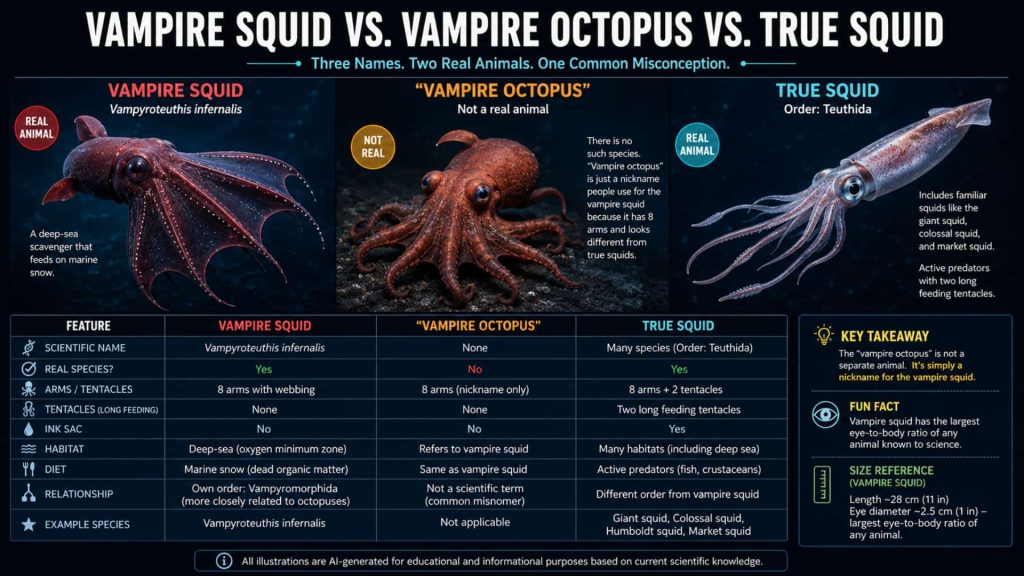
Genetically and physically, the animal blends features of both groups, which is exactly why the vampire octopus label refuses to die online. It has eight webbed arms like an octopus, but it also carries two long retractile filaments no true octopus or squid possesses. Those filaments, not tentacles, are what it actually uses to find food, and they remain the clearest way to separate a true vampire squid from anything else in the ocean, vampire octopus included. For a sense of how different a real octopus actually behaves, StrangeHappen’s profile of the dorado octopus shows a hunting style and body plan that has almost nothing in common with the vampire squid beyond the arm count.
A smaller share of searches use “viper squid,” another misremembering of the name that points to the exact same animal. Neither viper squid nor vampire octopus is a recognized name in taxonomy, but both show up often enough in search data to be worth clearing up here.
Vampire Squid Size and Anatomy
A fully grown vampire squid reaches about 28 centimeters, according to Guinness World Records, which is roughly the length of a housecat’s tail. Vampire squid size sounds unremarkable until you look at the eyes: at 2.5 centimeters across, they give this animal the largest eye-to-body ratio of any creature ever measured, edging out even the far larger colossal squid on that specific metric. Its body is gelatinous, closer in texture to a jellyfish than a typical cephalopod and often mentioned alongside the famously soft-bodied blobfish as an example of deep-sea pressure shaping anatomy, and it ranges from jet black to deep red depending on where it lives. Vampire squid size stays remarkably consistent across populations worldwide, which makes that eye measurement even more striking as a fixed trait of the species rather than a regional quirk.
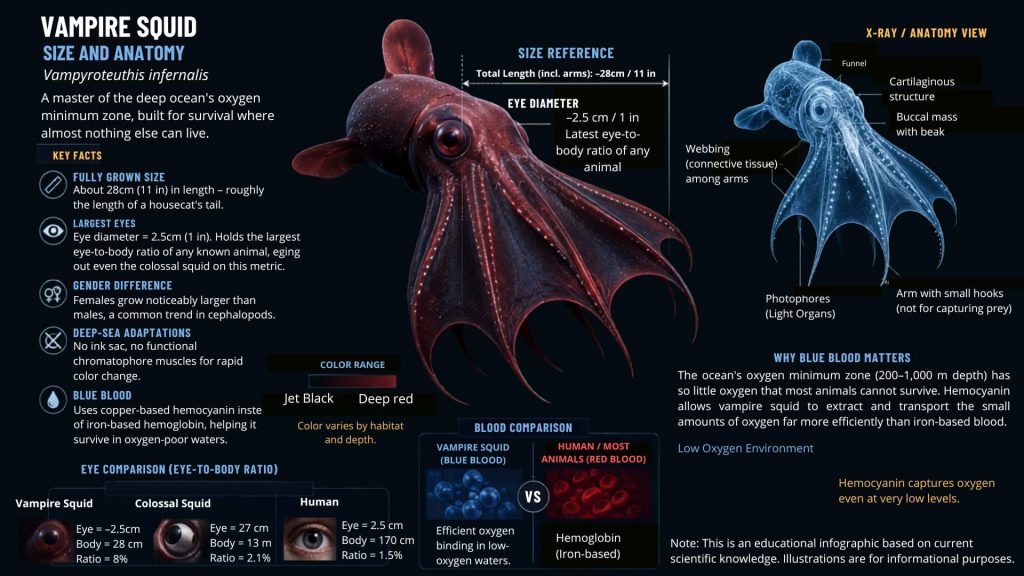
Male and female vampire squid do not reach the same size. Adult females generally become larger than males, reflecting a biological trend seen in many cephalopod species. Unlike true squid, Vampyroteuthis infernalis has no ink sac, no functional chromatophore muscles for rapid color change, and blue, copper-based blood called hemocyanin instead of the iron-based blood most animals rely on. That blue blood binds oxygen more efficiently than ours, which turns out to be the reason this animal can survive somewhere almost nothing else can.
Vampire Squid Habitat: Inside the Ocean’s Oxygen Minimum Zone
Vampire squid habitat is defined by one brutal statistic: oxygen saturation below 3 percent. They occupy the oxygen minimum zone, a band of ocean roughly 600 to 1,200 meters deep where most predators cannot survive, according to the Monterey Bay Aquarium Research Institute (MBARI). Water temperatures here hover just above freezing, and no sunlight reaches this far down.
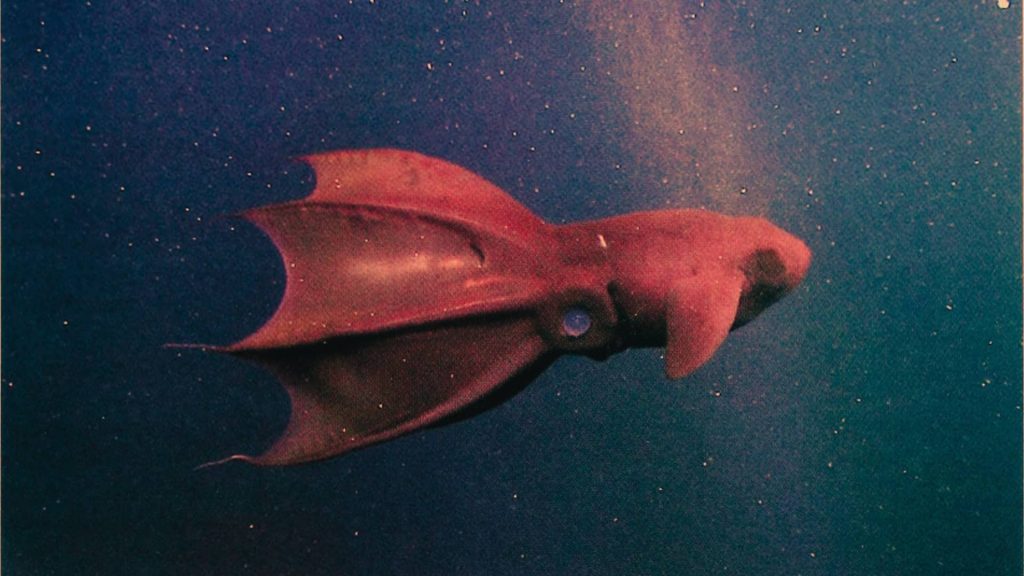
This vampire squid habitat spans tropical and temperate oceans worldwide, from the Gulf of Mexico to the South China Sea. Because so few animals can tolerate the low oxygen, the vampire squid effectively has this layer of ocean to itself, trading a hostile environment for near total safety from predators willing to follow it that deep.
The Ocean’s Depth Zones, Explained
The ocean is usually described in layers, and each one explains part of why vampire squid habitat sits exactly where it does. The sunlight zone, or epipelagic zone, reaches down to about 200 meters and holds nearly all marine plant life; StrangeHappen’s own breakdown of sunlight zone facts covers just how much of the ocean’s food web depends on that narrow surface layer.
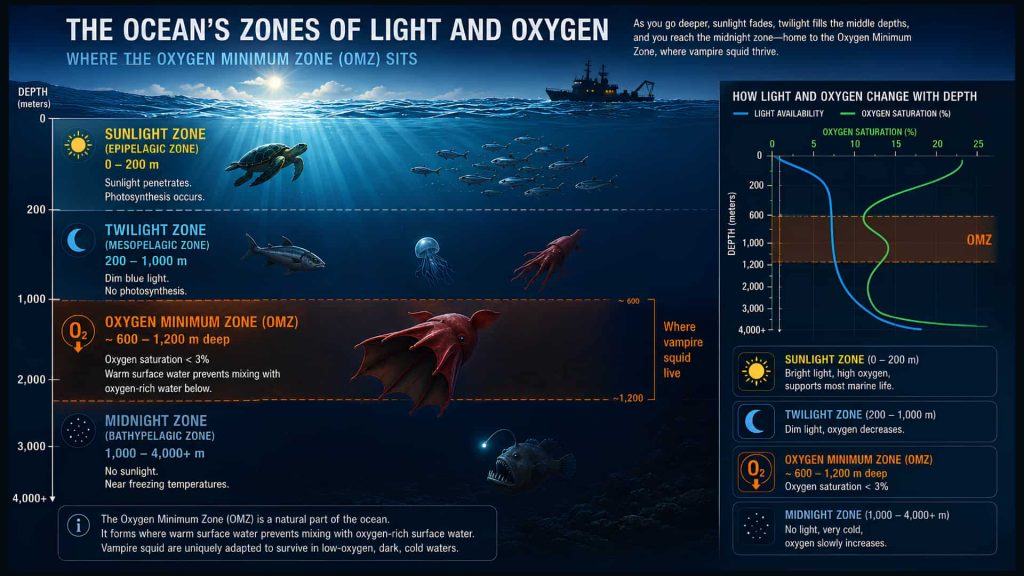
Below that sits the twilight zone, where sunlight fades to nothing by roughly 1,000 meters, followed by the permanently dark, crushingly cold midnight zone. The oxygen minimum zone overlaps the lower twilight and upper midnight zones, which is exactly the depth band the vampire squid calls home.
What Do Vampire Squid Eat? The Truth Behind Their Diet
A Diet of Marine Snow
For a century after its discovery, the question of what vampire squid eat had no real answer, since researchers never found intact prey inside a dissected specimen. MBARI postdoctoral fellow Henk-Jan Hoving and senior scientist Bruce Robison finally solved the mystery by filming the animal alive in its natural habitat instead of relying on dead specimens.
The footage showed something no cephalopod had ever been documented doing. Rather than hunting, the vampire squid extends one of its two filaments, sometimes up to eight times its own body length, and lets marine snow drift onto it: a mix of dead plankton, mucus, and fecal pellets sinking from the surface. Suckers on its arms coat the debris in mucus before finger-like cirri sweep it toward the mouth.
Vampire Squid Food Chain and Predators
This detritus diet places the vampire squid low on the food chain despite its intimidating name. Documented predators are limited, though deep-diving whales and other cephalopods are suspected candidates. Because it eats waste rather than living prey, it plays an unusual recycling role in the deep-sea food chain, keeping organic material moving instead of settling on the seafloor.
How Vampire Squid Defend Themselves: The Pineapple Posture
With no ink sac and a soft, slow-moving body, the vampire squid relies on theater rather than speed. When threatened, it turns its arms and webbing inside out over its head and mantle, exposing rows of spiny-looking cirri in a display biologists call the pineapple posture, sometimes also described as the pumpkin posture, according to Animal Diversity Web at the University of Michigan.
If the pineapple posture fails to deter a predator, the vampire squid has a second trick. It releases a cloud of bioluminescent mucus from the tips of its arms that can glow for close to ten minutes, according to field notes published through NOAA Ocean Exploration and the Ocean Exploration Trust. The glowing cloud distracts a predator just long enough for the squid to drift back into darkness.
By – RecoveryTweet
Photophores, light-producing organs scattered across its fins, mantle, and arm tips, let it flash and pulse light in patterns that confuse attackers, a strategy it shares with the ocean’s other light-based specialists like the glow jellyfish and the lure-dangling anglerfish, though each species puts bioluminescence to a completely different use. It can also swim in short, fast zig-zag bursts, reaching roughly two body lengths per second, despite looking too gelatinous to move quickly at all.
Are Vampire Squid Dangerous to Humans?
Are vampire squids dangerous? Not even slightly. Despite a name built for a horror movie, Vampyroteuthis infernalis carries no venom, has no bite worth mentioning, and shows no interest in humans whatsoever. Divers and remotely operated vehicles have filmed it at close range for decades without a single documented incident.
Its reputation says more about branding than biology. A creature with blood-red eyes, a cape of webbed skin, and a name meaning “from hell” was always going to be marketed as the scariest squid in the world, but its actual lifestyle, drifting motionless while eating debris, has more in common with a Roomba than a predator. Unlike genuinely dangerous ocean animals such as the box jellyfish, the vampire squid has never posed a real threat to anyone, and even the mislabeled vampire octopus version of the story doesn’t change that biology one bit.
The Discovery of the Vampire Squid: Carl Chun and the Valdivia Expedition
The vampire squid’s origin story begins with the Valdivia Expedition, Germany’s first major deep-sea research voyage. Carl Chun set sail from Hamburg in July 1898 aboard the converted steamer Valdivia, determined to prove that life could exist below 550 meters, a depth many scientists at the time assumed was completely lifeless.
Over nearly a year at sea, Chun’s team surveyed 268 stations across the Atlantic, Antarctic, and Indian Oceans. Among the thousands of specimens they hauled up was a small, dark, gelatinous animal Chun first classified as an octopus, arguably the origin of the vampire octopus confusion still circulating today, before recognizing it belonged somewhere entirely new. His findings, published over the following four decades across 24 volumes, gave science its first real look at deep-sea life, its first vampire squid, and some of the earliest vampire squid facts ever recorded.
Vampire Squid Lifespan and Reproduction: Breaking Every Cephalopod Rule
Almost every squid, octopus, and cuttlefish reproduces exactly once, in one dramatic burst, and then dies. Vampire squid do not follow that rule, in a twist that recalls the biological rule-breaking behind the immortal jellyfish, though the two species achieve their longevity through completely different mechanisms. A study in Current Biology led by Hoving alongside MBARI’s Bruce Robison examined preserved ovaries from more than 40 specimens and found something never before documented in a soft-bodied cephalopod.
Female vampire squid spawn in repeated cycles regardless of vampire squid size or age: release a batch of eggs, enter a resting phase, then develop a new batch, over and over. One 448-gram female had already spawned an estimated 38 times and still carried roughly 6,500 eggs in reserve. Based on that math, researchers estimate the adult stage of the vampire squid life cycle alone lasts three to eight years, likely making its total lifespan longer than any other cephalopod studied so far.
A Strange Vampire Squid Life Cycle
Juveniles hatch with four fins, an early-stage feature almost no other cephalopod carries into adulthood. As they mature, one pair of fins is reabsorbed into the body while a second pair, positioned differently, takes over for swimming, according to the Monterey Bay Aquarium. Scientists still don’t know exactly how long the earliest larval stages last in the wild, since mating itself has never been directly observed.
The 2026 Discovery That Rewrote the Vampire Squid’s Family Tree
For over a century, the vampire squid stood completely alone as the only living member of its order. That changed in 2024, when researchers from the South China Sea Institute of Oceanology described a second species, Vampyroteuthis pseudoinfernalis, based on a specimen collected near Hainan Island in 2016. Researchers identified several features they believed set the specimen apart, including a pointed tail, a wider beak, and photophores positioned differently from those seen in previously examined vampire squid. Together, they considered these traits strong enough to describe it as a separate species.
By- BBC Earth
In 2026, that conclusion was reversed. A team that included Smithsonian cephalopod expert Michael Vecchione re-examined a wider set of specimens and published their correction in the Bulletin of Marine Science. They found that beak shape and photophore position actually vary naturally across a vampire squid’s life stages, and that soft-bodied specimens frequently deform during capture and transport from crushing ocean depths. Expanded genetic testing found no separation deep enough to support a second species after all.
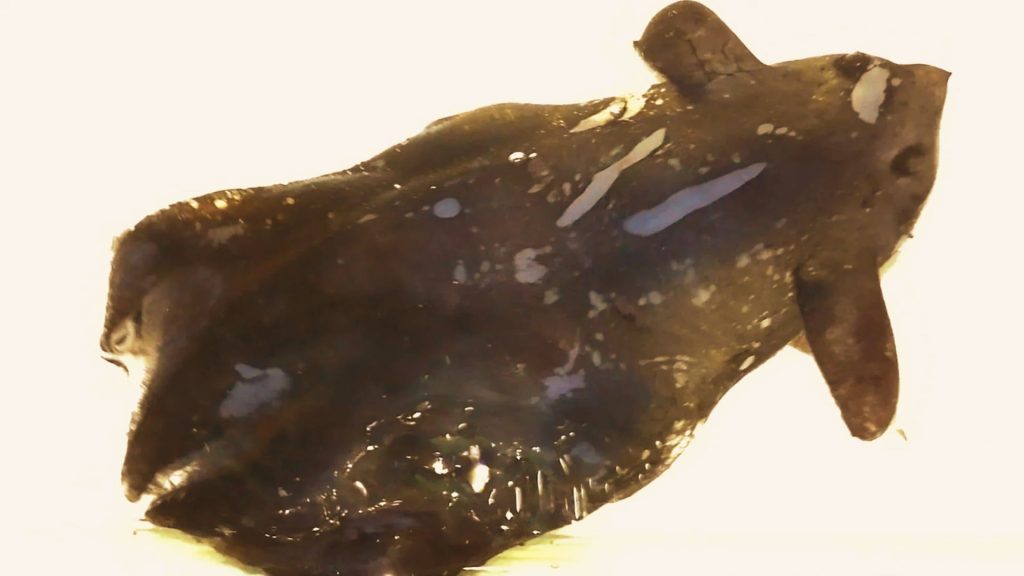
Image credit: Live Science. Used for educational and informational purposes.
Vampyroteuthis pseudoinfernalis was formally folded back into Vampyroteuthis infernalis as what taxonomists call a junior synonym: a name still preserved in the scientific record but no longer attached to a distinct species. The process behind that kind of reversal follows the same formal rules used across biology; StrangeHappen’s own explainer on how scientists name a new species walks through how a name like Vampyroteuthis pseudoinfernalis gets proposed, peer-reviewed, and occasionally retired. It is a rare, recent, well-documented example of science correcting itself in real time, and it is a story almost no other vampire squid facts page currently covers in full.
Other Deep-Sea Discoveries Redefining the Ocean
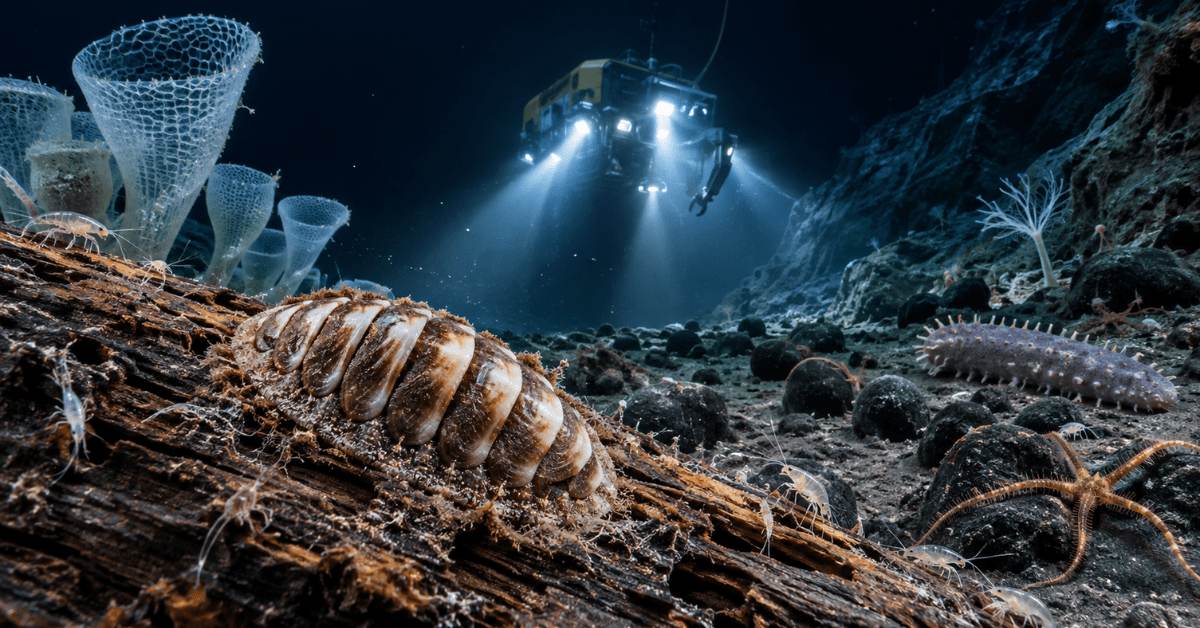
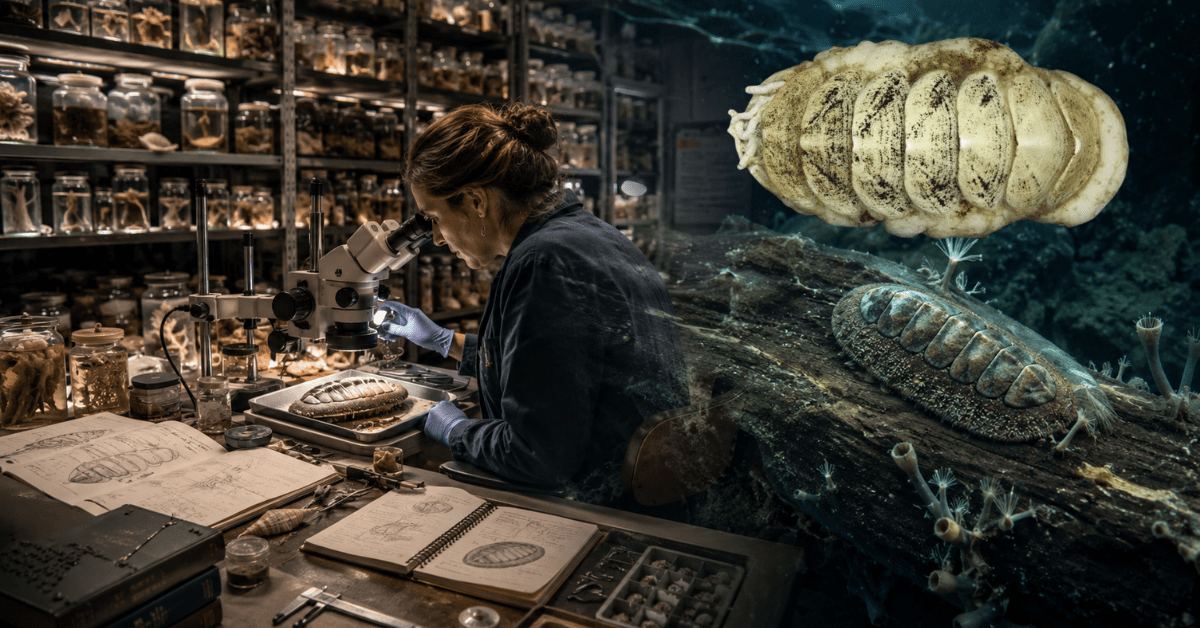
The vampire squid’s 2026 reclassification is not an isolated event. Deep-sea researchers continue naming and re-examining species at a pace that would have astonished Carl Chun, including the recently described Ferreiraella populi deep-sea chiton and an unusual animal pulled from Japan’s Sagami Bay. Extreme-depth survivors like the yeti crab and the oddly named elven abyss tunicate show the same pattern the vampire squid does: strange, hyper-specific adaptations for environments almost nothing else can tolerate. StrangeHappen’s running list of newly discovered species tracks just how often this keeps happening across the ocean.
Why Scientists Call It a Living Fossil
The vampire squid is often labeled a living fossil because its order, Vampyromorphida, once included many more species before nearly all of them died out. Fossil evidence suggests relatives of this lineage existed alongside dinosaurs. Today, Vampyroteuthis infernalis is the only living representative of its ancient lineage. Its overall body design has remained remarkably consistent for tens of millions of years, making it one of the ocean’s most remarkable evolutionary survivors.
Because it lives in one of the harshest environments on the planet, largely untouched by human activity, the vampire squid also functions as a baseline for deep-sea health. Whether people call it a vampire squid or mistakenly a vampire octopus, its evolutionary story stays the same. Oceana has flagged proposed deep-sea mining operations as a future threat, since disruption could reach the vampire squid habitat deep inside the oxygen minimum zone; StrangeHappen’s closer look at deep-sea mining explains why so many scientists are worried about species nobody has even finished cataloging yet. It has not been formally evaluated by the IUCN Red List, largely because population data from a habitat this difficult to survey barely exists.
Future Research: What Scientists Still Don’t Know
Mating in the vampire squid has never been directly observed, and nobody knows for certain how long its earliest stages take to mature in open water. The 2026 taxonomic correction also raises a sharper question: with beak shape and photophore position now ruled out as reliable markers, what would it actually take to prove a second living vampire squid species, if one is ever genuinely found?
Key Takeaways
Here is a quick recap of the vampire squid facts covered above, useful for anyone still searching “vampire octopus” and landing here by accident:
- Vampyroteuthis infernalis is not a squid, octopus, or vampire; it is the last living member of its own order, Vampyromorphida, and not a “vampire octopus” despite the common search term.
- These vampire squid facts include the largest eye-to-body ratio of any known animal: 2.5 cm eyes on a 28 cm body, according to Guinness World Records.
- Its diet is entirely marine snow and detritus; it has never once been observed hunting live prey.
- It survives in the oxygen minimum zone using copper-based blue blood and an extremely low metabolism.
- It defends itself with the pineapple posture and glowing bioluminescent mucus rather than ink or speed, despite a reputation as the scariest squid in the world.
- Female vampire squid spawn dozens of times across a multi-year adult life, unlike any other known cephalopod.
- A proposed 2024 “second species,” Vampyroteuthis pseudoinfernalis, was formally reversed in a 2026 study and reclassified as the same species.
Related Topics You May Like
- Ducibella Camanchaca: The Atacama Trench’s Own Deep-Sea Predator: another extreme-depth hunter built for crushing pressure and total darkness.
- How Scientists Name a New Species: the formal process behind the exact kind of reclassification that just happened to the vampire squid.
- Deep-Sea Mining: What’s Really at Stake: why conservation groups are watching threats to the oxygen minimum zone and the species that depend on it.
- The Immortal Jellyfish: another marine animal that breaks the reproductive rules of its own group, in its own strange way.
- Chinese Giant Salamander: Earth’s Largest Living Fossil Amphibian: a freshwater cousin in the same relict-species story, unchanged since the age of dinosaurs.
- Glass Octopus: The Nearly Invisible Cephalopod of the Open Ocean: a cephalopod relative that survives the deep through transparency instead of camouflage.
- Stonefish: The Ocean’s Most Camouflaged Danger: a reef dweller whose defenses are the deadly opposite of the harmless vampire squid.
Frequently Asked Questions About Vampire Squid Facts
What are the most surprising vampire squid facts?
The most surprising vampire squid facts are that its eyes give it the largest eye-to-body ratio of any animal despite modest vampire squid size, and that it is neither a squid nor an octopus and never hunts. It survives on marine snow, defends itself with glowing mucus, and can spawn dozens of times over a multi-year lifespan, all details these vampire squid facts cover in full above.
Why is it called a vampire squid?
It is called a vampire squid because of its blood-red eyes and the webbed, cape-like skin between its arms, which reminded discoverer Carl Chun of a vampire’s cloak. Despite the name, it has never been observed drinking blood or threatening any animal.
Is a vampire squid a vampire octopus or a true squid?
Neither. Though frequently searched as “vampire octopus,” Vampyroteuthis infernalis belongs to its own order, Vampyromorphida, and is only distantly related to both octopuses and true squids, sharing physical traits with each group.
What do vampire squid eat?
Vampire squid eat marine snow, a mix of dead plankton, mucus, and fecal debris drifting down from the ocean’s surface. They collect it using a sticky, retractable filament rather than hunting live prey, a feeding style unique among cephalopods.
Are vampire squids dangerous to humans?
No, vampire squids are not dangerous to humans in any way. They carry no venom, show no aggressive behavior, and spend their entire lives in deep water far below where people swim or dive.
Where do vampire squid live?
Vampire squid habitat is the ocean’s oxygen minimum zone, roughly 600 to 1,200 meters deep, where oxygen saturation drops below 3 percent and few predators can follow. This vampire squid habitat spans tropical and temperate oceans worldwide, from the Gulf of Mexico to the South China Sea.
How big is a vampire squid?
Vampire squid size tops out around 28 centimeters in length, roughly the size of a football, with females growing larger than males. Its eyes alone measure 2.5 centimeters across, proportionally the largest of any animal on record.
How long do vampire squid live?
Their exact lifespan is unknown, but researchers estimate the adult stage lasts three to eight years based on repeated spawning cycles, which would make the vampire squid the longest-lived cephalopod documented so far.
Was a second vampire squid species really discovered?
In 2024, researchers suggested that a specimen collected from the South China Sea represented a previously unknown species, which they named Vampyroteuthis pseudoinfernalis. A 2026 study in the Bulletin of Marine Science reversed that finding, concluding it was a natural variation of Vampyroteuthis infernalis rather than a distinct species.
Source References
- Monterey Bay Aquarium Research Institute (MBARI), “Vampire Squid” species profile: (accessed 2026)
- MBARI News, “MBARI researchers discover what vampire squids eat”: (2012)
- MBARI News, “Vampire squid live long and reproduce often”: (2015)
- NOAA Ocean Exploration / Nautilus Live, “Not So Bloodthirsty: An Encounter with a Vampire Squid”: (2014)
- Animal Diversity Web, University of Michigan, “Vampyroteuthis infernalis”: (updated 2025)
About the Author
Author Mubashir Razzaq is a science and history writer for Strangehappen.com, specializing in archaeology, space exploration, ancient civilizations, and emerging scientific discoveries. His work focuses on translating complex research into engaging, evidence-based stories that help readers understand the mysteries of our world and beyond.