
Slice the ocean into layers and only one of them ever sees daylight. The sunlight zone runs barely 200 meters deep, yet it’s the warmest, busiest, most fished, and one of the most oxygen-rich stretches of water on the planet. Much of the life living below it ultimately depends on organic matter produced near the surface, including a slow rain of dead plankton and other material called marine snow.The one major exception lives around hydrothermal vents, where entire ecosystems run on chemical energy instead of sunlight at all. Everywhere else, though, this is the ocean most people already picture in their heads: blue, sunlit, and crowded with life. It’s also stranger, thinner, and more overworked than it looks from the surface.
Sunlight Zone Facts at a Glance
| Feature | Details |
|---|---|
| Depth | Surface to ~200 m (660 ft), by convention |
| Other names | Epipelagic zone, photic zone, euphotic zone (related but not identical terms) |
| Share of ocean volume | Only 2–3% |
| Surface temperature range | -2°C to 36°C (28°F to 97°F) |
| Light remaining at 200 m | 1% or less, in clear open ocean water |
| Oxygen contribution | Produces roughly half of Earth’s oxygen output each year |
| Signature animals | Whales, dolphins, sharks, tuna, sea turtles, jellyfish |
| Human dependence | Supports major commercial pelagic fisheries |
What Is the Sunlight Zone?
The sunlight zone, formally known as the epipelagic zone, is the top layer of the open ocean, the only one that gets enough light for photosynthesis to happen. You’ll also see it called the photic zone or the euphotic zone, and while people often use all three names interchangeably, they’re not quite the same thing. Epipelagic is a fixed depth convention, roughly the top 200 meters, used mainly to classify biological zones. Photic simply means “sunlit,” a broad category that includes both the euphotic zone (where photosynthesis can outpace respiration) and a dimmer transitional band beneath it. Euphotic zone depth actually shifts with water clarity, sometimes closer to 20 meters in murky coastal water, sometimes close to 200 meters in the clearest parts of the open ocean. In marine biology terms, this whole overlapping stretch is simply the shallow ocean region with sunlight for photosynthesis: the only part of the open sea where marine plant life and other photosynthetic organisms can actually grow.
As a biome, it’s also one of the most crowded neighborhoods in the entire ocean. According to the Woods Hole Oceanographic Institution, the sunlit zone makes up only 2 to 3 percent of the ocean’s total volume, yet although it occupies only a small fraction of the ocean’s total volume, it supports an enormous concentration of marine life, beginning with the phytoplankton that form the base of many ocean food webs., starting with the phytoplankton that anchor the entire ocean food web. Warm, well-mixed by wind and waves, and constantly stirred by sunlight, this layer behaves less like the “deep sea” people imagine and more like a sunlit meadow floating on top of a much colder, darker world underneath it.
Where Is the Sunlight Zone Located?
The sunlight zone isn’t one specific place so much as a condition: it exists wherever ocean water is shallow enough for meaningful light to reach it, which, practically speaking, is everywhere along the surface. Near the coast, this top layer sits over the continental shelf as part of what oceanographers call coastal or neritic waters, and in many spots it’s shallow enough to reach all the way down to the seafloor. Further out over the open ocean, it still only ever occupies that same top 200 meters, floating above thousands of meters of mesopelagic, bathypelagic, and abyssal water below.
It starts right at the ocean’s surface, where sunlight, wind, and waves constantly shape the water above.
How Deep Is the Sunlight Zone?
The sunlight zone extends from the surface down to roughly 200 meters (about 660 feet), the standard depth convention used by NOAA and most oceanographic institutions. Past that point, the ocean shifts into what’s classified as the mesopelagic, or twilight, zone.
That 200-meter mark is a working average, not a line drawn in the sand, and it’s worth understanding why. The epipelagic boundary is a fixed biological classification, while the actual limit of usable sunlight (the euphotic zone) is a moving target tied to water clarity. In exceptionally clear, nutrient-poor water, the open tropical Pacific is a good example, measurable sunlight can push close to that 200-meter mark. In murky coastal water clouded by sediment or a heavy plankton bloom, meaningful light can fade out at a small fraction of that depth. Scientists use 200 meters as a classification boundary, while the real edge of usable sunlight actually shifts with water clarity, latitude, and time of year.
Temperature of the Sunlight Zone
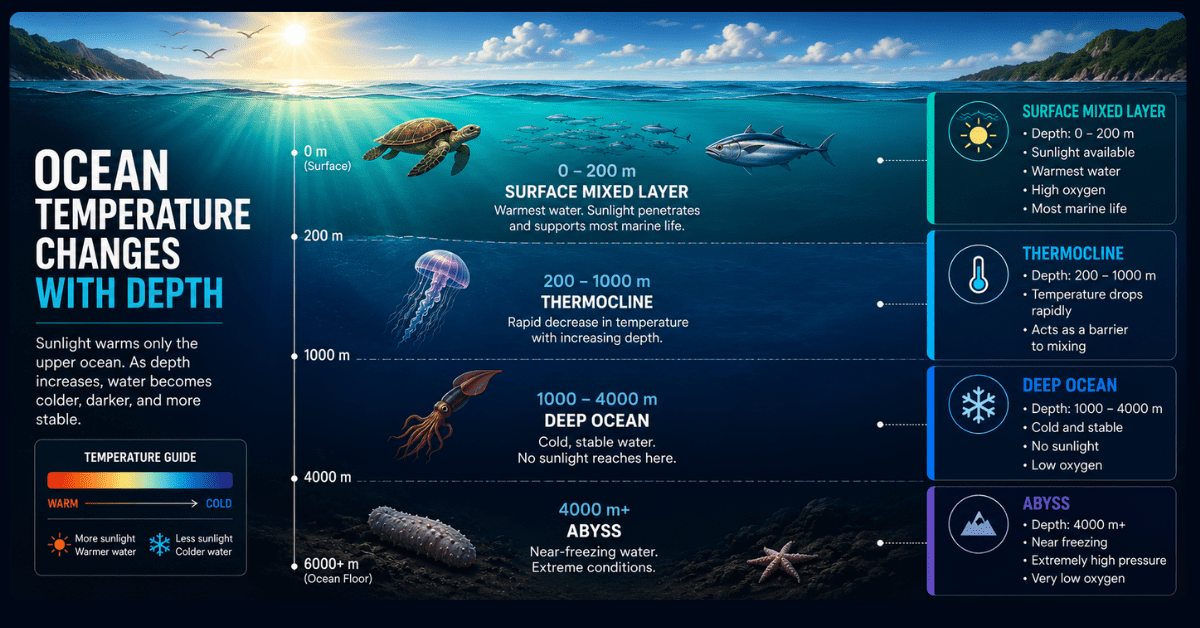
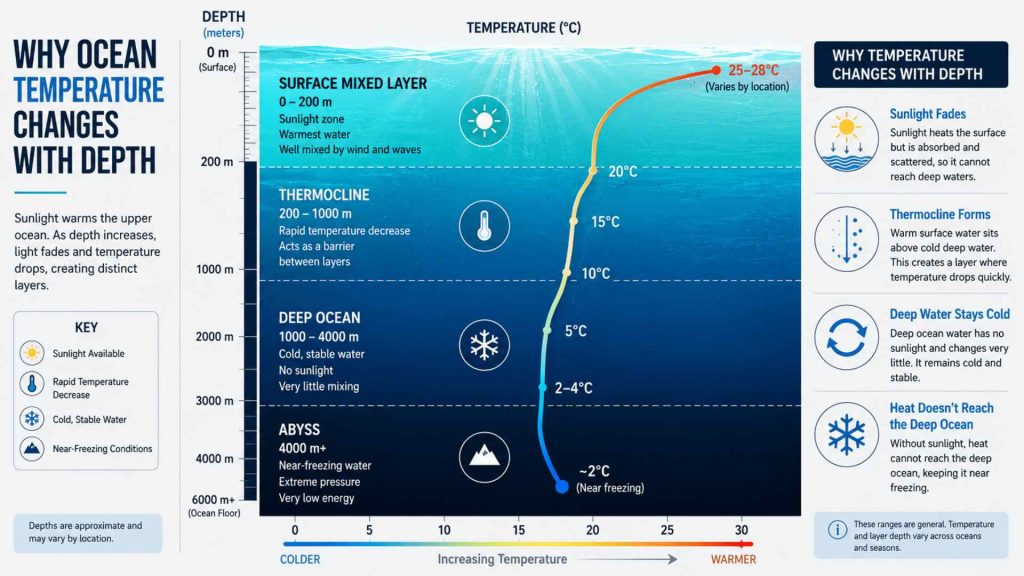
What is the temperature of the sunlight zone? Sea surface temperatures here swing from as low as -2°C (28°F) near the poles to as high as 36°C (97°F) in the Persian Gulf, making the sunlight zone’s surface temperature range the widest and warmest of any layer in the ocean, according to NOAA’s JetStream ocean program. It’s worth being precise here: that range describes the sea surface specifically, not the entire 200-meter column. Even in the warmest tropical water, temperature at 200 meters typically sits far closer to 10 to 15°C, because the sunlight zone doesn’t stay uniformly warm all the way down.
Why This Layer Swings So Wildly
That huge surface range exists because sunlight doesn’t just carry light, it carries heat, and this is the only layer of ocean that absorbs solar energy directly. Wind helps mix and spread that warmed surface water, but how deep that mixing actually reaches (what oceanographers call the mixed layer) varies a lot depending on season, latitude, and storm activity. It might only be 20 to 50 meters deep during a calm, stratified summer, or extend well past 100 meters during winter storms at higher latitudes. Either way, the sharpest change happens at the floor of the mixed layer, where it meets the thermocline, a layer in which temperature can fall rapidly with depth.
How It Compares to the Deep Ocean
Once you’re past the mesopelagic zone entirely, temperature settles into a narrow, steady range no matter the season. During the Océano Profundo 2018 expedition off Puerto Rico and the U.S. Virgin Islands, NOAA Ocean Exploration recorded an average temperature of just 2.2°C (36°F) at 5,000 meters on Mona Seamount during the Océano Profundo 2018 expedition. Set that next to a sun-warmed tropical surface pushing past 30°C, and the swing at the top of the ocean starts to look almost extreme by comparison.
Why Is It Called the Sunlight Zone?
It’s called the sunlight zone for the simplest reason possible: it’s the one layer of ocean where sunlight penetrates strongly enough to keep photosynthetic life alive. The related names attached to it, epipelagic zone, photic zone, euphotic zone, describe overlapping but not identical concepts, as explained above. “Sunlight zone” is simply the version marine educators use so nobody needs a full grasp of that terminology to follow along.
Is the sunlight zone the same as the epipelagic zone?
Close enough for everyday use, yes. Scientific papers almost always say “epipelagic” for the fixed 200-meter classification, while aquariums, textbooks, and nature documentaries use “sunlight zone” as the friendlier stand-in. Worth remembering: epipelagic marks a fixed depth line, whereas euphotic and photic track something more fluid, the actual distance light manages to reach before it’s gone..
Which zone receives the most sunlight?
This one, by a wide margin. The twilight zone sitting directly underneath still gets a faint, blue-tinted trace of light down to roughly 1,000 meters, dim and biologically almost useless, but not total darkness. True darkness doesn’t begin until you drop below that, into the aphotic zone where the midnight zone and the abyss take over.
How Much Sunlight Reaches the Sunlight Zone?
Sunlight in ocean water doesn’t fade evenly as it moves down through the water column: it drops off fast. In clear open ocean water, by the time you reach the 200-meter floor of the sunlight zone, roughly 1 percent or less of the sunlight that hit the surface is still detectable, a commonly used reference point for describing the depth of the euphotic zone. In murkier or more turbid water, that same 1 percent threshold can be reached at a small fraction of that depth.
Color disappears in a predictable sequence on the way down, and the usual explanation (that red light “runs out of energy” first) actually gets the mechanism backward. Water molecules absorb red and orange wavelengths strongly, largely because those wavelengths line up with water’s own vibrational absorption properties, so red light gets soaked up within the first few meters regardless of how much energy each photon carries. Blue light survives far longer because water absorbs and scatters it much less efficiently, which is exactly why the deeper end of the sunlight zone, and the water beyond it, takes on that familiar deep-ocean blue. Very little of that remaining light ever makes it past the twilight zone, and none of it survives all the way down to the true darkness of the midnight zone and the abyss.
One practical result of this color-fade: divers who cut themselves at depth often notice their blood looks black or dark green rather than red, simply because there’s no red light left down there for the blood to reflect back.
Plants in the Sunlight Zone
The sunlight zone is the only part of the open ocean where photosynthetic life can thrive, since below this layer, light quickly becomes too weak to support photosynthesis. It’s worth being precise about what’s actually growing down there, too. The main producers, phytoplankton, aren’t true plants in the strict biological sense; most are single-celled algae, diatoms, and cyanobacteria that photosynthesize like plants without being classified as one. Closer to shore, the sunlight zone also supports genuine plant life: seagrass meadows and mangrove forests, along with free-floating and rooted seaweed and red, green, and brown algae in the shallows.
Their collective impact stretches well beyond the water itself. According to the ocean conservation group Oceana, algae living in the sunlight zone produce at least 50 percent of the oxygen generated on Earth each year, a production rate that roughly matches or exceeds the combined output of every forest on land. That’s a claim about how much oxygen these organisms generate annually, not a claim that half of the air in the atmosphere right now was supplied by them, since a large share of that oxygen also gets consumed again through ocean respiration and decomposition. Either way, it makes this thin surface layer one of the planet’s biggest active sources of oxygen, produced almost entirely by organisms most people will never actually lay eyes on.
Animals in the Sunlight Zone
So what animals are in the sunlight zone, exactly? It supports an enormous variety of life, from microscopic plankton to some of the largest animals on Earth, largely because it’s the only one with enough food, oxygen, and light to support such dense life across every size class, from plankton to blue whales. Air-breathing marine mammals depend on this layer almost entirely, including dolphins, orcas, and the great baleen whales, all of which have to surface regularly no matter how deep they’re capable of diving. That last part matters: while baleen whales rely on the sunlight zone to breathe and do most of their feeding here, species like blue whales and other rorquals routinely dive well past 200 meters in pursuit of dense krill swarms, so “surface-dependent” isn’t quite the same as “surface-bound.”
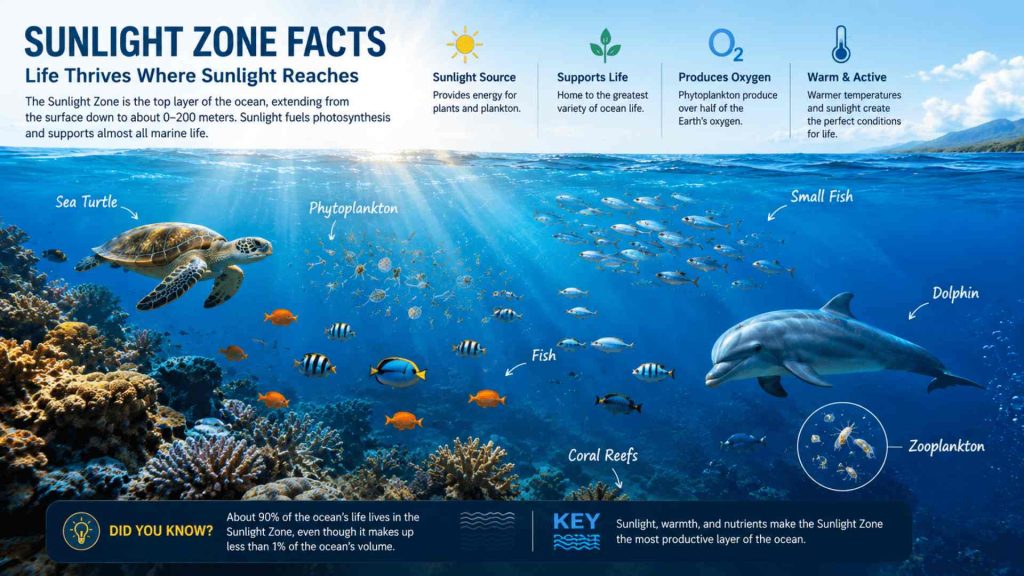
Sea turtles, most shark species, tuna, billfish, and reef fish spend most or all of their lives inside this layer, alongside drifting jellyfish and the shallow, light-dependent corals that build tropical reefs. Counting biomass and species diversity together, this thin surface layer holds an outsized share of all ocean life, a fact that surprises a lot of people who assume ocean animals must be more plentiful in the vastness of the deep.
Strange Bottom-Dwellers of the Sunlight Zone
Not every sunlight-zone animal lives near the surface. The red-lipped batfish, a bottom-dwelling fish famous for its bright red mouth and its habit of walking across the seafloor on modified fins instead of swimming, is found in shallow reef habitat around the Galápagos Islands and off the coast of Peru, well within the sunlight zone’s boundaries. That makes it one of the odder residents of an otherwise sun-drenched neighborhood. For a closer look at how it hunts and moves, the full red-lipped batfish facts breakdown covers it in more detail. It shares that shallow reef habitat with equally unlikely neighbors, including the tiny, translucent skeleton panda sea squirt, discovered anchored to reefs about 20 meters down off Japan.
Fish Built for Open Water
Fish in the sunlight zone generally fall into two broad camps: fast, open-water predators built for speed, like tuna and mackerel, and smaller forage fish, like sardines and anchovies, that travel in dense schools for protection. Both groups tend to share the same basic toolkit, smooth, spindle-shaped bodies, forked tails, and streamlined fins built for covering long distances efficiently in open water with nowhere to hide.
Not every animal in this layer plays it safe, either. The stonefish, one of the most venomous fish on the planet, takes the opposite approach entirely, sitting motionless on shallow reef bottoms and blending in so well it’s nearly invisible until something steps too close.
Food Chain of the Sunlight Zone
The sunlight zone’s food chain starts with phytoplankton, which turn sunlight, carbon dioxide, and dissolved nutrients into the energy that powers nearly everything above them. Zooplankton, including copepods and krill, graze directly on that phytoplankton and are in turn eaten by forage fish like anchovies and sardines. Those forage fish support the layer’s mid-level predators, tuna, mackerel, and reef fish, which are hunted themselves by apex predators including sharks, billfish, dolphins, and orcas.
Energy in this system mostly moves in two directions at once, and they’re worth telling apart. Dead plankton, waste, and other organic debris constantly sink downward as marine snow, carrying energy and carbon out of the sunlight zone and into the darker layers below, feeding entire mesopelagic and deep-sea food chains that never see the sun directly. Meanwhile, nutrients move the opposite way: because photosynthesis and constant grazing strip nutrients out of the surface water fast, much of what fuels renewed growth up here arrives from below, carried back up from deeper, nutrient-rich water through a process called upwelling, along with the mixing driven by wind, waves, and currents. Without nutrient resupply from deeper water and other sources, productivity in many ocean regions would decline sharply.
Adaptations of Sunlight Zone Animals
Life in open, brightly lit water creates a very specific problem: there’s nowhere to hide, in any direction, from predators above, below, or beside you. Animals in the sunlight zone have landed on a small handful of solutions to that problem, again and again, regardless of species.
Countershading
Countershading is probably the most common form of camouflage in this layer. Sharks, tuna, dolphins, and plenty of other species are dark on top and pale underneath, which hides them from above against the dark depths and from below against the bright surface, all at the same time.
Speed
Torpedo-shaped bodies, crescent-shaped tails, and reduced drag let fast-moving predators and prey alike outrun trouble in water with no obstacles to break their line of sight. Speed matters most precisely because there’s nowhere to hide out here, only distance.
Schooling Behavior
Sardines, anchovies, and mackerel lean on tightly coordinated schools as a third layer of defense, since a coordinated group is far harder for a predator to single out than any one fish swimming alone.
None of this resembles the bioluminescence and oversized eyes so common one layer down in the twilight zone, because down there the entire survival problem flips: finding faint light instead of hiding from too much of it.
Why Is the Sunlight Zone Important?
The sunlight zone matters well beyond the animals that call it home. Its phytoplankton generate a large share of the planet’s annual oxygen output and absorb enormous amounts of atmospheric carbon dioxide through photosynthesis, which makes this thin surface layer an important part of Earth’s carbon cycle and climate system, not just a habitat. It anchors the marine food web that everything in the ocean ultimately depends on, including species that spend most of their lives in far darker water but still rise into the sunlight zone at night to feed. That gives it outsized importance for overall marine ecosystem health, not just a single species’ backyard.
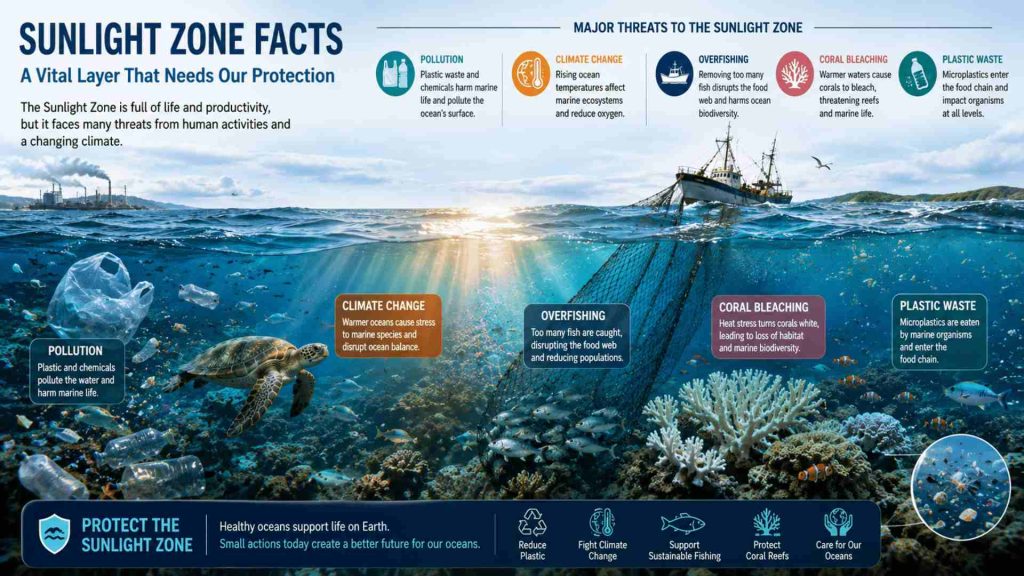
It’s also where humanity interacts with the ocean most directly, though not quite universally. Many major commercial pelagic fisheries, including fisheries targeting tuna, sardines, anchovies, and other open-water species, operate within the sunlight zone, tying its health directly to global food security. Deeper, demersal, and bottom-dwelling fisheries do exist outside this zone, but by sheer catch volume, the sunlight zone carries most of the load. Marine biodiversity is denser here than anywhere else in the ocean, and threats such as overfishing, plastic pollution, and warming seas can have major effects on ecosystems within this zone, precisely because it’s the layer most exposed to both sunlight and human activity.
Sunlight Zone vs. Twilight Zone
The sunlight zone and the twilight zone sit directly on top of each other, but they function like two different worlds. Here’s how they stack up.
| Feature | Sunlight Zone (Epipelagic) | Twilight Zone (Mesopelagic) |
|---|---|---|
| Depth | Surface to ~200 m (660 ft) | ~200 m to 1,000 m (660–3,280 ft) |
| Light | Sunlight strong enough to support photosynthesis | Faint, blue-tinted light, present but too dim for photosynthesis |
| Temperature | Highly variable at the surface: -2°C to 36°C | Sharp, rapid drop via the thermocline |
| Plant life | Phytoplankton, algae, seagrass, mangroves | None, no light strong enough for photosynthesis |
| Typical animals | Sharks, tuna, dolphins, sea turtles, jellyfish | Lanternfish, squid, bristlemouths |
| Key adaptation | Countershading, speed, schooling | Bioluminescence, oversized eyes |
Animals cross that boundary constantly. Plenty of twilight zone species migrate upward into the sunlight zone every night to feed under cover of darkness, then retreat back down at dawn to dodge predators that hunt by sight, a daily migration that is widely regarded as the largest movement of biomass in the ocean.
Interesting Facts About the Sunlight Zone
A quick round of fun facts about the sunlight zone, covering everything from color physics to seafood economics:
- The sunlight zone holds a huge share of all marine life, yet it accounts for only 2 to 3 percent of the ocean’s total volume.
- Red light disappears from seawater within the first few meters, which is why a bleeding wound looks black rather than red once a diver drops much past the shallows.
- Coral reefs only build in the sunlight zone because the algae living inside coral tissue need light to photosynthesize and feed their host.
- The red-lipped batfish spends its life walking on the seafloor of this layer instead of swimming, using fins that work more like stiff little legs.
- Sea turtles can hold their breath for hours underwater, but every species still returns to the surface of the sunlight zone to breathe and to nest on land.
- Phytoplankton in this layer are so small that a single drop of seawater can contain thousands of them, yet together they’re responsible for producing roughly half of Earth’s oxygen output each year.
- The thermocline at the base of the sunlight zone can drop water temperature by more than 15°C in under 100 meters of depth.
- Some open-ocean predators, like tuna, are partially warm-blooded, letting them hunt efficiently across a wider temperature range than the surrounding water would normally allow.
- The Persian Gulf regularly records the warmest sea surface temperatures on the planet, largely because its shallow sunlight zone heats up fast and has almost nowhere to lose that heat.
- Polar sunlight zone water can sit right at -2°C, just below freezing, because dissolved salt keeps seawater liquid at lower temperatures than fresh water.
- Nearly every hydrothermal vent ecosystem on Earth, far below the sunlight zone, runs entirely on chemical energy instead of anything drifting down from the sun-lit surface above.
Frequently Asked Questions About the Sunlight Zone
What is the sunlight zone?
The sunlight zone, or epipelagic zone, is the upper ocean layer where enough light is available for photosynthesis and where much of the ocean’s biological production begins.
How deep is the sunlight zone?
The sunlight zone runs from the surface down to roughly 200 meters (660 feet). That boundary is a standard classification depth; the actual reach of usable sunlight varies with water clarity, season, and latitude.
What animals live in the sunlight zone?
Dolphins, whales, sharks, tuna, sea turtles, jellyfish, and shallow-water corals all live in the sunlight zone, along with the phytoplankton and zooplankton that support them. It holds a denser mix of animal life than any other ocean layer.
Why is it called the sunlight zone?
It’s called the sunlight zone because it’s the only ocean layer that gets enough sunlight to support photosynthesis. Scientists also refer to it as the epipelagic, photic, or euphotic zone, though those terms describe slightly different things.
What is the temperature of the sunlight zone?
Surface temperatures in the sunlight zone range from about -2°C (28°F) near the poles to 36°C (97°F) in the warmest tropical waters, making it the most temperature-variable layer in the ocean. Temperature drops off quickly with depth even within this layer.
What plants grow in the sunlight zone?
Seagrass and mangroves are the true plants found here, alongside phytoplankton and algae, which photosynthesize like plants without being classified as one. Together, these organisms produce roughly half of Earth’s oxygen output each year.
Which ocean layer receives sunlight?
The sunlight zone, or epipelagic zone, is the only ocean layer that receives enough sunlight for photosynthesis. Deeper layers like the twilight zone still get a faint trace of light, but it’s too dim to support plant life, and true darkness begins around 1,000 meters down.
What is another name for the sunlight zone?
The sunlight zone is also called the epipelagic zone, and it’s closely related to the photic and euphotic zones, which describe how far usable light travels rather than a fixed depth.
Is the sunlight zone the same as the epipelagic zone?
Close enough for everyday use, yes. Both terms point to that same 200-meter layer: ‘sunlight zone’ is the plain-language version, ‘epipelagic’ is what you’ll find in the scientific literature. Just remember the exact depth sunlight reaches still shifts with how clear the water is.
Why is the sunlight zone important?
The sunlight zone produces a large share of the planet’s oxygen, anchors the entire marine food web, and supports most of the world’s commercial pelagic fishing. It’s also the ocean layer most exposed to threats like pollution, overfishing, and warming seas.
Sunlight Zone Key Takeaways
- The sunlight zone (epipelagic zone) runs from the surface to about 200 meters deep and is the only ocean layer with enough light for photosynthesis.
- Surface temperatures here range from -2°C to 36°C, by far the widest temperature swing of any ocean layer, though it drops off fast with depth.
- In clear open ocean water, roughly 99 percent of surface sunlight is gone by 200 meters.
- Phytoplankton and algae in this layer produce roughly half of Earth’s oxygen output each year.
- The sunlight zone makes up just 2 to 3 percent of ocean volume but supports the highest density of marine life and most of the world’s commercial pelagic fisheries.
- Much of the organic matter supporting deeper ocean food webs ultimately originates in sunlit surface waters.
Cross that 200-meter floor, though, and almost every one of those rules gets rewritten. Light doesn’t vanish all at once, it fades into a dim, blue half-light that lingers for another 800 meters before real darkness ever begins. Temperature stops swinging and locks into a narrow, steady band. And the animals waiting down there stopped relying on eyesight and speed generations ago, trading them for glowing lures and eyes built to catch a single stray photon. That’s the twilight zone, and it’s next.
You May Also Like: More From the Sunlight Zone
More Life in the Sunlight Zone
- Red-Lipped Batfish: the sunlight zone’s strangest bottom-walker, found around the Galápagos Islands
- Red-Lipped Batfish Facts: a deeper dive into nature’s most bizarre reef-walker
- Skeleton Panda Sea Squirt: the translucent reef-dweller that looks like a tiny panda
- Box Jellyfish: one of the sunlight zone’s most dangerous residents
- Stonefish: the reef predator that hides in plain sight
- Camouflage Animals: how countershading and other disguises help sunlight-zone species survive
- Beluga Whale: the Arctic “canary of the sea” known for its flexible neck and shape-shifting forehead
What’s Waiting Below: Twilight & Abyssal Zone Dwellers
- Anglerfish: the twilight zone’s most infamous ambush predator
- Barreleye Fish: the deep-sea fish with a transparent head and rotating eyes
- Glass Octopus: a nearly invisible hunter of the mesopelagic dark
- Yeti Crab: the hairy-armed crustacean that farms bacteria at hydrothermal vents
- Elven Abyss Tunicate: a strange filter-feeder from the ocean’s darkest reaches
- Dorado Octopus: a golden-skinned hunter found 1,000 to 3,000 meters down
- Glass Sponges: Ancient Architects of the Deep Sea
Dedicated Twilight Zone, Midnight Zone, Abyssal Zone, and Hadal Zone pillar guides are next in this cluster and will link back here once published.
SOURCE REFERENCES
- Woods Hole Oceanographic Institution, “Sunlit Zone”: https://www.whoi.edu/ocean-learning-hub/ocean-topics/how-the-ocean-works/ocean-zones/sunlit-zone/
- NOAA JetStream, “Layers of the Ocean”: https://www.noaa.gov/jetstream/ocean/layers-of-ocean
- NOAA Ocean Exploration, “How Does the Temperature of Ocean Water Vary?”: https://oceanexplorer.noaa.gov/ocean-fact/temp-vary/
- NOAA Ocean Exploration, “How Far Does Light Travel in the Ocean?”: https://oceanexplorer.noaa.gov/ocean-fact/light-distributed/
- Smithsonian Ocean Portal, “The Deep Sea”: https://ocean.si.edu/ecosystems/deep-sea/deep-sea
- Oceana, “Open Ocean”: https://oceana.org/marine-life/open-ocean/
AUTHOR BIO
Mubashir Razzaq is a fact-finding researcher for StrangeHappen.com, digging into natural phenomena, bizarre occurrences, and the stranger, more overlooked corners of science and the natural world, with a particular focus on marine ecosystems and ocean science. Every fact in this piece was checked against primary sources from NOAA, the Woods Hole Oceanographic Institution, and Oceana before publication. His process starts with the research, not the narrative: verify each claim against authoritative sources first, then build the story around what actually holds up, separating genuine scientific mystery from myth along the way.