
Deep-sea mining is moving faster than science can keep up, and the numbers from 2026 show exactly why that’s becoming a growing concern. A 2026 assessment of hydrothermal vent mollusks found that 125 out of 201 known species, about 62 percent, are now considered threatened by deep-sea mining. More than a third of those are rated endangered or critically endangered.
The number that raises the biggest concern, though, isn’t one scientists can calculate yet. It’s how many species living in those same deep-ocean habitats haven’t been discovered, described, or given a scientific name at all, and whether they’ll be documented before mining equipment reaches them.
That exact tension sits behind the 2026 discovery of Ferreiraella populi, a newly named deep-sea chiton pulled from Japan’s Izu-Ogasawara Trench nearly three miles down. When its research team published its formal description, they didn’t stop at taxonomy. How scientists name a new species helps explain why formally documenting biodiversity has become an increasingly important part of conservation efforts today.
Table of Contents
What Deep-Sea Mining Actually Targets
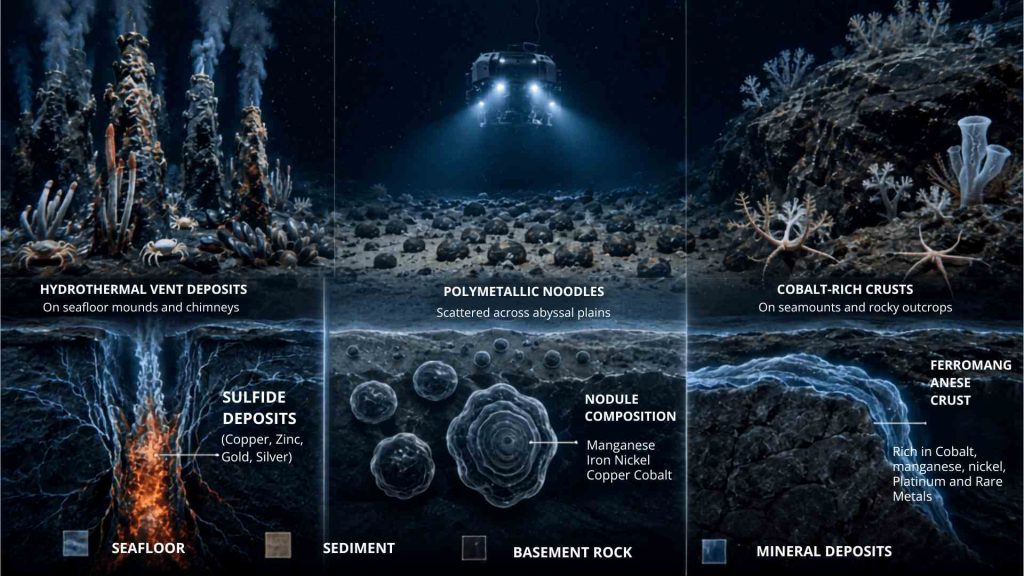
Deep-sea mining is the industrial extraction of mineral resources from the ocean floor, usually at depths of 3,000–6,000 meters, far beyond where sunlight ever reaches. This form of seabed mining is being explored for three main resources with growing interest in their use for modern technology.
Polymetallic Nodules, Vent Deposits, and Cobalt-Rich Crusts
- Polymetallic nodules — potato-sized mineral deposits scattered across the abyssal plains. These nodules form extremely slowly over millions of years and contain high concentrations of cobalt, nickel, manganese, and copper. These critical minerals deep sea deposits are in heavy demand for electric vehicle batteries, electronics, and renewable energy infrastructure.
- Hydrothermal vent fields — mineral-rich chimney structures where superheated, chemically rich water erupts from the seafloor, depositing valuable metals as it cools. These hydrothermal vents deep sea formations are some of the richest metal deposits on the seafloor.
- Cobalt-rich ferromanganese crusts — slow-growing mineral layers that form on the slopes and summits of seamounts (underwater mountains). Often containing some of the highest cobalt concentrations found in the deep ocean, seamount mining is being considered for these crusts due to their valuable metal content.
All three of these seafloor features share one critical trait: they support deep-sea ecosystems found nowhere else on Earth.
Why These Habitats Are So Vulnerable
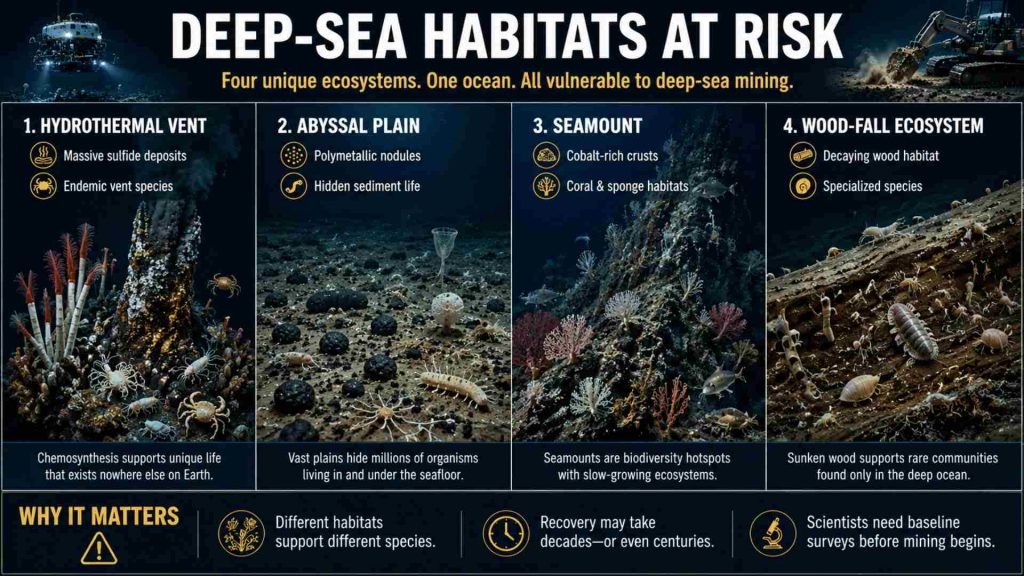
Hydrothermal vents, wood-fall ecosystems, abyssal plains, and seamounts differ in how they function, but each supports highly specialized communities that can be vulnerable to disturbance.
Because each deep-sea habitat supports different communities and faces different levels of mining pressure, comparing them side by side helps explain why conservation concerns vary across the ocean floor. The table below summarizes the main habitats associated with deep-sea mining and their relative conservation risks.
Deep-Sea Habitats and Mining Risk
| Habitat | Primary Mining Target | Relative Species Risk | Why the Risk Differs |
|---|---|---|---|
| Hydrothermal vents | Massive sulfide deposits | Very High | Many species are endemic to a single vent field, making localized disturbance especially damaging. |
| Wood-fall ecosystems | None currently | Unknown | Not an active mining target, but these rare habitats remain poorly studied and many species have yet to be described. |
| Abyssal plains | Polymetallic nodules | Moderate to High | Nodule removal disrupts slow-growing seabed ecosystems and species adapted to abyssal sediments. |
| Seamounts | Cobalt-rich ferromanganese crusts | High | Mining could damage unique communities living on slow-growing crusts and rocky underwater mountains. |
Chemosynthesis and Deep-Sea Chemosynthetic Ecosystems
Hydrothermal vents run on an entirely different energy source than the rest of the ocean. Instead of sunlight, specialized bacteria use chemicals from vent fluids to create energy through a process called chemosynthesis hydrothermal vents rely on. This process powers deep-sea chemosynthetic ecosystems, forming the base of a unique food web that supports giant tube worms, vent crabs, and highly specialized mollusks found around hydrothermal vents. Many of these hydrothermal vent species are range-restricted endemics, meaning they’re found only at a single vent field, or a very small cluster of vents, and nowhere else on the planet.
Wood-Fall Ecosystems and Hidden Biodiversity
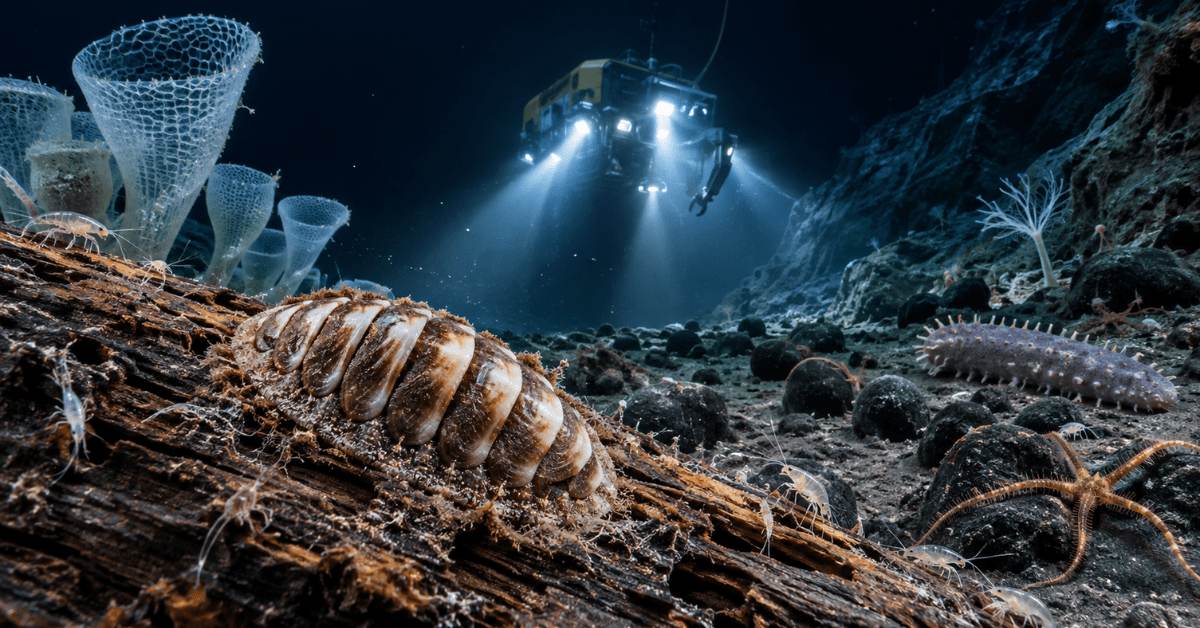
Wood-fall ecosystems, the habitat where Ferreiraella populi was discovered, work differently but carry a very similar vulnerability. These deep-sea wood fall communities form around sunken logs and branches that drift to the seafloor and slowly decay over years or decades. They support wood-boring bivalves, isopods, and specialized chitons adapted to feed on nothing else. Because these habitats occur in isolated locations and are difficult and costly to find in the deep ocean, researchers still know very little about the organisms that depend on them.
Range-Restricted Endemic Species and the Risk of Disturbance
The common thread across both of these habitats is the presence of endemic species deep sea life with extremely narrow geographic ranges. These range-restricted endemic species are far more vulnerable to localized disturbance than widely distributed species. Deep-sea mining, by its very nature, is a highly localized form of industrial disturbance. This combination of narrow ranges, slow growth, and habitat specialization is what makes the deep-sea mining species threat so serious, especially for vent mollusks threatened by large-scale seafloor disruption.
The Challenge of Undiscovered Deep-Sea Species
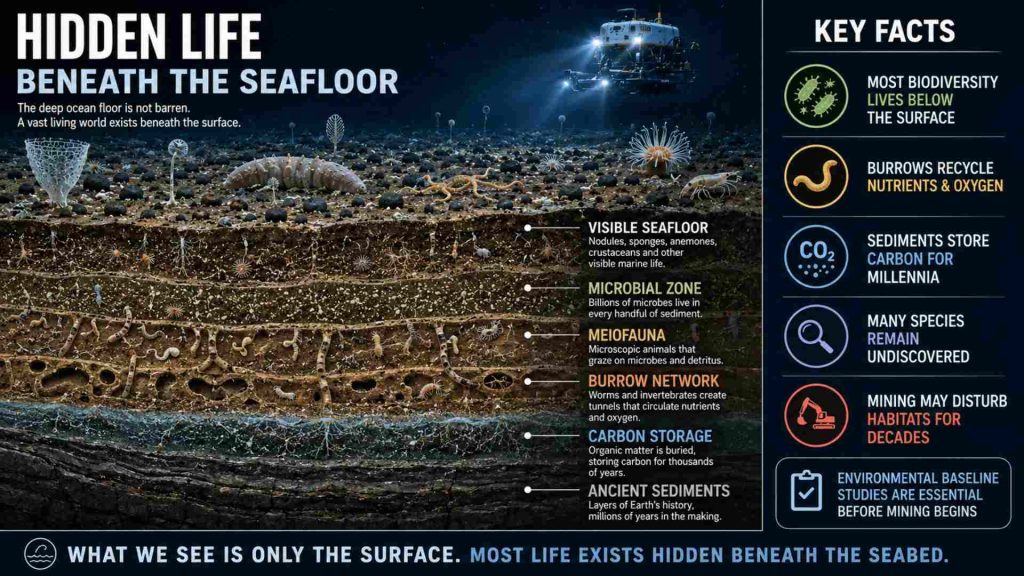
One of the biggest concerns surrounding deep-sea mining environmental impact is the sheer amount of newly discovered deep-sea species still left to find. Vast areas of the abyssal plain mining zones, seamount mining regions, and unexplored trench habitats remain completely unsurveyed. With every new deep-sea expedition, researchers continue to uncover species that have never been formally described before, meaning entire lineages of ocean life are still being formally identified for the first time.
This growing list of unknown life directly contributes to deep-sea biodiversity loss risk. The more time passes without documenting these organisms, the higher the chance that industrial activity moves forward before they’re ever recognized by science.
The Scientists Sounding the Alarm
Deep-sea biologist Chong Chen, a co-author on the description work related to Ferreiraella populi, has consistently tied new deep-sea discoveries to this growing conservation concern. Speaking with Mongabay in July 2026 about the vent mollusk Red List assessment, Chen said he hopes stakeholders will “think about the species that their future actions will make extinct.”
That direct link between taxonomy and conservation is echoed by lead taxonomist Julia Sigwart, who has noted that speeding up how quickly new species are formally named and published helps protect marine biodiversity before industrial activity reaches habitats that scientists haven’t finished surveying. This is where the precautionary principle deep-sea mining discussions become especially important.
Environmental Baseline and the Precautionary Principle
One of the biggest challenges in deep-sea mining regulation is what’s called an “environmental baseline deep sea” inventory. To measure damage accurately, regulators first need to know what was there to begin with. The problem is that, for large areas of the deep seafloor, that baseline is still incomplete. According to research and exploration data from NOAA Ocean Exploration, large portions of the deep ocean remain unmapped and biologically unexplored, making accurate baselines extremely difficult to establish.
The precautionary principle deep-sea mining approach means documenting and understanding these ecosystems before potentially disturbing them, especially when damage could be long-lasting or irreversible, as is the case for many slow-growing deep-sea habitats. The International Union for Conservation of Nature (IUCN) has also called for a precautionary approach, citing significant scientific uncertainty about the environmental impacts of commercial deep-sea mining. Without this baseline data, it becomes nearly impossible to track deep-sea biodiversity loss or properly measure the full environmental impact over time. Ongoing deep-sea research from MBARI continues to show just how much of this hidden biodiversity remains unknown with each new expedition.
Why Undiscovered Species Matter for Deep-Sea Mining Policy
Without an official scientific description, a species is difficult to include on threatened-species lists, monitor through environmental impact assessments, or formally recognize within conservation policies, regardless of how vulnerable it may actually be. This is why faster, accurate taxonomic work is increasingly viewed as a conservation tool in its own right, rather than simply an academic exercise. Resources like Smithsonian Ocean help explain why documenting this biodiversity is so important for long-term ocean conservation.
It’s important to be precise about scope here. Ferreiraella populi is a wood-fall ecosystem specialist, not a hydrothermal vent species, and there is currently no confirmed deep-sea mining license overlapping its known trench location. The 62% threatened figure applies specifically to known hydrothermal vent mollusks, not to wood-fall communities. What applies across all of these habitats is the same underlying pattern: industrial interest is moving ahead while biodiversity inventories are still far from complete. The IUCN Red List remains one of the key tools used to track species at risk as these threats continue to develop.
Deep-Sea Mining vs Biodiversity: The Trade-Off
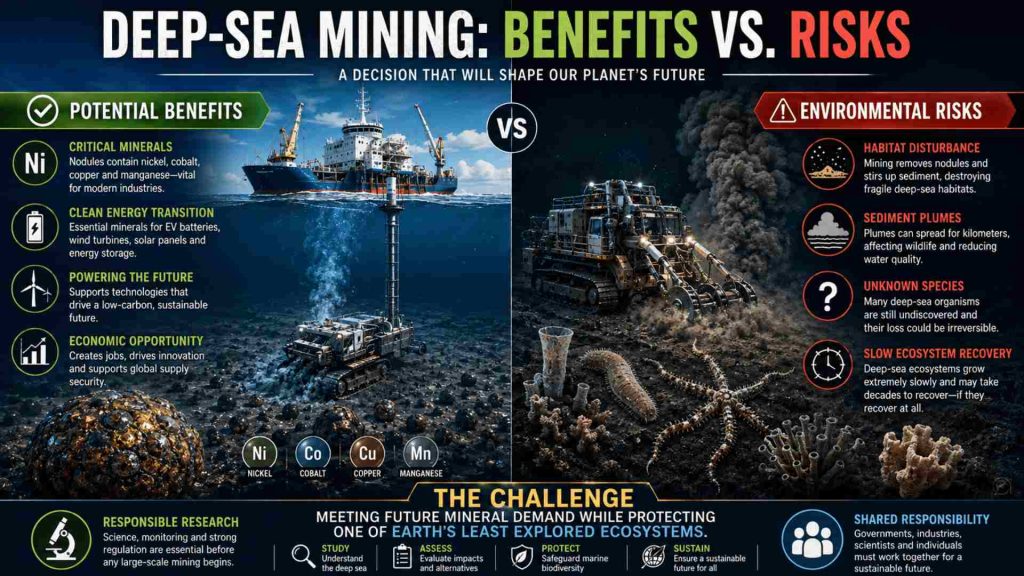
Balancing the potential benefits of deep-sea mining with the need to protect marine biodiversity remains one of the most challenging questions facing ocean policy today.
Demand for critical battery metals, including cobalt, nickel, manganese, and copper, continues to grow as countries expand electric vehicle production and renewable energy infrastructure. Many of these resources occur in polymetallic nodules, hydrothermal vent deposits, and cobalt-rich crusts on the seafloor, making deep-sea mining an increasingly important part of discussions about future mineral supplies.
At the same time, much of the deep ocean remains poorly explored. Marine scientists and conservation organizations have raised concerns that large-scale extraction could affect ecosystems that are still being documented, making long-term environmental impacts difficult to predict. Many deep-sea habitats also recover very slowly after physical disturbance, adding further uncertainty to decisions about commercial mining.
As National Geographic Ocean notes, balancing the demand for critical minerals with the protection of deep-sea ecosystems remains one of the defining environmental challenges surrounding seabed resource extraction.
Who Regulates Deep-Sea Mining?
The ISA Mining Code and Global Regulation
Deep-sea mining in international waters is regulated by the International Seabed Authority (ISA), an organization established under the United Nations Convention on the Law of the Sea (UNCLOS). UNCLOS deep-sea mining frameworks form the legal foundation for governing the international seabed.
The ISA is still in the process of finalizing its comprehensive regulatory framework, often referred to as the “ISA Mining Code”, to govern potential commercial-scale seabed extraction. Many marine scientists have argued that seabed mining regulation needs to be strengthened, and that environmental baseline data, including full species inventories, must be significantly more complete before moving forward with large-scale deep-sea mining permits or approval timelines. Groups such as the Deep Sea Conservation Coalition (DSCC) have consistently emphasized the importance of applying a strong precautionary approach while these regulations are still being finalized.
The core concern is straightforward: without knowing what exists, it’s functionally impossible to measure, mitigate, or meaningfully account for deep-sea mining environmental impact after disturbance occurs. This is exactly why discussions around deep-sea mining regulations 2026 remain highly important for both science and policy.
The Trade-Offs and Timeline
The debate around deep-sea mining pros and cons comes down to timing and recoverability. While the demand for cobalt mining ocean floor resources is growing, the slow growth rates of deep-sea ecosystems mean recovery from large-scale physical disturbance, if it happens at all, would likely take decades to centuries, not years. Many polymetallic nodule fields, for example, form over millions of years, far slower than any realistic human restoration timeline.
As of 2026, no global commercial deep-sea mining has been finalized, and regulatory decisions remain pending over the next one to two years. With that window approaching, species discoveries like Ferreiraella populi are increasingly being cited alongside policy discussions, underscoring why documenting ocean life before industrial decisions are locked in matters more now than it has in decades.
FAQ: Deep-Sea Mining and Ocean Species
What is deep-sea mining?
Deep-sea mining is the industrial extraction of mineral resources, including polymetallic nodules, hydrothermal vent deposits, and cobalt-rich seamount crusts, from the ocean floor, typically at depths of 3,000–6,000 meters.
Why are hydrothermal vent species especially vulnerable to deep-sea mining?
Many hydrothermal vent species are range-restricted endemics, found only at a single vent field or small cluster of vents. That extremely limited range makes localized mining disturbance far more likely to threaten their survival.
How many species are threatened by deep-sea mining?
A 2026 assessment found that 125 of 201 known hydrothermal vent mollusk species (about 62%) are considered threatened by deep-sea mining, with more than a third rated endangered or critically endangered.
Who regulates deep-sea mining?
The International Seabed Authority (ISA), established under the United Nations Convention on the Law of the Sea (UNCLOS), regulates deep-sea mining in international waters and is still finalizing its regulatory framework (the ISA Mining Code).
Is deep-sea mining legal?
Deep-sea mining is not yet authorized for full commercial-scale operations in international waters. It remains under regulatory development by the ISA while exploration permits are still active. Commercial approval has not been finalized as of 2026.
Is Ferreiraella populi directly threatened by deep-sea mining?
Not confirmed. Ferreiraella populi lives in a wood-fall ecosystem, not a hydrothermal vent field, and no confirmed deep-sea mining license currently overlaps its known location. It’s used here to highlight the broader risk to underexplored deep-sea habitats.
What metals are mined from the deep sea?
The main metals targeted are cobalt, nickel, manganese, and copper, primarily found in polymetallic nodules, hydrothermal vent deposits, and cobalt-rich crusts on seamounts.
What metals are companies mining the seafloor for?
Companies are exploring the seafloor for cobalt, nickel, manganese, and copper. These critical minerals deep sea resources are mainly sought from polymetallic nodules, hydrothermal vent fields, and cobalt-rich ferromanganese crusts for use in batteries and renewable energy technologies.
Why does undiscovered biodiversity matter for deep-sea mining?
Without a complete environmental baseline deep sea inventory, it’s impossible to accurately measure environmental impact. Species that haven’t been formally named and described can’t be assessed for threat status or properly accounted for in environmental impact reviews, increasing the risk of deep-sea biodiversity loss.
What is the precautionary principle in relation to deep-sea mining?
The precautionary principle deep-sea mining means documenting and understanding ecosystems before potentially disturbing them, especially when damage could be long-lasting or irreversible, as is the case for many slow-growing deep-sea habitats.
What are the deep-sea mining pros and cons?
The main potential benefit is access to critical battery metals (cobalt, nickel, manganese, and copper) needed for renewable energy and electric vehicles. The main concerns are deep-sea mining environmental impact, irreversible habitat damage, extremely slow ecosystem recovery, and the risk of losing undiscovered deep-sea species before they can be studied or protected.
Related Reading
- Ferreiraella populi: The Deep-Sea Chiton the Internet Named
- Ducibella camanchaca: Another New Deep-Sea Discovery
- Lithoredo Abatanica: The Rock-Eating Worm
- Yeti Crab: Life at the Hydrothermal Vents
- Glass Sponges: The Ocean’s Ancient Reef Builders
- Sunlight Zone Facts: What Lies Above the Deep Sea
- Elven Abyss Tunicate: A New Species from the Deep
About the Author
Evan Brooks, author at StrangeHappen.com, writes about strange events, unexplained mysteries, unusual wildlife, ancient discoveries, and the science behind stories that seem almost too strange to be true. He enjoys digging through old reports, forgotten cases, and unusual claims to uncover what really happened.
His work looks beyond the mystery without taking away the sense of wonder. From eerie encounters and unexplained phenomena to bizarre creatures and ancient secrets, he separates documented facts from rumors, legends, and internet fiction.