
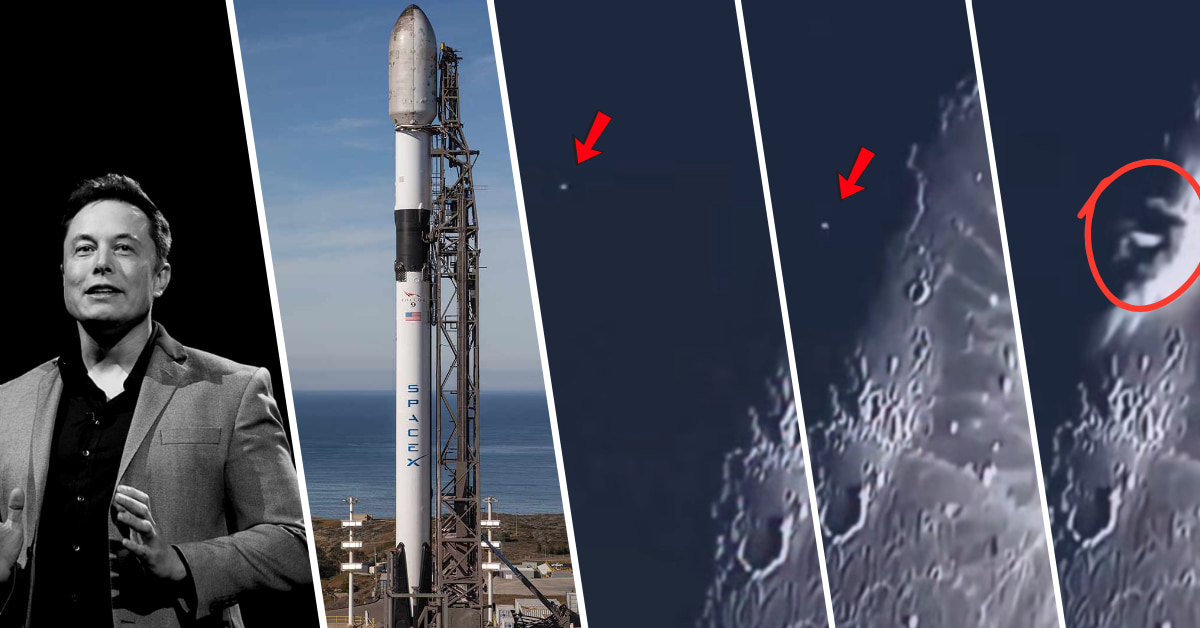
A spent Falcon 9 upper stage (the rocket’s second-stage booster, not the entire vehicle) crashed into the Moon on August 5, 2026, after drifting through space for nineteen months since its January 2025 launch. The impact struck near Einstein Crater at 2:34 a.m. ET, hitting the surface at roughly 5,400 miles per hour while astronomers on three continents watched for the exact moment it happened. So why did a SpaceX rocket crash into the Moon, and should anyone worry about the next one? The short answer involves solar radiation pressure, lunar gravity, and a disposal gap nobody had closed yet.
Table of Contents
What Happened on August 5, 2026
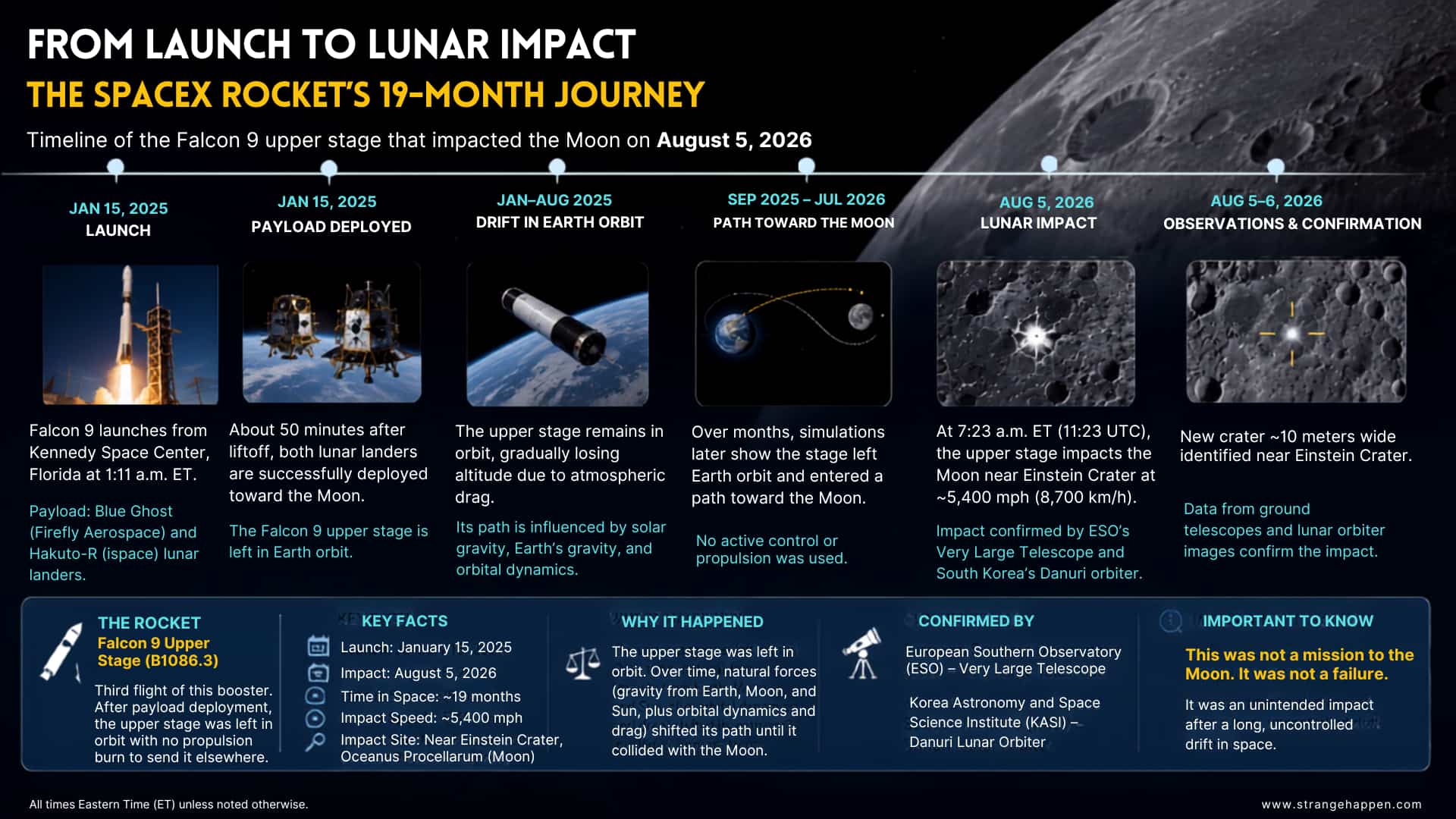
The story starts with the launch, not the impact. On January 15, 2025, this same Falcon 9 upper stage carried two commercial lunar landers into space under NASA’s Commercial Lunar Payload Services program: Firefly Aerospace’s Blue Ghost, which went on to complete the first fully successful private Moon landing, and ispace’s Resilience lander, which crashed during its own landing attempt.
By- NASASpaceNews
Once the upper stage released both spacecraft, its job was done. Rather than being sent back toward Earth, it was left in a high, looping orbit, a decision that wasn’t so much an oversight as a gap in standard procedure. NASA confirmed that solar activity and gravitational forces drove the stage’s unplanned return to the Moon, and SpaceX’s Julianna Scheiman, director of NASA Science and Dragon Programs, explained that disposal procedures for missions traveling beyond low-Earth orbit differ from the standard playbook used for satellites parked closer to home.
Astronomer Bill Gray, who runs the orbit-tracking site Project Pluto, first calculated the coming impact on April 29, 2026, more than three months in advance, then refined the prediction using telescope surveys contributed by amateur astronomers worldwide. Gray placed the impact point near Einstein Crater on the Moon’s western limb, a dusty, sunlit patch that’s notoriously hard to observe from Earth because it sits so close to the edge of the visible lunar disk.
Why Did a SpaceX Rocket Crash Into the Moon?
The short version: nobody chose this outcome, and nobody stopped it either. Once the Falcon 9 upper stage released its landers, it was left on a chaotic, uncontrolled trajectory, with no engine burn and no course correction ever planned for it.
Retired astrophysicist Jonathan McDowell, who tracks orbital objects at the Harvard-Smithsonian Center for Astrophysics, put the physics bluntly to the Associated Press: what goes up, he said, must eventually come down. He also flagged the bigger concern: while this particular piece of space debris wasn’t dangerous, similar uncontrolled impacts could become a real issue once there are long-term human bases on the Moon, and rocket operators need to stop leaving stages in these chaotic orbits.
The impact was not deliberate, nor was it the result of a failed lunar mission. The SpaceX rocket moon crash wasn’t caused by a failed launch or deliberate targeting; it was orbital mechanics working exactly the way physics says it will, on a piece of hardware nobody had a plan to bring home.
How Did the Rocket’s Orbit Change?
To understand how, it helps to know what usually happens instead. Objects circling close to Earth eventually lose altitude to atmospheric drag and burn up on reentry, which is why most dead satellites and rocket stages never become a long-term hazard. A stage flung out toward the Moon has no atmosphere to slow it down, so once this one released its landers, it was left to drift.
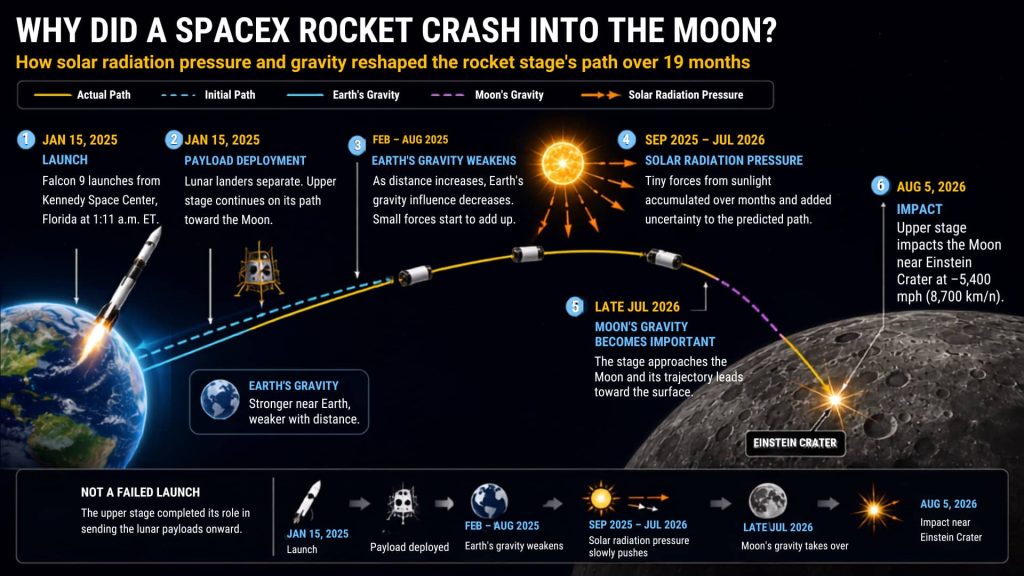
Over the following months, the steady push of sunlight and the combined gravitational tug of the Earth, Moon, and Sun reshaped the stage’s path bit by bit, until the Moon was directly in the way. Think of a coin resting almost upright on an unstable surface. Even a tiny disturbance can eventually make it tip, with gravity determining the final direction.
That’s roughly what happened here. The stage wasn’t orbiting the Moon or aimed at it, but small, persistent nudges from sunlight and gravity slowly tipped its path until the Moon was in the way. Nothing dramatic, just physics with nineteen months to work.
Was the Moon Crash Intentional?
No. Both NASA and SpaceX confirmed the impact resulted from an unplanned drift in the stage’s orbit, not any deliberate targeting. There was no engine burn, no last-minute correction, and no one steering it toward the Moon; it simply drifted there over a year and a half.
Scheiman’s comments point to how SpaceX is responding: the company said this week it’s working with NASA to prevent future incidents like this one, and stressed that the collision course was never intentional.
Where Did It Hit the Moon?
The impact struck near Einstein Crater, on the Moon’s western limb, a region that sits close to the edge of the lunar disk as seen from Earth, which makes it a genuinely difficult spot for ground-based telescopes to watch directly. Gray’s April 2026 prediction placed the impact point here months in advance, and the location held up once the crash was confirmed.
How Fast Was It Traveling?
The stage struck the surface at roughly 5,400 miles per hour, a speed that’s typical for an object falling into the Moon’s gravity well from deep space rather than being launched at it directly. That velocity, combined with the stage’s mass, generated enough energy to carve a fresh crater and throw lunar material outward in a visible plume.
How Did Scientists Confirm the Impact?
No telescope or spacecraft camera was pointed at the exact patch of lunar surface at the precise moment of impact, so there’s no direct video of the collision itself. What researchers do have is two independent, separately timed lines of evidence: a chemical signature detected within minutes, and photographic proof of the resulting crater captured a day later.
The Chemical Fingerprint in the Sky
At the European Southern Observatory’s Paranal site in Chile, the Very Large Telescope was trained on the Moon in the minutes surrounding impact. ESO communications manager Dr. Bárbara Ferreira confirmed to CNN that the telescope detected spectral lines of sodium and lithium gas in the impact plume, lasting five to ten minutes after the collision.
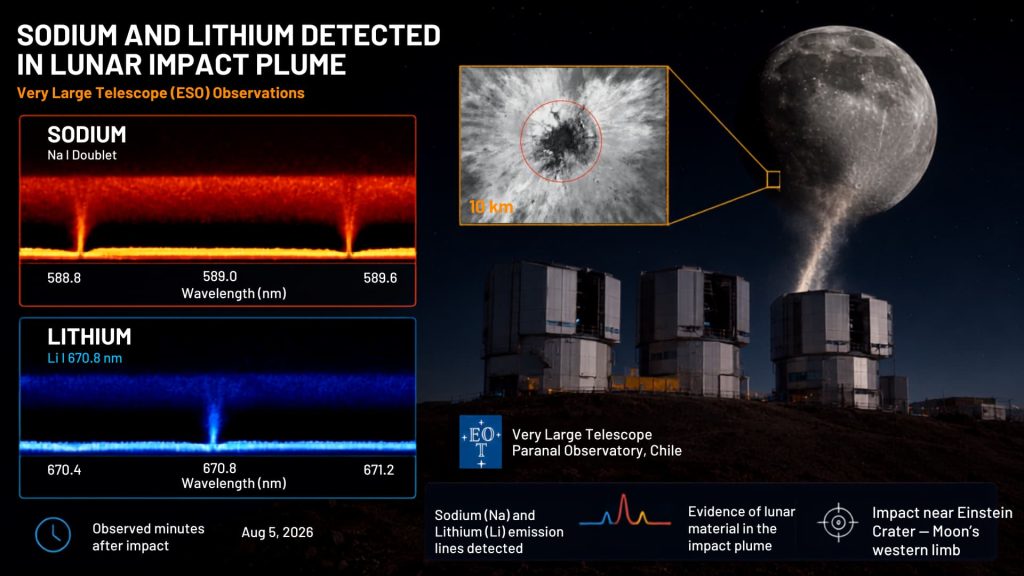
Carl Schmidt, a research assistant professor of astronomy at Boston University who led the observation, said the plume spanned a few tens of kilometers, with the sodium likely coming from lunar soil and the lithium possibly originating from the rocket stage itself. Benjamin Fernando, a postdoctoral fellow at Los Alamos National Laboratory, separately confirmed the detection using the telescope’s ultraviolet and visual spectrograph, which had been specifically watching for the rocket’s chemical fingerprint scattering across the lunar surface.
What Did Danuri See?
South Korea’s Danuri orbiter, formally the Korea Pathfinder Lunar Orbiter, began imaging the target area roughly thirty minutes before impact and made eight separate passes over the site afterward. This was the visual half of the evidence, captured over the following day rather than in real time. According to the Korea Aerospace Research Institute, the resulting before-and-after images, taken with Danuri’s Lunar Terrain Imager, showed clear changes in the terrain around the impact site along with visible traces of scattered ejecta.
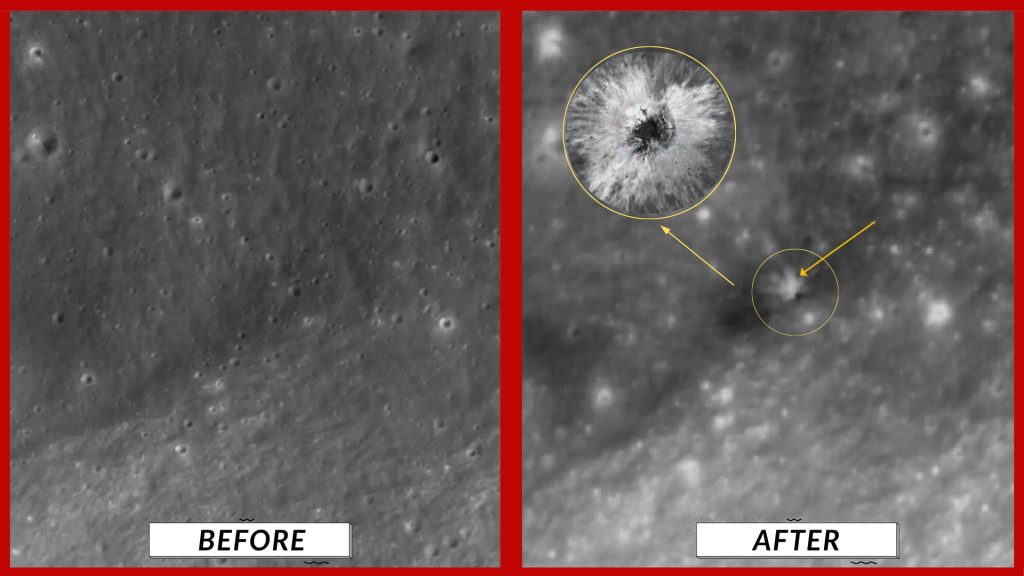
Danuri also carries a NASA-built instrument called ShadowCam, though it was the Lunar Terrain Imager that captured the crater itself. NASA’s own Lunar Reconnaissance Orbiter, which has circled the Moon since 2009, was scheduled to fly over the same region days later to add a second, higher-resolution dataset, giving researchers two independent looks at the same impact site.
How Big Was the Crater?
Two separate research teams ran the numbers before the impact happened, and they didn’t fully agree, which is itself a useful data point. NASA’s Meteoroid Environments Office at Marshall Space Flight Center calculated a crater roughly 18 meters (about 59 feet) wide and 4 meters (13 feet) deep.
A separate multiphysics simulation led by Fernando’s team at Los Alamos, using modeling software called HOSS, predicted a somewhat larger scar: 20 to 30 meters (66 to 98 feet) across and about 5 meters (16 feet) deep, with an estimated 1.1 million kilograms of lunar regolith thrown outward. The gap between the two predictions comes down to a detail that matters more than it sounds: a spent rocket stage is mostly hollow, so it doesn’t gouge the Moon the way a solid asteroid of the same mass would.
Danuri’s images and the Lunar Reconnaissance Orbiter’s follow-up pass give researchers their first chance to check both predictions against reality, turning what could have been a purely theoretical exercise into a genuine before-and-after experiment on a body with zero erosion to complicate the picture.
Was the SpaceX Moon Crash Dangerous?
No. The impact happened roughly 240,000 miles from Earth, with zero risk to anyone here, to satellites, or to the Artemis II astronauts, who had already returned home by the time it occurred. NASA and independent astronomers tracked the object for months and confirmed it posed no threat well before impact.
Is This the First Rocket to Hit the Moon?
No. Rocket parts have been finding their way to the lunar surface for nearly seven decades. The very first human-made object to reach the Moon, the Soviet probe Luna 2, deliberately crash-landed there in 1959, three years before anyone had orbited it.
NASA’s own Apollo missions left Saturn V third stages behind on purpose, using their impacts to calibrate seismometers that astronauts had placed on the lunar surface, the same kind of moonquake data researchers hope to pull from this impact. In 2009, NASA intentionally slammed the LCROSS mission’s spent Centaur stage into a permanently shadowed crater near the lunar south pole specifically to kick up debris and search it for water ice, a deliberate experiment rather than an accident.
In March 2022, a rocket body identified as part of a Chinese Long March 3C stage struck the Moon near Hertzsprung crater, carving out a double crater roughly 95 feet wide, the last confirmed accidental impact before this one. What’s different about the 2026 event isn’t that it happened; it’s how closely scientists were able to watch it happen, thanks to a level of tracking precision that simply didn’t exist for earlier impacts.
Is the Moon Becoming a Junkyard?
This SpaceX rocket moon crash wasn’t an isolated incident, and researchers are increasingly framing it as a preview of a bigger issue. One widely cited figure, an estimate from Forbes rather than a NASA or peer-reviewed count, puts the total human-made debris in lunar orbit and on the Moon’s surface at just over 209 tons, a mix of spent rocket stages, failed landers, and equipment left behind since the Apollo era.
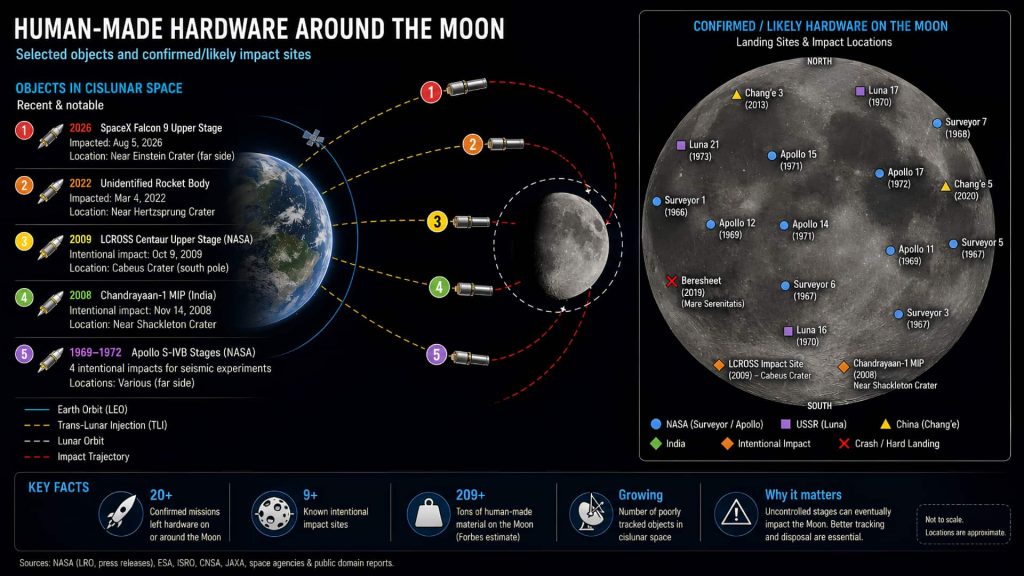
Most of that material is inert and poses no immediate danger, but McDowell’s warning is the part worth sitting with: the real risk isn’t this crash, it’s what happens once permanent lunar bases sit inside the debris field. NASA is actively working toward exactly that kind of sustained presence through its Artemis program, and every added mission increases the odds that more abandoned hardware, from SpaceX or any other operator, drifts somewhere nobody wanted it to go.
Could Another Rocket Crash Into the Moon?
Possibly, unless disposal procedures change. Jonathan McDowell and other trackers have warned that uncontrolled orbits like this one will keep producing lunar impacts unless operators actively plan for stage disposal on missions that travel beyond Earth orbit, SpaceX included.
Scheiman’s comments suggest the company is already working on it: SpaceX says it’s coordinating with NASA to prevent future incidents like this one. Whether that translates into new disposal requirements for beyond-Earth-orbit missions industry-wide is one of the open questions this crash has put back on the table.
What Happens Next?
The Lunar Reconnaissance Orbiter’s follow-up imagery, expected in the days after Danuri’s first photos, will let researchers directly compare NASA’s crater estimate against the Los Alamos HOSS prediction and refine both models for future events. Scientists are also using the confirmed impact to study how far ejected lunar material actually travels.
Dr. Paul Wiegert, an astronomer at Western University, has noted that debris from an impact like this can potentially scatter as far as 500 miles from the crash site, a figure that matters directly to anyone planning where to put a lunar base or a landing pad. None of that research changes what already happened, but it’s the difference between one crater and a genuinely useful dataset for the Artemis era.
Related Articles You May Like
- Why do moonquakes matter? The same kind of seismic data Apollo’s astronauts collected on purpose is exactly what researchers hope to pull from this accidental impact.
- Miranda, one of the solar system’s strangest moons A look at Uranus’s oddest satellite, for readers curious about moons beyond our own.
- Planet Nine: is there a hidden world at the edge of the solar system? Another open question in orbital mechanics, on a much larger scale than a single rocket stage.
- Interstellar comet 3I/ATLAS A different kind of object tracked across the solar system, and a good companion read on how astronomers spot things headed our way.
- What’s at the solar system’s boundary wall? For readers who want to go further into the gravity and pressure forces that shaped the Falcon 9 stage’s path.
Key Takeaways
- A spent Falcon 9 upper stage (not the full rocket) struck near Einstein Crater at 2:34 a.m. ET on August 5, 2026, traveling about 5,400 miles per hour.
- Why did a SpaceX rocket crash into the Moon in the first place? Solar radiation pressure and gravitational drift slowly reshaped the stage’s orbit over 19 months until it intersected the Moon, with no engine burn, no targeting, and no intent.
- No camera captured the impact itself; the European Southern Observatory’s Very Large Telescope detected sodium and lithium gas from the plume within minutes, and South Korea’s Danuri orbiter photographed the resulting crater the next day.
- NASA’s Lunar Reconnaissance Orbiter followed up shortly after, and NASA and a Los Alamos-led team produced two separate crater-size estimates, roughly 18 to 30 meters wide, that scientists are now checking against the real thing.
- It’s the fourth confirmed human-made lunar impact on record, and a reminder that the cislunar space debris problem isn’t going away on its own.
Frequently Asked Questions About the SpaceX Rocket Moon Crash
Why did a SpaceX rocket crash into the Moon?
A Falcon 9 upper stage was left in a high orbit after deploying two lunar landers in January 2025. Over the next 19 months, solar radiation pressure and gravitational drift gradually reshaped its path until it intersected the Moon on August 5, 2026. SpaceX has said the collision was unintentional.
What caused the SpaceX rocket moon crash?
No single failure caused it. The SpaceX rocket moon crash came from a gap in disposal planning: the Falcon 9 upper stage was never given a controlled deorbit or engine burn after releasing its payload, so solar radiation pressure and the combined gravity of the Earth, Moon, and Sun were left free to steer it over the following 19 months.
What happened to the Falcon 9 upper stage after launch?
After deploying the Blue Ghost and Resilience lunar landers on January 15, 2025, the Falcon 9 upper stage was left in a high, looping orbit rather than sent back toward Earth or given a controlled disposal. It drifted there for nineteen months before solar and gravitational forces steered it into the Moon on August 5, 2026.
Where did the SpaceX rocket hit the Moon?
It struck near Einstein Crater, on the Moon’s western limb, a sunlit but hard-to-observe region that sits close to the edge of the lunar disk as seen from Earth. Astronomer Bill Gray predicted this impact site months in advance using orbital tracking data.
How fast was the SpaceX rocket going when it hit the Moon?
The Falcon 9 upper stage struck the lunar surface at roughly 5,400 miles per hour. That’s a typical speed for an object falling into the Moon’s gravity well from deep space, and it was fast enough to carve a fresh crater and throw debris outward in a visible plume.
Was the SpaceX Moon crash dangerous to Earth?
No. The impact occurred roughly 240,000 miles away on the lunar surface and posed no risk to Earth, satellites, or the Artemis II astronauts, who had already returned home. NASA and independent astronomers tracked the object for months and confirmed it posed zero threat before impact.
Could you see the SpaceX rocket hit the Moon from Earth?
Not directly, and not with the naked eye. No camera or telescope captured the moment of impact itself, but the European Southern Observatory’s Very Large Telescope in Chile detected a brief chemical signature from the debris plume within minutes, and South Korea’s Danuri orbiter photographed the new crater the next day.
How big is the crater from the SpaceX Moon crash?
Estimates range from about 18 meters (59 feet) wide, per NASA’s Meteoroid Environments Office, to 20–30 meters (66–98 feet), per a Los Alamos-led simulation. South Korea’s Danuri orbiter and NASA’s Lunar Reconnaissance Orbiter photographed the actual site to help settle the question.
Is this the first rocket to accidentally hit the Moon?
No. A Chinese Long March 3C rocket body struck the Moon near Hertzsprung crater in March 2022, and this is the latest, not the first. Rocket stages and probes have reached the lunar surface since 1959, though most before the space-tracking era went unrecorded.
What is space junk, and why is it hitting the Moon now?
Space junk refers to defunct rockets, satellites, and mission hardware left in orbit after their job is done; the Falcon 9 upper stage involved here is one example. As more missions head to the Moon under NASA’s Artemis program and similar efforts, more of that hardware ends up on trajectories that can eventually intersect the lunar surface.
Did NASA or SpaceX plan this impact?
No. Both agencies confirmed the impact resulted from an unplanned drift in the rocket stage’s orbit, driven by solar and gravitational forces, rather than any intentional targeting.
Will more rockets crash into the Moon in the future?
Possibly, unless disposal procedures change. Jonathan McDowell and other trackers have warned that uncontrolled orbits like this one will keep producing lunar impacts unless operators actively plan for stage disposal on missions that travel beyond Earth orbit.
About the Author
Evan Brooks, author at StrangeHappen.com, writes about strange events, unexplained mysteries, unusual wildlife, ancient discoveries, and the science behind stories that seem almost too strange to be true. He enjoys digging through old reports, forgotten cases, and unusual claims to uncover what really happened.
His work looks beyond the mystery without taking away the sense of wonder. From eerie encounters and unexplained phenomena to bizarre creatures and ancient secrets, he separates documented facts from rumors, legends, and internet fiction.
Sources & References
- NASA (Official): NASA Will Attempt to Observe Rocket Part’s Lunar Impact — Aug. 3, 2026
NASA — Official Source - CNN: New crater likely to form after SpaceX rocket slams into the moon — Aug. 4, 2026
CNN — Source Article - Space.com: SpaceX rocket’s impact crater on the moon spied by Korean lunar orbiter (photos) — Aug. 6, 2026
Space.com — Source Article - Space.com: Rocket-peppered moon: A brief history of impacts, from Luna 2 to SpaceX’s upper stage — Aug. 5–6, 2026
Space.com — Source Article - NBC News / AP: Scientists are certain a wayward SpaceX rocket slammed into the moon as predicted — Aug. 5, 2026
NBC News — Source Article