


In August 1966, a disturbing discovery in Niterói, Brazil, gave rise to one of the country’s most puzzling unsolved cases. Manoel Pereira da Cruz and Miguel José Viana, two technicians who worked with electronics, were found dead on Morro do Vintém, a hill overlooking the area near Rio de Janeiro. Investigators encountered an unusual scene: two pieces of lead shaped like crude eye coverings and a handwritten message referring to capsules and a signal. The purpose of these objects and the circumstances surrounding the men’s deaths remain uncertain.
No official cause of death was ever established, and the mystery was never solved. But researcher transcriptions of a few surviving police reports, published in 2026, indicate that several chemical examinations were recorded. That contradicts a claim repeated across the internet, that nobody ever ran toxicology, although the originals could not be checked and none of the tests identified a cause.
Table of Contents
Lead Masks Case Summary: What Happened in Brazil in 1966?
Two friends from Campos dos Goytacazes told their families they were going to São Paulo to buy a used car and electronic parts. Later accounts say they travelled to Niterói on Wednesday, August 17, 1966. Some retellings identify an 18-year-old named Jorge da Costa Alves, who was retrieving a kite, as the person who found the bodies.
However, the surviving transcription of the first police report describes the official notification differently: it says radio-patrol members reported the discovery at the police station at 6:10 p.m. on August 20. The report does not name Jorge as the person who first found the bodies. This difference between later retellings and the surviving official account should be kept visible rather than smoothed over. Read the incident-report transcription.
Police and technical experts reached the clearing the following morning, August 21. The scene report, reproduced in a researcher’s transcription, describes two men lying on their backs in formal suits and raincoats. The report is dated August 21, as are the two autopsy reports listed in the surviving-document inventory. These dates refer to the official examination, not necessarily the moment the bodies were first discovered.
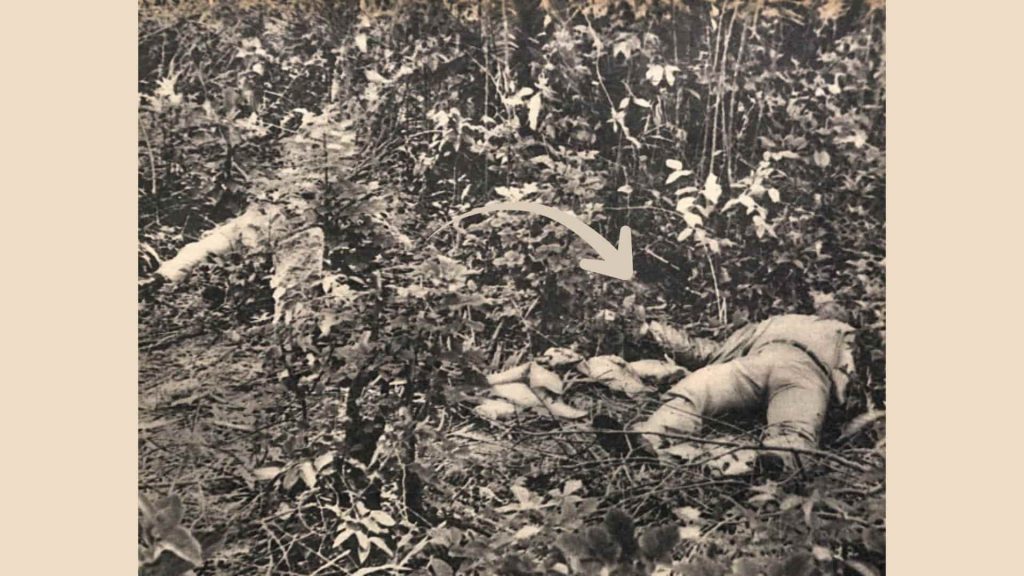
Other details remain disputed. Press accounts describe a boy who reportedly saw two men on the hill on August 18 and said a patrolman ignored him. Accounts differ on the date of death. One later account gives August 18, 1966, while a death certificate reportedly lists August 17 as the probable date. The discrepancy remains unresolved in the sources reviewed. The available transcriptions do not resolve every discrepancy, so these details should be presented as conflicting reports rather than settled facts.
The autopsies found no injury that explained the deaths. That combination, two prepared men, a written schedule and no visible cause of death, is why the story has lasted six decades.
Who Were Manoel Pereira da Cruz and Miguel José Viana?
Both men ran a small home-based television repair shop in Campos dos Goytacazes, in Rio de Janeiro state. They had taken electronics courses in São Paulo, and Miguel had completed a 1951 correspondence course with a Los Angeles school, according to the pmig96 case archive. The archive says they were well regarded locally for their electronics skills. Miguel was married to Elza Gomes Viana, and Manoel to Neli da Cruz.
Magazine accounts give Miguel as 34 and Manoel as 32, but the official scene report lists Manoel as 34, so the ages are not settled. Miguel’s death certificate, registered October 17, 1966, says 32.
Their circle included a friend, Élcio Correia Gomes, who described himself as a Kardecist Spiritist and had helped in the shop. A shop employee, Valdir Cardoso, told police the group held long spiritual sessions there. Police found a book titled Vida no Planeta Marte (“Life on Planet Mars”), with handwritten notes, in the shop. These details come from witness statements and press reports, so they show the men’s interests, not what happened on the hill.
The Lead Masks Case Timeline: August 1966
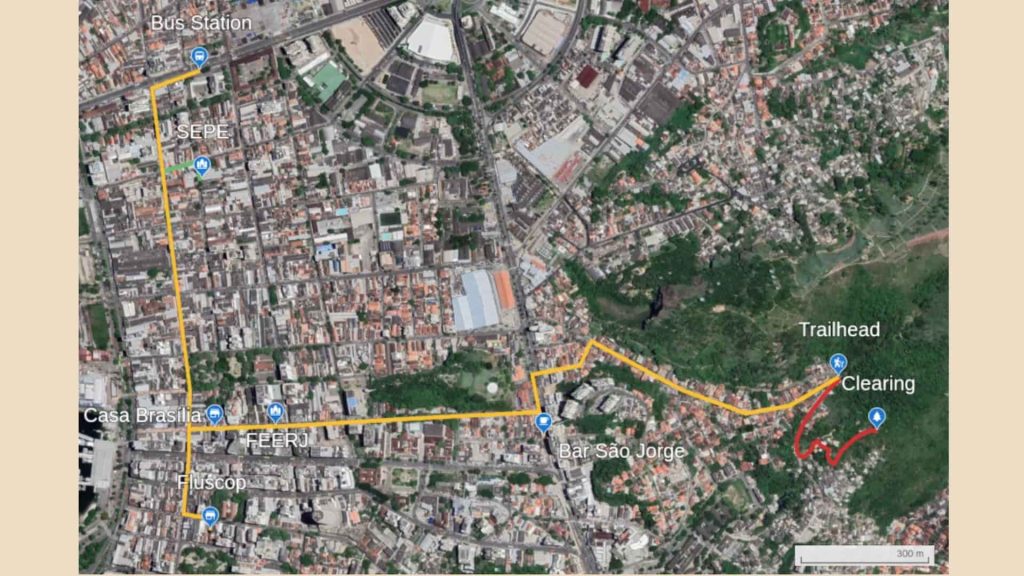
The timeline below combines a transcribed incident report, contemporary press accounts and later research. The report says patrol members notified police at 6:10 p.m. on August 20, while technical experts reached the scene the following morning. Some later accounts name Jorge da Costa Alves as the finder, but the surviving report transcription does not name him as the person who first discovered the bodies. Other events and times remain reconstructed or disputed. Incident report · Scene report.
| Date and time | Event | Reliability |
|---|---|---|
| Aug 17, early afternoon | The men arrive at Niterói bus station (accounts give 2:00 to 2:30 pm) | Reconstructed from tickets and witnesses |
| Aug 17, about 2:45 pm | They buy two raincoats at a plastics store | Shop witness |
| Aug 17, about 3:15 pm | They buy cold mineral water at Bar São Jorge and wait for a refund receipt | Bar staff testimony; receipt reportedly found at the scene |
| Aug 17, after 3:15 pm | They walk toward the base of the hill | Inferred |
| Aug 17, about 7:00 pm | A woman later says she saw an orange light above the hill | Reported after the story reached the news |
| Aug 18, morning | A boy reportedly tells a patrolman he saw two men lying on the hill; no action is taken | Researcher-compiled press reports; unconfirmed |
| Aug 20, evening | Radio-patrol members report the discovery at the police station at 6:10 pm; some later accounts name Jorge da Costa Alves as the finder | Incident-report transcription; later accounts differ |
| Aug 21, morning | Police and experts reach the clearing (experts reportedly arrive at 7:10 am) | Scene-report transcription |
| Aug 24 | Both men are buried in Campos | Press reports |
Reaching Morro do Vintém
The note gives two times: 16:30 to be at the designated place and 18:30 to take capsules. Published accounts do not establish what the men did during every part of that interval. A researcher’s archive describes an unexplained gap of about 21 minutes between the bus station and the first shop on the reconstructed route. Police reportedly considered whether the men had stopped to meet someone, possibly at a nearby Spiritist center, but no meeting was confirmed.
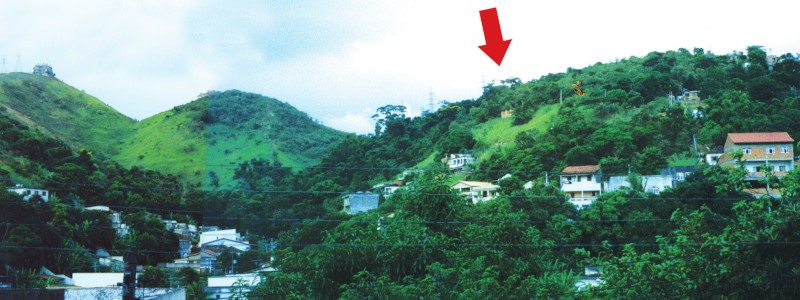
A separate story about a jeep carrying unidentified men is also unconfirmed. It comes from a second-hand account about a woman who reportedly saw a jeep near the hill; police were unable to locate her. These details may be relevant to the investigation, but they should not be treated as established events.
What Were the Lead Masks of Vintém Hill?
Police examined the objects in report No. 31,485, dated August 3, 1967. It describes two roughly rectangular lead plates, 225 and 240 grams, 2 mm thick and 200 mm long, with a U-shaped cut in the center that made them resemble half-masks. They had hammer marks and no eyeholes or straps, as described in the transcribed examination report.
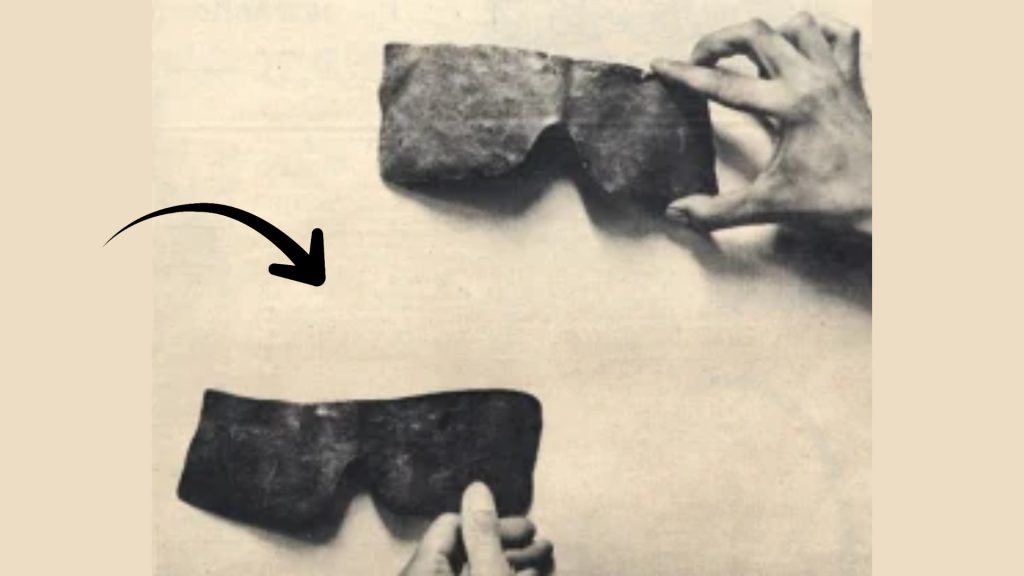
Manoel’s wife, Neli, reportedly told police the men made them the day before the trip, apparently from lead pipe. A neighbor, Fernando José, said he saw the pair hammering lead on August 12. Those two accounts conflict by several days, and the record does not resolve them. Police reportedly found cut pieces of lead at Manoel’s home that matched the notches in the plates.
Why Were They Wearing Lead Masks?
Nothing in the surviving record establishes the purpose of the plates. One possible explanation draws on a book found at the men’s repair shop, reportedly containing highlighted passages about intense light. Skeptoid discussed this clue in its analysis of the case. The men may have expected a bright light and intended to shield their eyes, but that remains an inference—not a documented explanation. The purpose of the lead masks remains unknown.
Mask positions are also reported inconsistently. The scene report lists the plates between the bodies, while some magazine accounts place them on the men’s faces.
Were the Lead Masks Radiation Masks?
Unconfirmed. Skeptoid argued that the plates’ shape would have made ordinary vision difficult and that they did not resemble practical full-head protective equipment. That is an interpretation of their design, not proof of their purpose. A researcher’s transcription says the Army Engineering Institute found no radioactive material in the plates. That result addresses whether the plates themselves were radioactive; it does not establish whether they were intended to shield the eyes from a particular type of radiation or whether they would have been effective. No source reviewed for this article establishes a radiation-related purpose.
What Did the Lead Masks Case Note Say?
The instruction note was reportedly found in Miguel’s pocket. A commonly published Portuguese transcription reads: “16:30 estar no local determinado. 18:30 ingerir cápsulas, após efeito proteger metais aguardar sinal máscara.” A rough English rendering is: “16:30, be at the designated place; 18:30, ingest capsules; after the effect, protect metals; await signal, mask.” Because the wording is unpunctuated and published transcriptions vary, this translation should be treated as an approximate reading rather than a definitive statement of what the writer meant.
Versions differ. Some published transcriptions use “estar” and the plural “cápsulas,” while others give “está” and the singular “cápsula.” The handwriting report’s transcription also records “ESTÁ.” The note lacks punctuation, making it difficult to determine how the phrases should be grouped. In particular, the wording does not clearly establish what “after the effect,” “protect metals,” or “mask” referred to. These differences matter because small changes in transcription can change how the instructions are interpreted.
How Reliable Is the Handwritten Note?
A handwriting examination, report No. 31,824 dated October 27, 1967, compared the notes with samples attributed to Miguel, according to the researcher’s transcription of the report. According to a researcher’s transcription of the report, the documents were judged to have been written by the same person. Miguel’s brother reportedly also identified the sheet as coming from a notebook in Miguel’s shop. However, the original report was not independently examined for this article, and parts of the transcribed conclusion are illegible. The reported handwriting match supports the attribution to Miguel, but it does not establish who originated the instructions, what the capsules contained, or whether the men swallowed them.
A second note listed one capsule per day from Sunday to Wednesday, the last one “when lying down.” August 17 was a Wednesday. A third sheet of letters and numbers, often called a code, matches TV valve types such as EY88, ECL82 and 12AU7, which fits their repair work.
What Evidence Did Investigators Find?
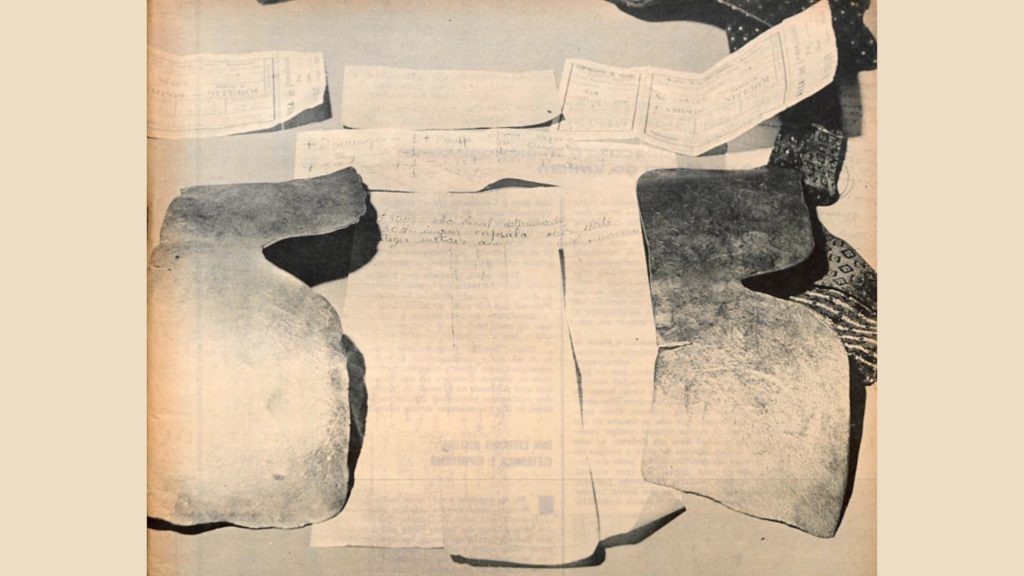
Press lists of the recovered items vary, so the table separates the documented items from what each one proves.
| Item | What it establishes | What it does not establish |
|---|---|---|
| Two lead plates | Two lead plates shaped somewhat like masks were found at the scene | Why they made them or what they were intended to do |
| Handwritten note with instructions (reported match to Miguel’s handwriting) | A planned schedule mentioning capsules, in handwriting reported to match Miguel’s | Who originated the plan or what the capsules contained |
| Capsule schedule note | A multi-day routine is described | That the routine was followed |
| Magnesiana water bottle | They carried water reportedly bought at 3:15 pm | That the water caused the deaths; the tested liquid reportedly gave negative results |
| Raincoats and towels | The items were present at the scene | Any intended ritual meaning |
| Money found: Cr$161,000 | Some cash was reportedly left with the bodies | How much money they originally carried |
| Wedding ring and watch in pockets | Metal objects were reportedly kept on the men | That this explains the note’s instruction to “protect metals”; Miguel’s family reportedly said his watch was at home |
| Handkerchief initialed A.M.S. | An item with unidentified initials was reported | Who owned it or whether it was connected to the deaths |
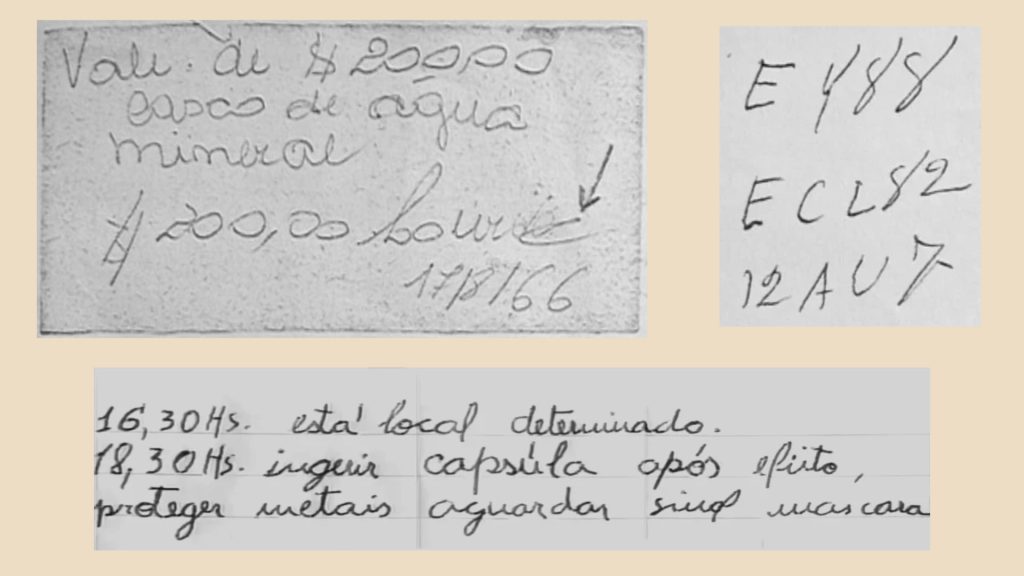
The money question deserves care. Relatives and press gave amounts from about 2.3 million to 6 million cruzeiros, and Skeptoid used 3 million. The researcher behind the pmig96 archive converts the Cr$161,000 recovered to roughly 73 US dollars at the 1966 exchange rate. Because the original sum comes from relatives, “missing money” is an inference, not a documented loss.
Lead Masks Case Cause of Death: What Did the Autopsies and Toxicology Reveal?
The cause of death in the lead masks case was never determined. The surviving-document inventory describes several chemical examinations, which are easy to confuse because they involved different materials and dates. The details below come from a researcher’s transcriptions of surviving reports, not from the original reports themselves. None of the examinations identified the capsules or established a cause of death.
The 1966 autopsies
Autopsy reports 3051/66 and 3052/66, dated August 21, 1966, found no lesion that could explain either death, according to the surviving-document inventory and the researcher’s forensic review. The experts removed viscera for toxicology. The transcribed report records negative results for tests involving mineral, organic and volatile substances. These results mean that the examinations did not detect substances identified by the tests used; they do not prove that poisoning was impossible. The surviving transcription does not specify every substance tested. It also states that decomposition could have obscured traces, according to the forensic document review.
That account is disputed. Reporters at the time said the organs were too deteriorated and had not been refrigerated, and the researcher who compiled the surviving documents considers the toxicology result almost certainly unreliable. A negative result on a general screen of decomposed organs cannot rule out poisoning. The surviving copies also show an erased name, with specialist Sebastião Faillace replaced by Walmor Giani.
The water bottle
Report No. 29,384, dated September 1, 1966, examined the 95 cc of liquid remaining in the bottle, according to the surviving-document inventory. According to the transcription, the chemical tests for mineral, organic and volatile substances returned negative results. This finding applies to the liquid that remained in the bottle; it cannot establish what the men may already have consumed and does not answer what the capsules contained.
The 1967 exhumation
On August 25, 1967, experts exhumed both men at Caju cemetery in Campos, according to the surviving-document inventory and the forensic review. The bodies had been embalmed with formalin. Samples went into eight sealed vials, and the October 18, 1967 laboratory report, as transcribed, tested for hydrocyanic acid, phosphorus, phenolic substances, some insecticides, barbiturate derivatives and alkaloids, with negative results. It reported formaldehyde, concluded that the material submitted held no toxic substance able to explain the deaths, and tied that conclusion to the fact that the bodies were embalmed, as described in the same forensic review.
The limits are significant. The samples were taken a year after death from embalmed bodies, the transcription names only some of them (muscle, skin, cotton and sawdust), and embalming is widely considered to complicate toxicology. A negative result here covers only the substances tested.
The 1968 hair analysis
Hair samples went to the Institute of Atomic Energy in São Paulo for neutron activation analysis. The June 21, 1968 official letter reported arsenic, mercury, barium and thallium values and concluded that poisoning by those four elements was ruled out, according to the researcher’s neutron activation write-up. The researcher notes that the thallium figure looks high against modern references but may reflect the instrument’s detection limit.
Hair analysis covered only four elements, so it says nothing about other substances. None of the four examinations identified the capsules, and none can definitively rule out poisoning: each covered a limited set of substances and was affected by delay, decomposition or embalming.
One popular version does not match the documents
An investigative site, Veriarch, says the coroner tested only for formic acid and cyanide, and that a 1968 atomic report named thallium but was dismissed as a typo. The transcribed reports described above list different tests and conclusions. Veriarch’s claims may rest on sources not reviewed here, so treat them as unverified.
Was the Lead Masks Case Solved? Why It Remains Unsolved
No. No cause of death was officially established, no capsule was identified and nobody was convicted.
It helps to separate three levels. Officially established, as far as the reviewed sources show: the identities, the route to Niterói, the absence of visible injury and a reported 1967 handwriting match between the instruction note and Miguel’s handwriting. A hypothesis that police adopted: officer Idovam Ferreira reported that the men died seeking a parapsychology experiment by taking capsules of unidentified chemical composition. The sources reviewed do not date his report. Unresolved: what the capsules were and who, if anyone, supplied them.
The prosecutor, Edmo Lutterbach, rejected the police conclusion in March 1967, and a homicide detective, Saulo Soares de Souza, reopened the inquiry. In 1969 Lutterbach moved posts, and his successor asked for closure while police were still working. A hypothesis repeated by many websites is not proof that the case was solved. The distinction between documented evidence and later retellings also matters in the Fowler Clan story.
The Main Lead Masks Case Theories
Accidental poisoning or overdose
This is the explanation closest to the note. The men planned to swallow capsules and left a daily schedule. Against it: no capsules or residue were identified to support that cause of death, and the men were found lying in order, with no sign of a struggle. Status: plausible but unproven.
Two named substances have appeared. Journalist Mário Dias wrote that he believed the men were poisoned with hemlock, and detective Saulo Soares de Souza developed a theory involving curare, which the pmig96 researcher notes is not toxic when swallowed. Neither was proven.
A failed experiment or planned ritual
The context is strong but circumstantial. Witnesses described the group’s spiritual interests, the book mentioned bright light, and a May 1966 explosion at Atafona beach is linked by witnesses and press accounts to the same friends, though accounts conflict and the cause of that explosion was never established. Élcio told police the pair were behind it, while Valdir said Élcio led the outing. Status: well supported as background, but it does not identify what killed them.
Criminal involvement
Police pursued robbery, a trap at a Spiritist center, smuggling and espionage. No arrest ever solved the case.
Two prisoners offered stories in 1969, and police judged the first one false. A fugitive known as “Professor Ramayana” was reported in 1969 as a suspect, partly because his initials matched the handkerchief. No evidence tied him to the scene. Status: plausible but unproven, and the recovered cash and lack of struggle argue against a simple robbery.
A suicide pact
Police dropped this early, and the file offers no sign it could have solved the case. The men had no known motive, and they had asked for a receipt to claim a bottle refund. Status: unsupported.
UFO contact
Covered in the next section. Status: unsupported by physical evidence.
Lead Masks Case UFO Theory: Were the Masks Connected to UFOs or Radiation?
The lead masks case UFO theory draws on several reported stories. In May 1966, accounts of an explosion and a fireball at Atafona were accompanied by rumours of a “flying saucer.” A woman later reportedly told investigators she had seen an orange object above the hill on August 17. In 1967, Flying Saucer Review published an account by Charles Bowen, helping bring the case to the attention of UFO researchers. These reports explain how the theory spread; they do not establish that a UFO was present or connected to the deaths. Another mystery involving an unusual physical object is the Betz Sphere mystery, which also raises questions about how unexplained evidence should be assessed.
The weak point is timing.
According to the researcher’s archive, the woman reported the sighting only after the case hit the news, and no photograph or physical trace supports it. Dunning’s analysis found no logical reason to tie a reported light to the deaths. So, were the lead masks radiation masks? The purpose is unconfirmed, as explained above. The absence of radioactivity in the plates does not settle it, but nothing documents a radiation link either.
A 1962 story of another technician found dead with a lead mask on Cruzeiro Hill is also unverified. It first appears as third-hand testimony in 1966, and the pmig96 researcher found no 1962 newspaper report.
What Happened to the Investigation?
Early on, Federal Police and the armed forces’ intelligence services joined the inquiry, according to newspaper reports, because the earlier Atafona blast raised security questions. Élcio was arrested on August 27, released by habeas corpus on August 31, and reportedly presented an alibi on September 2.
Over the next three years, investigators pursued further examinations, including a second autopsy, an exhumation, handwriting analysis and testing at an atomic institute. Several leads failed to resolve the deaths, and the investigation never established an official cause.
The police file, estimated at about 4,000 pages, is reported to have been destroyed sometime between 1990 and 2004. This account comes from the researcher who catalogued the surviving copies, not from an independently examined destruction order. According to the researcher’s inventory, the surviving 74-page collection contains 66 unique pages, a little over 1.5% of the estimated original file. Read the surviving-document inventory.
What can be concluded from the surviving material? Transcriptions record several chemical examinations with negative results, a reported 1967 handwriting examination linking the instruction note to Miguel’s writing samples, and an examination reportedly finding no radioactive material in the plates. These findings have limitations. They do not establish the cause of death, the substance involved, who may have supplied it, why the plates were made, or exactly what happened on the hill.
Lead Masks Case Facts vs. Myths
| Claim often repeated | What the records show |
|---|---|
| “No toxicology was ever done” | Four examinations are reported in transcribed records, all negative and limited; none identified the capsules or ruled out poisoning |
| “They wore black suits” | The scene-report transcription lists beige and light-blue suits |
| “The masks were radiation shields” | The report describes mask-shaped lead plates without eyeholes or straps. Their purpose is unknown; a radioactivity test does not establish shielding intent or effectiveness |
| “The note was a secret code” | One page of letters and numbers reportedly matches TV valve part numbers |
| “Millions in cash vanished” | The original sum is unverified; Cr$161,000 was reportedly recovered |
| “A UFO was seen over the hill” | A reported sighting surfaced after the news broke; no physical evidence is identified in the reviewed sources |
| “The case file was hidden” | A researcher reports that the file was destroyed between 1990 and 2004; this article has not independently verified a destruction order |
| “Overdose was confirmed” | No substance was identified and no cause of death was established |
Related Topics
Betz Sphere: The Mysterious 1974 Sphere Still Unexplained: another unusual object surrounded by competing explanations.
Bell Island Boom: What Really Happened in 1978: a historical event with disputed explanations.
Fowler Clan: Is the Viral 1976 Story Real?: an example of how retellings can drift from the available record.
MKUltra: The Real CIA Mind Control Behind Stranger Things: documented government research. There is no evidence linking MKUltra to Morro do Vintém.
Key Takeaways: What We Know and What Remains Unknown
The lead masks case concerns two electronics technicians whose bodies were reported found on Morro do Vintém on August 20, 1966; police and experts reached the scene on August 21. No official cause of death was established.
The lead plates were mask-shaped but had no eyeholes or attachment straps, according to the transcribed examination report. Their purpose remains unknown, and the available evidence does not establish that they were intended as radiation protection.
A transcribed 1967 handwriting report attributes the notes to the same writer as Miguel’s known samples, but the original report was not independently examined for this article.
Several chemical examinations were recorded in 1966, 1967 and 1968. Their reported negative results apply only to the materials and substances tested and do not conclusively rule out poisoning.
An adverse reaction to an unidentified substance is one possible explanation, but it has not been proven. The UFO theory is also unsupported by physical evidence in the sources reviewed.
The case remains unsolved, and most of the original police file is reported to have been destroyed. For another historical mystery with disputed explanations, see our account of the Bell Island Boom.
Frequently Asked Questions About the Lead Masks Case
What is the lead masks case summary, and when did it happen?
The lead masks case is an unsolved Brazilian mystery from 1966 involving two electronics technicians found dead on Morro do Vintém in Niterói. Lead plates and a handwritten note were found with them. Police reached the scene on August 21, while some accounts place the reported discovery on August 20. No official cause of death was established.
Who Found the Lead Masks Case Bodies?
Some later accounts identify Jorge da Costa Alves, an 18-year-old retrieving a kite, as the person who found the bodies. However, the surviving incident-report transcription records radio-patrol members reporting the discovery at the police station at 6:10 p.m. on August 20; it does not name Jorge as the original finder. Police and technical experts reached the scene the following morning. Read the incident-report transcription.
Who were Manoel Pereira da Cruz and Miguel José Viana?
Manoel Pereira da Cruz and Miguel José Viana ran a TV repair shop in Campos dos Goytacazes. Friends and employees linked them to Spiritism and an interest in other planets. Their ages appear as 32 to 34 in different records.
What did the lead masks case note say?
The note reads, in Portuguese, “16:30 estar no local determinado. 18:30 ingerir cápsulas, após efeito proteger metais aguardar sinal máscara.” It translates as be at the place at 16:30, ingest capsules at 18:30, then protect metals and await the signal. Wording varies slightly across sources.
Why were they wearing lead masks, and were they radiation masks?
No document establishes the purpose of the plates. They were mask-shaped but had no eyeholes or attachment straps, according to the examination report. That design raises questions about their practical use, but it does not by itself prove what the men intended. A test showing that the plates were not radioactive cannot settle whether they were meant to shield against a particular type of radiation. A book about bright light suggests they may have meant to shield their eyes, but that is inference.
What was the lead masks case cause of death, and what did the autopsies reveal?
The cause of death was never determined. Autopsies found no injury, and toxicology on viscera, a water bottle, exhumed tissue and hair was negative. Decomposition, delay and embalming limited all of it, and negative results do not rule out poisoning.
Was the lead masks case solved?
No, it was never solved. Police in 1966 favored poisoning during a parapsychology experiment, but the prosecutor rejected that conclusion and no substance was ever identified. No one was convicted.
Was toxicology done in the lead masks case, and what happened at the 1967 exhumation?
Yes, several examinations were recorded in transcribed reports. At the August 25, 1967 exhumation, experts found the bodies embalmed with formalin and reported no toxic substance in samples, though embalming limited reliability.
Was money missing from the scene?
Possibly, but it is unproven. Police found Cr$161,000, while relatives and press accounts put the amount the men carried at 2.3 million or more. The original amount is unverified.
Are Lead Masks Case Photos Available?
Historical photographs of the men, the plates and the investigation have been reproduced in magazine coverage and later accounts. However, each image should be checked against its original publication or archive before being described as an authentic police photograph. This article does not independently authenticate images found in online reposts, and image reuse rights must be checked separately.
Is There a Lead Masks Case Documentary?
The case has been covered by television programs and mystery documentaries, including Brazilian coverage of the investigation. Before recommending a specific programme, check its title, broadcaster, release date and current availability. A documentary may provide useful historical context, but its interpretation should not be treated as an official finding unless it is supported by records.
Is the Lead Masks Case True, and What Remains Unverified?
The strongest documented items are the instruction note, reported to match Miguel’s handwriting, and the plates described in the police examination report. Both rest on transcriptions of the 1967 reports. Unverified: the capsules, the amount of money, the jeep story, the 1962 mask death and the UFO sighting.
About the Research
This is a desk review of publicly available reporting and a researcher’s transcriptions of surviving document copies. The author did not inspect the original police file or the original physical reports. The transcriptions are valuable leads, but some scans are faint and the underlying copies have not been independently authenticated for this article. Claims based on them are attributed accordingly. The Rede Globo page and The Black Archive entry could not be accessed and were not used.
About the Author
Evan Brooks is a science and history writer for Strangehappen.com, specializing in archaeology, space exploration, ancient civilizations, and emerging scientific discoveries. His work focuses on translating complex research into evidence-based stories that help readers understand the mysteries of our world and beyond.
Sources and Further Reading
- pmig96, “The Lead Masks Case” (background account): https://pmig96.wordpress.com/2021/05/10/the-lead-masks-case/
- pmig96, “The Initial Police Report” (transcription of Incident Report No. 535, dated August 21, 1966): https://pmig96.wordpress.com/2026/08/16/the-initial-police-report/
- pmig96, “Not all is Lost” (August 6, 2026): https://pmig96.wordpress.com/2026/08/06/not-all-is-lost/
- pmig96, “Forensics” (August 30, 2026): https://pmig96.wordpress.com/2026/08/30/forensics/
- pmig96, “Death scene” (August 21, 2026): https://pmig96.wordpress.com/2026/08/21/death-scene/
- pmig96, “Lead Plates” (August 29, 2026): https://pmig96.wordpress.com/2026/08/29/lead-plates/
- pmig96, “Handwriting Analysis” (August 17, 2026): https://pmig96.wordpress.com/2026/08/17/handwriting-analysis/
- pmig96, “Neutron Activation” (September 12, 2026): https://pmig96.wordpress.com/2026/09/12/neutron-activation/
- Brian Dunning, Skeptoid #398 (January 21, 2014): https://skeptoid.com/episodes/398
- Wikipedia, “Lead masks case”: https://en.wikipedia.org/wiki/Lead_masks_case