

More than fifty years ago, a Florida family walked into a patch of burned scrub on their own property and picked up something that would stay with them for the rest of their lives. It was a smooth metal ball, about the size of a bowling ball, sitting in the ashes as though it had been left there. Within weeks, the object had become a national news story. Within a year, it had been examined by the U.S. Navy, x-rayed, and discussed by scientists who did not agree on exactly what they were looking at.
The object became known as the Betz Sphere. Decades after the cameras left Fort George Island, it remains one of the stranger stories in American UFO folklore. That is not because nobody ever suggested an explanation. Several plausible explanations have been put forward. The interesting part is that the explanation that best fits the physical evidence does not completely settle the family’s reports about what they saw the object do. Adding to the mystery, a professional investigative podcast spent an entire season in 2019 trying to track down the sphere and still could not establish where it was.
This is the story of what the Betz family reported, what the Navy and J. Allen Hynek found when the object was examined, why skeptics believe it was probably an industrial component, how some of the more dramatic claims entered the story, and what can actually be said about where the sphere may be today.
Quick Answer
The Betz Sphere was a stainless-steel sphere discovered by the Betz family on Fort George Island, Florida, in 1974. The object became famous after the family reported that it moved on its own and produced a humming or metallic sound. The U.S. Navy examined it and reportedly found evidence consistent with a manufactured object rather than extraterrestrial technology. A later explanation identified it as a ball used in an industrial check valve, although that has never been established as a definitive forensic match. The sphere’s current whereabouts remain unknown.
Table of Contents
What Was the Betz Sphere?
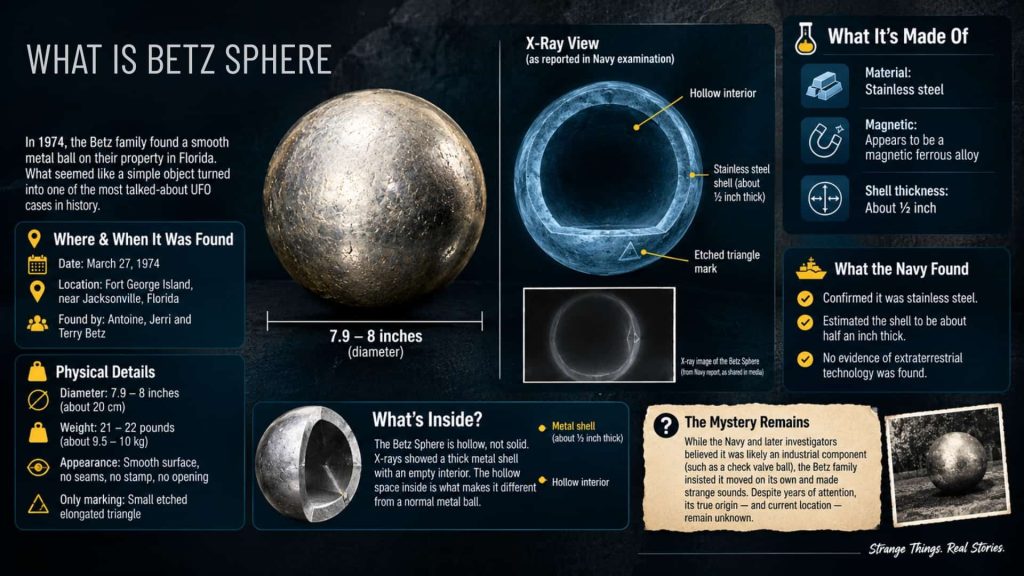
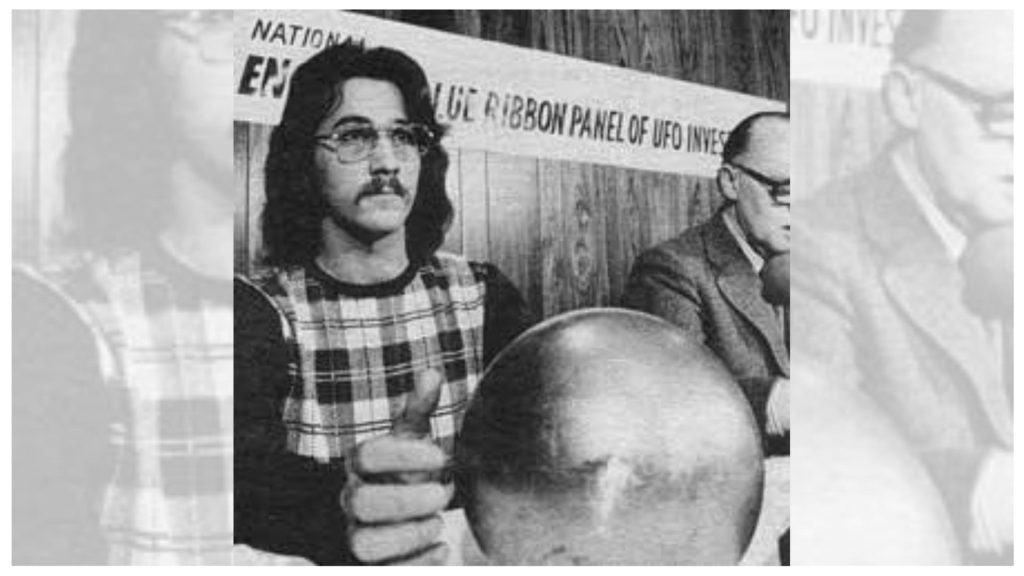
The Betz sphere was a hollow metal ball roughly 7.9 to 8 inches in diameter and weighing about 21 to 22 pounds. It was found on Fort George Island near Jacksonville, Florida, in the spring of 1974. The object had no obvious seams, manufacturer’s stamp, or visible opening. The only notable marking was a small etched shape that reportedly looked like an elongated triangle.

Navy testing identified the object as stainless steel, apparently a magnetic ferrous alloy, with a shell approximately half an inch thick. By itself, there was nothing particularly extraordinary about that description. What turned the object into a national story was what the Betz family said happened after they took it home.
The Day the Betz Family Found the Sphere
Evidence at a Glance
| Question | What the evidence supports |
|---|---|
| What was it? | A manufactured metal sphere |
| Was it alien? | No credible evidence establishes this |
| Did it move? | Reported by witnesses, but controlled evidence is lacking |
| Did it make a sound? | Reported by the family |
| Was it investigated? | Yes |
| Was it X-rayed? | Reports describe examination of the object |
| Was it a check valve ball? | Strong industrial explanation, but not a proven forensic identification |
| What about “atomic weight 140”? | A later claim requiring careful source attribution |
| Where is it now? | Current whereabouts are unconfirmed |
On March 27, 1974, Antoine and Jerri Betz and their 21-year-old son Terry, a pre-med student, were checking their 88-acre property on Fort George Island after a small brush fire had burned through part of the land. In the blackened undergrowth, Terry noticed something round and metallic, partly exposed by the fire.
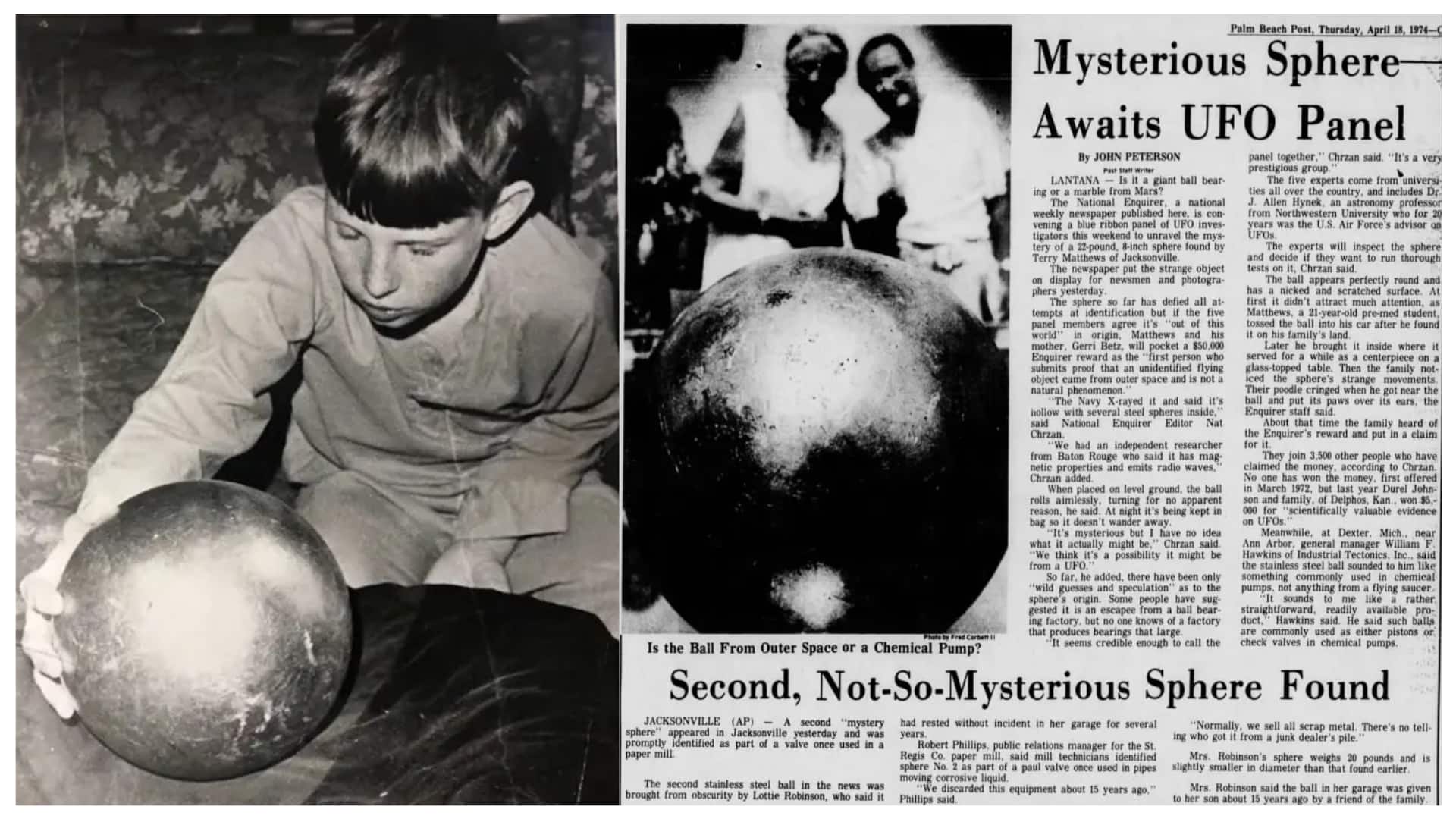
Their first thought was fairly ordinary. Fort George Island has a long history involving Spanish settlement and military activity, so a cannonball was not an unreasonable guess. But the object was clean, polished, and showed none of the rust or pitting they would have expected from something that had spent centuries buried in Florida soil.
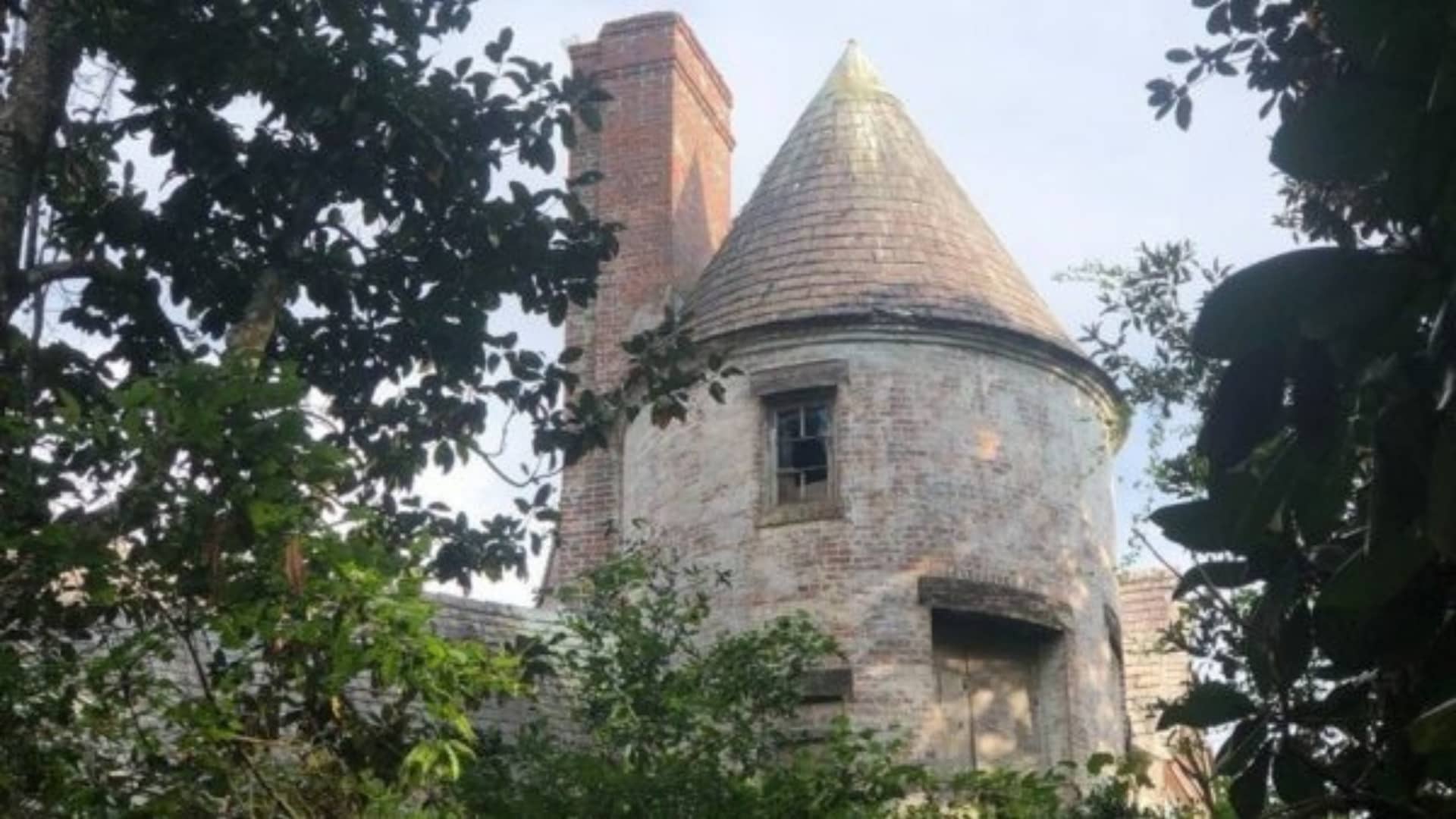
They took it home and placed it on a window sill in the family’s seven-level, 21-room house, a Tudor-style mansion locally nicknamed The Castle, a Fort George Island landmark with its own unrelated reputation.
The Neff House: The Betz Family’s “Castle”
After bringing the sphere home, the Betz family kept it inside the historic Neff House on Fort George Island. The large Tudor-Revival mansion, often referred to as the “Betz Castle,” became an important setting in the story because the unusual behavior was reportedly observed there after the sphere was brought inside.
The family later described the house as the place where they heard strange sounds and watched the sphere move across floors and behave in ways they could not explain.
For several days, nothing particularly unusual happened. Then, according to the family, that changed.
What Made the Betz Sphere So Strange?
The family said the object remained quiet for roughly two weeks after they brought it inside. The strange behavior they later described reportedly began after Terry played his guitar near it.
Gerri Betz told reporters that the sphere seemed to respond to certain guitar notes with a low, throbbing hum or vibration, according to reporting compiled by The Jaxson Magazine. Terry began experimenting with it, tapping it, shaking it, and placing it on different surfaces to see how it behaved.
According to the family, the sphere sometimes rolled across the floor without anyone touching it. They said it could stop suddenly, change direction, and even come to a halt near the edge of a table instead of falling. Terry also described it stopping before a set of steps rather than continuing down them.
The family said their dog reacted badly when the object began moving, whining and backing away.
There is an important limitation here. None of these movements was recorded under controlled laboratory conditions in a way that has survived. There are eyewitness accounts, but no surviving measurements that allow the reported behavior to be tested today. That leaves a clear divide between what the witnesses said they saw and what can actually be demonstrated from the surviving evidence.
The Strange Sounds and Other Reported Behavior
The stories did not stop with the rolling.
The Betz family and some visitors also reported hearing what sounded like organ music inside the house even though there was no organ playing. There were reports of doors closing on their own and of a high-pitched tone that seemed to bother dogs more than people.
A local radio host who covered paranormal subjects, Ron Kivett, visited the family and later said he had seen the sphere move. Newspaper photographer Lou Egner was also sent to photograph the object and later said he personally witnessed it move. Another photographer reportedly experienced a camera malfunction while trying to photograph the sphere, a detail included in Florida Heritage’s account of the case.
These accounts are part of the historical record, but they are still eyewitness accounts. They were made in a private home rather than during a controlled scientific experiment.
There is also a much simpler possibility for at least some of the movement. A heavy, smooth steel ball can roll surprisingly easily on a slightly uneven surface. Small changes in the floor, vibration, or the way the ball is positioned can affect its movement. That possibility does not prove that this was what happened in the Betz home, but it shows why eyewitness reports alone cannot establish that the object behaved in a physically impossible way.
A Navy spokesman later made a similar point when discussing the sphere’s reported movement.
The Betz Sphere and the U.S. Navy Investigation
As newspaper coverage spread beyond Jacksonville, Gerri Betz became the family’s main contact with institutions and researchers interested in examining the object. She reportedly negotiated a written agreement allowing the U.S. Navy to study the sphere for roughly two weeks, with the understanding that it would be returned if it proved not to be government property.
The Navy examined the object at Jacksonville Naval Air Station and, according to some accounts, also at Naval Station Mayport. Investigators carried out magnetic tests, checked it for radioactivity, and eventually obtained X-ray images of the interior.
United Press International reported in April 1974 that a Navy spokesman described the object as a large ball bearing used as a check valve in an industrial piping system. The same reporting, as preserved in later accounts of the case, indicated that the Navy regarded the object as terrestrial rather than extraterrestrial. A summary of the contemporary account records the Navy’s position.

That matters because it is one of the clearest contemporary pieces of evidence in the case. The Navy did not publicly identify the object as alien technology. Its assessment pointed toward an ordinary manufactured object.
What Did the X-Ray Examination Reveal?
The first attempt to X-ray the sphere reportedly failed because the equipment could not penetrate the thick stainless-steel shell. Two later attempts using more powerful equipment reportedly produced usable images.
Descriptions of those images said they appeared to show two or three smaller spherical shapes inside the outer shell. Some observers compared the arrangement to a gyroscope.
The interior became one of the most disputed parts of the case.
Engineering professor James Harder, who examined material connected with the investigation, believed the images could indicate something more unusual. He proposed that the object might be some kind of pressurized probe of unknown origin.
Skeptics offered much less exotic possibilities. An industrial valve ball with an internal component could potentially produce an unusual image, particularly when viewed through the curved walls of a thick metal sphere. Imaging artifacts were another possible explanation.
The difficulty is that the original X-ray material has not been subjected to a modern, independently published forensic analysis that settles the question. Without that, the interior remains a matter of interpretation rather than established fact.
Where the “Superheavy Element” Claim Actually Comes From
One of the most dramatic claims associated with the story is that the sphere contained material with an atomic weight of 140. Versions of the story have also claimed that drilling into the material could have caused a catastrophic explosion.
Those claims are often presented online as though they were part of the original 1974 investigation. The available record does not support that presentation.
The atomic-weight claim can be traced to the History Channel’s Ancient Aliens, which discussed the sphere in its 2017 Season 12 episode “Forged by the Gods,” rather than to a published Navy report or peer-reviewed scientific study.
There is no contemporary Navy statement cited in the surviving record that reports an atomic weight of 140 or warns that drilling into the sphere could trigger a thermonuclear-style explosion. For that reason, the claim should be treated as a later television claim rather than established evidence from the original investigation.
J. Allen Hynek and the UFO Investigation
Astronomer J. Allen Hynek became involved in the case around the same period. Hynek was already well known for his work on UFO reports and for developing the close-encounter classification system that later became widely associated with UFO investigations.
At the time, he was in New Orleans for a gathering connected with a $50,000 prize offered by the National Enquirer for convincing evidence of extraterrestrial contact. A panel of scientists had been assembled to evaluate cases submitted for consideration.
Terry Betz and the sphere were reportedly brought before the panel. According to UPI reporting from June 1974, the scientists concluded that the object was made from a type of stainless steel manufactured on Earth.
Hynek’s involvement is important because his reputation sometimes gets used to imply that the object received a scientific endorsement as extraterrestrial. That is not what the historical record shows. His involvement demonstrates that the case attracted serious attention, but it does not establish an extraterrestrial origin.
A later WJCT Public Media podcast episode used the title “Hynek vs. Harder,” reflecting the disagreement between researchers who interpreted the evidence differently.
Was the Betz Sphere Really a UFO?
Strictly speaking, calling it a UFO is misleading. The object was not seen flying, and nobody reported watching it fall from the sky.
Its place in UFO history comes from something else: a mysterious object, unusual eyewitness reports, military involvement, and a period when stories involving possible extraterrestrial technology received enormous public attention.
Some researchers and podcasters have since connected the case with the broader discussion surrounding metallic orb sightings, including the more recent Buga sphere case, as well as military UAP activity reported near U.S. installations.
Those comparisons are interesting, but they should not be confused with evidence of a connection. There is no documented link between the 1974 sphere and later UAP footage. The similarity is mainly visual and speculative.
The Ball Check Valve Theory
The strongest ordinary explanation is that the sphere was an industrial ball used inside a check valve.
A detailed 2012 analysis from Skeptoid helped popularize this explanation. Large stainless-steel balls were used in industrial check valves to control the flow of materials through pipes. Similar components were used in industries such as chemical processing and paper manufacturing.
Robert Edwards, president of a Jacksonville equipment supply company, contacted a UPI reporter after seeing the news coverage. He reportedly produced a new stainless-steel ball from his inventory that closely matched the Betz object in size, weight, and finish.
There was another relevant piece of evidence. The Miami Herald reported in April 1974 that a similar ball found near Jacksonville had been identified as a valve component from a paper mill, reportedly from equipment that had been decommissioned years earlier. That account is preserved in later summaries of the case, including the Wikipedia record.
These reports do not prove that the Betz family found that exact valve ball. They do, however, show that objects matching the sphere’s physical characteristics were already being manufactured and used commercially.
That is why the check-valve explanation remains the leading mundane theory.
Who Was James Durling-Jones?
Another important part of the explanation involves an artist named James Durling-Jones from Taos, New Mexico.
Durling-Jones collected industrial scrap metal and used pieces in his sculptures. According to research compiled by WJCT Public Media’s investigative podcast, he said that around 1971, three years before the Betz family’s discovery, he had been driving through the Jacksonville area with several large steel balls strapped to the roof of his Volkswagen bus.
The balls were reportedly intended for a large clock sculpture. During the trip, the roof rack failed and some of the spheres fell off into roadside brush.
If Durling-Jones’s account is accurate, it offers a straightforward explanation for how an industrial steel ball could have ended up in the wooded area and remained there until the brush fire exposed it.
It is still a story told years after the event, so it should not be treated as conclusive proof. But it fits the known physical evidence and the existence of similar industrial balls remarkably well.
Betz Sphere Debunked? What the Evidence Actually Shows
The phrase “Betz sphere debunked” makes the case sound more settled than it really is.
There is a strong ordinary explanation for the physical object. The Navy’s findings, the reports from industrial suppliers, the paper-mill connection, and the account given by James Durling-Jones all point toward a manufactured steel sphere rather than an unknown piece of extraterrestrial technology.
But that is not the same thing as proving every detail of the story.
Nobody has produced the original valve component with a documented chain of custody showing that it is the exact sphere discovered by the Betz family. There is also no surviving controlled experiment demonstrating the unusual movement described by the family.
That leaves two separate questions.
The first is what the object probably was. The available evidence strongly favors an industrial origin.
The second is what caused the movement and sounds reported inside the Betz home. That part cannot now be tested directly. The reports were never documented under laboratory conditions, so it is impossible to establish exactly what the family and visitors experienced.
The same distinction applies to some of the more dramatic claims surrounding the sphere. The atomic-weight-140 story, for example, traces to a later television production rather than the original Navy investigation.
So the most accurate conclusion is not that every part of the mystery has been solved, nor that the sphere must have been something extraordinary. The physical evidence strongly favors an ordinary explanation, while some of the eyewitness claims remain impossible to verify today.
What Happened to the Betz Sphere?
After the Navy returned the object and media attention declined around 1975, the Betz family’s public involvement gradually faded.
Gerri Betz had handled much of the media attention surrounding the case. Later accounts say she continued working in the Jacksonville area, including in real estate and trucking. As the story became less newsworthy, the family became increasingly reluctant to deal with reporters and curious visitors.
There is no reliable evidence of a dramatic ending. There is no established record showing that the sphere was secretly confiscated, destroyed, or transferred to a government laboratory.
The simplest explanation is also the least exciting: the object eventually disappeared from public view, and its trail became difficult to follow.
Where Is the Betz Sphere Now?
This is probably the question that most interests people who discover the case today.
Unfortunately, there is no confirmed answer.
In 2019, WJCT Public Media reporter Lindsey Kilbride investigated the story through the Odd Ball podcast. The investigation included an attempt to determine what had happened to the physical sphere decades after the original publicity. Despite the effort, the podcast did not establish a confirmed present-day location for the object.
That is significant because this was not simply an old internet rumor being repeated by another website. Lindsey Kilbride investigated the case for WJCT’s Odd Ball podcast and still could not establish where the original sphere was.
Over the years, different claims have circulated. Some say the sphere remained with the Betz family or their descendants. Others claim it was sold privately. There have even been stories about a similar object appearing on eBay.
None of those claims has been supported by documentation strong enough to establish the sphere’s current location.
There is no publicly confirmed record showing that a museum, university, or government archive currently holds the original object. No known member of the Betz family has publicly confirmed its present location.
So if someone asks, “Where is the Betz Sphere now?” the safest answer is simple: its current whereabouts have not been confirmed.
Why the Betz Sphere Mystery Survived
The timing helped.
The story appeared during a period when UFO reports were receiving widespread attention. Newspapers and wire services quickly picked up the unusual account, while the involvement of the Navy and J. Allen Hynek gave the case an additional layer of credibility and intrigue.
But timing alone does not explain its longevity.
The bigger reason is that the story sits in an uncomfortable middle ground. There is a plausible explanation for the object itself, yet the people who were there continued to describe behavior that was never properly tested.
If the sphere had been conclusively identified and preserved with a complete paper trail, the mystery would probably have faded. If it had demonstrated extraordinary behavior under controlled conditions, the story would have become a very different kind of scientific case.
Instead, neither happened.
The sphere disappeared from public view. The witnesses grew older. The original evidence remained incomplete. Decades later, writers, researchers, skeptics, and television producers continued returning to the same unanswered questions.
The story resurfaced in the 2012 Skeptoid analysis, the 2017 Ancient Aliens episode, and the 2019 investigative podcast. Each brought the case to another generation without producing the one thing that could finally settle every part of it: the original object and a complete scientific record.
That is a big reason the story continues to attract attention.
Betz Sphere vs. Other Famous Metal-Sphere Mysteries
The Betz sphere is not the only unusual metal-orb story to attract public attention.
In 2001, reports from Sasovo, Russia, described strange metallic spheres in connection with unusual explosions. Later explanations linked the material to industrial or military activity rather than extraterrestrial technology.
More recently, the Buga sphere case from Colombia has generated its own wave of speculation. Other unidentified spherical objects reported around the world have eventually been associated with things such as satellite debris, pressure vessels, or marine equipment.
The Betz case stands apart because of the behavior reported by the witnesses.
A mysterious sphere that simply appears is one kind of story. A sphere that its discoverers say rolled by itself, changed direction, responded to sounds, and behaved strangely around obstacles is much harder to settle decades later.
The problem is that the physical object can potentially have an ordinary explanation while the eyewitness reports cannot be recreated.
That same evidence gap appears in other unexplained cases involving unusual sounds and observations, including the Taos Hum and the Bell Island Boom.
Related Topics
- The Buga Sphere Mystery a modern metallic orb case with striking echoes of the Betz story and an unresolved origin.
- UFO Sighting Near Holloman Air Force Base recent UAP activity near a U.S. military installation, part of the wider discussion surrounding unexplained aerial observations.
- The Taos Hum: Unsolved Mystery another case involving a reported unexplained sound that has never been conclusively explained.
- The Skyquake Mystery unexplained sound phenomena with a long history of investigation and competing explanations.
- Bell Island Boom an unusual object-and-sound mystery that has never been completely resolved.
- Project MKUltra: CIA Mind Control Experiments another historical case in which government records became central to the story.
Key Takeaways
- The Betz sphere was a roughly 8-inch, 22-pound stainless-steel ball found by the Betz family on Fort George Island, Florida, on March 27, 1974.
- The family reported that it rolled, changed direction, and produced sounds, including a hum that they associated with guitar notes.
- Those unusual movements were never documented under controlled laboratory conditions.
- The U.S. Navy examined the object, tested it, and publicly treated it as a manufactured terrestrial object rather than extraterrestrial technology.
- The strongest ordinary explanation is that it was an industrial ball used in a check valve.
- The James Durling-Jones account provides a possible explanation for how such a ball could have ended up near the Betz property.
- The dramatic claim about an atomic weight of 140 does not come from a documented 1974 Navy report and instead appeared in a later television treatment of the case.
- J. Allen Hynek examined evidence connected with the case but did not establish that the object was extraterrestrial.
- The original sphere has never been publicly located and its present whereabouts remain unconfirmed.
Frequently Asked Questions About the Betz Sphere
What is the Betz Sphere?
The Betz Sphere is a stainless-steel ball roughly 8 inches across and weighing about 22 pounds. The Betz family found it on Fort George Island, Florida, in March 1974. It became famous after they reported that it moved and made unusual sounds.
When was the Betz Sphere found?
The Betz family discovered the object on March 27, 1974, while inspecting their property after a small brush fire.
Who found the Betz Sphere?
Terry Betz, then a 21-year-old pre-med student, noticed the sphere in the burned vegetation while he was with his parents, Antoine and Jerri Betz.
Did the Betz Sphere really move by itself?
The Betz family and several visitors said that it rolled, stopped, and changed direction without being touched. However, the movement was never documented under controlled conditions, so there is no surviving scientific test that confirms exactly what caused it.
Did the Navy investigate the Betz Sphere?
Yes. The U.S. Navy examined the object, carried out tests including magnetic and radioactivity checks, and obtained X-ray images of its interior. Contemporary accounts describe the Navy as considering it a manufactured object of terrestrial origin.
What did the X-ray of the Betz Sphere show?
Reports said the later X-rays appeared to show two or three smaller shapes inside the outer shell. Some researchers interpreted the images as potentially unusual, while skeptics argued that an industrial component or imaging effects could account for what appeared in the pictures. There is no modern independent analysis that conclusively settles the issue.
Was the Betz Sphere a UFO?
Not in the literal sense. Nobody reported seeing the object fly, and it was discovered on the ground. It became part of UFO folklore because of its reported behavior and the speculation that followed the Navy investigation.
Was the Betz Sphere debunked?
The physical object has a strong conventional explanation. Industrial check-valve balls matching its basic characteristics existed at the time, and the Navy regarded it as a terrestrial manufactured object. However, there is no documented chain of custody proving that the exact ball found by the Betz family was a particular valve component.
What is the ball check valve theory?
The theory is that the sphere was a large stainless-steel ball manufactured for use inside an industrial check valve. One possible history connects it to industrial equipment and another to artist James Durling-Jones, who said similar balls fell from his vehicle near Jacksonville several years before the Betz family found theirs.
What happened to the Betz Sphere?
After the Navy returned it and public interest declined, the sphere disappeared from the public record. There is no confirmed evidence that it was confiscated or transferred to a government or scientific institution.
Where is the Betz Sphere now?
Its current location has never been confirmed publicly. WJCT’s 2019 Odd Ball investigation attempted to track it down but did not establish where the original object was.
Is the Betz Sphere still unexplained?
The physical object has a well-supported earthly explanation, but the reports about its movement and sounds remain unresolved in the sense that they were never documented well enough to determine exactly what happened.
Conclusion
The Betz sphere remains interesting because the mystery is not as simple as either side sometimes makes it sound.
The physical evidence points strongly toward an industrial origin. Stainless-steel check-valve balls matching the object’s basic characteristics were in use at the time, the Navy considered it terrestrial, and the account given by artist James Durling-Jones provides a possible explanation for how one could have ended up in the Jacksonville area.
But that does not allow anyone to go back and prove exactly what happened inside the Betz home.
The family’s reports of the sphere rolling, stopping, changing direction, and producing unusual sounds were never captured in controlled experiments. Some visitors said they witnessed movement, but their observations cannot now be repeated or independently tested.
That is where the story remains open.
The evidence does not establish an alien object, and the more dramatic claims surrounding the sphere have often grown beyond what the original records support. At the same time, saying that the case has been completely solved goes further than the evidence allows.
Even the physical sphere itself has disappeared from public view. A journalist who investigated the case decades later could not establish where it was.
That combination is what has kept the story alive: a probably ordinary object, unusual eyewitness reports, an incomplete historical record, and a mystery that never received a final piece of evidence.
About the Author
Evan Brooks, author at StrangeHappen.com, writes about strange events, unexplained mysteries, unusual wildlife, ancient discoveries, and the science behind stories that seem almost too strange to be true. He enjoys digging through old reports, forgotten cases, and unusual claims to find out what really happened. His work looks beyond the mystery without taking away the sense of wonder. From eerie encounters and unexplained phenomena to bizarre creatures and ancient secrets, he separates documented facts from rumors, legends, and internet fiction.
Source References
- Wikipedia, “Betz mystery sphere”
- Skeptoid, “The Betz Mystery Sphere,” Episode 334, October 30, 2012
- The Jaxson Magazine, “The Mysterious Betz Sphere of Fort George Island”
- Modern Cities, “The Mysterious Betz Sphere of Fort George Island” (2023)
- WJCT Public Media, “Odd Ball” podcast, Lindsey Kilbride (2019)
- Florida Heritage, “The Betz Sphere: Florida’s Metallic Mystery That Still Defies Explanation” (2025)