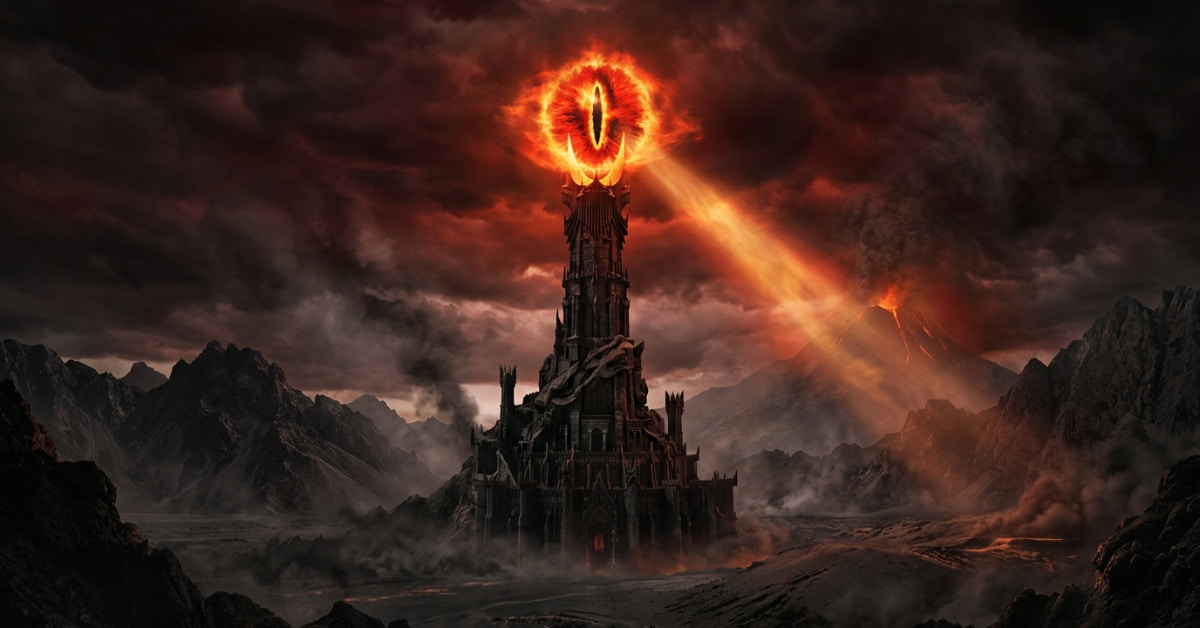
Picture the villain of The Lord of the Rings and most people see one image: a giant flaming eyeball on a black tower, sweeping a searchlight over Mordor. That exact image is not how Tolkien wrote Sauron. It isn’t a mistranslation of the books and it isn’t a myth either; it’s a real design choice built on top of a much older, stranger literary idea, and separating the two is the point of this guide.
Table of Contents
What Is the Eye of Sauron, Exactly?
“The Eye of Sauron” gets used to mean several different things, and mixing them up is where most confusion starts. It helps to separate four layers:
- Sauron himself: a real character, a Maia (an angelic spirit), who commands armies and forges the One Ring.
- “The Eye” as a title and symbol: one of Sauron’s names in the text, alongside the Great Eye and the Lidless Eye, used the way “the Crown” can stand in for a monarchy.
- The Eye as imagery tied to Barad-dûr: visions, a felt pressure on the mind, and brief glimpses of red light from the tower, all described in the books.
- The giant flaming eyeball appearing atop the tower: the specific visual Peter Jackson’s films created to dramatize that imagery, rather than a shape Tolkien describes Sauron physically taking.
Tolkien Gateway’s entry on the emblem catalogs layers two and three in detail: the Eye of Barad-dûr, the Eye of Mordor, the Great Eye, and the Lidless Eye all appear across The Lord of the Rings, and Orcs called it the Red Eye, painting it on shields and banners as a mark of war.
Sauron’s search for the One Ring is central to the Eye’s imagery in The Lord of the Rings. He lost the Ring when Isildur cut it from his hand at the end of the Second Age, and recovering it becomes the overriding goal of his war against Middle-earth. Anyone who puts the Ring on, including Frodo Baggins, risks drawing that attention directly.
Was Sauron an Elf, Human, or Something Else?
Sauron was a Maia, one of the divine spirits Eru Ilúvatar made to help shape the world before Elves or Men existed. Tolkien Gateway’s Sauron entry traces his original name, Mairon, “the Admirable,” and his early service under Aulë the Smith, learning to shape metal and stone. Tolkien lays this lineage out himself in The Silmarillion.
That love of order is what doomed him. Wanting to organize Middle-earth faster than patience allowed, Mairon was drawn to Melkor, the first Dark Lord later called Morgoth, and abandoned his old name for Sauron. He is not human either: he predates Men entirely, and while the fall of Númenor destroyed the body he wore at the time, his spirit survived until the One Ring itself was unmade.
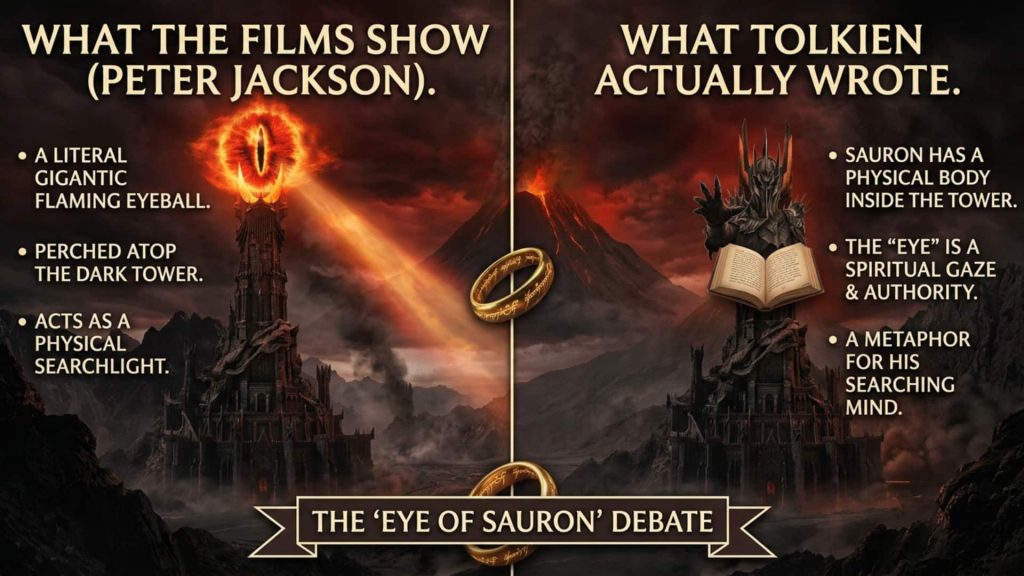
Tolkien portrays Sauron as a being capable of taking physical forms at different points in his history. Tolkien’s text never describes him transforming his entire body into a disembodied eyeball; the Eye is something tied to his presence and will, most vividly through the Ring and through visions like Galadriel’s Mirror, rather than a literal shape he physically becomes. How literally to read that connection, as an actual extension of Sauron’s body, or as symbolic and visionary language, is something Tolkien’s text leaves open. It’s a point readers and scholars still argue over rather than a settled fact.
Is Sauron Evil, or More Complicated Than That?
Tolkien’s letters are fairly direct on this: he described Morgoth and his chief servant Sauron as coming closer to a wholly evil will than anything else in his invented world, a characterization documented in Tolkien’s own correspondence and echoed across Tolkien Gateway’s Sauron entry.
That is not the same as saying he was born evil. Mairon began as a being devoted to craftsmanship and order, qualities that are not evil on their own; his fall came from impatience and a hunger to impose his own design on everyone else. By the time his Eye appears in The Lord of the Rings, that early nuance has mostly burned away, replaced by a will devoted almost entirely to domination.
How the Books Describe the Eye
The Silmarillion describes Sauron taking a new physical guise after Númenor’s fall and presents the Eye of Sauron as part of that terrifying image. It does not describe him as a floating or disembodied eyeball. Instead, Tolkien presents Sauron as physically embodied, while the Eye becomes part of the terrifying imagery associated with his presence and will.
The same source explains that while Sauron wore the One Ring, he could perceive much of what was done through the lesser Rings and could reach into the thoughts of those who wore them. In the text, the Eye represents that searching perception, Sauron’s hunt for the Ring, and the oppressive reach of his will. It’s not a mechanical surveillance system with one fixed job.
Its most vivid narrative appearance is inside Galadriel’s Mirror, where Frodo sees a single burning eye, rimmed in fire, its pupil a slit opening onto emptiness, searching for him within the vision itself. He feels that same pressure again atop Amon Hen, and near Mount Doom, he and Sam glimpse a real flicker of red light from the tower before storm clouds close over it again. Gollum separately tells Frodo and Sam that Sauron’s Black Hand has only four fingers, a detail that only makes sense if Sauron still has an actual, physical hand.
Put together, the books never establish Sauron as literally transforming into an eyeball, and they never describe a giant eye physically installed atop Barad-dûr the way the films do. What they establish is a corporeal Dark Lord whose Eye is a title, a symbol, and a genuinely felt, vision-borne presence.
Where Is the Eye of Sauron?
Whichever sense of “the Eye” you mean, it is anchored to Barad-dûr, Sauron’s fortress in the heart of Mordor. The text associates Sauron’s watchfulness with an opening in the tower sometimes referred to as the Window of the Eye, an image of Sauron’s attention rather than a literal frame holding a giant eyeball. Throughout the war, Sauron’s attention is repeatedly associated with watching the lands to the west, including the approaches toward Gondor.
That fixation matters for the plot, though not as simply as “Sauron looked the wrong way.” Gandalf’s strategy is to march the Army of the West to the Black Gate specifically to draw Sauron’s forces and his attention outward, as a deliberate diversion, while Frodo and Sam creep toward Mount Doom unnoticed.
It’s only at the very end, when Frodo claims the Ring for himself at the Cracks of Doom, that Sauron’s attention snaps away from the army at his gate and fixes on the mountain, by which point it’s already too late for him to stop what happens next. The films visualize this general dynamic by placing a literal, searching eye on the tower’s summit; the books describe the same strategic misdirection through Sauron’s will and forces rather than a single roving eyeball.
The Eye as a Symbol
Beyond Sauron’s own perception, the Eye of Sauron functioned as a wartime symbol. Mordor’s Orcs wore the Red Eye on shields, helmets, and black banners during the War of the Ring, deliberately set against the white hand rune used by Saruman’s Orcs of Isengard, a separate faction with a separate emblem.
The Eye of Sauron became one of the most recognizable Lord of the Rings symbols. As a Sauron symbol, it represents vigilance, power, and his relentless search for the One Ring, while Tolkien’s own Eye of Sauron art helped shape the imagery long before the films.
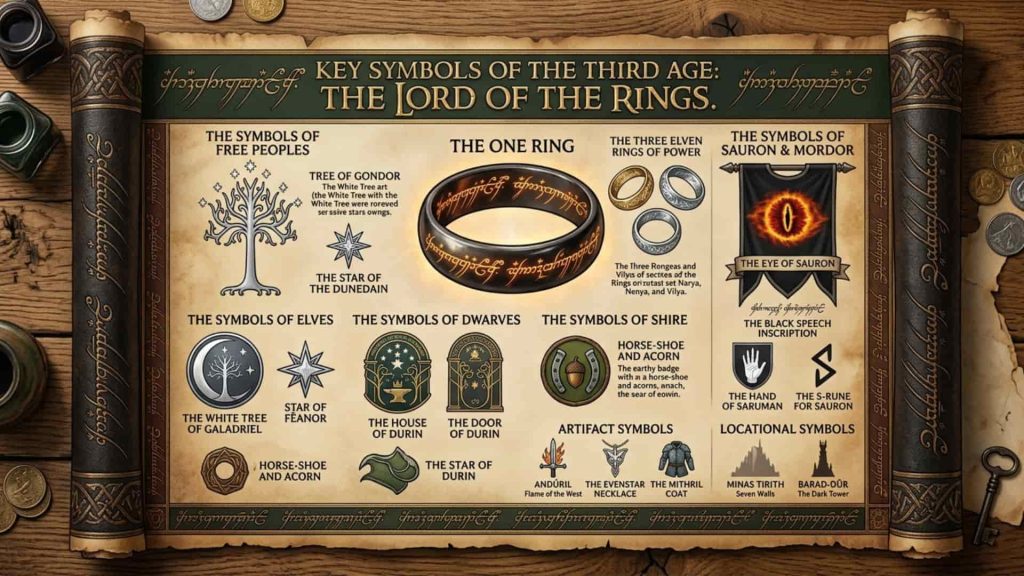
One distinction matters, though. Tolkien’s Lidless Eye and Great Eye are specific to his invented mythology. Real-world “all-seeing eye” and “evil eye” imagery exists independently across many cultures, with ancient Egypt’s own eye symbolism among the best known. Readers have noted the resonance, but there’s no reliable evidence that Tolkien was directly drawing on those specific traditions. His Eye is best understood as a distinct fictional symbol that happens to tap into a very old, cross-cultural fear of being watched.
The visual identity most fans recognize today has three separate sources worth telling apart. Tolkien himself sketched a lidless, flame-rimmed eye for early dust-jacket art, decades before any film existed. Illustrator John Howe’s paintings of Sauron and his emblem later influenced how Peter Jackson’s production designed the character for the screen. Everything else, from fan art to Eye of Sauron drawings sold as posters and merchandise, sits outside both of those and is not official Tolkien branding.
Books vs. Films: The Eye Side by Side
The Eye of Sauron book vs movie difference is ultimately a difference between Tolkien’s literary imagery and the films’ visual interpretation. The Eye of Sauron books vs films comparison makes this especially clear: Tolkien emphasizes Sauron’s will, perception, and symbolic Eye, while the Eye of Sauron movie version turns that idea into a literal visual presence.
Tolkien created the concept and imagery of the Eye. Jackson’s films transformed that literary imagery into the literal, giant flaming Eye that appears above Barad-dûr on screen. Neither version is “wrong.” The film version is an adaptation choice, built to make an abstract, page-bound idea instantly visible to an audience. Laid out side by side, the differences look like this:
| Element | Tolkien’s Books | Peter Jackson’s Films |
|---|---|---|
| Sauron’s body | A physical, corporeal form, described directly in the text | Sauron’s presence is largely represented through the Eye in the final films |
| The Eye | A title, a symbol, and imagery tied to his searching will | A literal, animated giant flaming eye |
| Barad-dûr | Associated with the Window of the Eye and Sauron’s fortress | The Eye visually dominates the top of the tower |
| Searching for the Ring | Sauron’s central objective, described through perception and dread | Represented visually through the Eye’s searchlight-like gaze |
| Omniscience | Not literally all-seeing; his attention can be misdirected | Visually staged as an intense, sweeping surveillance presence |
How Did Sauron Become an Eye?
He didn’t, in the literal sense the question implies. There is no scene in Tolkien’s writing where Sauron transforms into an eyeball. What actually happened is that after losing his fair form at the fall of Númenor, Sauron took on a terrible guise in which the Eye became part of the terrifying image Tolkien associates with Sauron, a symbol of his watching, searching will rather than his entire physical body.
The modern idea of Sauron literally “becoming an eye” is strongly associated with the films, which needed a way to represent an antagonist who barely appears directly on the page. Turning his presence into a literal, physical eye gave audiences something constant to watch and fear. It’s a smart piece of visual storytelling and a reasonable solution to a very specific film problem, but it answers that problem, not a plot point drawn straight from the novels.
What Tolkien Scholarship Still Debates
Some questions about the Eye remain genuinely open among Tolkien readers and scholars rather than settled fact. In one scholarly interpretation, Edward Lense’s 1976 essay in the journal Mythlore argues that the Eye’s imagery draws on older literary and folkloric ideas of a watching evil that Tolkien never spelled out directly himself. It’s a reading other critics have debated rather than universally accepted.
Readers also disagree on how literally to take the Mirror of Galadriel scene: as a genuine supernatural link between Sauron and Frodo, or as a psychological projection of the Ring’s growing hold over him. Tolkien’s own letters don’t resolve this directly, so it remains an interpretive question rather than a settled one.
Related Topics May You Also Like
- Top 10 Ancient Egyptian Symbols and What They Really Meant
- The Egyptian Ankh Symbol Explained
- Yajooj and Majooj: The Myth of Gog and Magog
- The Real Mythology Behind The Mummy
- The Lost Labyrinth of Egypt
- Forgotten Places History Left Behind
- Galaxy of Horrors: The Universe’s Darkest Discoveries
Conclusion
Tolkien’s Eye and Peter Jackson’s Eye are related but not identical. In the books, the Eye is imagery, title, and symbol, a manifestation of Sauron’s searching will, tied to a Dark Lord whom Tolkien portrays as having a physical, corporeal form. In the films, that concept becomes a literal giant flaming Eye, a deliberate adaptation choice that turns an abstract literary presence into something an audience can watch onscreen. Knowing the difference doesn’t make either version lesser; it just makes clear which parts of the image came from Tolkien and which came from Peter Jackson’s production designers.
Key Takeaways
- “The Eye of Sauron” refers to at least four related things: Sauron himself, a title/symbol, textual imagery tied to Barad-dûr, and the film’s literal giant-eye design. Mixing these up is the main source of confusion.
- Sauron was a Maia, an immortal spiritual being distinct from Elves and Men, and Tolkien portrays him as capable of taking physical form.
- Tolkien’s own letters describe Sauron as approaching a wholly evil will, though he began as a being devoted to order, not malice.
- The books never show Sauron literally transforming into an eyeball or a giant eye physically installed on Barad-dûr; that specific image was created for Peter Jackson’s films, building on Tolkien’s own Eye imagery and artwork.
- In the text, the Eye represents Sauron’s searching perception and his hunt for the Ring, powerful, but not literal, all-seeing omniscience.
Frequently Asked Questions About the Eye of Sauron
What is the Eye of Sauron?
It is both a title Sauron goes by and the imagery Tolkien uses for his searching, perceiving will, most vividly shown through Frodo’s vision in Galadriel’s Mirror. It is not a separate creature, and the books don’t describe it as a disembodied eyeball with its own independent body.
Is Sauron’s Eye actually a giant eyeball?
Not in the books. That specific image, a giant eye appearing above Barad-dûr with a sweeping searchlight, was created for Peter Jackson’s films, building on Tolkien’s own Eye imagery and dust-jacket artwork. In Tolkien’s writings, Sauron is portrayed as having a physical form; the books never depict him as literally becoming a giant disembodied eyeball.
Was the Eye of Sauron actually on top of Barad-dûr?
Not as a physical object sitting on the tower. Tolkien’s books associate Sauron’s watchfulness with an opening described as the Window of the Eye, part of the fortress rather than a giant eyeball mounted above it. The films made that association literal, staging an enormous flaming eye visibly above the tower so audiences could see Sauron’s presence and attention at a glance.
Is the Eye of Sauron in the books?
Yes, as imagery and felt presence, most clearly in the Mirror of Galadriel scene and in brief glimpses near Mount Doom, but never as a standing monument on the skyline.
How did Sauron become an eye?
He didn’t literally. After Númenor’s fall destroyed his fair form, Sauron took on a new, terrible guise in which the Eye was his most feared feature, a symbol of his will rather than a full-body transformation.
Where is the Eye of Sauron?
The Eye is strongly associated with Barad-dûr and Sauron’s watchfulness from the fortress. Tolkien also refers to a ‘Window of the Eye,’ an opening high in the tower associated with Sauron’s watchfulness toward the west.
What does the Eye of Sauron actually do?
It represents Sauron’s search for the One Ring and his ability to perceive and influence those using the lesser Rings, a searching, oppressive presence rather than literal, total omniscience. His attention can be resisted, misdirected, or drawn away, which is exactly what Gandalf’s strategy at the Black Gate relies on.
Was Sauron an Elf?
No. He was a Maia, a type of angelic spirit that existed before Middle-earth’s mortal races, entirely separate from Elves, Men, or Dwarves.
Is Sauron human?
No. He predates humanity in Tolkien’s timeline and is an immortal spirit whose body can be destroyed but whose essence survived until the One Ring was unmade.
What is the difference between the Eye of Sauron and the Eye of Saruman?
There isn’t an “Eye of Saruman” in Tolkien’s books; Saruman is a separate character whose Orcs used a white hand symbol instead. The confusion likely comes from his own scrying device, the palantír.
Did Sauron have a head in the books?
Yes. Tolkien portrays Sauron as a physically embodied being, not as a giant floating eyeball. The books describe his physical form and even refer to his Black Hand, which makes the film’s giant-eye depiction a visual adaptation rather than a literal description of his body.
You May Also Like
- Top 10 Ancient Egyptian Symbols and What They Really Meant
- The Egyptian Ankh Symbol Explained
- Yajooj and Majooj: The Myth of Gog and Magog
- The Real Mythology Behind The Mummy
- The Lost Labyrinth of Egypt
- Forgotten Places History Left Behind
- Galaxy of Horrors: The Universe’s Darkest Discoveries
About the Author
Evan Brooks is a science and history writer for Strangehappen.com, specializing in world mythology, literary lore, and the strange stories behind fiction’s most iconic symbols. His work focuses on translating complex source material into engaging, evidence-based stories that help readers understand the mysteries of our world and beyond.
Sources
- J.R.R. Tolkien, The Lord of the Rings (primary text, including the Mirror of Galadriel, Amon Hen, and Mount Doom scenes)
- J.R.R. Tolkien, The Silmarillion (primary text, including the Akallabêth and Of the Rings of Power)
- Tolkien Gateway: Eye of Sauron
- Tolkien Gateway: Sauron
- Edward Lense, “Sauron and the Idea of Evil,” Mythlore (1976)