

In March 2025, a fish with almost no bones, barely any muscle, and a face that looks permanently disappointed did something nobody predicted. It won an election. New Zealand’s Fish of the Year competition crowned the blobfish its 2025 champion, edging out the orange roughy by fewer than 300 votes. That’s a strange twist for an animal best known for one thing: being named the world’s ugliest animal back in 2013.
The real story behind the blobfish, once the confirmed facts are separated from the numbers that keep getting repeated without a source, turns out to be stranger and more interesting than the meme. These blobfish facts cover what the animal actually is, why it looks the way it does, is the blobfish endangered or not, and how it went from internet punchline to conservation mascot. Along the way, this piece also fact-checks a couple of claims that show up everywhere online but don’t hold up to scrutiny.
Table of Contents
What Is a Blobfish?
Before getting into the more surprising blobfish facts covered further down (the fact-checks, the 2025 win), it helps to start with the basics. The species most people picture is Psychrolutes marcidus, also called the smooth-head blobfish. It’s a deep-sea fish in the family Psychrolutidae, described in 1926 by the Australian naturalist Allan Riverstone McCulloch, according to the species’ taxonomic record on Wikipedia. It lives in the deep waters off mainland Australia, Tasmania, and New Zealand.
One Famous Species, One Large Family
“Blobfish” isn’t a single species so much as a nickname that gets applied across a wider group. The genus Psychrolutes includes roughly a dozen recognized species, among them the blob sculpin (Psychrolutes phrictus), the western Australian sculpin (Psychrolutes occidentalis), and Psychrolutes microporos, the species behind the most famous photo of all. The wider family, Psychrolutidae, is sometimes called the fatheads, and it stretches across cold, deep waters worldwide, not just the Southern Hemisphere. It shares those depths with plenty of other odd-looking specialists, including the anglerfish, which solves the same darkness problem with a glowing lure instead of a low-density body.
How the Blobfish Got Its Name
McCulloch’s original 1926 description didn’t come with a catchy nickname. The name only became common decades later, once photographs of its collapsed, gelatinous form out of water started circulating. It describes what happens to the animal once it’s pulled to the surface, not what it looks like at home.
What a Blobfish Actually Looks Like Underwater
Nearly every photo in circulation shows a dead or dying specimen, hauled up from a thousand meters down and photographed on a boat deck. That image is real, but it’s not how the fish spends its life. Underwater, in its actual habitat, it looks nothing like the collapsed shape most people picture.

Why It “Melts” Once It Reaches the Surface
The fish has no swim bladder, the gas-filled organ most fish use to control buoyancy, because a swim bladder would be crushed at the depths where it lives. Instead, its flesh is a gelatinous mass slightly less dense than seawater, letting it hover just above the sea floor without spending energy swimming, a mechanism National Geographic explains in detail. At depth, the surrounding water pressure, 60 to 120 times what we feel at sea level, holds that soft tissue in a shape that looks like an ordinary fish. Pull it up fast, and the pressure drop lets the tissue sag and tear, which is what produces the pale, drooping “blob” everyone recognizes.
The Story Behind the Viral Photo: Meet Mr Blobby
The specimen behind the famous image was trawled in June 2003 during the NORFANZ Expedition, a joint Australian-New Zealand survey of deep-sea life on the Norfolk Ridge. Researchers nicknamed it “Mr Blobby” after a British children’s TV character, and the specimen now sits preserved in the Australian Museum’s ichthyology collection in Sydney. If you look closely at the original photo, the small yellowish speck near its mouth isn’t slime. It’s a parasitic copepod that had attached itself to the fish, the same basic survival trick used by stranger parasites like the tongue-eating louse, which replaces a fish’s tongue entirely.
Habitat and Distribution
Its habitat is about as far from a coral reef postcard as ocean life gets: cold, dark, and crushing. The species lives on the seafloor at depths of roughly 600 to 1,200 meters (2,000 to 3,900 feet) off southeastern Australia, Tasmania, and New Zealand. Down there, temperatures hover just above freezing and sunlight never reaches. This is genuinely inhospitable territory for most life, which is part of why its habitat has stayed so poorly studied.
Almost everything scientists know comes from specimens caught by accident, not from direct observation in the wild. That same remoteness is a big part of why “is the blobfish endangered” has no clean answer yet. Nobody has been able to survey the population closely enough to say for sure.
Diet and Feeding Behavior
Feeding behavior is one of the more settled blobfish facts, with far less disagreement across sources than the lifespan and population questions further down. The fish doesn’t hunt. It hovers near the bottom with its mouth open and waits for something edible to drift within reach, then sucks it in.
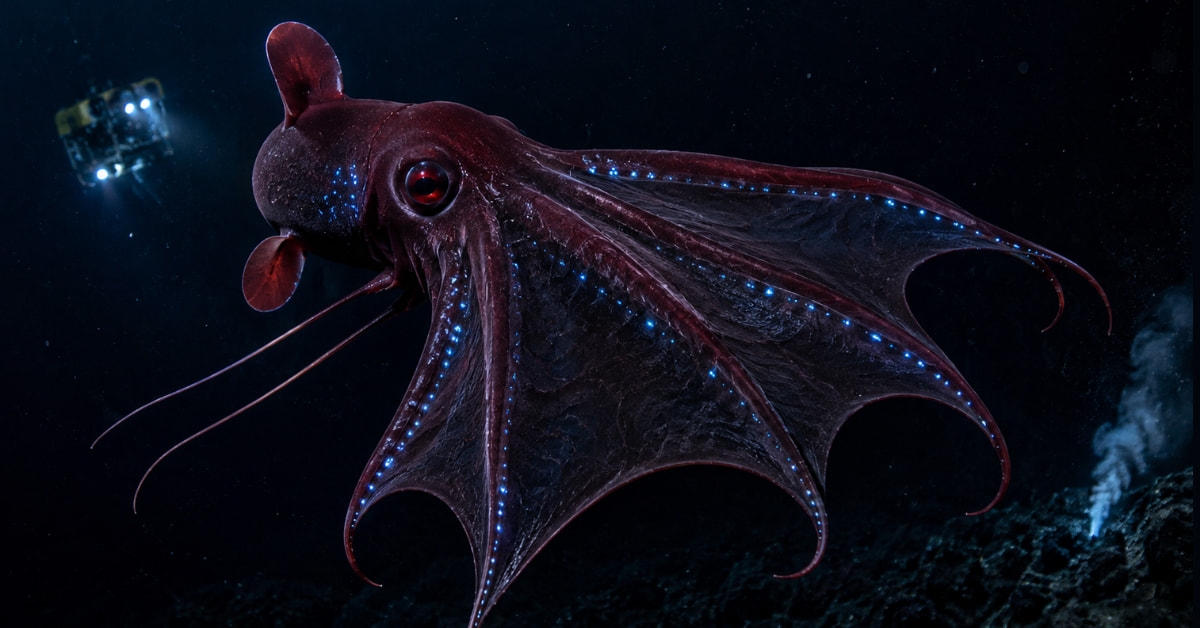
What do blobfish eat this way? Mostly small crustaceans, mollusks, sea urchins, and carrion that sinks down from higher in the water column. This sit-and-wait strategy fits an animal with almost no muscle to spare: in a food-scarce environment, not chasing prey is the whole point, the same passive approach a vampire squid takes to feeding on marine snow rather than hunting.
Reproduction and Life Cycle
Direct observations of reproduction are rare, for the same reason everything else about the species is hard to pin down: nobody is watching them mate a kilometer underwater. The best available evidence, again from National Geographic’s reporting, describes large clutches of around 100,000 eggs laid in a single nest, with a parent staying close by to guard them as they develop. That detail matters, because it runs against an older, looser claim, repeated in plenty of blobfish facts round-ups, that the eggs are simply abandoned to develop on their own.
How Long Do Blobfish Actually Live? Fact vs. the “130-Year” Claim
Search for how long do blobfish live and you’ll find wildly different numbers: 25 years on one site, “100 years or more” on another, “up to 130 years” on several more. None of them link back to an actual longevity study of Psychrolutes marcidus. The higher figures appear to be inferred from a real pattern in deep-sea biology, since many cold-water fish do grow slowly and live long because a slow metabolism is an advantage when food is scarce and predators are few.
That pattern gets stretched into a specific number for a species nobody has actually tracked over its full lifespan. So how long do blobfish live? The honest answer is that it isn’t known.
Treat any exact figure you see, this article’s included, as an estimate based on related species, not a measured fact. That same gap in direct study is exactly why “is the blobfish endangered” turns out to be a harder question than it looks, which is where this article turns next.
Is the Blobfish Endangered? What’s Actually Known
This is the question with the most conflicting answers online, and it’s worth untangling carefully. Is the blobfish endangered? As of this writing, Psychrolutes marcidus does not appear to carry a completed assessment on the IUCN Red List at all. Neither Wikipedia’s species entry nor the taxonomic databases that track it list a Red List category, which places it in the IUCN’s “Not Evaluated” bucket rather than any of the actual threat categories.
Not Evaluated is not the same thing as safe. It means nobody has yet done the assessment, for a species that is genuinely difficult to survey given how deep and remote it lives.
The one documented, real threat is bycatch: the fish are sometimes swept up in bottom trawling nets set for commercial species like orange roughy, and the trip to the surface is generally fatal regardless of how gently a crew handles the fish. That’s a legitimate conservation concern. It’s just a different claim than “the blobfish is officially endangered,” which several popular animal-facts sites state as settled fact.
Fact-Checking the “Only 420 Left” Claim
One number shows up constantly whenever someone asks how many blobfish are left: 420, repeated across online content everywhere, including in a Change.org petition with thousands of signatures. It’s stated with total confidence and almost never sourced. Given that the species hasn’t even received a formal population assessment, a precise headcount like 420 has no visible origin.
It’s the kind of number that likely started somewhere as a guess or a rounding of an offhand remark, then got copied from site to site until it looked like established science. Until someone can point to the actual study behind it, it belongs in the same category as the exact lifespan claims above: repeated often, confirmed nowhere.
From “World’s Ugliest Animal” to New Zealand’s Fish of the Year
The fish’s fame rests on two very different public votes, twelve years apart, that say almost opposite things about how people see it.
The 2013 Ugly Animal Contest
In 2013, the British-based Ugly Animal Preservation Society ran a public poll to find a mascot for overlooked, unglamorous species that don’t attract the same conservation attention as pandas or tigers. The blobfish won by a wide margin and, as Smithsonian Magazine later pointed out, the whole premise rested on a photo of a fish that had already suffered severe tissue damage from decompression, not a fair likeness of a living animal. Calling it the world’s ugliest animal turned out to be judging a fish by the worst possible day of its life.
The 2025 Fish of the Year Win
Twelve years later, the same fish became a symbol of something closer to affection. New Zealand’s Mountains to Sea Conservation Trust runs an annual Fish of the Year contest, formally the New Zealand Fish of the Year award, to raise public awareness of native freshwater and marine species. In 2025 the blobfish took the crown with 1,286 of the 5,583 votes cast, narrowly ahead of the orange roughy, according to UPI’s coverage of the announcement.
Organizers noted that the contest exists specifically to highlight species, like both 2025 finalists, that are affected by deep-sea bottom trawling. It’s a roundabout way of putting the “is the blobfish endangered” question in front of a much bigger audience than a Red List entry ever could. The New Zealand Fish of the Year win wasn’t just a popularity contest result. It was a deliberate attempt to turn an internet joke into public support for protecting the habitat it actually depends on.
Can You See a Live Blobfish? Meet Bob, the Only One on Public Display
If you want to see a fish that isn’t a decompressed photograph, there’s exactly one place to look: Bob the Blobfish. In May 2017, a fisherman working a gill net off Rausu, Hokkaido, accidentally caught one at a depth of roughly 750 to 1,200 meters, and it survived the trip up. Aquamarine Fukushima, a public aquarium in Japan, put the fish, nicknamed Bob, on permanent display, and outlets covering the story at the time, including Practical Fishkeeping and IBTimes, described it as the only one held anywhere in captivity.
Bob the Blobfish’s tank is kept cold and dim to mimic the deep sea, which is also why, unlike the collapsed specimens most people picture, a living specimen in a properly pressured, cold environment looks far closer to an ordinary fish.
Related Topics
- Red-Lipped Batfish: An Unusual Marine Miracle: a remarkable seafloor fish that walks across the ocean floor instead of relying on conventional swimming.
- Glass Sponges: Ancient Architects of the Deep Sea: another deep-sea survivor adapted to cold, dark, high-pressure environments far below the surface.
- 10 Newly Discovered Species: a broader look at unusual species and the extraordinary adaptations that help life survive in extreme environments.
Key Takeaways
The core blobfish facts worth remembering, stripped of the myths:
- The species most people know is Psychrolutes marcidus, one of roughly a dozen species in the genus Psychrolutes, described in 1926.
- The famous “melted” look only happens after the fish is hauled to the surface. In its natural deep-sea habitat, water pressure holds its gelatinous body in a normal fish-like shape.
- Is the blobfish endangered? Not officially. It has no completed IUCN Red List assessment, which is different from being confirmed safe.
- The “only 420 left” and “up to 130-year lifespan” figures that circulate widely have no traceable source and shouldn’t be treated as established facts.
- In 2025, the species won New Zealand’s Fish of the Year, a conservation-awareness contest, twelve years after its 2013 “world’s ugliest animal” title.
- Exactly one specimen, nicknamed Bob, lives on public display at Aquamarine Fukushima in Japan.
Frequently Asked Questions About Blobfish
Is the blobfish endangered?
Not officially. Psychrolutes marcidus has no completed IUCN Red List assessment, so it isn’t formally classified as endangered, threatened, or safe. The real, documented risk is bycatch from deep-sea bottom trawling, which is a genuine conservation concern even without a formal endangered listing.
How long do blobfish live?
Nobody knows for certain. That’s the honest answer to how long do blobfish live, whatever number you’ve seen elsewhere: figures ranging from 25 to over 130 years circulate online, but none are backed by a dedicated longevity study of the species. The higher figures appear to be extrapolated from other slow-growing deep-sea fish rather than measured directly.
How many blobfish are left in the world?
The specific figure of 420, widely repeated across facts pages online, has no traceable scientific source. Since the species hasn’t received a formal population assessment, no verified worldwide count currently exists.
What do blobfish eat?
They are passive, sit-and-wait feeders that consume small crustaceans, mollusks, sea urchins, and carrion drifting past on the seafloor. They don’t actively hunt, relying instead on prey coming within reach of their large mouths.
Why does a blobfish look so different underwater compared to in photos?
Photos show fish that have been rapidly pulled to the surface, where dropping pressure lets their gelatinous, low-muscle tissue collapse and sag. In their natural deep-sea habitat, the surrounding water pressure holds that same tissue in a shape much closer to an ordinary fish.
Can you eat a blobfish?
They aren’t commercially fished or considered edible; their soft, watery, gelatinous flesh has little food value, and they’re not targeted by any fishery. When they do turn up, it’s almost always as accidental bycatch in nets set for other species, which loops back to the same bycatch pressure that makes “is the blobfish endangered” worth asking in the first place, even without a formal Red List listing.
Where can you see a live blobfish?
Aquamarine Fukushima in Japan is currently the only public aquarium known to display a living specimen. Bob the Blobfish, caught off Hokkaido in 2017, is the exhibit’s star resident, and live specimens are otherwise essentially never seen outside their deep-sea habitat.
Did the blobfish really win New Zealand’s Fish of the Year?
Yes. In March 2025, the species won the Mountains to Sea Conservation Trust’s New Zealand Fish of the Year contest with 1,286 of 5,583 votes cast, narrowly beating the orange roughy. The contest is run to raise awareness of New Zealand’s native fish and the threats they face.
Source References
- National Geographic — Blobfish, Facts and Photos
- Australian Museum — Fathead (Psychrolutes), aka Mr Blobby
- Wikipedia — Psychrolutes marcidus
- UPI — NZ Names Blobfish Its 2025 Fish of the Year
- Smithsonian Magazine — In Defense of the World’s Ugliest Animal
- Practical Fishkeeping — World’s Ugliest Creature Goes on Display at Aquarium
- IBTimes — World’s Ugliest Animal Exhibited at Japan’s Fukushima Aquarium
Author Bio
Evan Brooks is a science and history writer for Strangehappen.com, specializing in marine biology, unusual wildlife, and emerging scientific discoveries. His work focuses on translating complex research into engaging, evidence-based stories that help readers understand the mysteries of our world and beyond.