

By Evan Brooks · Published: 28 October 2026
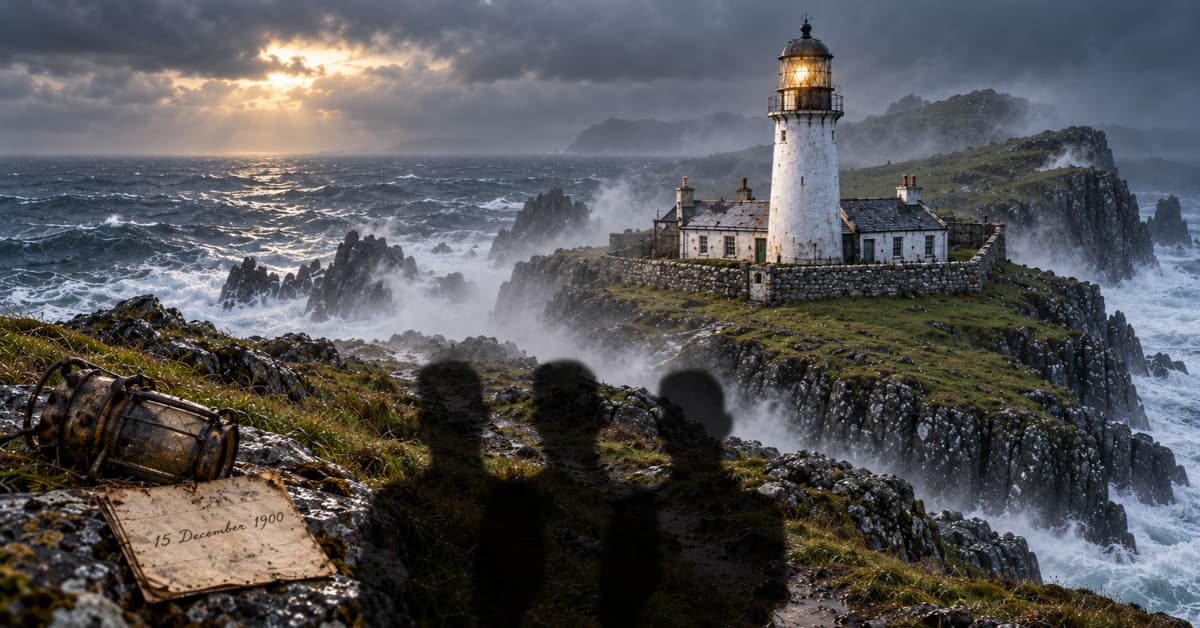
Around 15 December 1900, three keepers disappeared from the Flannan Isles lighthouse. Investigators judged that an unexpectedly powerful wave most likely swept them into the sea near the West Landing. The Flannan Isles lighthouse mystery therefore has a supported official explanation, but no eyewitness account or recovered remains establish exactly how the tragedy unfolded.
To understand the Flannan Isles lighthouse mystery, this guide examines records held or published by the Northern Lighthouse Board (NLB) and National Records of Scotland (NRS). It distinguishes documented observations from investigators’ interpretations and details introduced in later retellings.
The case is also known as the Flannan Isle mystery. It took place on Eilean Mòr, the largest of the Flannan Isles, which are also known as the Seven Hunters.
NLB and some older sources use the spelling “Islands”, so you may also meet the Flannan Islands lighthouse mystery. The name Eilean Mòr lighthouse mystery refers to the island where the lighthouse stands and the keepers disappeared. All these names refer to the same event: the December 1900 lighthouse disappearance in which three keepers vanished from Eilean Mòr. Today it is widely remembered as the 1900 Flannan Isles lighthouse mystery.
Table of Contents
Flannan Isles Lighthouse Mystery at a Glance
| Question | Answer |
|---|---|
| Location | Eilean Mòr, the largest of the Flannan Isles (the Seven Hunters), lies west of Lewis in Scotland’s Outer Hebrides (NLB, NRS). |
| Date | On or about Saturday 15 December 1900 |
| Missing keepers | James Ducat, Thomas Marshall and Donald McArthur |
| Discovery date | 26 December 1900, when the tender Hesperus brought relief keeper Joseph Moore |
| Main evidence | An orderly station, slate notes ending on the morning of 15 December, missing outdoor clothing and heavy sea damage at the West Landing |
| Flannan Isles lighthouse official explanation | Superintendent Robert Muirhead’s report of 8 January 1901 judged it most likely that the men went down to secure a box of mooring ropes and were swept away by an unexpectedly large wave |
| Case status | Well-supported explanation, not proven. The death register records “probably drowning” (NRS) |
Who Were the Flannan Isles Lighthouse Keepers?
James Ducat, the principal keeper, was on duty at Eilean Mòr with second assistant Thomas Marshall and occasional keeper Donald McArthur. McArthur was filling in for William Ross during his sick leave (NLB). Joseph Moore, another keeper, was ashore when his colleagues disappeared and later discovered the deserted station.
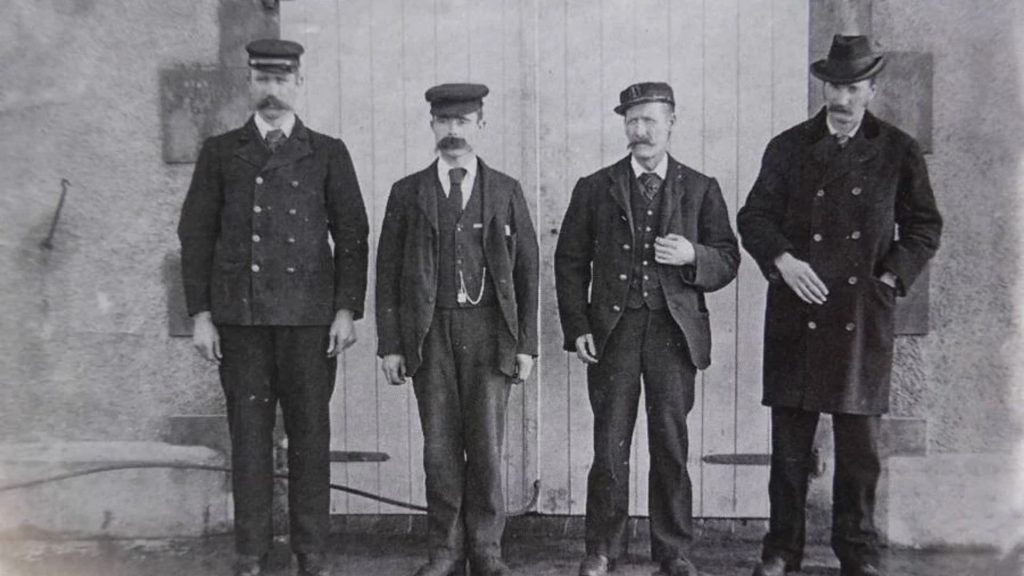
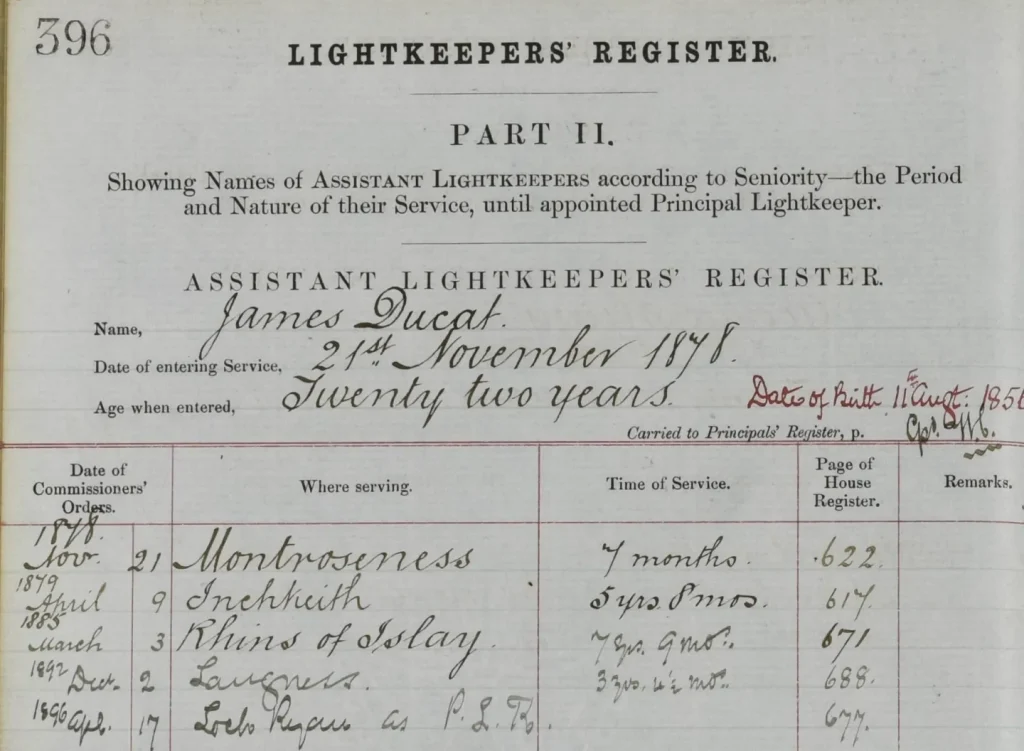
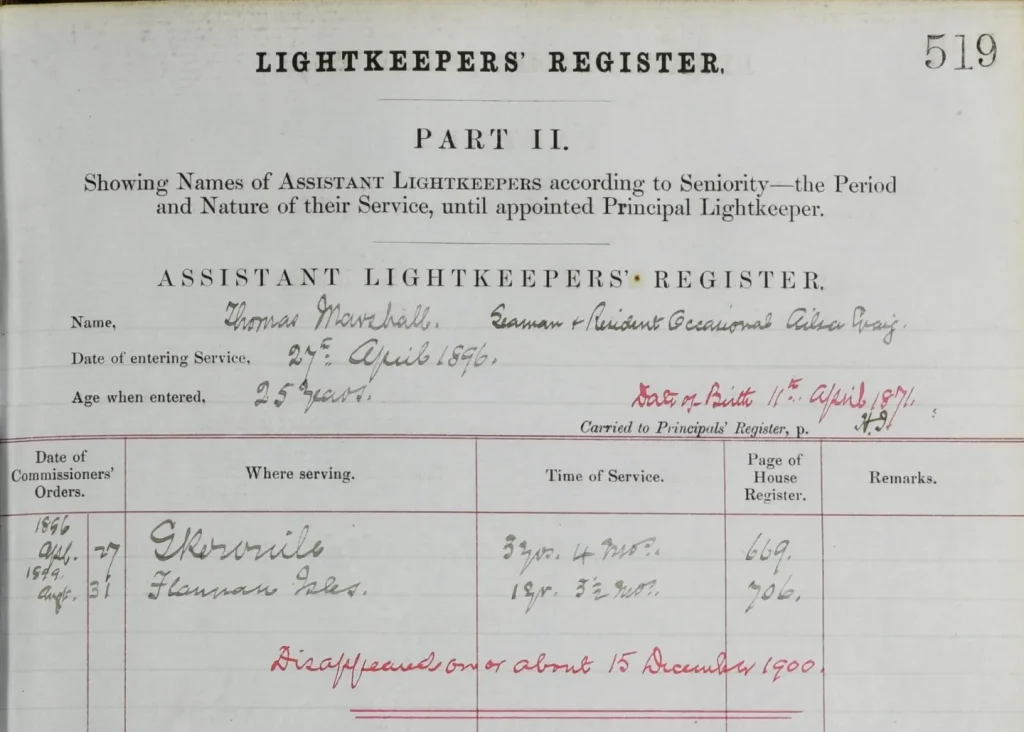
The lightkeeper registers add detail. James Ducat was born on 11 August 1856, joined the lighthouse service in 1878 and became principal keeper in April 1896. Thomas Marshall, a former seaman, joined the service in April 1896, aged 25 according to his register entry. Donald McArthur worked as an occasional lighthouse keeper, but his name does not appear in the registers reviewed by NRS.
Source note: Marshall’s handwritten service entry gives his age as 25 on joining. The NRS article states 27.
These were real families. Ducat left a wife and four children. Marshall was unmarried and survived by his father, brother and sister. The available records suggest that McArthur was survived by his wife and two children. Both NLB and NRS stress that the families never knew for certain what happened.
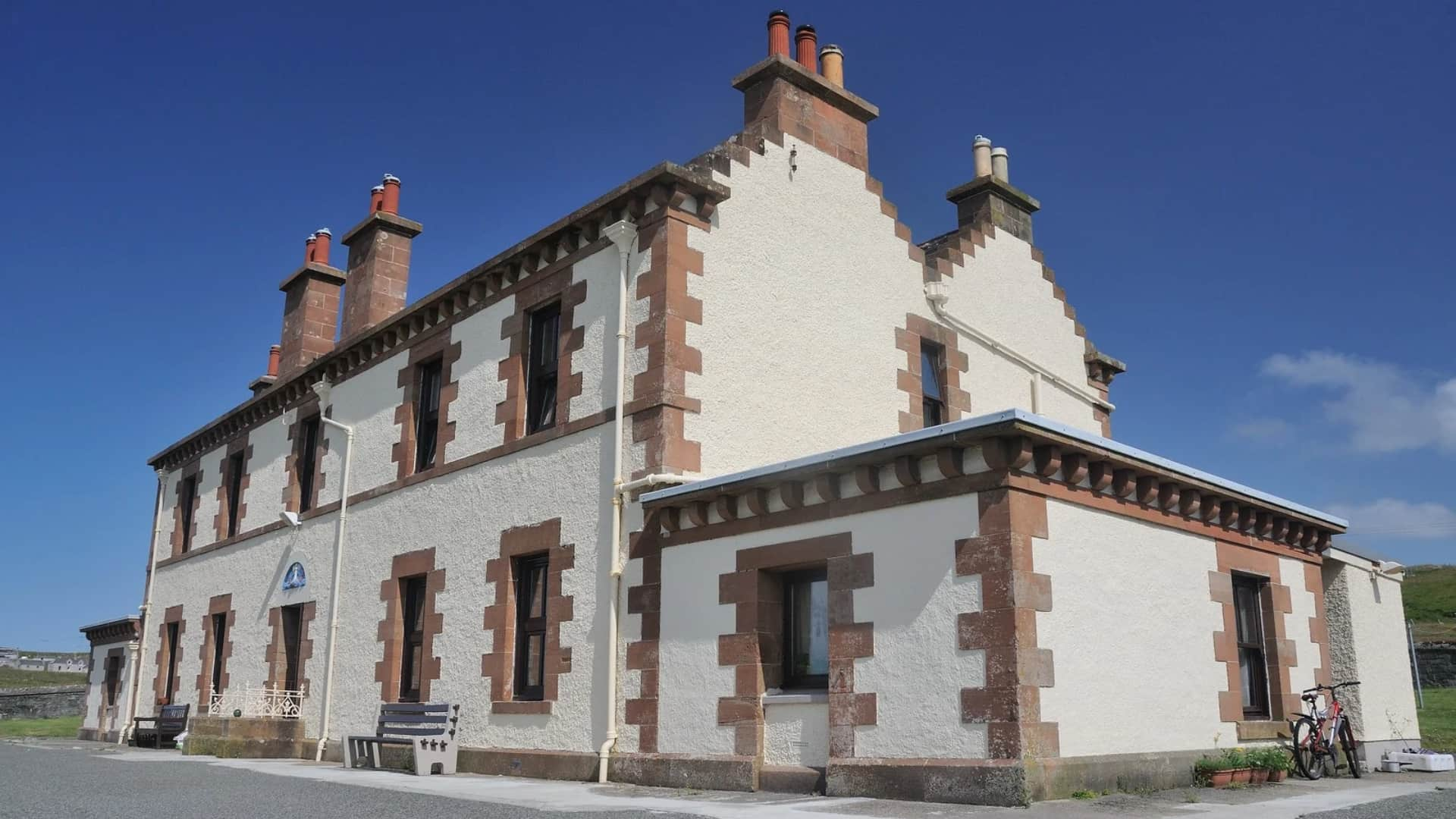
Timeline of the Flannan Isles Lighthouse Disappearance
The Eilean Mòr lighthouse disappearance can be followed from the last routine relief to Muirhead’s report.
| Date | Event | Source |
|---|---|---|
| 7 December 1900 | Routine relief. Muirhead speaks with Ducat before leaving | NLB |
| 12 December | The shore watch’s return book records the light as seen. It is not recorded again until 26 December | NLB |
| 13 December | Last entry in the keepers’ log | NLB |
| 15 December, morning | Slate notes made, including the 9am wind reading. Lamp work completed | NRS |
| 15 December, afternoon | Muirhead’s estimate of when the men disappeared | NLB |
| 15 December, about midnight | The steamer Archtor passes the Flannan Isles lighthouse and does not see the light | NLB |
| 26 December | Hesperus reaches the Flannan Isles. Moore lands, finds the station empty, and he and three volunteers relight the lamp that night | NLB |
| 28 December | Moore writes his letter to the Commissioners | NLB |
| 29 December | Muirhead lands and begins his inquiry | NLB |
| 8 January 1901 | Robert Muirhead submits his Flannan Isles report | NLB |
The sources differ on a few details. Muirhead places Hesperus’s arrival around midday, but Captain Harvie’s telegram gives the afternoon. NLB’s lighthouse page dates receipt of the Archtor’s report to 18 December. Its history page and the NRS account instead say the report only reached the authorities after the disappearance was discovered.
Why Did It Take 11 Days to Discover the Disappearance?
Without radio contact, observers on shore relied on spotting the lighthouse beam, which was not always visible. Muirhead found that watchers on Lewis, about 18 miles away, sometimes lost sight of it for four or five nights. A steamer’s report of an unlit lamp did not prompt action. He recommended that the lookout be kept by a trained lightkeeper. NLB adds that the relief vessel could not land until 26 December (NLB history, NLB lighthouse page).
What Was Found Inside Flannan Isles Lighthouse?
With the timeline in place, the next question is what Joseph Moore saw when he reached the station. He found it empty but orderly. In his letter from the Flannan Isles dated 28 December, Joseph Moore described the entrance gate and doors as closed, the kitchen fire as cold for several days, and the beds as empty, as though the men had left early in the morning. In the lightroom, the lamp was cleaned, the oil fountain full and the blinds in place (NLB).
Muirhead’s report adds that the last slate entry was Ducat’s, from the morning of 15 December. The pots and pans were clean and the kitchen tidy, which he took to mean the cook’s work was finished.
Was the Flannan Isles Lighthouse Locked?
The records say the gate and doors were closed. Moore found the outer gate, the entrance door and the door inside it shut, while the kitchen door itself was open. Neither Moore’s letter nor Muirhead’s report, as transcribed by NLB, describes the doors as locked.
What Do the Stopped Clocks Tell Us?
Reports of stopped clocks at the Flannan Isles lighthouse do not establish when the keepers disappeared. Captain Harvie’s telegram says the clocks were stopped and guessed the accident happened “about a week ago”. Muirhead’s report mentions one stopped clock. Neither account explains why the clock stopped (NLB).
What Was the Flannan Isles Lighthouse Last Log Entry?
The last completed entry in the Flannan Isles lighthouse logbook is dated 13 December. Notes for 14 December and the readings for the morning of 15 December, including the 9am wind, were written on a slate. The log’s final entry therefore says nothing about the disappearance itself (NLB).
Evidence Found at the Flannan Isles Lighthouse West Landing
Moore’s account covers the inside of the station. The Flannan Isles lighthouse mystery evidence outdoors comes from Muirhead’s inspection. He could not climb down to the landing itself because of the sea. He reached the crane platform, 70 feet above sea level, and recorded what he found there and on the path above (NLB).
| Evidence | Documented observation | What it supports | What it cannot prove | Source |
|---|---|---|---|---|
| Railings | Iron railings round the crane platform and along the path to the concrete steps were displaced and twisted | Heavy seas reached the West Landing area | When the damage happened, or that the men were there at that moment | NLB |
| Box of mooring ropes | A box fixed in a rock crevice about 110 feet above sea level was gone. Its ropes lay coiled and strewn near the crane | A reason for the men to go down | That they were trying to save it | NLB |
| Displaced stone | A block weighing upwards of 20 cwt (about a ton) was moved from higher ground onto the concrete path | Very powerful water action | The height or timing of any wave | NRS |
| Lifebuoy | A lifebuoy on the railings, 110 feet above sea level, was torn from its ropes. The ropes were untouched | The sea reached that level. Muirhead rejected the idea that the men took it | A measured wave height | NLB |
| Crane | Undamaged, with the jib lowered and secured | The telegram’s guess about securing the crane is not supported | That the men did nothing else there | NLB |
| East Landing | Everything in order. Ropes were in place from the 7 December relief | No sign the men left from the east side | That no boat ever came | NLB |
| Outdoor clothing | Ducat’s sea boots and waterproof and Marshall’s sea boots and oilskins were missing. McArthur’s coat remained | At least two men dressed to go down to the landings | Where exactly they went, or in what order | NRS |
What Happened to the Flannan Isles Lighthouse Keepers?
Taken together, these observations point towards one explanation. How did the Flannan lighthouse keepers disappear? The best-supported answer is that they went down towards the West Landing on the afternoon of 15 December 1900 and were swept into the sea by an unexpectedly large wave. That was Muirhead’s judgment, and it stands as the Flannan Isles lighthouse official explanation. He called it the most likely explanation. It is an inference from damage, clothing and timing, not an observed event.
The damage cannot be dated to the minute, and the records do not show who went first or why all three went. Muirhead himself framed his conclusion as an opinion in the Flannan Isles lighthouse official report (NLB).
Why Were All Three Keepers Outside?
The records do not say. Muirhead thought they went to secure the box of ropes. NRS says they may also have gone to check for damage. Moore believed McArthur left in his shirt sleeves, which NRS reads as suggesting haste. That is interpretation, since Moore wrote only that this was how McArthur went out “as far as I know”.
Could a Large Wave Reach Them?
The damage suggests that it could. The strongest wave evidence at the Flannan Isles lighthouse is the physical damage documented around the West Landing. Muirhead wrote that the force of the sea had torn a lifebuoy from railings 110 feet above sea level, and that a heavy stone had been carried onto the path. He judged that a large body of water rose above the men and came down on them.
That shows how far the sea could reach. It is not a measured wave height, and the 110-foot figure should not be read as one.
What Is the Flannan Isles Rogue Wave Theory?
Modern writers often describe the official explanation as the Flannan Isles rogue wave theory. That is a modern label. The historical account speaks of a “large roller”, and it does not claim the event was observed or measured.
Was the Flannan Isles Lighthouse Mystery Solved?
The evidence points to a powerful wave as the most likely cause of the keepers’ disappearance. Yet without witnesses, their final movements remain uncertain. NLB continues to describe the case as a mystery, while NRS acknowledges that the families never received a definite answer about what happened (NLB, NRS).
Flannan Isles Lighthouse Facts and Myths
Much of the story people know today was added after 1900. The Flannan Isles lighthouse mystery facts below separate the record from later retellings.
| Claim | What the records say | Verdict | Source |
|---|---|---|---|
| Dramatic logbook entries (storm, Ducat silent, McArthur weeping, a calm final entry on the 15th) | The real log was completed through 13 December, with later observations on a slate. The dramatic entries appear in none of the contemporary accounts reviewed here and belong to later retellings | Not supported by the contemporary accounts. Described here as “supposed entries”, since no physical forgery is documented | Skeptoid, NLB |
| Genuine Flannan Isles lighthouse logbook and slate notes | Log entries stop on 13 December. Notes for 14 December and the 15 December readings, including the 9am wind, were on a slate | Documented | NLB |
| Flannan Isles lighthouse uneaten meal | Not mentioned by Moore or Muirhead. Muirhead noted the kitchen was tidy and the pans clean. The image appears in W. W. Gibson’s 1912 poem | Later addition | NRS, Skeptoid |
| Flannan Isles lighthouse overturned chair | Not mentioned in either 1900 account. It also comes from the poem | Later addition | Skeptoid |
| Flannan Isles lighthouse stopped clocks | The telegram and Muirhead’s report mention stopped clocks | Documented, but it gives no time | NLB |
| Closed or locked doors | Gate and doors were closed. Neither report, as transcribed by NLB, describes them as locked | Closed: documented. Locked: not documented | NLB |
| Missing oilskins | Two sets of outdoor gear were missing. McArthur’s coat stayed | Documented, with interpretation needed | NLB |
| Flannan Isles lighthouse ghost story and supernatural theories (haunted claims) | No record of anything of the kind. Folklore about the “Isle of Little Men” predates the lighthouse | Unsupported | Skeptoid |
Flannan Isles Lighthouse Theories Compared
| Theory | Supporting evidence | Problems | Evidence rating |
|---|---|---|---|
| Powerful wave | Storm damage at the West Landing, missing waterproofs, slate timing, Muirhead’s report, death register | No witness. Exact movements unknown | Strongest supported explanation |
| Wind | Muirhead acknowledged the wind’s great force | He noted it was westerly and would have blown men up the island, not off it | Weak |
| Rescue attempt | Could explain why a third man left without his coat | No record. It is a variant of the wave scenario, not a separate cause | Possible but unverified |
| Fight, murder, abduction or supernatural causes | None found in the accounts reviewed here | The station was in order, the East Landing untouched, and no vessel, witness or physical trace is recorded | Unsupported |
Is there any evidence for a Flannan Isles lighthouse murder theory? No evidence of a struggle appears in the reports, and investigators found the station tidy. Flannan Isles lighthouse supernatural theories rely on folklore and fictional retellings, with no support in the contemporary accounts.
Where Is Flannan Isles Lighthouse?
The Flannan Isles lie west of Lewis in Scotland’s Outer Hebrides. The lighthouse stands on Eilean Mòr, the largest island in the group. The islands are also called the Seven Hunters, which explains the alternative name Seven Hunters lighthouse mystery.
At approximately 58°17′N, 7°35′W, the lighthouse occupies Eilean Mòr’s highest ground. NLB lists a white tower 23 metres high, with the light 101 metres above sea level (NLB). Every 30 seconds, the lighthouse emits a pair of white flashes.
Is Flannan Isles Lighthouse Still Operating?
Yes. The lighthouse has operated automatically since 28 September 1971. NLV Pharos visits each year so crews can inspect the station and carry out maintenance.
Can You Visit Flannan Isles Lighthouse?
NLB lists public access as “No”. Before arranging a trip, read NLB’s visitor safety advice and ask the board about access restrictions.
Readers looking for Flannan Isles lighthouse photos can find exterior views on the NLB lighthouse page. Interior photos of the Flannan Isles lighthouse are harder to find. Before publishing one, confirm where it came from and whether its licence allows reuse.
The Vanishing and Other Cultural Retellings
The Scottish lighthouse mystery has inspired poems, books and film. Wilfrid Wilson Gibson’s 1912 poem “Flannan Isle” added the uneaten meal and toppled chair. NLB highlights the books inspired by the case and the international audience reached by The Vanishing (2018), a Flannan Isles lighthouse mystery movie that fictionalises the disappearance. Its story is fictionalised and should not be treated as a historical record.
In June 2026, NRS revealed plans to exhibit Moore’s letter publicly for the first time that August as part of For the Safety of All. The exhibition ran on weekdays from 3 August to 25 September 2026 and also opened on Saturday, 26 September, for Doors Open Day (NRS). A transcript remains on the NLB website.
Readers interested in other sea legends and disappearances can also read about the ghost ship SS Ourang Medan, the Alaska Triangle and Malaysia Airlines Flight MH370.
What Remains Unknown?
The surviving records leave several questions unanswered.
- The exact moment and sequence. The records suggest the afternoon of 15 December, but no more.
- Why all three went. The reason is inferred, not recorded.
- Why no trace was found. The records reviewed here do not explain it.
- McArthur’s family. NRS has not yet confirmed the identities of his wife and children from the records it holds.
The Flannan Isles lighthouse mystery therefore rests on a strong official explanation and a record that stops short of proof.
Frequently Asked Questions
When did the Flannan Isles lighthouse keepers disappear?
On or about Saturday 15 December 1900. The slate notes end on the morning of the 15th, and a steamer saw no light at about midnight that night. The disappearance was discovered on 26 December.
Were the Flannan Isles logbook entries real?
The famous dramatic entries are not supported by the contemporary accounts reviewed here. The genuine log ended on 13 December, with later notes on a slate.
Was there an uneaten meal or an overturned chair?
Neither appears in Moore’s letter or Muirhead’s report. Both images come from Gibson’s 1912 poem. Muirhead described a tidy kitchen with clean pans.
Why were the Flannan Isles lighthouse keepers’ bodies never found?
The records reviewed here do not say. No trace of the men was found, and Muirhead concluded they were swept into the sea. Ducat, Marshall and McArthur are recorded in the Carloway death register with the cause “probably drowning”.
Is The Vanishing based on a true story?
The film takes inspiration from the Flannan Isles disappearance, but its plot is fictionalised. For the historical evidence, consult the NLB and NRS records.
Is the Flannan Isles lighthouse still operating, and can you visit?
NLB maintains the lighthouse, which now operates automatically. NLB lists public access as “No”.
Is the Flannan Isles lighthouse haunted?
The official records examined for this article contain no evidence of supernatural involvement. Island folklore predates the lighthouse, while later retellings introduced the haunting claims.
You May Also Like
- The Lead Masks Case
- Scientists missing and dead (2026)
- The mystery of the reappearing villages of Siberia
- Bell Island Boom
- The Betz Sphere Mystery
About the Author
Evan Brooks is a science and history writer for Strangehappen.com, specializing in archaeology, space exploration, ancient civilizations, and emerging scientific discoveries. His work focuses on translating complex research into evidence-based stories that help readers understand the mysteries of our world and beyond.
Research Method and Sources
This article was checked on 28 October 2026 against NLB’s history and lighthouse pages and NRS’s disappearance page, archivist’s article and exhibition announcement.
- NLB, Flannan Isles history: telegram, Moore letter and Muirhead report
- NLB, Flannan Islands lighthouse details
- NRS, The Flannan Islands Lighthouse: A disappearance
- NRS archivist’s article, Flannan Isles Lighthouse Keepers: The disappearance
- NRS, Flannan Isles disappearance among records going on display
- Skeptoid, The Keepers of Flannan Light (secondary commentary on later myths)