

Nearly three miles down, in permanent darkness, a sunken log was the whole world for a creature that had no name. Then more than 8,000 strangers on the internet decided what to call it. That is how Ferreiraella populi, a chiton with an iron tongue and a tail full of tenant worms, became one of the only animals on Earth named by public vote instead of a single scientist’s Latin.
The story behind that vote says as much about how science is racing to catch up with the deep sea as it does about the animal itself.
Quick Facts
| Metric | Value |
|---|---|
| Depth found | ~5,500 m (about 18,000 ft) |
| Location | Izu-Ogasawara Trench, Japan |
| Collected | 2024 |
| Naming submissions | 8,000+ |
| Time to formal name | ~2 years |
| Vent mollusks threatened by mining (2026 IUCN update) | 62% |
Table of Contents
A Chiton Living on Sunken Wood, Nearly Three Miles Down
The species was first collected in 2024, when Japanese researchers exploring the Izu-Ogasawara Trench off Japan’s Pacific coast brought up a pale, armored mollusk from roughly 5,500 meters down. That’s close to 18,000 feet, deeper than the trench itself is wide. At that depth, sunlight has never once reached the seafloor.
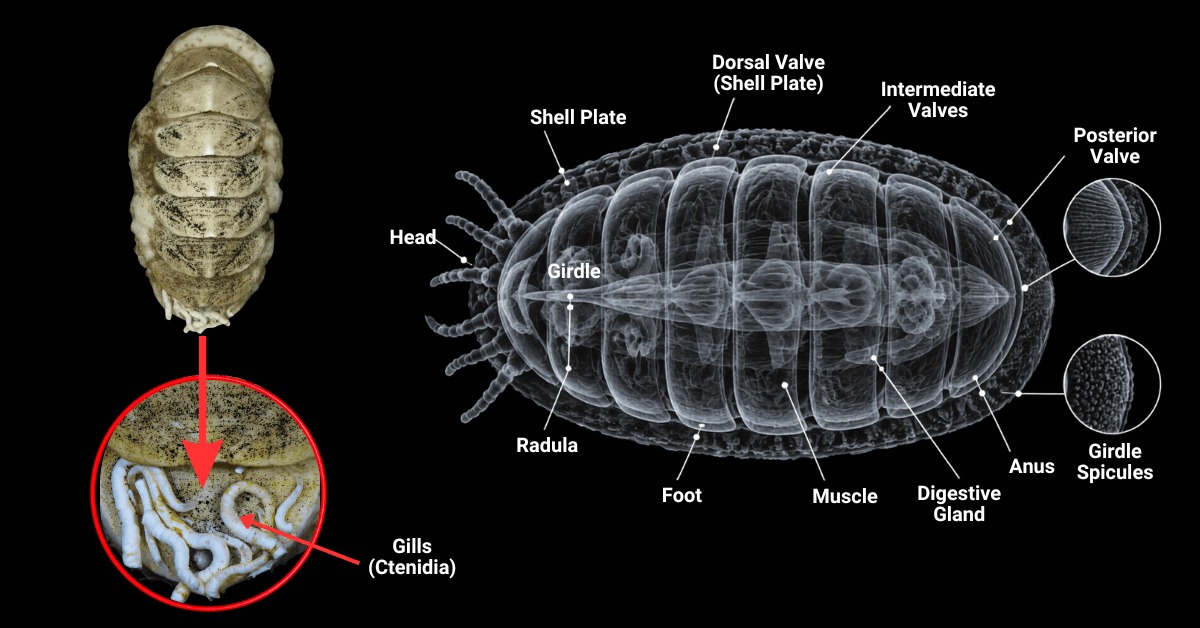
The animal belongs to a small, specialized genus called Ferreiraella, part of the chiton class Polyplacophora. Unlike most mollusks, which carry one continuous shell, chitons wear eight overlapping plates that let them flex and curl against uneven surfaces: in this case, the bark of a sunken tree.
Taxonomy at a Glance
| Characteristic | Details |
|---|---|
| Scientific name | Ferreiraella populi |
| Kingdom | Animalia |
| Phylum | Mollusca |
| Class | Polyplacophora (chitons) |
| Habitat | Deep-sea wood-fall |
| Depth | ~5,500 m |
| Location | Izu-Ogasawara Trench, Japan |
| Formally described | 2026 |
That flexibility isn’t just anatomy trivia, it’s the reason this animal can live where it does at all. Members of this genus live almost exclusively on wood that has drifted down and settled on the seafloor, a habitat type marine biologists call a wood-fall. These patches function like brief, decaying islands of food in an otherwise starved landscape, and the animals that specialize in them, wood-boring bivalves, isopods, and chitons among them, are rarely found anywhere else. Some of those relatives take wood-eating to an extreme: Lithoredo abatanica, a distant cousin in the same broad wood-and-rock-boring guild, bores through both timber and stone.
Because such habitats are scattered, small, and expensive to locate at depth, scientists have barely begun cataloging what lives on them. A single sunken log, sampled once, can turn out to hold a species found nowhere else on record.
What Scientists Discovered
Researchers brought the specimen to the Senckenberg Ocean Species Alliance (SOSA), a joint initiative of the Senckenberg Research Institute and Natural History Museum Frankfurt built specifically to speed up the path from discovery to formal species description. There, the team confirmed it as new to science.
An Iron Tongue and Tail-Riding Worms
Like other chitons, the animal feeds using a radula: a ribbon-like, tooth-covered tongue, though this one is reinforced with iron, letting it rasp nutrients off waterlogged wood that would blunt a softer feeding structure. Its eight shell plates let it roll into a defensive ball when disturbed, protecting the soft tissue underneath.
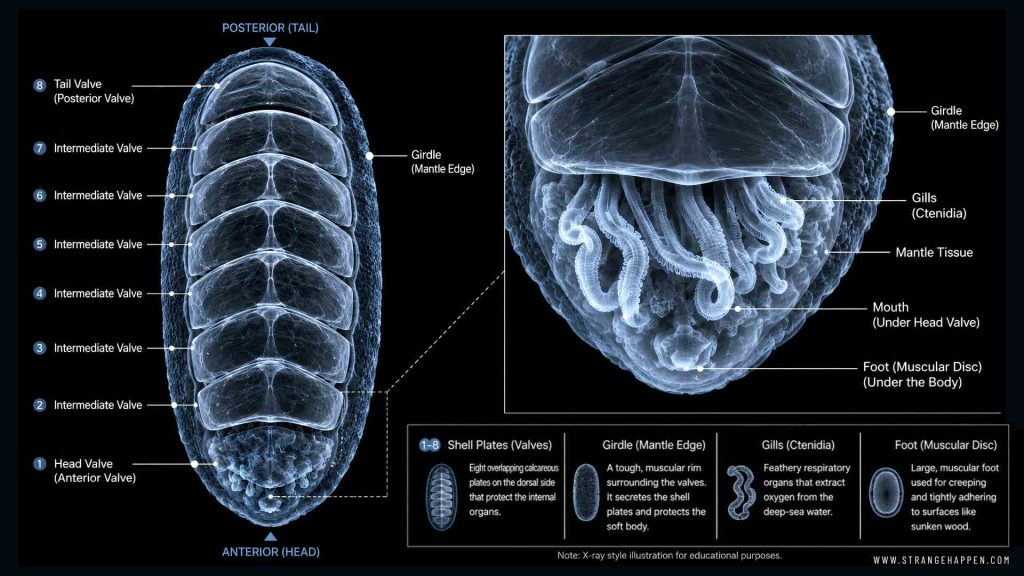
Close to its tail, researchers found something stranger still. A small resident population of worms lives on the chiton itself, feeding on its waste. It’s a detail that reads like it belongs in a nature documentary script, not a species description, and it’s exactly the kind of first-hand, observed detail that makes the formal write-up worth reading in full.
Confirming a New Species
The species was formally described by a research team led by Prof. Dr. Julia Sigwart, co-chair of the Senckenberg Ocean Species Alliance (SOSA) The study appeared in the open-access Biodiversity Data Journal, published by Pensoft. Sigwart has noted that the find “provides further evidence that deep-sea wood-fall ecosystems host highly specialized and still largely undiscovered communities,” a line that turns out to matter for reasons well beyond taxonomy (more on that below).

The species was formally described by a research team led by Prof. Dr. Julia Sigwart, co-chair of the Senckenberg Ocean Species Alliance (SOSA) The study appeared in the open-access Biodiversity Data Journal, published by Pensoft. Sigwart has noted that the find “provides further evidence that deep-sea wood-fall ecosystems host highly specialized and still largely undiscovered communities,” a line that turns out to matter for reasons well beyond taxonomy (more on that below).
Prof. Dr. Julia Sigwart said the discovery adds to growing evidence that deep-sea wood-fall ecosystems support highly specialized communities, many of which have yet to be discovered by scientists.
Prof. Dr. Julia Sigwart, Co-Chair, Senckenberg Ocean Species Alliance (SOSA)
From Sunken Log to Scientific Name
- 2024, collected in the Izu-Ogasawara Trench
- SOSA taxonomists confirm it as new to science
- 2026, naming contest opens after Ze Frank’s “True Facts” feature, drawing 8,000+ public submissions
- 2026, the official species description appeared in the Biodiversity Data Journal
How the Internet Named a Deep-Sea Species
Most new species wait years for a name most people will never hear. This one went viral before it had one.
Science YouTuber Ze Frank introduced the still-unnamed chiton to a wider audience in an episode of his long-running “True Facts” series. The response was strong enough that SOSA, working with Pensoft and Ze Frank directly, opened the naming decision to the public rather than settling it in-house.
More than 8,000 name suggestions poured in from social media users within about a week of the contest launching. The scientific team ultimately chose populi, a Latin genitive singular noun meaning “of the people,” as the species epithet. In a detail that made the story even stranger, 11 separate contributors independently suggested that exact name without seeing each other’s entries.
It wasn’t the only strong contender. Ferreiraella stellacadens, meaning “shooting star chiton,” referenced both the shell’s distinctive pattern and how fast the animal had gone from obscure to internet-famous. Ferreiraella ohmu nodded to a chiton-like creature from a Studio Ghibli film, and to Japan, where the specimen was found.
Sigwart said the Senckenberg Ocean Species Alliance (SOSA) team was delighted by the strong public response, with the naming contest attracting thousands of imaginative suggestions.
Why It Matters
The naming contest was a fun story. The reason SOSA ran it at all is not.
Formally describing a new species can normally take ten to twenty years from first collection to a published, citable name, a backlog with real consequences, since an organism without a formal name has no legal standing in conservation policy. It cannot be added to an extinction-risk assessment. It cannot be cited in an environmental review. This chiton went from collection to formal name in roughly two years, a pace SOSA treats as a template, not an exception, precisely because of what’s happening elsewhere in the deep sea.
That urgency is easiest to see in a habitat this species doesn’t even live in: hydrothermal vents. A 2026 update to the IUCN Red List found that 125 of 201 known vent-endemic mollusk species, 62%, are now considered threatened by deep-sea mining, with more than a third rated endangered or worse, deep-sea biologist Chong Chen told Mongabay. Chen said he hopes decision-makers will “take a minute to think about the species that their future actions will make extinct.”
“I hope stakeholders will take a minute to think about the species that their future actions will make extinct.” Chong Chen, deep-sea biologist
To be precise: no confirmed mining license currently overlaps the specific trench where this chiton was found, and its habitat type hasn’t been directly targeted by mining proposals the way vent fields have. But the same underlying pressure applies to both. The International Seabed Authority, which regulates mining in international waters under the UN Convention on the Law of the Sea, met in Kingston, Jamaica through July 2026 and again failed to finalize the commercial “mining code” that would govern large-scale extraction, while extending an existing exploration contract in the process. Regulatory decisions are still catching up to commercial interest, in every deep-sea habitat type alike.
Naming a species faster doesn’t stop that pressure. It simply makes sure the species exists on paper before the decision gets made, which, as Sigwart’s team is demonstrating, is the whole point.
Future Research
So far, the species has been found at only one location off the coast of Japan, and scientists have examined just a handful of specimens, leaving too little evidence to confidently evaluate its conservation status. Answering basic questions about its range will require further dives by Shinkai 6500, a crewed Japanese deep-sea submersible capable of reaching the depths where it lives.
Deep-sea expeditions are expensive, slow to schedule, and limited to a handful of vessels worldwide, which is a large part of why specialists like this one remain so poorly documented. Until scientists explore more deep-sea wood-fall sites, Ferreiraella populi remains known from a single location, highlighting how much of this hidden seafloor habitat is still waiting to be surveyed. Cataloging that kind of benthic, abyssal biodiversity is slow, deliberate work, closer to marine taxonomy than to the popular image of deep-sea exploration.
How This Compares to Other Deep-Sea Life
Wood-falls are just one of several extreme habitats that host animals found nowhere else. Here’s how Ferreiraella populi stacks up against a few better-known examples:
| Species | Habitat | Typical depth |
|---|---|---|
| Ferreiraella populi | Wood-fall (sunken logs) | ~5,500 m |
| Yeti Crab | Hydrothermal vent | ~2,200 m |
| Glass Sponge | Open seafloor, sponge gardens | 300 m to over 6,000 m |
Each of these habitats runs on a different energy source, vent chemosynthesis, decaying wood, or filtered particles drifting down from above, which is part of why deep-sea biodiversity turns out to be so much harder to generalize about than shallow-water ecosystems.
Related Topics
- Ducibella camanchaca: Another New Deep-Sea Discovery: a second recently described deep-sea species and what it adds to the same undiscovered-biodiversity picture.
- Deep-Sea Mining Is Moving Faster Than Science Can Keep Up: the fuller picture of why species like this one are being named against the clock.
- 10 Newly Discovered Species: more animals science only just caught up with.
- Yeti Crab: another deep-sea animal whose name and biology are stranger than its reputation suggests.
- Glass Sponges: a look at another slow-growing, poorly surveyed deep-sea life form.
- Nereidid Worm: a related deep-sea worm with its own strange feeding habits.
Key Takeaways
- Ferreiraella populi is a deep-sea chiton discovered in 2024 in Japan’s Izu-Ogasawara Trench, roughly 5,500 meters down, living exclusively on sunken wood.
- It has eight shell plates, an iron-reinforced radula, and a small population of commensal worms living near its tail.
- The species was named populi, meaning “of the people,” after its winning name was selected from more than 8,000 public suggestions inspired by Ze Frank’s viral YouTube feature.
- The formal description was published in the Biodiversity Data Journal by a team led by Julia Sigwart of the Senckenberg Ocean Species Alliance.
- Its two-year path from discovery to formal name is part of a deliberate push to describe deep-sea species faster, since unnamed species have no standing in conservation policy.
- Its habitat remains poorly surveyed, and the same regulatory gap driving that urgency is also shaping the current fight over deep-sea mining.
Frequently Asked Questions About Ferreiraella Populi
What is Ferreiraella populi?
Ferreiraella populi is a species of deep-sea chiton discovered in 2024 in Japan’s Izu-Ogasawara Trench. The species lives on sunken wood nearly 5,500 meters beneath the ocean’s surface and was officially described by scientists in 2026.
What does the name Ferreiraella populi mean?
The species name populi is Latin for “of the people,” chosen because the name was selected from more than 8,000 public submissions rather than picked by the describing scientists alone.
How was Ferreiraella populi discovered?
Japanese researchers collected the specimen in 2024 while exploring the Izu-Ogasawara Trench. It was later brought to the Senckenberg Ocean Species Alliance, where scientists confirmed it as a new species.
Why did the public get to name Ferreiraella populi?
After YouTuber Ze Frank featured the unnamed chiton on his “True Facts” series, SOSA partnered with Pensoft Publishers and Ze Frank to open the naming decision to a public contest rather than the usual scientist-only process.
What is a wood-fall ecosystem?
A wood-fall is a patch of seafloor built around sunken logs or branches, which feed specialized deep-sea animals like wood-boring bivalves, isopods, and chitons that live almost nowhere else.
Is Ferreiraella populi endangered?
Its conservation status hasn’t been formally assessed. It’s currently known from only one site and a small number of specimens, and no confirmed deep-sea mining license overlaps its known habitat.
How deep does Ferreiraella populi live?
It was found at roughly 5,500 meters (about 18,000 feet) below the surface, in permanent darkness on the floor of the Izu-Ogasawara Trench.
Why do scientists want to name deep-sea species faster?
A species without a formal scientific name can’t be added to conservation or extinction-risk assessments. Faster naming gives vulnerable species legal standing before industrial activity like deep-sea mining reaches their habitat.
How many new species are discovered every year?
A 2025 University of Arizona-led study published in Science Advances found that scientists are now formally describing more than 16,000 new species a year, including over 10,000 animals, the fastest pace of species discovery on record.
Why are deep-sea species difficult to find?
Most of the deep seafloor has never been surveyed. Reaching it requires specialized submersibles, expeditions are expensive and slow to schedule, and only a handful of vessels worldwide are equipped for the depths involved, so scientists sample a tiny fraction of the ocean floor in any given year.
Can chitons survive outside the ocean?
Some shallow-water chitons can tolerate brief air exposure at low tide, but deep-sea species like Ferreiraella populi live under near-freezing temperatures and crushing pressure. They have no ability to survive outside those conditions.
Why are wood-fall ecosystems considered rare?
Wood-falls form only where logs or branches happen to sink and settle on the seafloor, and they gradually decay over years to decades. Because they’re scattered and short-lived compared to permanent habitats like hydrothermal vent fields, they’re much harder for scientists to locate and study.
Source References
- Senckenberg Ocean Species Alliance / Pensoft, official release, eurekalert.org/news-releases/1115280 (Feb 6, 2026)
- Biodiversity Data Journal, original species description, bdj.pensoft.net/article/180491
- Mongabay, 2026 IUCN Red List / deep-sea mining context, Chong Chen interview, news.mongabay.com/short-article/2026/07/deep-sea-mining-identified-as-biggest-threat-to-known-and-unknown-deep-sea-creatures (Jul 15, 2026)
- earth.com, expedition/future-research detail (Shinkai 6500, single-site status), earth.com/news/scientists-poll-the-internet-to-name-a-strange-new-deep-sea-creature-ferreiraella-populi (Apr 8, 2026)
- International Seabed Authority, regulatory context, isa.org.jm/sessions/31st-session-2026
Author Bio
Evan Brooks, author at StrangeHappen.com, writes about strange events, unexplained mysteries, unusual wildlife, ancient discoveries, and the science behind stories that seem almost too strange to be true. He enjoys digging through old reports, forgotten cases, and unusual claims to uncover what really happened.
His work looks beyond the mystery without taking away the sense of wonder. From eerie encounters and unexplained phenomena to bizarre creatures and ancient secrets, he separates documented facts from rumors, legends, and internet fiction.