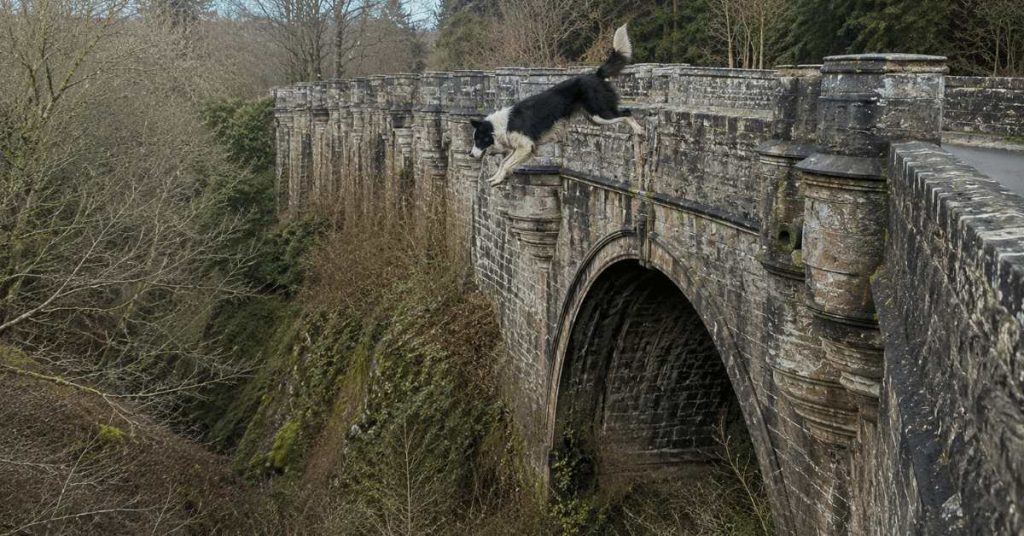
A dog crosses a quiet stone bridge in Scotland, freezes for a moment at the same spot dozens of dogs have frozen before it, then leaps over the parapet without warning. Owners call it possession. Scientists call it scent. Since the 1950s, this has been the story of Overtoun Bridge, and the honest answer to why do dogs jump off Overtoun Bridge is more grounded, and more strange, than most retellings let on.
This piece pulls together the full incident timeline, the named investigations, the skeptic and paranormal cases side by side, and the practical facts anyone walking a dog there today should know.
Table of Contents
Where Overtoun Bridge Is, and What Has Actually Happened There
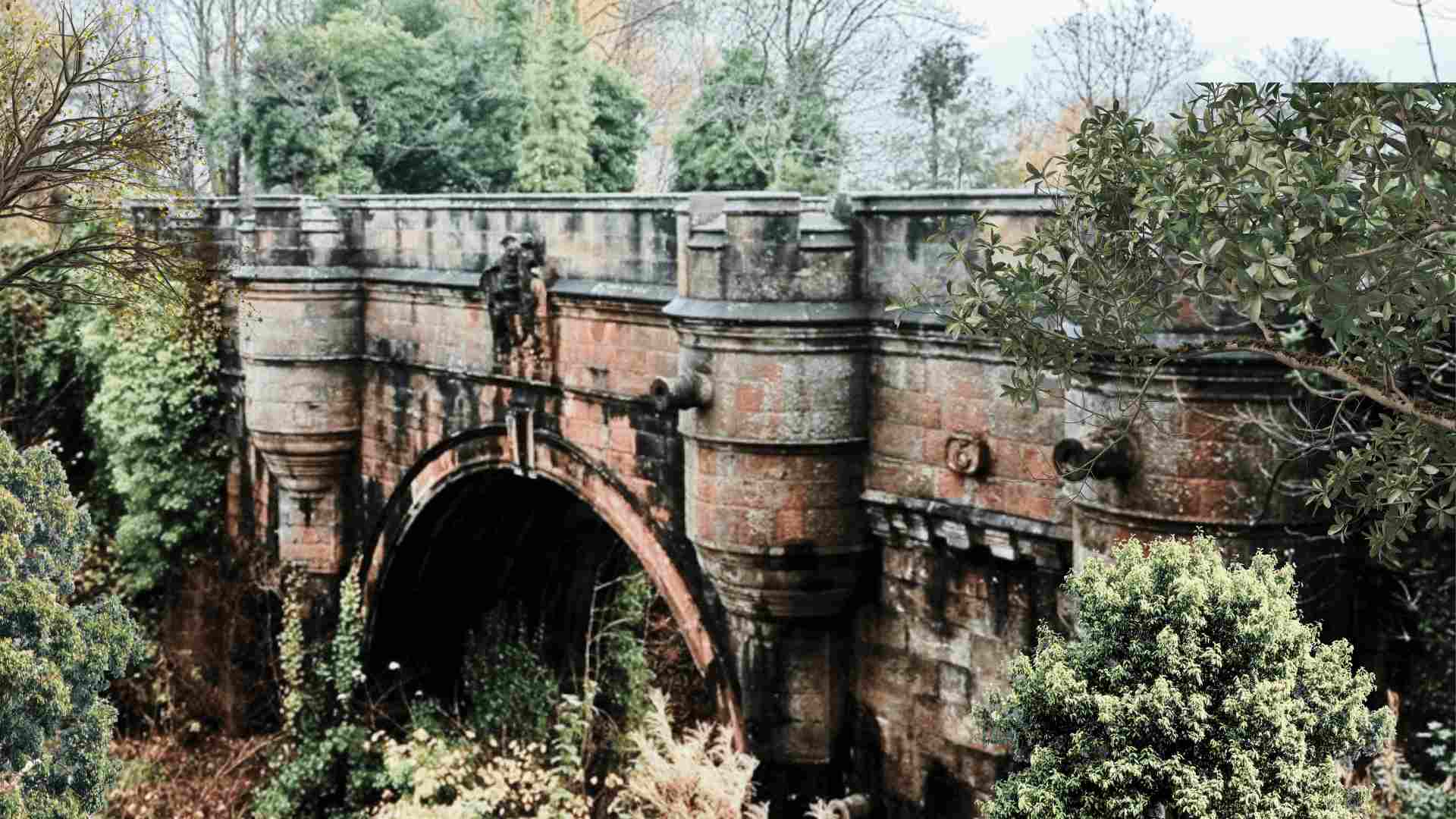
Overtoun Bridge sits on the approach road to Overtoun House, near Dumbarton in West Dunbartonshire, Scotland. It was completed in June 1895, commissioned by John Campbell White, later the 1st Baron Overtoun, and designed by landscape architect Henry Milner. The bridge is a category B-listed structure, built from rough sandstone ashlar, spanning a steep ravine known as Spardie Linn, according to Wikipedia’s entry on Overtoun Bridge.
White’s father, industrialist James White, had bought the Overtoun estate in 1859 and built the original Overtoun House. When James White died in 1884, his son inherited the property and commissioned the bridge to extend the driveway across the gorge. Locals nicknamed it the “Bridge of Death,” and it has since become more widely known in press coverage as “the dog suicide bridge,” once dogs started jumping from it in the 1950s, decades after it was built for an entirely different purpose.
Estimates of how many dogs have gone over the parapet vary by source. The New York Times reported in 2019 that local researchers put the figure at roughly 300, while some tabloid accounts push the number closer to 600. Most sources converge on around 50 confirmed deaths, with the rest surviving the fall onto rocks and shallow water roughly 50 feet below.
The Short Answer: Why Dogs Jump Off Overtoun Bridge
The leading, evidence-backed explanation is scent, not the supernatural. Investigators found that the stretch of parapet dogs favor sits directly above burrows used by American mink, and in a controlled scent test, seven out of ten dogs were strongly drawn to a mink-scent sample over mouse or squirrel scent.
Combine that pull with the bridge’s solid stone wall, tall enough to block a dog’s view of the drop until it is already on top of the parapet, and a plausible chain of cause and effect emerges: a strong smell, a wall that hides the danger, and a breed built to chase a scent to its source. It is not a closed case, and researchers are careful not to claim it explains every single incident, but it is currently the best-supported theory available.
What Investigators Actually Found
The RSPB’s Mink, Mouse, and Squirrel Scent Test
David Sexton, a habitat expert working on behalf of the Royal Society for the Protection of Birds (RSPB) in Scotland, led one of the two major investigations into the bridge. He first ruled out sound, working with an acoustics firm from Glasgow to test whether a nearby source, sometimes rumored to be linked to the Faslane naval base, was emitting a frequency only dogs could hear. The acoustic survey found nothing unusual.
Sexton then searched the vegetation and rock crevices on the side of the bridge where jumps clustered and found nests belonging to mice, squirrels, and American mink. When he presented ten dogs from breeds that had previously jumped with canisters holding each scent, seven went straight for the mink sample, several of them dramatically. Only two showed no particular interest in any of the three scents.
Dr. David Sands’ Independent Investigation
Canine behaviourist Dr. David Sands ran a separate investigation, working alongside the Scottish SPCA and owners who had lost dogs at the bridge. He later followed up on one specific case in 2006, walking Hendrix, at that point the only dog on record to have lived through a jump, over that same section of the bridge again. Age had taken away Hendrix’s ability to climb the parapet, but not his fascination with it: he lingered at that exact spot with the same intensity investigators had noted in him years before.
Sands also strapped a camera to his own dog and walked it across the bridge to study its behavior at ground level, and later concluded, in comments reported by HowStuffWorks, that ordinary canine curiosity, not intent to self-harm, was the far more likely explanation in nearly every documented case.
Why Long-Nosed Dog Breeds Are Most at Risk
Nearly every dog on record as having jumped from Overtoun Bridge has been a long-nosed breed: collies, retrievers, spaniels, and Labradors, the kind of dog bred over centuries to track scent for long distances. Short-nosed breeds are almost entirely absent from the incident reports, which is itself a data point in favor of the scent-based explanation over a purely visual or acoustic one.
The Scottish Society for the Prevention of Cruelty to Animals (Scottish SPCA) also sent representatives to investigate the bridge independently. Their inquiry, unlike the RSPB’s, came back inconclusive, which is part of why the mystery has never been formally closed even as the mink theory has become the dominant explanation.
A Different Angle: Stan Rawlinson’s Depth-Perception Theory
Not every behaviourist who has looked at Overtoun points to scent alone. UK dog behaviourist Stan Rawlinson has argued that a dog’s naturally reduced depth perception and limited colour vision may play a supporting role: Seen from a dog’s height, that same drop past the wall might not register as a threat at all, even though a person peering over would sense the danger immediately. Rawlinson’s theory has not been tested with the same fieldwork rigor as Sexton’s scent trial, and it is not presented here as equally proven, but it fits comfortably alongside the mink theory rather than competing with it. A dog drawn toward a strong scent is more likely to go over a wall it does not fully perceive as a threat in the first place.
The Cases That Made Overtoun Famous
No single earlier account of Overtoun Bridge merges its full timeline with its named incidents. Doing both together shows how consistent the pattern actually is, and how it has recurred across five decades rather than clustering in one unusual year.
In 2004, Kenneth Meikle was walking his family’s Golden Retriever across the bridge when the dog suddenly bolted for the parapet and jumped. It survived the fall but was visibly shaken afterward, according to the incident record preserved on Wikipedia. At least five more dogs jumped within a six-month span the following year.
Hendrix, the dog Dr. Sands brought back to the bridge in 2006, remains one of the clearest data points investigators have: a dog that survived once, and still reacted the same way to the same spot years later.
The pattern did not stop once the RSPB and Sands published their findings. In 2011, Sophie, a Labrador belonging to David and Louise McPhail, jumped from the same stretch of parapet, and in 2014, Cassie, a Springer Spaniel owned by Alice Trevorrow, did the same, both documented in Wikipedia’s record of the bridge. Springer Spaniels and Labradors are both long-nosed, scent-driven breeds, consistent with every other case on record.
In 2016, Lottie MacKinnon was walking her border collie, Bonnie, along the same route when the dog froze on the first step onto the bridge before leaping. Bonnie survived; the account was reported directly by the New York Times, which spoke with MacKinnon as part of its 2019 coverage of the bridge.
Skeptic Theories vs. Paranormal Theories at Overtoun Bridge
Most coverage of Overtoun Bridge picks one lens, either scientific or supernatural, and stays there. The fairest way to look at the mystery is to lay both sets of explanations side by side and see which ones the evidence actually supports.
The White Lady of Overtoun
Local legend holds that the ghost of a grieving widow, known as the White Lady of Overtoun, haunts the estate and is somehow responsible for compelling dogs to jump. Some residents report seeing a figure in the windows of Overtoun House or feeling a presence on the grounds, and the story predates the dog-jumping phenomenon by decades. There is no physical evidence tying the legend to the incidents; it functions as folklore layered onto an already strange location, not a testable claim.

The Submarine and Acoustic Theory
A second theory holds that a low-frequency sound, possibly linked to the nearby Faslane naval base, is audible to dogs but not humans and drives them into a frenzy. This is the one theory investigators actually tested and ruled out: the RSPB’s acoustics survey, run by a Glasgow-based firm alongside David Sexton’s fieldwork, found nothing unusual in the sound levels at the bridge. It’s a comparable sensory anomaly case to the Taos Hum in New Mexico, another unexplained sound reported by only a fraction of people who pass through the area, and one that has similarly resisted a single confirmed cause.
A “Thin Place” in Celtic Myth
Celtic folklore has its own term for sites like this: a “thin place,” where the separation between the physical and spiritual worlds is believed to grow unusually faint. Overtoun’s landscape and history have made it a natural fit for this framing, and it shows up repeatedly in local interviews and retellings. Like the White Lady legend, it is a cultural explanation rather than a scientific one, and it is worth naming honestly as folklore rather than dressing it up as evidence.
A Local Skeptic: John Joyce’s Case Against the Mink Theory
A fair account of Overtoun has to include the strongest objection to its own leading theory, not just the paranormal ones. John Joyce, a hunter who has worked the land around the bridge for roughly fifty years, has publicly disputed the mink explanation, stating flatly that there is no mink in the area for dogs to be drawn to. His objection is documented in Wikipedia’s own account of the bridge and is the clearest on-record pushback against the RSPB’s findings.
Joyce’s doubt is worth weighing seriously rather than waving away; he knows the terrain in a way no visiting researcher does. At the same time, David Sexton’s investigation did not rely on local reputation alone. He physically located mink, mouse, and squirrel nests and burrows in the rock crevices below the favored stretch of parapet before running the scent test. Both things can be true at once: mink may be less visible to a hunter watching the land at a distance than they are to a researcher specifically searching crevices for nesting activity at close range. The disagreement does not overturn the scent theory, but it does mean the mink explanation is a strong leading theory, not a settled fact, and a genuinely fair account should say so.
Where the Evidence Actually Points
Of the theories above, the scent-based explanation is the only one built on fieldwork and a controlled test, and the acoustic testing indirectly reinforces it by ruling out one alternative. The paranormal explanations have not been, and by their nature cannot be, tested the same way. John Joyce’s objection sits in a different category again: it is a real, on-record challenge to the leading scientific theory itself, not a supernatural claim, and it deserves to be named rather than smoothed over. The most honest summary is this: mink-scent is the best-supported explanation currently available, it is not a proven, closed case, and a fair account of the mystery should hold all three of those facts at once rather than picking the version that makes the best headline.
The 1994 Tragedy at Overtoun Bridge
Overtoun Bridge’s darkest chapter has nothing to do with dogs. In October 1994, Kevin Moy, a 32-year-old suffering from severe psychiatric illness, threw his two-week-old baby son, Eoghan, from Overtoun Bridge during the child’s first outing, believing in his delusional state that the infant was connected to malevolent forces. Eoghan died in hospital the following day.
Moy attempted to harm himself immediately afterward but was restrained by his wife and taken into custody. At his 1995 trial, psychiatrists agreed he had been insane at the time of the act; a jury found him not guilty by reason of insanity, and he was ordered detained at Scotland’s State Hospital at Carstairs. Some retellings blend this tragedy into the dog phenomenon as evidence of a single malevolent force at the bridge, but the two events are separate: one is a documented case of acute mental illness with a tragic outcome, the other an unresolved pattern in animal behavior. Treating them as the same story does a disservice to both.
Is Overtoun Bridge Dangerous for Dogs Today?
Do Dogs Still Jump Off Overtoun Bridge?
Reported incidents have become far less frequent since the 2010s, in part because awareness of the pattern has made dog owners more cautious on that specific stretch of parapet. Isolated jumps are still occasionally reported by locals and visitors, but nothing at the scale documented between the 1950s and mid-2000s.
Safety Signs and Leash Advice
Following Dr. Sands’ investigation, signage was put up at both ends of the bridge warning dog owners about the pattern. The most practical, evidence-based precaution is a simple one: keep dogs on a lead while crossing, particularly on the clear, dry days when the mink-scent theory suggests dogs are most likely to catch and chase the smell.
Can You Visit Overtoun Bridge and House?
Overtoun House and its grounds, including the bridge, are open to the public and remain a popular walking route near Dumbarton. Bob Hill, who lives at Overtoun House, has spoken to press, including the New York Times, about the bridge’s reputation and his own experience living beside it. The estate continues to function as a working property rather than a roped-off attraction.
Overtoun Bridge in Film and Popular Culture
The bridge’s story has been retold across several decades of media, each version adding a small piece to how the mystery is now understood publicly. One of the earliest was a 2006 UK television entry, “The Dog Suicide Bridge,” which aired as part of the Stranger Than Fiction series and helped carry the story to a much larger audience.
A 2014 documentary titled Overtoun explored the estate’s broader history alongside the bridge phenomenon, and a 2021 episode of the YouTube series The Why Files revisited the mystery for a newer audience. Most recently, filmmaker Scott McMillan wrote and directed The Bridge (2023), a short horror film loosely inspired by the Overtoun legend; McMillan has said the ghost story in the film is a deliberately exaggerated version of the real account, and the project went on to win awards at several independent film festivals, according to IMDb’s page for the film.
Why This Mystery Still Matters
Overtoun Bridge is one of the clearer real-world cases where an animal-behavior mystery has an active, named, testable investigation trail rather than pure speculation. The pattern of dog deaths at Overtoun House and its bridge has made this one of Scotland’s most thoroughly documented animal-behavior mysteries, not just a piece of local legend. It sits alongside other unexplained animal behavior with a scientific angle, like Zombie Deer Disease, where researchers have identified a real biological mechanism but still can’t fully explain every detail of how it spreads or why. It offers a useful model for how to separate folklore from evidence without dismissing either: the ghost stories are worth understanding as cultural history, while the RSPB and Sands findings are worth understanding as the closest thing to an actual answer currently available.
Future Research: What’s Still Unresolved
The mink-scent theory explains the breed pattern, the location pattern, and the weather pattern, but it does not fully explain why other bridges near mink habitat in Scotland have not produced the same phenomenon. No controlled, peer-reviewed study has directly compared Overtoun to a matched set of similar bridges elsewhere, which remains the clearest open question for anyone who wants to move the mink theory from “best available explanation” to a fully confirmed one. It also has not resolved the tension between David Sexton’s fieldwork and on-the-ground skeptics like John Joyce, who disputes that mink are present at all.
Related Topics You May Also Like Them
- The Skyquake Mystery: another unexplained phenomenon investigators have tried to trace to a physical, testable cause.
- Animals Predict the Future: a look at other cases where animal behavior has puzzled researchers and locals alike.
- The Taos Hum: An Unsolved Mystery: a comparable case of a sensory anomaly that affects only certain listeners.
- Zombie Deer Disease: another entry in the site’s coverage of unexplained animal behavior with a documented scientific angle.
- The Village of Whispering Walls: a related site where local legend and unexplained phenomena intersect.
Key Takeaways
- The best-supported answer to why dogs jump off Overtoun Bridge is scent: seven of ten tested dogs were drawn strongly to a mink-scent sample in the RSPB’s investigation, led by David Sexton.
- Nearly every recorded jump involved a long-nosed breed, in the same stretch of parapet, on clear, dry days, which fits a scent-based explanation better than a visual or acoustic one.
- The acoustic “submarine sound” theory was specifically tested by an acoustics firm working with the RSPB and found no unusual sound levels at the bridge.
- The mink theory isn’t universally accepted, either. John Joyce, a local hunter with decades of firsthand knowledge of the area, has pushed back on the idea that mink live there at all, a genuine counterpoint that this piece treats as an open question rather than something to wave away.
- Estimates of total jumps range from roughly 300 to 600 since the 1950s, with around 50 confirmed deaths; the Scottish SPCA’s own separate investigation was inconclusive.
- The 1994 death of infant Eoghan Moy is a separate, documented case of acute mental illness and should not be blended into the animal-behavior mystery.
- Dog owners can reduce risk today by keeping dogs on a lead while crossing, especially on clear, dry days.
Frequently Asked Questions About Overtoun Bridge Dog Deaths
Why do dogs jump off Overtoun Bridge?
The best-supported explanation is scent: an RSPB investigation found mink, mouse, and squirrel nests under the bridge’s favored parapet, and in a scent test, seven of ten dogs were strongly drawn to the mink sample. Combined with a wall that hides the drop until a dog is already on top of it, this produces a plausible, testable explanation rather than requiring a supernatural one.
Why do dogs jump off a bridge in Scotland?
This almost always refers to Overtoun Bridge near Dumbarton, Scotland, the site with a well-documented, decades-long pattern of dogs jumping from one specific stretch of parapet. The leading explanation, based on an RSPB investigation, is that dogs are drawn over the wall by the strong scent of American mink nesting in the rocks below.
What is the mystery of Overtoun Bridge?
The mystery is why, since the 1950s, dogs crossing one specific stretch of this Scottish bridge have repeatedly jumped from the parapet, some fatally, in a pattern consistent enough that it earned the nickname “the dog suicide bridge.” Investigators have proposed several explanations, from a mink-scent theory backed by field research to ghost stories with no physical evidence, and while the scent theory is the best-supported answer available, no single explanation has been confirmed to account for every case.
How many dogs have died at Overtoun Bridge?
Estimates vary by source, with local researchers citing roughly 300 total jumps and tabloid accounts citing closer to 600, but most sources converge on around 50 confirmed deaths since the 1950s, with the remainder surviving the fall.
Do dogs actually jump off the Overtoun Bridge?
Yes. This isn’t exaggerated folklore, it’s a well-documented pattern with named cases, independent investigations by the RSPB and Scottish SPCA, and press coverage going back decades. The exact total number of jumps is debated, but the core phenomenon itself, dogs repeatedly going over that specific stretch of parapet, is real and has been directly observed and studied, not just passed along as rumor.
Do dogs still jump off Overtoun Bridge?
Reported incidents have dropped significantly since the 2010s, partly due to increased awareness and signage warning dog owners about the pattern, though isolated cases are still occasionally reported.
Is Overtoun Bridge haunted?
There is no physical evidence supporting the White Lady legend or other paranormal explanations for the dog jumps. The haunting stories predate the phenomenon and persist as local folklore, but the RSPB’s tested explanations, scent and sound, are the only theories that have been directly investigated and supported by evidence.
What breed of dogs jump off Overtoun Bridge most often?
Almost every recorded jump has involved a long-nosed breed such as a collie, retriever, spaniel, or Labrador, breeds developed for scent-tracking, which supports the mink-scent theory over alternative explanations.
Why do dogs jump off a bridge?
In general, dogs are far more likely to go over a barrier when they’re chasing a strong scent than out of any intent to harm themselves. Breeds developed for tracking can become so focused on a smell that they lose awareness of a drop on the other side of a wall, especially if the wall itself blocks their view of the danger until they’re already on top of it. Overtoun Bridge is the most documented example of this pattern, but the underlying behavior, scent-driven tunnel vision, isn’t unique to that one location.
Is Overtoun Bridge dangerous for dogs today?
The bridge itself is not inherently dangerous with normal precautions. Keeping dogs on a lead while crossing, particularly on clear, dry days when scent carries furthest, is the most practical safety measure available.
What is the mink theory at Overtoun Bridge?
The mink theory holds that dogs are drawn over the parapet by the strong scent of American mink nesting in the rocks below, a pattern first identified by RSPB habitat expert David Sexton in a scent test where seven of ten tested dogs were strongly attracted to the mink sample.
Why was Overtoun Bridge built?
Overtoun Bridge was completed in 1895, commissioned by John Campbell White, later the 1st Baron Overtoun, and designed by landscape architect Henry Milner, to extend the driveway to Overtoun House across a steep ravine known as Spardie Linn. It was built purely as a practical estate access route, decades before any dog-jumping incidents were ever recorded there.
Has the Overtoun Bridge mystery been solved?
Not definitively. The mink-scent theory is the strongest and most tested explanation available, but researchers, including Dr. David Sands, have been careful not to claim it accounts for every individual case, and local skeptics like hunter John Joyce have disputed the mink theory outright. No controlled study has yet compared Overtoun directly against similar bridges elsewhere.
Were the dog jumps at Overtoun Bridge actually “dog attacks”?
No. Despite the phrase showing up in some searches, none of the documented incidents at Overtoun Bridge involve aggression toward people or other animals. Every recorded case is a dog jumping from the parapet unprompted, which is why researchers investigate it as a question of scent and behavior, not aggression.
Is Overtoun Bridge related to the “Rainbow Bridge” for pets?
No, these are two unrelated ideas that just happen to share the word “bridge.” The Rainbow Bridge is a popular, comforting poem describing where pets are believed to wait for their owners after death; it has no connection to Overtoun Bridge in Scotland or the dog-jumping phenomenon documented there. The overlap in search results comes from shared keywords, not a shared subject.
Author Bio
Mubashir Razzaq is a science and history writer for Strangehappen.com, specializing in archaeology, space exploration, ancient civilizations, and emerging scientific discoveries. For cases like Overtoun Bridge, his approach is to work directly from the primary investigations, RSPB and Scottish SPCA findings, named witness accounts, and contemporaneous reporting, rather than repeating secondhand retellings, so readers can see where the evidence actually comes from and where it runs out.
Source References
- Wikipedia, “Overtoun Bridge,” https://en.wikipedia.org/wiki/Overtoun_Bridge (accessed 2026)
- The New York Times, “Overtoun Bridge, Scotland: The Dog Suicide Bridge,” https://www.nytimes.com/2019/03/27/world/europe/scotland-overtoun-bridge-dog-suicide.html (March 27, 2019)
- HowStuffWorks, “What’s Really Going on at the ‘Dog Suicide Bridge’?,” https://science.howstuffworks.com/science-vs-myth/unexplained-phenomena/dog-suicide-bridge.htm (March 7, 2024)
- RSPB Scotland (official), https://www.rspb.org.uk/scotland
- Scottish SPCA (official), https://www.scottishspca.org/home/