
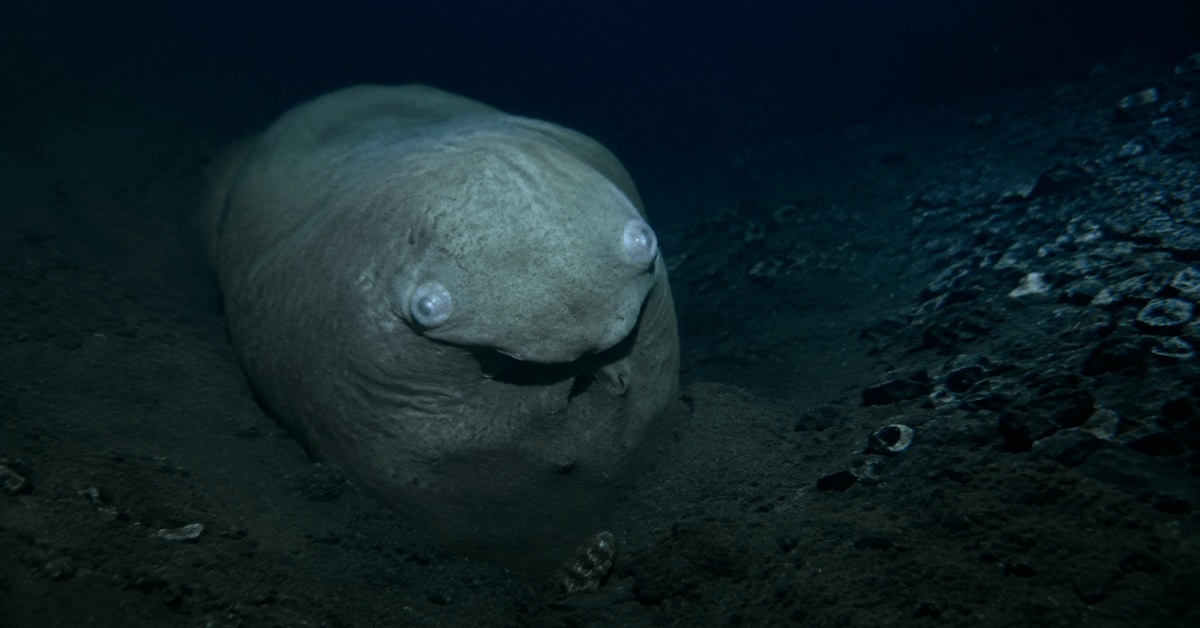
In October 2010, a handful of blog posts did what fifteen years of scientific silence never managed: they turned a few seconds of grainy ROV footage into an internet monster. The object sat motionless on the floor of Sagami Bay, roughly 1,000 meters down, with two pale rounded shapes that read as eyes and a wide, frozen grin. No agency ever announced what it was.
That gap is exactly why the sagami bay creature still won’t die online, and why so much of what circulates about it today, including several viral clips on TikTok, is simply wrong about what the footage actually shows.
Table of Contents
Where and What Is Sagami Bay
Sagami Bay sits about 40 kilometers southwest of Tokyo, bounded by the Miura Peninsula to the east and the Izu Peninsula to the west, with the island of Izu Ōshima marking its southern edge. The bay reaches depths of roughly 1,500 meters, and a branch of the warm Kuroshio Current keeps it unusually rich in marine life for its latitude, while cold-water intrusions from the Oyashio Current add species you would not expect to find sharing the same water.
That mix of warm and cold currents is a big part of why this particular patch of ocean keeps producing strange footage. It sits directly on researchers’ doorstep. The University of Tokyo’s Misaki Marine Biological Station, one of the oldest marine research stations in the world, has used Sagami Bay to identify new species for well over a century, including the goblin shark and the Japanese pancake devilfish.
What Scientists Actually Recorded
The footage came from the Japan Agency for Marine-Earth Science and Technology, known as JAMSTEC, using a remotely operated vehicle called Hyper-Dolphin. According to JAMSTEC’s own technical page, Hyper-Dolphin is rated to dive as deep as 4,500 meters and had logged more than 2,200 dives as of June 2023, using six thrusters and ultra-high-definition cameras built for close-range seafloor survey work.
The clip itself surfaced publicly on October 15, 2010, when the Japanese-culture blog Pink Tentacle posted it with the caption “Giant sea frog? Ningen? Smiling rock with sea sponge eyes? You be the judge.” Around the same time, Boing Boing joined the discussion by playfully referring to the mystery object as “P. areidolia,” a humorous nod to pareidolia, the psychological phenomenon that causes people to perceive familiar faces or shapes in random patterns. Cryptozoology writer Loren Coleman flagged it too, filing it under “Sea Monster” on his site CryptoZooNews.
What none of those early posts had, and what still has not surfaced since, is a follow-up. JAMSTEC has a track record of formally naming and studying unusual creatures its cameras catch, including a still-unnamed gelatinous animal filmed in 2002 that researchers concluded was very likely a new species. That process, collecting a specimen and running it through the formal steps scientists use to name a new species, is exactly what this particular object never received. No specimen was collected, no paper was published, and no JAMSTEC statement on the record identifies it.
Scientific Concept Illustration of the Sagami Bay Creature
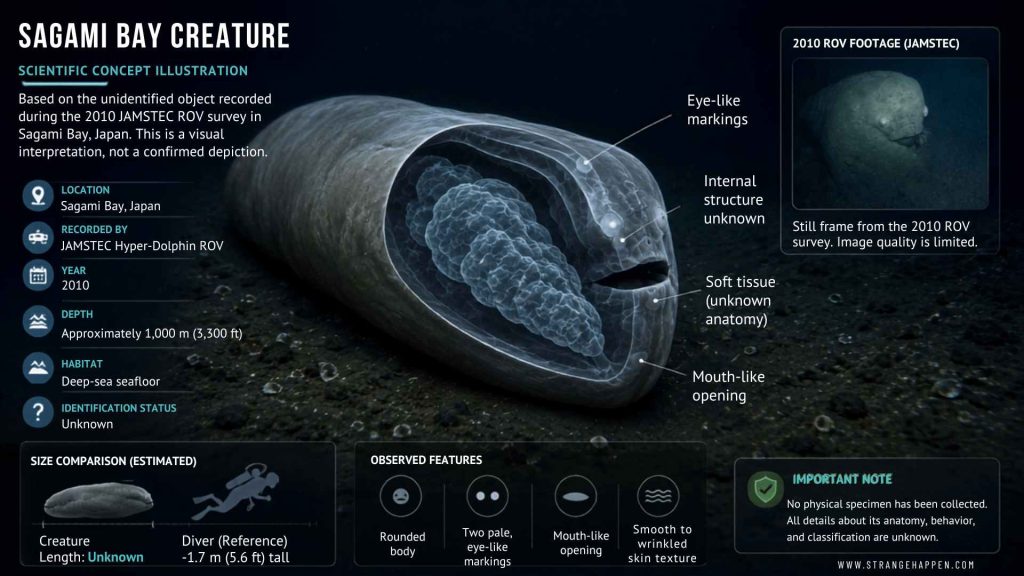
The illustration below presents one possible visualization of the mysterious Sagami Bay creature based on the publicly available 2010 JAMSTEC footage. It combines the visible features recorded by the ROV with a scientific concept diagram for educational purposes. Because the object has never been identified or recovered, the internal anatomy shown is interpretive rather than confirmed.
The Leading Theories, from Most to Least Likely
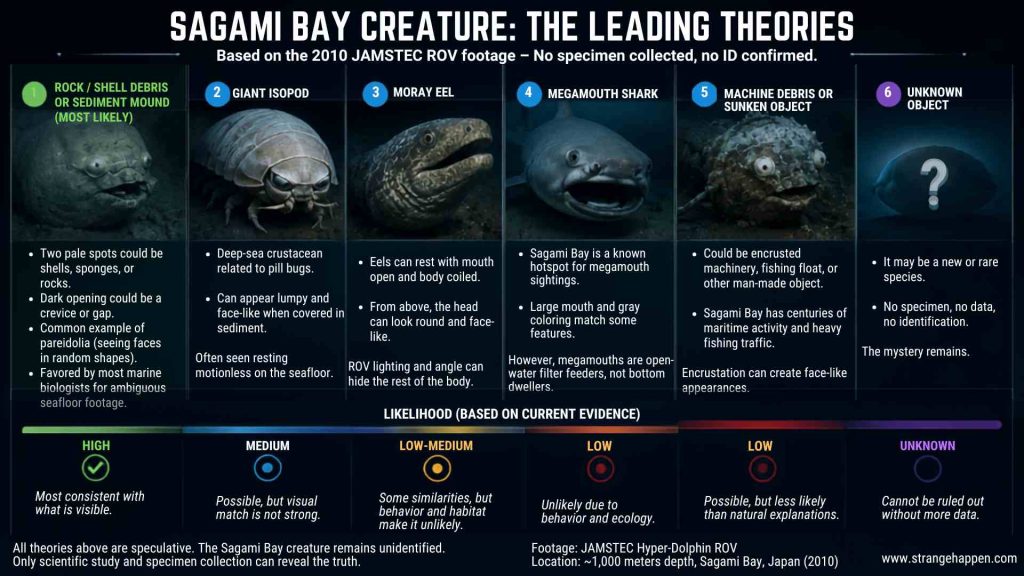
Fifteen years of internet speculation has produced a handful of recurring explanations. None of them come from a published study, so treat every one of these as a theory, not a finding.
Pareidolia: A Rock, Shell Debris, or Sediment Mound
The simplest explanation, and the one marine biologists tend to favor for ambiguous seafloor footage in general, is that the “eyes” are two light-colored rocks, shells, or patches of sponge sitting on a mound of sediment or an outcropping. Human brains are primed to find faces in asymmetric shapes, especially two round marks positioned above a dark gap, the same camouflage-driven pattern-matching that makes plenty of ordinary animals look like something else entirely. Commenters on the original Pink Tentacle and AnandTech Forums threads reached this conclusion independently within hours of the video going up.
Giant Isopod or Moray Eel
A giant isopod, a deep-sea crustacean related to the pill bug (and a distant relative of Cymothoa exigua, the parasitic isopod best known for replacing a fish’s tongue), was a popular guess in the original comment threads, since a mud-covered isopod curled at rest can produce a similarly lumpy silhouette. A resting moray eel was suggested for similar reasons: a coiled body with a rounded head can look static and face-like from directly above, especially through the color-flattening effect of ROV lighting at depth.
Megamouth Shark
Some viewers pointed to the megamouth shark, Megachasma pelagios, partly because Sagami Bay is a genuine hotspot for megamouth encounters. Researchers led by Dr. Yoshihiro Fujiwara have documented multiple megamouth sightings and tagging events in the bay, and a 540-centimeter female was famously filmed alive there for a Discovery Channel special. The problem with this theory is behavioral: megamouths are slow-moving open-water filter feeders, not animals that park motionless on the seafloor, which makes the visual match weaker than it first appears.
Machine Debris or a Sunken Object
A minority of viewers read the shape as inanimate from the start: encrusted machinery, a fishing float, or even, as one later blog post speculated, a sunken sculpture. Sagami Bay has centuries of maritime traffic and sits near a historically active fishing and shipping corridor, so debris on the seafloor is common. Nothing in the video rules this out.
Cryptid Framings: Ningen and Godzilla Jokes
The infographic below compares the leading scientific theories proposed for the mysterious Sagami Bay creature, based on the available evidence from the 2010 JAMSTEC footage.
The comment section on the original 2010 post also reached for cryptid names, most often Ningen, plus jokes about Cthulhu and Godzilla. None of these hold up as real theories. Ningen is a specific, well-documented piece of internet folklore: a pale, whale-sized humanoid said to inhabit the subantarctic waters near Antarctica, first described in a 2channel forum post around 2002 and popularized after 2007, according to the academic case study by Greenland and Hayward (2020) in Shima journal. Sagami Bay is thousands of kilometers from the Ningen’s claimed Antarctic range, and the described size and shape do not match a small, stationary seafloor object at all. Godzilla, obviously, is fiction.
The comparison below highlights the key differences between the mysterious Sagami Bay creature and two well-known deep-sea organisms that are often mistakenly linked to the 2010 footage.
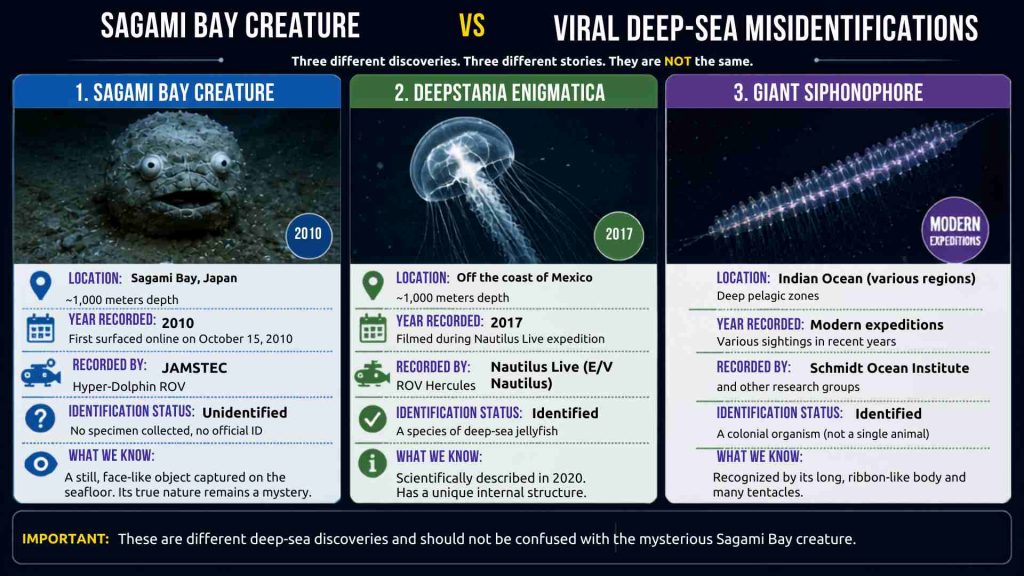
Correcting the Record: This Is Not Deepstaria enigmatica or a Giant Siphonophore
The single biggest source of active misinformation about this topic isn’t the 2010 footage itself, it’s newer viral clips that get mislabeled with the Sagami Bay name. Several TikTok posts circulating in 2025 and 2026 caption unrelated deep-sea footage as the “Sagami Bay creature” or credit it to JAMSTEC when it is neither, the same recaptioning pattern we traced in the golden penguin discovery.
The best-known example is Deepstaria enigmatica, the translucent, bag-shaped jellyfish that went viral for looking like a ghost. That footage was recorded by the ROV Hercules, operated by the Ocean Exploration Trust’s Nautilus Live program, off Mexico’s San Benedicto and Socorro Islands in November 2017, roughly seven years after the Sagami Bay video and thousands of miles away. The encounter was documented in a study led by biologist David Gruber and covered in detail by both National Geographic and Live Science. JAMSTEC had no role in filming it.
A second frequently mislabeled clip shows a giant siphonophore, a colonial organism related to jellyfish that can stretch over 40 meters long. Viral footage of these animals, some of it credited to the Schmidt Ocean Institute filming in the Indian Ocean off Western Australia, gets recaptioned with “Sagami Bay” often enough that it now shows up in searches for the topic. Neither the jellyfish nor the siphonophore footage has any documented connection to Sagami Bay, JAMSTEC, or the 2010 video.
Why It Matters
The Sagami Bay creature is a useful case study in how little separates a real scientific mystery from an internet legend, not unlike the Buga sphere mystery, another unidentified object that never got an official explanation. JAMSTEC’s Hyper-Dolphin program is a legitimate, ongoing deep-sea research effort that has helped identify new species, monitor undersea volcanic activity, and document animals few humans will ever see firsthand. This particular clip happened to surface without the institutional follow-up that usually accompanies JAMSTEC’s stranger finds, and the resulting vacuum got filled with speculation, then with recycled misinformation from unrelated footage years later.
Sagami Bay’s genuine biodiversity is what makes the mystery plausible in the first place. Researchers have used the bay to describe new species for well over a century, most recently Ferreiraella populi, a deep-sea chiton described in August 2026, and a 2025 study in Frontiers in Marine Biology and Ecology confirmed a previously unknown species of Portuguese man o’ war, Physalia mikazuki, drifting north from waters historically limited to Sagami Bay and Okinawa. Sagami Bay is far from alone here; it’s part of a steady stream of newly discovered species turning up in deep water worldwide, which is exactly why an unidentified shape on a fifteen-year-old video does not read as far-fetched.
Future Research: Will We Ever Know What It Was
Without a recovered specimen, a follow-up dive to the same coordinates, or a JAMSTEC statement on the record, the object’s identity is unlikely to be resolved from the existing footage alone. Deep-sea surveys of Sagami Bay continue, however. Joint survey work coordinated through JAMBIO, a partnership between the University of Tsukuba’s Shimoda Marine Research Center and the University of Tokyo’s Misaki Marine Biological Station, has already logged around 50 probable undescribed species in the bay’s shallower waters, with deeper zones far less thoroughly cataloged.
If JAMSTEC or an academic partner ever revisits the exact site with modern imaging, or if a specimen matching the shape turns up in a trawl or survey net, that would be the first real evidence either way. Until then, every explanation on this page remains a theory.
Related Topics
- The Truth Behind the Golden Penguin Discovery: another viral animal claim that needed the same fact-check treatment as this one
- The Buga Sphere Mystery: an unidentified object that, like the Sagami Bay creature, never got an official explanation
- Camouflage Animals: the biology behind why so many real animals get mistaken for something else
- Stonefish: a real fish evolved to look exactly like a rock, the pareidolia theory’s closest living parallel
- Blobfish: the internet’s favorite “monster” that turned out to be an ordinary deep-sea fish out of water
- Ferreiraella Populi: A New Deep-Sea Chiton: proof that genuinely new species are still turning up in deep water right now
- 10 Newly Discovered Species: a look at how often science, not the internet, solves cases like this one
Key Takeaways
- The Sagami Bay creature is real footage, filmed by JAMSTEC’s Hyper-Dolphin ROV and first published online on October 15, 2010, but it was never officially identified by JAMSTEC or any other institution.
- The leading scientific-minded theory is pareidolia: rocks, shells, or sediment forming a face-like pattern, not a living animal.
- Megamouth shark, giant isopod, and moray eel are the next most-cited theories, though none has been confirmed.
- The Ningen and Godzilla comparisons are internet jokes and folklore, not serious explanations, and don’t match the creature’s location or description.
- Viral TikTok clips labeling Deepstaria enigmatica or giant siphonophore footage as the “Sagami Bay creature” are misidentifications of unrelated animals filmed years later, in different oceans, by different research teams.
- Sagami Bay remains one of the most biodiverse and actively studied stretches of ocean in Japan, which is exactly why an unresolved mystery like this one still feels plausible.
Frequently Asked Questions About the Sagami Bay Creature
Was the Sagami Bay creature ever identified?
No. No agency, including JAMSTEC, has published an official identification, study, or statement naming what the object in the 2010 footage actually is. It remains an open question, with pareidolia (a rock or sediment formation) as the most commonly favored explanation among viewers.
Is the Sagami Bay creature real?
The footage itself is real and was genuinely recorded by JAMSTEC’s Hyper-Dolphin ROV in Sagami Bay. Whether the object in the video is a living animal, however, has never been confirmed, so “real creature” versus “rock formation” remains unresolved.
What is P. areidolia?
“P. areidolia” is a joke name coined by Boing Boing in its original 2010 post, a pun combining a mock scientific-species format with “pareidolia,” the tendency to see faces in random patterns. It was never a real proposed species name.
What does the Sagami Bay creature actually look like?
In the footage, it appears as a rounded, mottled shape roughly the color of the surrounding seafloor, with two lighter, circular marks positioned like eyes above a darker gap that reads as a mouth. It does not move during the clip.
What is the JAMSTEC Hyper-Dolphin ROV?
Hyper-Dolphin is a remotely operated vehicle built by the Japan Agency for Marine-Earth Science and Technology, capable of diving to 4,500 meters and equipped with ultra-high-definition cameras. It has completed more than 2,200 research dives since entering service.
Is the Sagami Bay creature the same as the Deepstaria enigmatica jellyfish?
No. Deepstaria enigmatica is a real, separately documented jellyfish filmed by the ROV Hercules off Mexico in November 2017, seven years after the Sagami Bay footage and in a completely different ocean. Viral clips crediting this jellyfish footage to Sagami Bay or JAMSTEC are misidentifications.
Is the Ningen connected to Sagami Bay?
No. Ningen is an internet-born cryptid tied to Antarctic waters, first described on a Japanese forum around 2002. It has no documented connection to Sagami Bay and doesn’t match the size, shape, or behavior described in the 2010 footage.
How deep was the creature filmed?
Secondary sources widely cite a depth of roughly 1,000 meters (about 3,353 feet), consistent with the operating range Hyper-Dolphin regularly surveys in Sagami Bay. JAMSTEC has not published an exact depth figure for this specific clip.
Has the Sagami Bay creature been found or explained since 2010?
No confirmed sighting, follow-up dive, or specimen tied to this specific object has been reported since the footage surfaced. It remains exactly as unresolved today as it was in 2010.
What’s the difference between Sagami Bay and Suruga Bay?
Sagami Bay and Suruga Bay are separate bodies of water on Japan’s Pacific coast. Suruga Bay, west of the Izu Peninsula, is known for its extreme depth and giant squid sightings, while Sagami Bay, east of Izu, is where the 2010 ROV footage was recorded.
Source References
- JAMSTEC: ROV Hyper-Dolphin, Institute for Marine-Earth Exploration and Engineering. https://www.jamstec.go.jp/mare3/e/ships/deep_sea/hyper-dolphin.html (accessed 2026)
- Pink Tentacle: “Video: Mystery creature in Sagami Bay,” October 15, 2010. https://pinktentacle.com/2010/10/video-mystery-creature-in-sagami-bay/
- National Geographic: “Rare Deep-Sea Jellyfish Spotted, Looks Like Plastic Bag,” May 14, 2018. https://www.nationalgeographic.com/animals/article/rare-jellfish-filmed-mexico-animals-spd
- Live Science: “This Mysterious, Deep-Sea Jellyfish Looks Like the Ghost of an Alien,” May 24, 2018. https://www.livescience.com/62643-rarely-seen-jellyfish.html
- Greenland, F. and Hayward, P.: “NINGEN: the generation of media-lore concerning a giant, sub-Antarctic, aquatic humanoid and its relation to Japanese whaling activity,” Shima: The International Journal of Research into Island Cultures, 14(1): 133-151, 2020. https://shimajournal.org/issues/v14n1/10.-Greenland-and-Hayward-Shima-v14n1.pdf
About the Author
Evan Brooks, author at StrangeHappen.com, writes about strange events, unexplained mysteries, unusual wildlife, ancient discoveries, and the science behind stories that seem almost too strange to be true. He enjoys digging through old reports, forgotten cases, and unusual claims to uncover what really happened.
His work looks beyond the mystery without taking away the sense of wonder. From eerie encounters and unexplained phenomena to bizarre creatures and ancient secrets, he separates documented facts from rumors, legends, and internet fiction.