

Ask five oceanographers how much of the ocean has been explored, and the answers will not agree. One might say 5 percent. Another might say 80. A third might point out that the question itself is broken.
By April 2026, modern high-resolution mapping covered 28.7 percent of the global seafloor, according to the Nippon Foundation-GEBCO Seabed 2030 Project. A separate 2025 study in the journal Science Advances found that humans have visually observed less than 0.001 percent of the deep seafloor. Those two figures are both true, both current, and describe almost entirely different activities.
There is no single percentage for how much of the ocean has been explored, because “mapped,” “explored,” “visited,” and “discovered” are not the same word. This piece walks through what each term actually means, what the best 2026 data says, and why those different figures are answering different questions rather than contradicting each other.
The short answer There is no single percentage that captures how much of the ocean has been explored. As of April 2026, 28.7 percent of the global seafloor had been mapped to modern high-resolution standards, while a 2025 study found that less than 0.001 percent of the deep seafloor had been visually observed. Those figures measure different things, so neither one should be treated as the percentage of the entire ocean humans have explored.
How Much of the Ocean Has Been Explored, Really?
The honest, short answer is that it depends what “explored” means. If the question is how much of the seafloor has been mapped, the answer is 28.7 percent, announced by Seabed 2030 at the International Hydrographic Organization Assembly in April 2026. But if we narrow the question to the deep seafloor that researchers have directly viewed through human eyes or underwater cameras, the figure drops below 0.001 percent, according to a 2025 Science Advances study led by marine scientist Katy Croff Bell and colleagues.
By- Sea&me
NOAA Ocean Exploration puts it plainly: the entire seafloor has technically been mapped using low-resolution satellite data, but explorers can’t say they’ve explored the seafloor until they’ve seen it. Because more than 90 percent of the ocean extends deeper than 200 meters, much of Earth’s largest habitat has never been viewed directly. That distinction, mapping from orbit versus actually seeing the seafloor, explains almost every conflicting statistic about ocean exploration.
| What’s being measured | What we currently know | Source |
|---|---|---|
| Broad, low-resolution satellite-derived seafloor coverage | Essentially the entire seafloor | NOAA Ocean Exploration |
| Modern high-resolution seafloor mapping | 28.7% as of April 2026 | Seabed 2030 / GEBCO |
| Deep-seafloor visual observation | Less than 0.001% | Ocean Discovery League, Science Advances, 2025 |
| Ocean species not yet formally described | Roughly two-thirds or more of an estimated 700,000–1,000,000 | NOAA |
That table is the reason different sources give wildly different answers to the same question: they’re often not measuring the same thing at all.
Mapped, Explored, Visited, Observed: Why These Words Don’t Mean the Same Thing
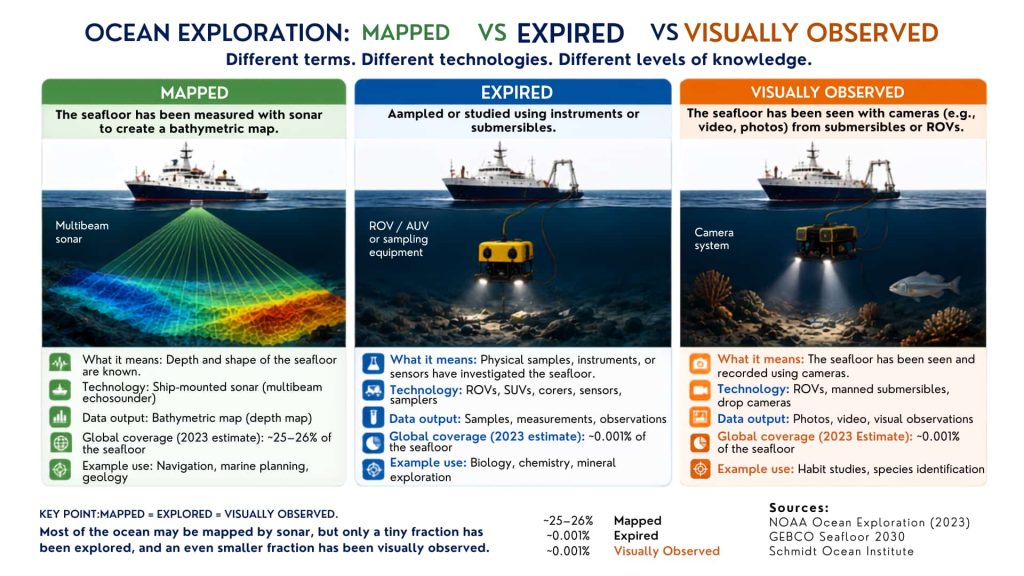
Most of the confusion around how much of the ocean is unexplored comes down to several words being used as if interchangeable. They aren’t, and NOAA’s own reporting relies on this exact distinction to explain how “the entire seafloor has been mapped” and “the ocean remains largely unexplored” can both be accurate at once.
Mapped
A region is mapped once its depth and general shape have been recorded, usually by satellite altimetry or ship-mounted multibeam sonar. Low-resolution satellite data already covers the whole ocean. High-resolution multibeam data, detailed enough to spot a shipwreck or a seamount, covers just 28.7 percent as of the 2026 Seabed 2030 grid.
Explored, Visited, and Observed
Exploration means a location has actually been examined, usually with a research vessel, a remotely operated vehicle (ROV), or an autonomous underwater vehicle (AUV). Visited narrows that further to somewhere a human or robotic vehicle physically reached. Observed means a camera or sensor actually recorded what’s there, the standard the Ocean Discovery League used to calculate its less-than-0.001-percent figure.
Sampled, Discovered, and Understood
Sampling means physical material, water, sediment, or an organism, was collected and studied. Discovery means something previously unknown to science was identified, still happening at a rate of almost 2,000 new ocean species a year, according to NOAA. Understanding is the highest bar: enough evidence exists to explain how an ecosystem actually works, and even well-mapped sites like hydrothermal vents are still yielding surprises.
Is 95 Percent of the Ocean Really Unexplored?
The “95 percent unexplored” figure is widely used, including by NOAA, but it is not directly comparable to the 28.7 percent seafloor-mapping figure or the less-than-0.001-percent visual-observation estimate. It is a broad description of how much of the ocean remains unexplored, rather than a standardized measurement of one specific type of exploration. It likely persists because it’s a round, memorable number that roughly matches the scale of the mapping and visual-survey gaps described throughout this piece. Scuba Diving magazine has flagged how the figure gets misused, often deployed to argue that undiscovered giant animals, like a surviving megalodon, could be hiding in the unexplored ocean, despite zero physical evidence for anything of the kind.
The safest way to use the 95 percent figure is as a loose gesture at how little of the deep seafloor has been closely surveyed, not as a literal, peer-reviewed statistic. The 2025 Science Advances study found that less than 0.001 percent of the deep seafloor has been visually observed, meaning more than 99.999 percent hasn’t been visually documented. That doesn’t mean those areas have never been mapped, acoustically surveyed, or sampled by other instruments; it only means nobody has directly seen or photographed them. A figure like 80, 95, or 99.999 percent unexplored depends on whether the claim is about mapping, visual surveys, or biological sampling, and conflating the three is where most viral ocean statistics go wrong.
How Much of the Ocean Floor Has Been Mapped in 2026?
The clearest, most current number available is the Seabed 2030 figure: 28.7 percent of the global seafloor mapped to modern high-resolution standards as of April 20, 2026, up from 27.3 percent in June 2025 and 26.1 percent in June 2024. The project, a partnership between The Nippon Foundation and the General Bathymetric Chart of the Oceans (GEBCO), added nearly 5 million square kilometers of new data in a single year, an area larger than India.
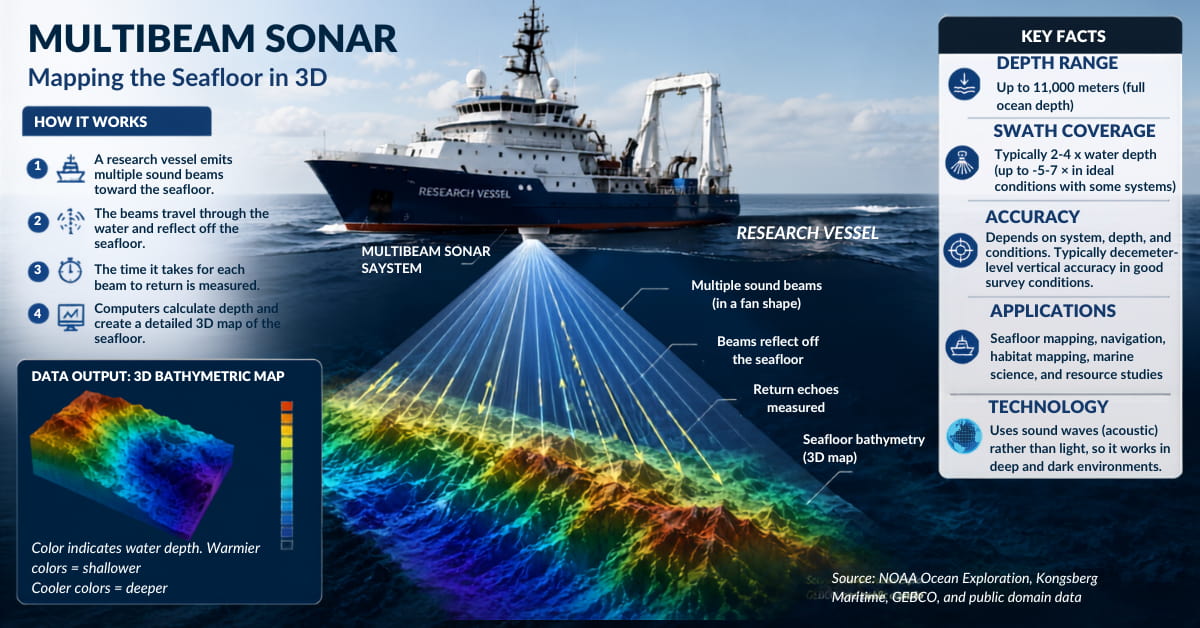
That mapping is done with multibeam sonar, which sends sound pulses from a ship and times their return to build a three-dimensional picture of the seafloor. It’s the difference between a blurry satellite silhouette and an actual photograph: satellite altimetry gives a rough depth map of the entire ocean, while multibeam sonar reveals the fine detail, individual seamounts, canyons, shipwrecks, that low-resolution data misses.
Coverage isn’t even, either. About 56 percent of the seafloor within U.S. waters has been mapped to modern standards, well above the global figure, according to NOAA.
How Much of the Ocean Have Humans Actually Explored?
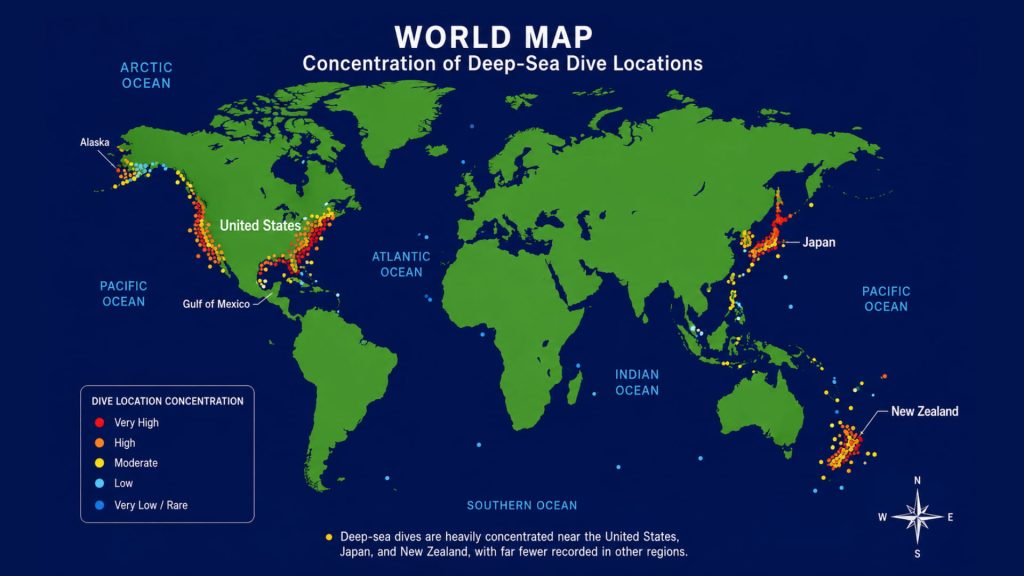
Mapping tells you the shape of the seafloor, not what’s living there or what geological processes are underway. That’s where Katy Croff Bell’s Science Advances study comes in: her team compiled records from roughly 44,000 deep-sea dives since 1958 across 120 countries, using human-occupied submersibles, ROVs, and AUVs, and found they add up to only about 12,000 unique locations, most clustered near three countries, the United States, Japan, and New Zealand.
The researchers estimated that less than 0.001 percent of the deep seafloor has been visually observed. They also noted that even if missing observations were substantial, the total would still represent less than 0.01 percent, an area roughly the size of Rhode Island or a tenth the size of Belgium. Bell told PBS NewsHour that despite nearly 70 years of deep-sea diving, “nobody’s actually sat down and done the math” before her study. Cost is a major reason why: deep-sea exploration requires expensive research vessels, specialized sonar, remotely operated vehicles, submersibles, trained crews, and long expeditions, which is part of why the deepest trenches, the abyssal plains, and the polar seafloor under permanent ice remain the least-visited parts of the planet.
How Much of the Ocean Has Been Explored by NASA?
This is a common search, but there is no meaningful percentage for how much of the ocean NASA has explored. NASA is not the primary U.S. agency for direct ocean-floor exploration. NOAA and its research partners conduct much of the ship-, sonar-, ROV-, and submersible-based exploration of the seafloor, while NASA contributes through satellite-based Earth observation.
NASA’s PACE mission studies ocean color and phytoplankton, while the SWOT satellite measures variations in sea-surface height, helping scientists study ocean circulation, currents, and other large-scale features. These missions provide a global view of the ocean from space, but they do not directly map or visually inspect the deep seafloor in the way research vessels, multibeam sonar, ROVs, and submersibles do.
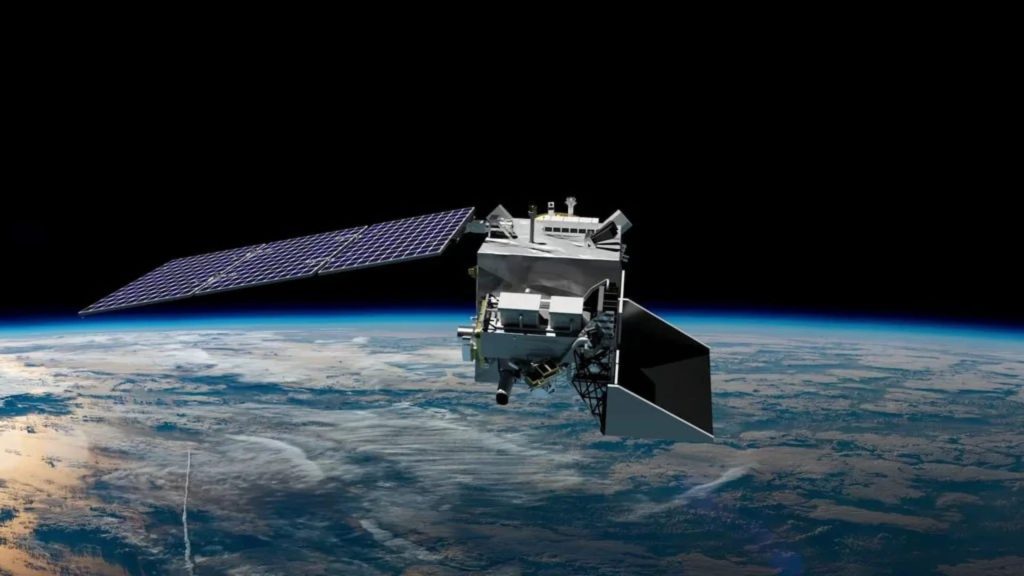
So, how much of the ocean has NASA explored? There is no meaningful percentage. NASA’s contribution is primarily remote sensing and Earth-system science rather than direct exploration of the ocean floor. Comparing NASA’s satellite observations with the 28.7 percent of seafloor mapped by Seabed 2030 would therefore mix two different kinds of exploration.
How Much of the Ocean Remains Undiscovered?
Mapping and visual surveys describe places. Discovery describes species, and by that measure the ocean is still overwhelmingly undiscovered. NOAA estimates there are between 700,000 and 1 million species in the ocean, mostly animals, and that roughly two-thirds of them, possibly more, have not yet been formally described by science, even as almost 2,000 new marine species are accepted into the scientific record every year.
That process is slower and stricter than it sounds. StrangeHappen has covered how scientists actually name a new species, and specimens can sit in museum collections for decades before someone has the time, funding, or expertise to formally describe them. The undiscovered ocean, in other words, isn’t only the deep trenches nobody has visited. It also includes specimens already collected by researchers that have not yet been formally described by taxonomists.
Why Is So Little of the Ocean Actually Explored?
The obstacles are physical before they’re financial. Below about 1,000 meters, water pressure exceeds 100 times that at the surface, enough to crush an unpressurized hull instantly, so deep-sea vehicles need thick titanium spheres or syntactic-foam hulls built for that depth. Past 200 meters, sunlight is gone, so every dive depends on artificial lighting, and seafloor temperatures typically hover just above freezing.
Then there’s scale. The deep ocean covers roughly two-thirds of Earth’s entire surface, and a single expedition using a ship-towed ROV might cover only a few square kilometers across a multi-week mission. That two-thirds figure and the “more than 90 percent” figure mentioned earlier aren’t in conflict, they’re just different denominators: NOAA’s 90 percent describes the deep ocean’s share of the ocean’s own volume, while two-thirds describes its share of Earth’s total surface, land included. Layer the cost of ships, sonar, ROVs, and submersibles on top of that scale, and it’s clear why exploration has stayed concentrated in the same accessible, well-funded regions for 70 years running.
What Strange Things Have Scientists Found in the Unexplored Ocean?
Expeditions into poorly sampled ocean environments continue to reveal unexpected species, habitats, and geological features, which is exactly why StrangeHappen keeps returning to this beat. Hydrothermal vents themselves weren’t discovered until 1977, when researchers found entire ecosystems living in total darkness, fueled by chemical energy instead of sunlight, a discovery that rewrote assumptions about where life can exist.
Some of the strangest recent finds sit in StrangeHappen’s own archive. The blobfish looks nothing like its viral internet photos once you understand the pressure it actually lives under. Ferreiraella populi, a chiton found on a sunken log nearly three miles down, went undescribed until internet volunteers helped name it.
The Elven Abyss Tunicate, scientifically described as Kaikoja undume Mandre & Rouse, 2025, was among the ten remarkable new marine species highlighted by the World Register of Marine Species (WoRMS) for 2025. Found in the deep sea, the strange tunicate shows just how much remains to be documented beneath the surface. Even the Sagami Bay creature, filmed by a Japanese ROV in 2010, still has no confirmed scientific identity.
That’s the direct, predictable consequence of visually surveying less than a Rhode Island’s worth of deep seafloor: when so little of a habitat has been seen up close, new and strange things are the expectation, not the exception.
Do We Really Know More About Space Than the Ocean?
It’s a popular comparison, and it’s more nuanced than the headline version suggests. Satellites have mapped the entire Martian surface at high resolution, a feat that dwarfs 28.7 percent seafloor coverage on paper. But comparing “photographed from orbit” to “physically explored” isn’t a fair fight in either direction: no rover has driven across Mars in person either, and remote sensing has its own blind spots.
The more accurate version of the claim is narrower: we have better remote, large-scale maps of some other worlds’ surfaces than of Earth’s deep seafloor, largely because a vacuum is easier to see through than several kilometers of seawater. Up close, though, the deep ocean has been visually surveyed far less than most planetary surfaces reachable by orbiting cameras, which is closer to what people usually mean by the comparison.
What Parts of the Ocean Have Not Been Explored?
The abyssal plains mentioned above, the flat, sediment-covered seafloor between 3,000 and 6,000 meters down, make up roughly half the planet’s surface on their own and are among the most under-surveyed environments on Earth. Remote seamounts far from shipping lanes round out the list alongside the trenches and polar seafloor already covered.
It’s worth being precise here: unexplored doesn’t automatically mean never touched by any instrument. Satellite altimetry has produced a rough depth profile of essentially the entire seafloor, trenches included. What’s missing from these regions is high-resolution mapping, direct visual observation, and biological sampling, the layers of knowledge that turn a shape on a screen into an understood place.
So, What Percentage of the Ocean Have We Actually Explored?
There is no single correct answer to how much of the ocean has been explored, because the question folds together several different, genuinely useful measurements, the ones laid out in the table earlier in this article. Pick whichever definition matters for your purposes, just don’t let one percentage stand in for all of them.
The ocean’s surface has essentially been mapped at low resolution. Its floor is a little over a quarter mapped in fine detail. And the part of it humans have actually laid eyes on, in person or by camera, is a small enough fraction that “less than 0.001 percent” is the more honest way to say it than any rounded-off percentage.
Key Takeaways
- No single percentage answers how much of the ocean has been explored; mapped, explored, visited, observed, sampled, and discovered are different measurements with different numbers.
- As of April 2026, Seabed 2030 has mapped 28.7 percent of the global seafloor to modern high-resolution standards.
- A 2025 Science Advances study found humans have visually observed less than 0.001 percent of the deep seafloor, an area roughly the size of Rhode Island; that doesn’t mean the rest has never been mapped, sampled, or detected by other instruments, only that it hasn’t been directly seen.
- The “95 percent unexplored” claim is a widely repeated approximation, not a current scientific measurement; treating it as literal fact is how pseudoscience claims, like a surviving megalodon, get traction.
- NASA studies the ocean’s surface remotely via satellites like PACE and SWOT; it isn’t the primary agency responsible for exploring the seafloor, and no meaningful “NASA exploration percentage” exists.
- Roughly two-thirds of an estimated 700,000 to 1 million ocean species remain formally undiscovered.
Related Topics
- Sunlight Zone Facts: Astonishing Facts About Ocean’s Top Layer: a look at the ocean’s better-studied upper layers, and why that makes the rest so different.
- Deep-Sea Mining: What’s Really at Stake for Ocean Life: why mining a habitat we’ve barely observed is drawing scientific alarm.
- Ferreiraella Populi: The Strange Chiton the Internet Named: a real example of a species found in the ocean’s least-explored territory.
- How Scientists Name a New Species (And Who Really Decides): the slow, careful process behind the ocean’s undiscovered-species numbers.
- Elven Abyss Tunicate: The Terrifying Deep Sea Monster That Nobody Told You About: a 2025 deep-sea discovery that shows the pattern still holding.
Frequently Asked Questions About How Much of the Ocean Has Been Explored
What percentage of the ocean is unexplored?
It depends on the measure. About 71.3 percent of the seafloor hasn’t been mapped to modern high-resolution standards as of 2026, while more than 99.999 percent of the deep seafloor has never been visually observed, though much of that area has still been mapped or acoustically surveyed by other means.
Is 95 percent of the ocean really unexplored?
Not as a precise current figure. It’s a widely repeated shorthand rather than one standardized measurement; the closest current figure, less than 0.001 percent of the deep seafloor visually observed, tells a similar story but comes from a specific, dated 2025 study.
How much of the ocean has been explored by humans?
Roughly 44,000 deep-sea dives since 1958 have covered about 12,000 unique locations, adding up to less than 0.001 percent of the deep seafloor observed directly, according to a 2025 Science Advances study.
How much of the ocean has been explored by NASA?
There’s no meaningful percentage, because NASA isn’t the primary agency responsible for direct ocean-floor exploration. NASA studies the ocean’s surface remotely through satellites like PACE and SWOT; physical ocean exploration is led by NOAA and research groups like the Ocean Discovery League.
How much of the ocean has been mapped in 2026?
28.7 percent of the global seafloor had been mapped to modern high-resolution standards as of April 2026, according to the Seabed 2030 project.
How much of the ocean is undiscovered?
In terms of species, an estimated two-thirds or more of the 700,000 to 1 million species thought to live in the ocean haven’t been formally described yet.
How much of the deep ocean has been explored?
Very little in visual terms. Deep ocean, defined as deeper than 200 meters, makes up over 90 percent of the ocean’s volume, and Very little in visual terms. A 2025 study estimated that less than 0.001 percent of the deep seafloor has been visually observed.
Why is the ocean so difficult to explore?
Crushing pressure, total darkness below 200 meters, near-freezing temperatures, and enormous scale combine with the steep cost of ships, sonar, ROVs, and submersibles to slow exploration down.
Source References
- NOAA Ocean Exploration, “How much of the ocean has been explored?” (last updated April 20, 2026): https://oceanexplorer.noaa.gov/ocean-fact/explored/
- Seabed 2030 / Nippon Foundation-GEBCO, “Global seabed mapping reaches new milestone as five million square kilometres added in a year” (April 20, 2026): https://seabed2030.org/2026/04/20/global-seabed-mapping-reaches-new-milestone-as-five-million-square-kilometres-added-in-a-year/
- Bell, K.C. et al., “How Little We’ve Seen: A Visual Coverage Estimate of the Deep Seafloor,” Science Advances (May 7, 2025): https://www.science.org/doi/10.1126/sciadv.adp8602
- Ocean Discovery League, official press release (May 7, 2025): https://www.oceandiscoveryleague.org/press/press-release-how-little-weve-seen-deep-ocean
- NASA Jet Propulsion Laboratory, “NASA’s PACE, US-European SWOT Satellites Offer Combined Look at Ocean” (December 2024): https://www.jpl.nasa.gov/news/nasas-pace-us-european-swot-satellites-offer-combined-look-at-ocean/
Author Bio
Evan Brooks, author at StrangeHappen.com, writes about strange events, unexplained mysteries, unusual wildlife, ancient discoveries, and the science behind stories that seem almost too strange to be true. He enjoys digging through old reports, forgotten cases, and unusual claims to uncover what really happened.
His work looks beyond the mystery without taking away the sense of wonder. From eerie encounters and unexplained phenomena to bizarre creatures and ancient secrets, he separates documented facts from rumors, legends, and internet fiction.