
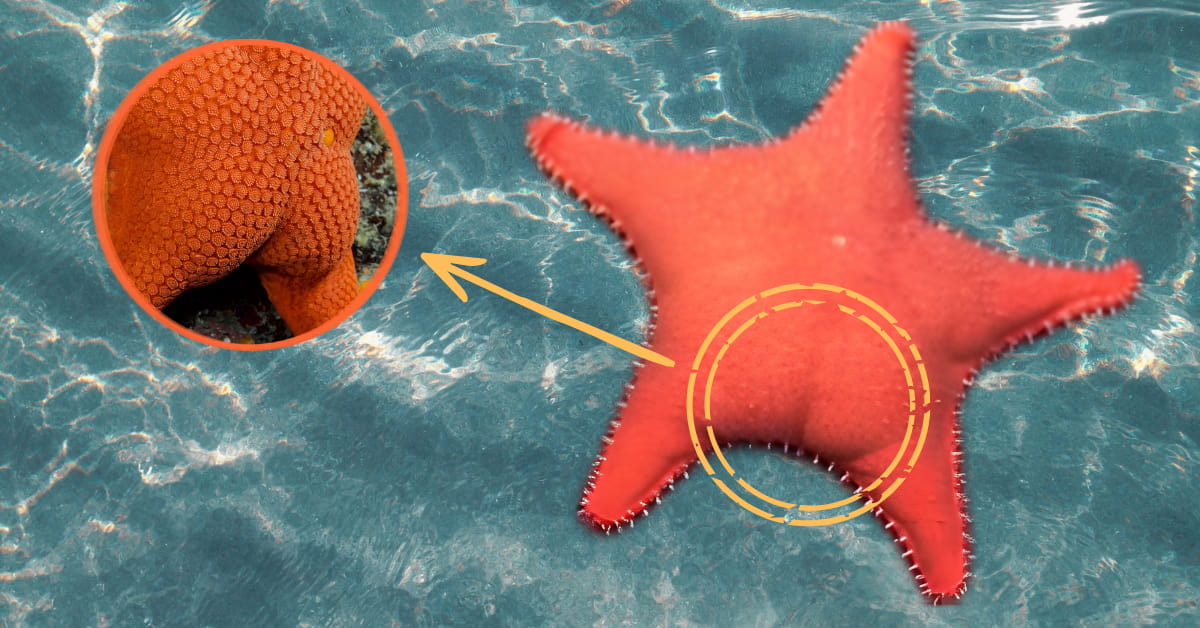
In July 2025, a robotic camera drifting nearly a kilometer below the South Atlantic found a starfish with an oddly round, swollen middle. Viewers watching the live broadcast nicknamed it estrella culona, Spanish for “big-butt star,” and the name spread within hours. The animal turned up during a CONICET and Schmidt Ocean Institute expedition off Mar del Plata, Argentina, and biologists later proposed it as Hippasteria phrygiana, a known deep-sea species rather than something new. A year on, a second sighting, a scientific follow-up expedition, and a genuine internet mythology around Patrick Star have kept the 2025 estrella culona story alive.
Table of Contents
Estrella Culona Facts at a Glance
| Fact | Details |
|---|---|
| Nickname | Estrella culona (“big-butt star”) |
| Proposed species | Hippasteria phrygiana, also known as the “trojan star” |
| Family | Goniasteridae |
| Reported size | Roughly 20–30 centimeters across, depending on the source |
| Depth range of the species | Roughly 150–1,500 meters |
| First filmed | Late July 2025, in the Mar del Plata submarine canyon, Argentina |
| Expedition | Talud Continental IV — CONICET / Schmidt Ocean Institute |
| Status | Not a new species; the species-level identification has not been officially confirmed for this specific specimen |
What Is the Estrella Culona?
“Estrella culona” is not a scientific term. It is an informal nickname coined by viewers of a livestreamed deep-sea survey, and its literal Spanish meaning, “big-butt star,” refers to the rounded central disc that made the animal look like it had a rear end. The name stuck instantly in Argentina and later spread through English-language coverage as “the big-butt starfish.”
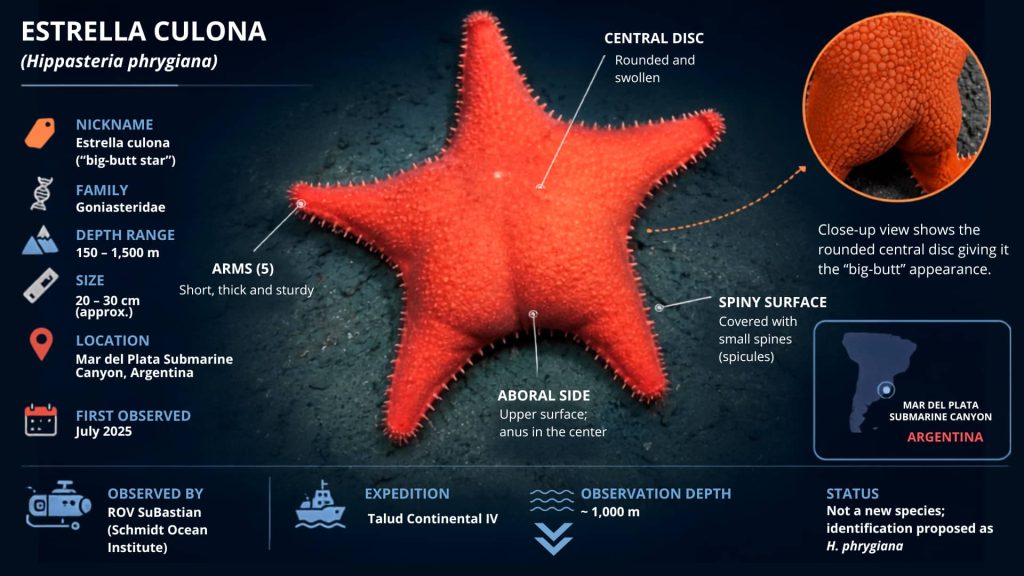
The animal itself is a sea star from the genus Hippasteria, an underwater starfish filmed clinging to a rock wall roughly 1,000 meters down. It was not new to science, and its now-famous shape is simply how members of this genus normally look, a body plan explained further in our guide to starfish anatomy.
Where Was the Big-Butt Starfish Found?
The sighting happened in the Mar del Plata submarine canyon, a deep trench roughly 300 kilometers off Argentina’s Atlantic coast that plunges past 3,500 meters in places. Researchers were using a remotely operated vehicle to survey the canyon floor for the first time when the camera settled on the starfish clinging to a vertical rock face.
The dive was part of Talud Continental IV, a joint expedition between CONICET, Argentina’s national science council, and the US-based Schmidt Ocean Institute, whose own expedition page describes it as the first opportunity for Argentine scientists to use the research vessel’s full suite of sonars, labs, and ROV systems to map this stretch of seafloor. For a few weeks that summer, it was the big-butt sea star Argentina couldn’t stop talking about.
What Is the Big-Butt Starfish Scientific Name?
The animal does not have a confirmed, published scientific identification tied specifically to this sighting. What biologists offered instead was a proposed identification. Shortly after the discovery, Pamela Rivadeneira, a biologist with a doctorate from the University of Buenos Aires, told Argentine outlets the specimen was likely Hippasteria phrygiana, while noting the identification would need closer study to confirm with certainty. That caveat matters, since much of the later coverage dropped it and reported the name as settled fact.
Hippasteria phrygiana and the Goniasteridae Family
Hippasteria phrygiana belongs to the family Goniasteridae, according to the World Register of Marine Species, a group of sea stars known for thick, plated skeletons and short, stubby arms extending from a heavy central disc, exactly the body plan seen in the viral footage. The species carries the common name “trojan star” in some references. As a deep-sea starfish, it is found across cold, deep waters in multiple ocean basins, not exclusively off Argentina, which is one reason biologists considered the identification plausible rather than exotic.
Is the Big-Butt Starfish a New Species?
No. Despite headlines describing a strange new deep-sea find, the estrella culona was not presented by the expedition team as a newly discovered species. It became famous for how it looked on a livestream, not because it was previously unknown to science.
That distinction gets lost easily. Genuinely new species go through a formal description process involving preserved specimens, comparison against related species, and peer review, a process this particular animal never triggered, since a plausible existing identity was already on the table. In short, this was not a new starfish discovery, just a new audience for an old one.
Why Does the Starfish Look Like It Has a Butt?
Two explanations came out of the original coverage, and neither involves anything unusual happening to the animal. One is simple: Hippasteria are active predators, and a well-fed individual can look noticeably swollen around its central disc. The other is gravity. Clinging to a vertical rock face nearly a kilometer down, the weight of the disc may sag downward under its own mass, exaggerating the rounded shape the camera caught.
Camera angle did the rest. Filmed from below and slightly behind, with two of its five arms tucked out of frame, the disc reads almost exactly like a pair of glutes to a human brain that is primed to see bodies everywhere.
Do Starfish Have Butts?
No, not in any anatomical sense. Starfish have radial symmetry, arranged around a central point rather than a front, back, top, and bottom the way humans are built, so there is no structure that corresponds to a rear end.
The real anatomy runs almost backward from what the meme implies. As the Smithsonian’s Ocean portal explains, a starfish’s mouth sits on its underside, the oral surface, pressed flat against whatever it is feeding on, while its anus sits at the center of the upper surface, the aboral surface, roughly where the “small of the back” would be in the viral photos. Biologist Mariela Romanelli, a curator at Argentina’s National Museum of Natural Sciences, confirmed as much in interviews at the time, while admitting the Patrick Star comparison was “pretty hilarious” regardless.
How Big Does the Estrella Culona Starfish Get?
Reported sizes vary depending on the source. General references for Hippasteria phrygiana list a maximum diameter of around 20 centimeters, while several Argentine biologists interviewed after the 2025 sighting described specimens closer to 30 centimeters across. Neither figure has been independently verified for the specific animal filmed in the canyon, so the size is best treated as an estimate rather than a measured fact.
What Do Hippasteria Starfish Eat?
Hippasteria species are active predators, not filter feeders or scavengers. Rivadeneira told Infobae that the genus feeds on other invertebrates, particularly cnidarians such as soft corals, which fits how Britannica describes feeding in advanced sea stars: they evert their stomachs onto prey such as bivalve mollusks, coral polyps, and other echinoderms, digesting the tissue outside the body before drawing the stomach back in.
The CONICET Expedition Behind the Viral Starfish
The CONICET starfish discovery didn’t begin as a story about one animal at all. The starfish’s fifteen minutes of fame happened almost by accident, as a byproduct of a much larger scientific survey. Talud Continental IV launched in July 2025, with a mission to visually document deep-sea habitats that had never been surveyed before in the Mar del Plata canyon, collect biological samples, and identify vulnerable marine ecosystems worth protecting.
ROV SuBastian and R/V Falkor (too)
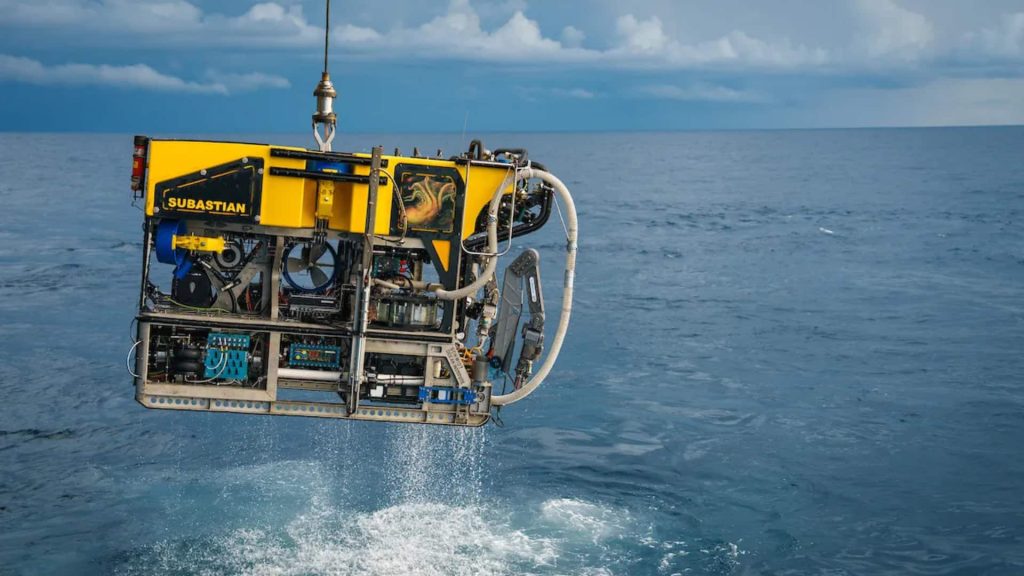
The expedition ran from the research vessel R/V Falkor (too), operated by the Schmidt Ocean Institute, using a remotely operated vehicle named SuBastian capable of working at depths down to 5,400 meters. Every dive was broadcast live on the Schmidt Ocean Institute’s YouTube channel, letting anyone watch the seafloor survey in real time rather than waiting for a published paper.
Talud Continental IV
Beyond the viral starfish, the expedition documented more than 40 species never before recorded in this stretch of the South Atlantic, including carnivorous sponges and translucent deep-sea fish. The team, drawn from CONICET, the Museo Argentino de Ciencias Naturales, and several other Argentine marine research institutes, streamed dives through August 10, 2025.
The “Batatita” Sea Cucumber and Other Viral Creatures
The estrella culona was not the only breakout star of Talud Continental IV. A small, plump sea cucumber found during the same expedition earned its own nickname, “batatita,” Spanish for “little sweet potato,” for its uncanny resemblance to the vegetable, joining a small internet tradition of deep-sea animals the public renames on sight.
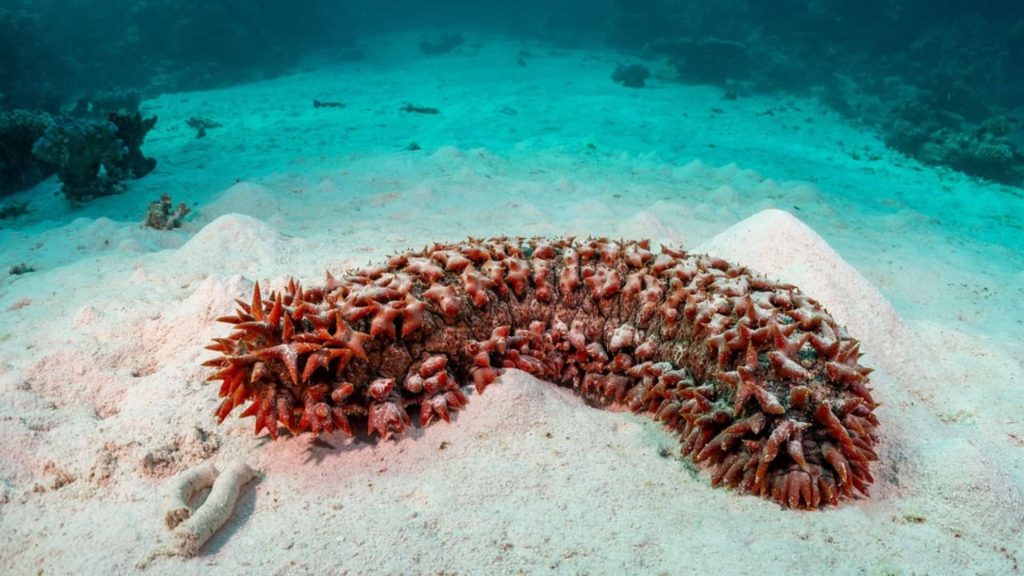
Between the two animals, a single deep-sea livestream generated two separate viral moments in one summer, an unusual outcome for a scientific survey and a reminder that a genuinely strange deep-sea creature will always find an audience online.
Why People Think the Estrella Culona Looks Like Patrick Star
The comparison to Patrick, SpongeBob’s best friend, was instant and near-universal in the livestream chat, and it is easy to see why: a plump, pinkish, roughly star-shaped animal resting on a rock face looks a great deal like a cartoon character built from the same basic outline.
The livestream comment section did not stop at “estrella culona,” either. Screenshots of the sighting later circulated online captioned everything from “starfish booty” and “starfish buttocks” to “cheeked up starfish,” “thicc starfish,” “star butt,” and even “big booty starfish,” proof that a single frame of ROV footage can spawn its own internet dialect.
That instant comparison also explains a strange pattern in search data: almost as many people now look up “real life Patrick Star,” “Patrick Star real life,” “Patrick Star in real life,” “real Patrick Star,” “sea star Patrick,” “starfish Patrick,” “what type of starfish is Patrick,” or simply “SpongeBob’s starfish” as look up the estrella culona by name. None of those searches has one clean answer. There are just two unrelated real species, covered next, that each fit part of the question.
Astrolirus patricki: The Real Starfish Named After Patrick Star
One starfish does officially carry Patrick’s name, though it looks nothing like the estrella culona. Described in 2020 by researchers Zhang, Zhou, Xiao, and Wang in the journal PeerJ, Astrolirus patricki is a spindly, seven-armed deep-sea species found on seamounts in the northwestern Pacific, between roughly 1,458 and 2,125 meters down.
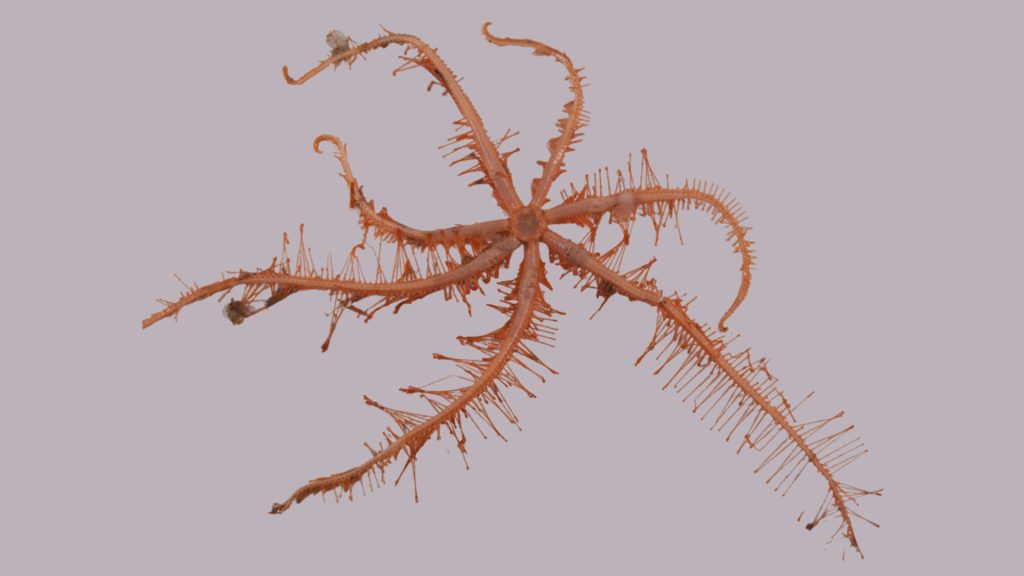
The naming had nothing to do with appearance. All five known specimens were found physically attached to deep-sea sponges, echoing Patrick’s on-screen friendship with SpongeBob, who is, after all, a sponge. It is a far more literal tribute than the round-bodied Argentine starfish, despite sharing none of its viral fame.
The 2019 Vermillion Sea Star and the Butt-Starfish Meme
Argentina’s starfish was not the first to trigger this exact reaction online. In June 2019, a photo of a vermillion sea star at the Aquarium of the Pacific went viral for an almost identical reason: its arms, contracted around a rock, created a rounded shape that read online as a human rear end.
Christopher Mah, an invertebrate zoology research associate at the Smithsonian, addressed the comparison for TIME magazine at the time, stating plainly that the shape was not anatomically what it looked like. The aquarium’s own curator gave a similar explanation separately. Six years and one ocean apart, a completely different species triggered the same joke, which says more about how people read starfish anatomy than it does about any one animal, and it likely won’t be the last viral sea star to get this treatment.
Scientists Found Another Estrella Culona
The story did not end with the 2025 headlines. During a follow-up CONICET livestream called “Vida en los extremos,” running from December 14, 2025 to January 10, 2026 off Puerto Madryn, researchers spotted a second Hippasteria specimen at roughly 1,000 meters deep.
This second estrella culona was visibly smaller than the original, and researchers joked on the broadcast that it “hadn’t done much exercise yet.” A second sighting does not establish how common the animal is in the region; nowhere near enough data exists for that. It does confirm that the original estrella culona, and now this second big-butt starfish, were not one-off flukes.
How Deep Do Trojan Star Sea Stars Live?
Across its broader range, Hippasteria phrygiana is typically documented between about 150 and 1,500 meters down, a wide span that reflects how adaptable the genus is to different cold-water habitats. The Argentine sighting, at close to 1,000 meters, sits comfortably within that known range rather than at an unusual extreme, in waters well below the sunlit surface layer of the ocean.
Is the Big-Butt Starfish Dangerous?
No. Like most deep-sea sea stars, Hippasteria phrygiana lives far below any depth reachable by swimmers or recreational divers, and like the vast majority of sea stars, it has no venom, sting, or bite capable of harming a person. It preys on invertebrates such as corals, not on anything remotely human-sized.
What Happens Next? Talud Continental V
CONICET confirmed in June 2026 that the team behind Talud Continental IV, working through the Grupo de Estudios del Mar Profundo de Argentina, will return for a follow-up expedition. Talud Continental V is currently planned to target the Ameghino and Almirante Brown submarine canyons off Chubut province, roughly 600 kilometers offshore, an area with almost no prior biological survey data.
The 23-day mission is currently scheduled for April 2027, with officials noting the timeline could move up to February, and researchers hope to reach depths beyond 4,000 meters, deeper than the original canyon dives. Whether it turns up another Hippasteria or something stranger, the livestream will likely draw a far bigger audience than the roughly 800 viewers Schmidt Ocean Institute broadcasts used to attract before 2025; Talud Continental IV itself peaked at more than 92,000 concurrent viewers, according to lead scientist Daniel Lauretta.
Related Topics
- Anatomy of Starfish — the radial body plan that explains why the estrella culona has no real “butt”
- Ferreiraella Populi: The Strange Chiton the Internet Named — another deep-sea species the public identified and nicknamed before science caught up
- The Elven Abyss Tunicate — a separate deep-sea livestream find that went viral for its unusual appearance
- Skeleton Panda Sea Squirt — another nicknamed deep-sea animal from the same wave of viral ocean discoveries
- Sagami Bay Creature — a different deep-sea livestream mystery that captivated online audiences
- How Scientists Name a New Species — the formal process the estrella culona never actually went through
- Red-Lipped Batfish Facts — another real, unedited animal regularly mistaken for something fake online
Frequently Asked Questions About the Estrella Culona
What is the big-butt starfish called?
Online, it is called the estrella culona, Spanish for “big-butt star.” That is an informal nickname, not a scientific name.
What is the big-butt starfish’s scientific name?
No confirmed scientific identification exists for this exact specimen. Biologists interviewed after the 2025 sighting proposed Hippasteria phrygiana as the likely species, with the caveat that further study would be needed to confirm it.
What does Estrella Culona mean in English?
It translates to “big-butt star,” a nickname livestream viewers gave the animal because of its rounded central disc.
Is the big-butt starfish a new species?
No. It is not a newly discovered species; it became viral for its appearance, not for being unknown to science.
Where was the big-butt starfish found?
It was filmed in the Mar del Plata submarine canyon, roughly 300 kilometers off Argentina’s Atlantic coast, during the Talud Continental IV expedition in July 2025.
Why does the starfish look like it has a butt?
A combination of a well-fed central disc, gravity pulling the disc downward on a vertical rock face, and a camera angle that hid two of its five arms created the illusion.
Do starfish have butts?
No. Starfish have radial symmetry with no front, back, or rear end; their mouth sits on the underside and their anus sits at the center of the upper surface.
Is the big-butt starfish dangerous?
No. It lives far below any depth reachable by people and has no venom or bite that poses a risk to humans.
How big does the Estrella Culona starfish get?
Estimates vary by source, from about 20 centimeters across in general species references to closer to 30 centimeters in some Argentine media reports. Neither figure has been independently verified for this specific animal.
Did scientists find another big-butt starfish?
Yes. A second, smaller specimen, sometimes called the December 2025 starfish, was filmed during a follow-up CONICET livestream off Puerto Madryn, at roughly 1,000 meters deep.
What do Hippasteria starfish eat?
They are active predators that feed mainly on cnidarians such as soft corals, along with other slow-moving invertebrates, using an eversible stomach to digest prey outside their body when needed.
How deep do trojan star sea stars live?
Hippasteria phrygiana is typically found between about 150 and 1,500 meters deep across its known range.
Was the big-butt starfish photo real or edited?
Yes, it was real. The footage came from a live ROV broadcast during an official CONICET and Schmidt Ocean Institute expedition, not an edited or staged photo.
Is there a real starfish that looks like Patrick Star?
Not exactly, but a real species, Astrolirus patricki, was officially named after him in 2020, based on its habit of attaching to sponges, not its appearance.
Is a starfish a mammal or a crustacean?
Neither. Starfish are echinoderms, a group that also includes sea urchins and sand dollars, and they are not closely related to mammals or crustaceans at all.
What is the biggest starfish in the world?
The estrella culona is nowhere near being the largest starfish in the world. That title goes to Midgardia xandaros, at roughly 134 centimeters across by arm span, followed by the sunflower sea star, Pycnopodia helianthoides, at up to about a meter across; both dwarf the roughly 20 to 30 centimeter estrella culona.
Source References
- CONICET, “Transmisión en vivo a 3.900 metros de profundidad” — conicet.gov.ar (2025)
- Schmidt Ocean Institute, “Underwater Oases of the Mar Del Plata Canyon” — schmidtocean.org (2025)
- World Register of Marine Species, “Hippasteria phrygiana (Parelius, 1768)” — marinespecies.org (accessed 2026)
- Infobae, “Qué se sabe sobre la estrella de mar ‘culona’ hallada en Mar del Plata” — infobae.com (July 31, 2025)
- Smithsonian Ocean, “Echinoderms: Sea Stars, Urchins, Sand Dollars, and Relatives” — ocean.si.edu (2024)
- Zhang, Zhou, Xiao & Wang, “A new sponge-associated starfish, Astrolirus patricki sp. nov.” PeerJ — peerj.com (May 27, 2020)
Author Bio
Evan Brooks, author at StrangeHappen.com, writes about strange events, unexplained mysteries, unusual wildlife, ancient discoveries, and the science behind stories that seem almost too strange to be true. He enjoys digging through old reports, forgotten cases, and unusual claims to uncover what really happened.
His work looks beyond the mystery without taking away the sense of wonder. From eerie encounters and unexplained phenomena to bizarre creatures and ancient secrets, he separates documented facts from rumors, legends, and internet fiction.