
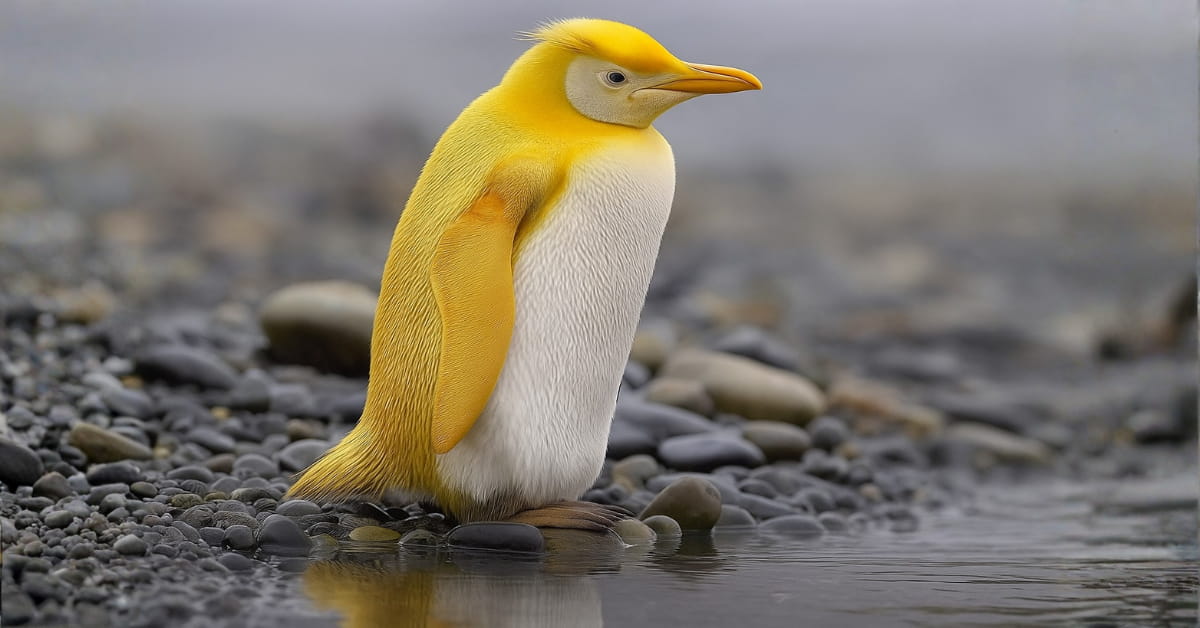
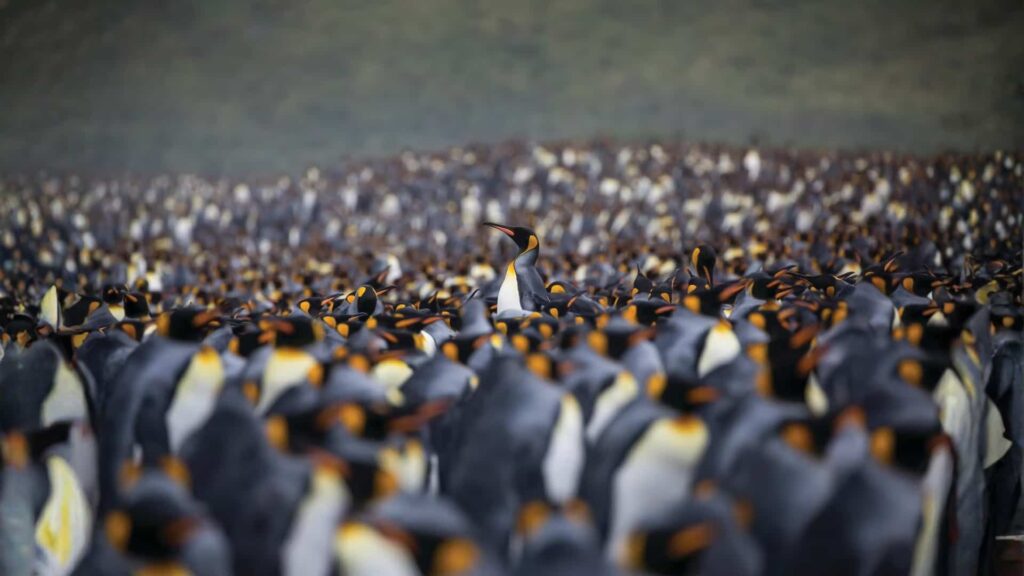
A wildlife photographer dropped his safety gear on a beach in the South Atlantic and grabbed his camera instead. Among 120,000 black-and-white king penguins stood one bird glowing pale gold, and At the time, nobody could say exactly why its feathers looked so different.
That bird became the world’s most famous “golden penguin,” also commonly called a yellow penguin. Years later, scientists still disagree about exactly what caused its extraordinary coloration.
What Is a Golden Penguin, and Where Was It Found?
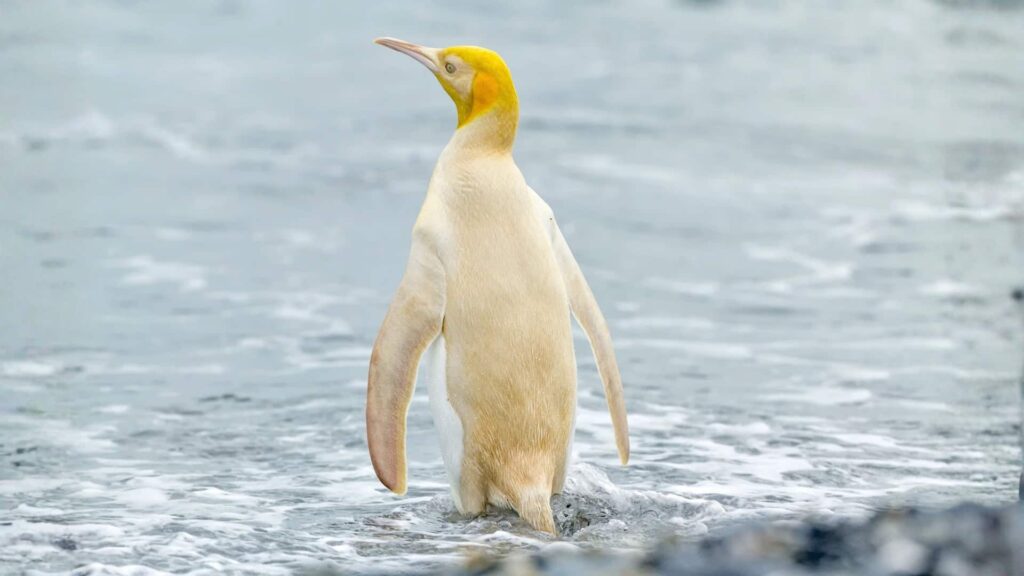
In December 2019, Belgian wildlife photographer Yves Adams was leading a two-month photography expedition through the South Atlantic. He and his group landed at Salisbury Plain on South Georgia Island, a remote sub-Antarctic outpost roughly 1,200 miles east of the southern tip of South America. This South Georgia yellow penguin sighting would become the defining photograph of Adams’s career.

Salisbury Plain hosts one of the largest king penguin colonies on Earth, sometimes numbering more than 100,000 birds. South Georgia itself has no permanent human population and almost no native land predators, which is part of why it supports such enormous seabird gatherings in the first place; whatever rare traits show up in a colony this size are far more likely to actually be seen than the same traits appearing somewhere quieter. Adams was unloading equipment when a group of penguins came swimming toward shore. One of them looked wrong. Instead of the usual black head and silvery back, this king penguin wore a coat of pale cream and lemon yellow, right down to its feet.
“I’d never seen or heard of a yellow penguin before. There were 120,000 birds on that beach, and this was the only yellow one there,” Adams told Kennedy News & Media, in comments later carried by Live Science and Smithsonian magazine. Adams’s photograph quickly became the defining image of the story. He and his group dropped their gear on the sand and started shooting.
By- Jungle Jordan
The photos didn’t surface publicly until early 2021, when Adams shared them online. Within days, “yellow king penguin” and “rare yellow penguin” were both trending search terms, and marine biologists were fielding calls from reporters who wanted an explanation nobody had ready.
Golden Penguin Facts
Before getting into what made this particular bird so unusual, it helps to know what a normal king penguin actually looks like and how the species lives. Here’s the quick king penguin species snapshot:
- Scientific name: Aptenodytes patagonicus
- King penguin size: the second-largest living penguin species, after the emperor penguin, standing roughly 85–95 cm tall and weighing 11–18 kg depending on sex and season
- King penguin habitat: breeds on subantarctic islands, including South Georgia, the Falklands, Crozet, Kerguelen, and Macquarie Island, usually in enormous, densely packed colonies
- King penguin diet: mainly fish, especially lanternfish, supplemented with squid and crustaceans, caught on deep foraging dives that can reach 300 meters or more
- King penguin breeding: an unusually long breeding cycle compared with most other penguin species, meaning pairs often can’t raise a chick every single year
- King penguin lifespan: roughly 15–26 years in the wild
- King penguin behavior: generally tolerant of odd-looking colony members, as this story itself illustrates
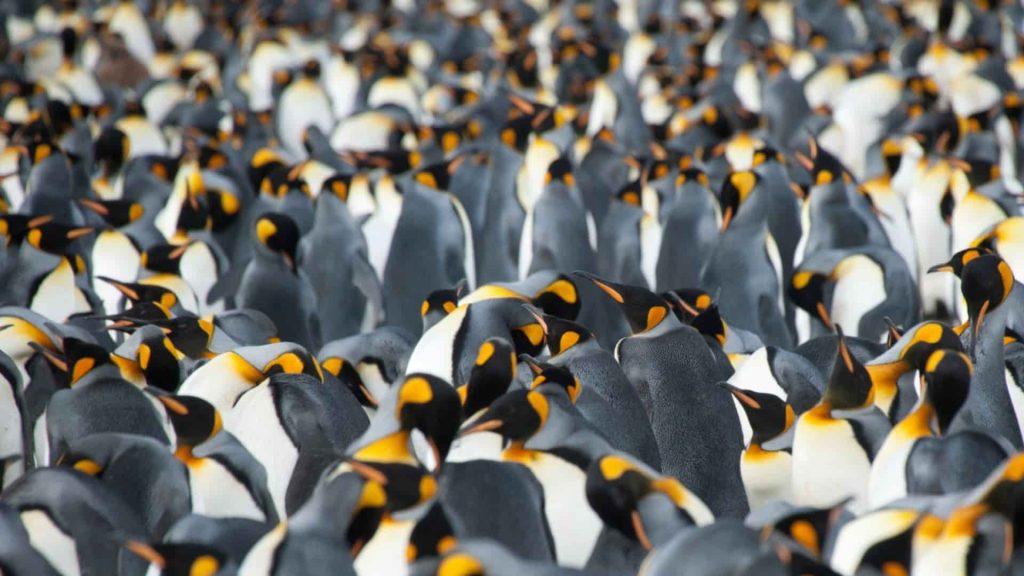
- Normal king penguin colors: a black head, chin, and throat, with vivid orange-yellow ear and neck patches — the exact pigment pattern the 2019 bird departed from
- Conservation status: Least Concern on the IUCN Red List, with a global population in the millions of breeding pairs
That last point matters for the rest of this story: South Georgia penguins aren’t rare. What happened to one particular bird’s pigment is.
What Scientists Discovered About the Yellow Penguin’s Color
King penguins normally get their look from two separate pigment systems working at once, and understanding penguin pigmentation is key to understanding what made this bird so unusual. Black, grey, and brown feathers come from melanin, the same pigment responsible for dark hair and skin in mammals. The bright orange-yellow neck patches, part of the bird’s normal feather pigmentation and plumage, come from a completely different chemical.
That second pigment wasn’t even identified until 2013. A team led by ornithologist Daniel Thomas, now at Massey University in New Zealand, used Raman spectroscopy to analyze the yellow feathers of king and macaroni penguins and found a signature that matched nothing in the existing king penguin pigment libraries. They named the new compound spheniscin, after Spheniscidae, the penguin family. According to the published study in the Journal of the Royal Society Interface, spheniscin appears to represent an entirely separate, sixth class of feather pigment, distinct from the more familiar carotenoid pigment family found in most other yellow and orange birds, and one found in no other bird family on the planet.
That detail is central to this case, though it needs to be stated carefully. Melanin and spheniscin are produced through different biological pathways, so a disruption to one does not automatically affect the other. The bird’s appearance is consistent with a disruption of normal melanin pigmentation, while its yellow-orange spheniscin pigment remained visibly intact. No published source has directly confirmed the precise genetic mutation involved, so that explanation should be read as the leading interpretation rather than a proven mechanism.

Color aberrations of this scale are genuinely rare in king penguins. A long-term survey published on ResearchGate recorded only 19 cases of color aberration or physical deformity across decades of observation at the Crozet Islands colony, one of the largest and most closely studied king penguin populations in the world.
Leucism vs Albinism: The Debate Over the Yellow Penguin
Once the photos went viral, the scientific argument split almost immediately into two camps, and it never fully resolved.
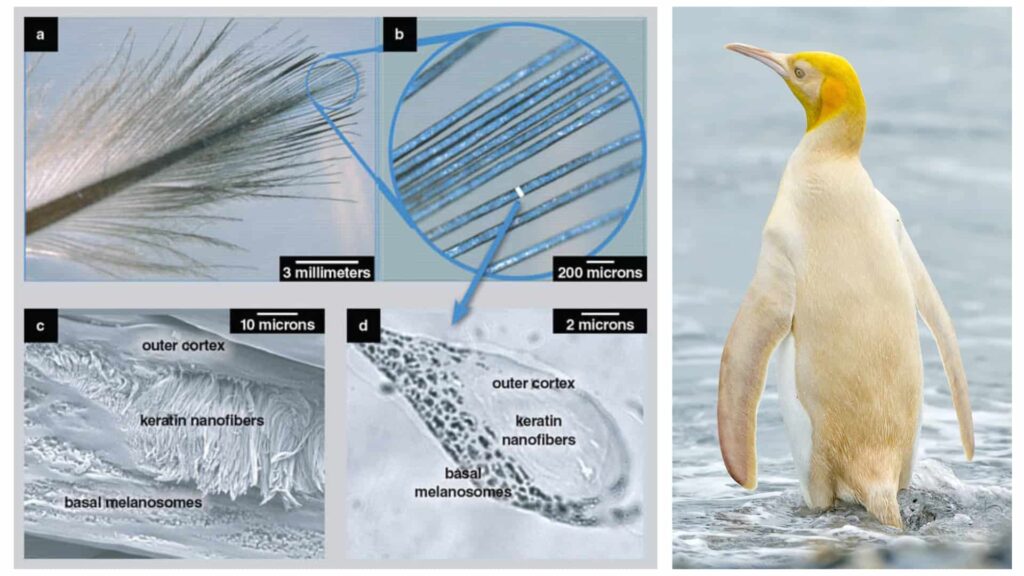
Dee Boersma, a conservation biologist at the University of Washington, told reporters the bird was most likely a leucistic penguin, a condition where pigment cells fail to develop properly across part of the body, leaving some areas pale while others keep normal color. She pointed to a faint rusty tinge still visible on the bird’s back as evidence that some melanin was still present, just not enough to darken the feathers fully.
Kevin McGraw, an integrative behavioral ecologist at Arizona State University, disagreed that it was simply a leucistic penguin. He argued the bird looked closer to an albino penguin, since it appeared to lack melanin in its plumage, feet, and eyes almost entirely. As McGraw put it to Live Science at the time, distinguishing the two conditions with certainty would require actual feather samples for biochemical testing, something nobody collected, because the bird was never captured or tagged.

A third expert added a wrinkle that most outlets never picked up. Hein van Grouw, an ornithologist at the Natural History Museum in Tring, told Audubon he wouldn’t call the bird a leucistic penguin at all. Because it still carried a rusty tone on its back, van Grouw suspected its melanin simply never finished oxidizing into its normal dark shade, a condition Europeans typically call “ino” rather than leucism, a term used more loosely in the United States to cover a wider range of pigment loss.
Here’s how the three conditions actually differ, in plain terms:
| Condition | Basic meaning | Melanin | Eyes | Typical appearance |
|---|---|---|---|---|
| Leucism in penguins | Reduced or absent pigmentation in some or many feathers | Reduced or patchy | Usually normal | White or pale feathers with some normal coloration remaining |
| Albinism | Melanin production is absent or severely disrupted | Absent or severely reduced | Often affected (pink/red) | Very pale, near-white appearance overall |
| Melanism | Excessive dark pigmentation | Increased | Usually normal | Unusually dark or fully black appearance |
So, is the yellow penguin real, and is it leucistic or albino? It’s unquestionably real and unquestionably photographed, but it cannot be definitively classified from photographs alone. Every scientist who examined the images agrees the bird’s appearance was consistent with disrupted melanin pigmentation. None of them agree on the precise classification, because the one piece of evidence that would settle it, a physical feather sample, was never collected in the field. That gap is exactly why this remains an open scientific interpretation rather than a closed case.
Why It Matters: What Color Mutations Reveal About Wildlife
A single strange-colored bird might look like a curiosity, but it’s also a live demonstration of how fragile pigment pathways can be, even in a species scientists have studied for over a century.
Van Grouw noted the mutation behind conditions like this is typically recessive. Based on that, one expert suggested it may have been a young female, since recessive traits like this can pass more easily through female lineage in some bird species. Nobody has confirmed the bird’s sex, survival, or breeding history; all three remain unknown.
To make the contrast concrete, here’s how the 2019 bird compared with a typical member of its own species:
| Feature | Normal King Penguin | Yellow Penguin |
|---|---|---|
| Species | Aptenodytes patagonicus | Aptenodytes patagonicus |
| Dark plumage | Normal, produced by melanin | Greatly reduced or altered |
| Yellow-orange pigment | Present in ear/neck patches only | Remains visually prominent across more of the body |
| Head/neck appearance | Dark with orange-yellow patches | Much paler overall, with the yellow tone dominating |
| Status | Normal coloration | Rare color abnormality |
| Separate species? | No | No — same species, same genome, different pigmentation |
Color also carries real social weight in this species. King penguins use their neck patches in mate selection, and past experiments removing the colored feathers found that dulled-down males had noticeably more trouble attracting a partner, a pattern National Geographic also flagged when covering this same bird. Observers who watched Adams’s bird move through the colony reported it behaving normally among its black-and-white neighbors. It’s a pattern StrangeHappen has covered before in a very different animal: our piece on why some beluga whales are naturally white looks at a case where unusual coloring is normal for the species rather than a mutation at all.
None of this happens against a backdrop of population decline, which is worth noting given the species’ Least Concern status covered above. A rare pigment mutation surfacing in a thriving, closely watched colony is far more likely to actually get photographed and studied than the same mutation appearing in a small or declining population, where far fewer eyes are present to notice it. It also raises the question we explored in our breakdown of how animal camouflage works and fails: losing your normal coloring can mean losing camouflage too, which is why aberrant-colored animals are more often reported in safe, predator-light environments like South Georgia than places where standing out gets you eaten first.
The Sequel Nobody Expected: A Melanistic King Penguin
Here’s the part almost no article on this topic mentions: Yves Adams went looking for his yellow penguin again, and found something rarer instead.
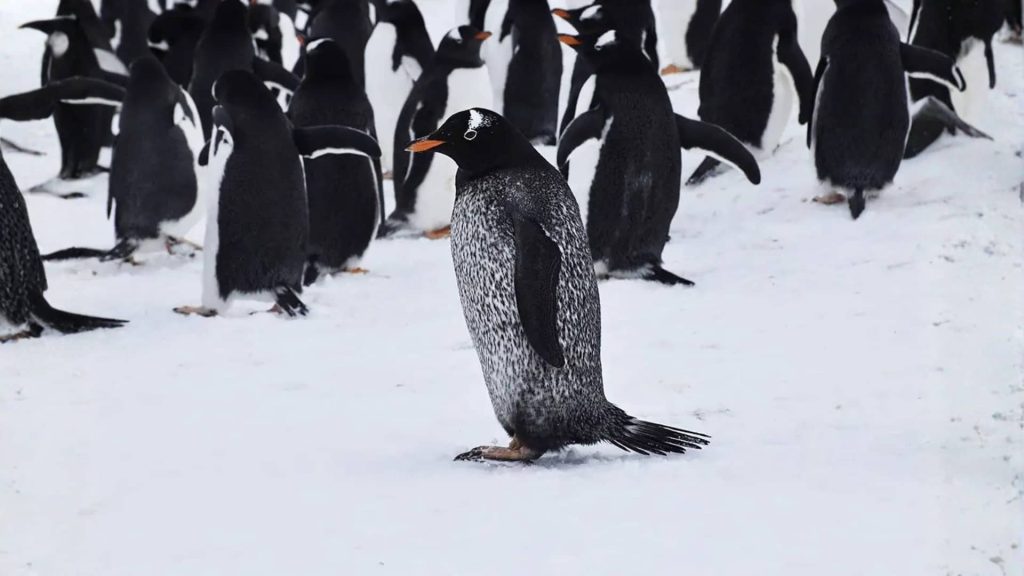
In November 2024, Adams returned to South Georgia on another expedition, this time landing at St Andrews Bay. A fellow photographer flagged an unusual bird in the colony, and Adams rushed over before it could vanish into the crowd. What he found wasn’t yellow at all. This Yves Adams black penguin discovery was a melanistic king penguin, a bird with an excess of melanin instead of a deficiency, its entire body soaked in black rather than the usual white belly and orange collar. A black king penguin like this looks like the visual opposite of the 2019 bird: one had almost no visible melanin, this one appeared to have far too much. The two birds provide striking examples of very different pigmentation abnormalities in the same species, though no published research has directly compared the two cases at a genetic level.
“I don’t believe anyone has seen this all black penguin before,” Adams said in comments carried by IFLScience. He described the bird’s neck and belly markings as showing a metallic green sheen up close, something invisible from a distance where the plumage simply reads as pure black. Researchers estimate partial melanism in penguins occurs at roughly one in 250,000 individuals, though that figure, like the yellow-penguin rarity estimates below, comes from limited observational data rather than a large-scale genetic survey, and a fully melanistic penguin like this one is likely rarer still, with essentially no prior documentation to compare it against.
Adams told IFLScience the melanistic penguin was “completely accepted by the other birds,” feeding and moving through the colony without difficulty. Between the 2019 yellow penguin and the 2024 melanistic king penguin, Yves Adams has now photographed two of the most striking penguin color mutations on record, in the same species, at the same island, within a five-year span.
Future Research: Open Questions About Rare Penguin Colors
Several genuine gaps remain open, and none of them have tidy answers yet.
No feather or blood sample exists from the original 2019 yellow penguin, so the leucism-versus-albinism-versus-ino debate may never be settled with certainty. Nobody has confirmed whether the bird survived to breeding age, found a mate, or passed the trait to any chicks. With a second, entirely different pigment anomaly now documented in the same colony type five years later, researchers still don’t have enough data to say whether South Georgia’s king penguins carry an unusually high rate of these mutations, or whether photographers are simply spending more time there than a generation ago.

There’s also a numbers problem nobody has fully reconciled. Some outlets have cited rarity figures as different as one in 30,000 and one in 140,000 for a color-aberrant king penguin, while the only long-term peer-reviewed count on record found just 19 cases across decades at a single colony. These numbers should not be read as if they measure exactly the same phenomenon. They may reflect different types of pigmentation abnormalities, different penguin populations, different observation periods, or different definitions of what counts as a “color aberration” in the first place, an individual sighting is not the same statistic as a documented case count. There is no single scientifically established “1 in X” probability for a yellow king penguin; published and media estimates vary because they measure different populations, abnormalities, or observation methods, not because any one of them has been disproven. For context on just how carefully researchers track individual wild animals once something unusual turns up, our explainer on how scientists name and document a new species covers the same verification process from the other direction.
Related Topics
- Why Some Beluga Whales Are Naturally White — a different kind of pigment story, where unusual coloring is normal rather than a mutation
- How Animal Camouflage Works, and Fails — how losing normal coloring affects an animal’s ability to hide from predators
- 10 Newly Discovered Species Scientists Only Just Found — other rare wildlife finds that stunned researchers
- How Scientists Name a New Species — the process researchers use to verify and document an unusual animal
- The Glowing Blue Spider That Surprised Scientists in Angola — another wild coloring story that puzzled experts on discovery
- Meet the Chinese Giant Salamander, One of the World’s Rarest Amphibians — a look at another critically rare animal and what makes it so hard to find
Key Takeaways
- The original yellow penguin is a king penguin (Aptenodytes patagonicus) photographed by Yves Adams at Salisbury Plain, South Georgia Island, in December 2019.
- Its appearance is consistent with a disruption to normal melanin pigmentation, while its yellow spheniscin pigment, discovered in 2013, remained visibly intact; the exact genetic mechanism has not been confirmed by direct testing.
- Scientists remain split on whether the bird is a true leucistic penguin, an albino one, or a third condition called “ino”; it cannot be definitively classified from photographs alone, since no feather sample was ever collected.
- There is no single agreed-upon rarity figure for a yellow king penguin, published estimates range from roughly 1 in 30,000 to 1 in 140,000, and a separate peer-reviewed survey found 19 documented color-aberration cases across decades at one major colony.
- In November 2024, the same photographer found an equally rare melanistic king penguin at South Georgia, an all-black bird representing a very different pigmentation abnormality in the same species.
Frequently Asked Questions About the Yellow Penguin
Is the yellow penguin real?
Yes, are yellow penguins real is one of the most common questions this story generates, and the answer is unambiguous. Yves Adams photographed the bird among a colony of roughly 120,000 king penguins on South Georgia Island in December 2019, and the sighting was independently corroborated by ornithologists who reviewed the original images.
Why is the yellow penguin yellow?
This is really the question of what causes a penguin to turn yellow in the first place. Its appearance is consistent with a disruption to normal melanin pigmentation, the pigment responsible for black and grey feathers, while a separate compound called spheniscin, responsible for the bird’s natural yellow-orange patches, remained visibly intact. Scientists never obtained a genetic sample, so the exact mutation remains unknown.
Is the yellow penguin leucistic or albino?
Experts disagree, and it cannot be definitively classified from photographs alone. Dee Boersma called it a leucistic king penguin because faint pigment remained on its back. Kevin McGraw argued it looked closer to an albino penguin due to near-total melanin loss. A third expert, Hein van Grouw, preferred the term “ino.” No feather sample was ever collected to settle it.
What species is the yellow penguin?
It’s a king penguin, Aptenodytes patagonicus, the same species as every normally colored bird around it. The unusual coloring is a pigmentation abnormality, not a different species or subspecies.
Is the yellow penguin a different species?
No. Are yellow penguins a separate species from ordinary king penguins? Not according to any source covering this bird, it’s the same species as any other king penguin on South Georgia. The color difference is consistent with disrupted pigmentation, not with any taxonomic distinction.
How rare is a yellow penguin?
Extremely rare, though there is no single scientifically established rarity figure. A published survey recorded only 19 color-aberration cases across decades at one major king penguin colony, while media estimates for a yellow king penguin specifically have ranged from roughly 1 in 30,000 to 1 in 140,000. Adams himself said this was the only yellow bird among 120,000 penguins on the beach that day.
Where was the yellow penguin found?
It was found at Salisbury Plain, a beach on South Georgia Island in the South Atlantic Ocean, home to one of the world’s largest king penguin colonies.
What is spheniscin?
Spheniscin is a pigment identified in 2013 that produces the yellow-orange coloring in penguin feathers. Researchers found it represents a distinct pigment class not found in any other bird family, separate from the carotenoid pigments that color most other yellow birds.
Can a leucistic penguin survive in the wild?
Observers reported the 2019 bird moving normally through its colony without being rejected, and researchers who study color-aberrant birds generally note that many survive to adulthood. Reduced camouflage from predators is a theoretical risk, but it hasn’t been confirmed for this specific bird.
Do leucistic penguins find mates?
Possibly, but it’s unconfirmed for this bird. Studies on king penguin plumage show that dulled or altered coloring can make it harder for a male to attract a mate, since neck-patch color plays a role in mate selection. Whether the 2019 bird ever bred has not been documented.
Has the yellow penguin been seen again?
Not confirmed. What is documented is that Yves Adams, the same photographer, returned to South Georgia and photographed a different rare bird in November 2024: an extremely rare melanistic king penguin at St Andrews Bay.
What happened to the yellow penguin?
Its fate afterward isn’t documented. It was never tagged or tracked, so there’s no confirmed record of whether it survived long-term, found a mate, or produced offspring.
What is a melanistic penguin?
A melanistic penguin has an excess of melanin rather than a deficiency, resulting in unusually dark or fully black plumage instead of the species’ normal black-and-white pattern. It’s essentially the opposite visual effect from leucism or albinism.
Was the 2024 black penguin found by Yves Adams?
Yes. Adams photographed the melanistic king penguin at St Andrews Bay on South Georgia Island in November 2024, five years after his original yellow penguin sighting at Salisbury Plain.
About Author
About the Author Mubashir Razzaq is a science and history writer for Strangehappen.com, specializing in archaeology, space exploration, ancient civilizations, and emerging scientific discoveries. His work focuses on translating complex research into engaging, evidence-based stories that help readers understand the mysteries of our world and beyond.
Sources & References
- Live Science — “There’s a rare yellow penguin on South Georgia island, and biologists can’t quite explain it” (Feb 22, 2021)
- National Geographic — “Yellow penguin spotted in Antarctica, here’s why it’s so rare” (2021)
- National Geographic — King Penguin species facts (size, weight, lifespan, IUCN status)
- Smithsonian Magazine — “Rare Yellow Penguin Photographed for the First Time” (Feb 23, 2021) —
- Audubon — “Rare Yellow Penguin Bewilders Scientists” (Mar 2021)
- IFLScience — “Leucism Or Albinism? Incredibly Rare Yellow Penguin Has Scientists Scratching Their Heads”
- IFLScience — “Incredible Footage Shows Ultra Rare All-Black King Penguin On South Georgia Island” (Nov 2024)
- Journal of the Royal Society Interface — Thomas et al., “Vibrational spectroscopic analyses of unique yellow feather pigments (spheniscins) in penguins” (2013)
- PubMed — indexed record of the same spheniscin study (2013)
- American Scientist — “The Penguin’s Palette: More Than Black and White” (plain-language explainer of the spheniscin research)