

A snow leopard can lie across a rock slope in full view of a herd of blue sheep and go completely unnoticed. A stonefish can rest on the seabed for hours while swimmers step past it, then deliver one of the most painful stings in the ocean. So why do animals use camouflage this precise? Because in the wild, being noticed a moment too late is often the difference between eating and being eaten, and camouflage animals have spent millions of years turning invisibility into one of evolution’s most effective survival tools.
This guide walks through what camouflage actually is, the specific mechanisms behind it, and 12 of the animal kingdom’s most striking examples, from a moth that helped prove Darwin right to two deep-sea creatures that switch their disguise strategy in the blink of an eye. Along the way, it also corrects a camouflage claim that recent research has actually disproven.
Table of Contents
What Is Camouflage?
Camouflage is any trait or behavior that helps an organism avoid detection, recognition, or accurate identification, whether by matching a background, breaking up its outline, or resembling something else entirely. Researchers use several overlapping terms to describe how this works, including crypsis, for avoiding detection altogether, and masquerade or mimesis, for being seen but mistaken for something uninteresting, such as a leaf or a twig. Biologists don’t always draw the line between these terms the same way, but together they cover most of what people mean by animal camouflage.
Not every one of the animals that use camouflage relies on the same trick. Some are born with fixed coloration that never changes. Others can shift pattern, color, or even body shape within seconds. Understanding the different mechanisms at work is what separates a surface-level list of camouflage animals from a real picture of how the strategy actually functions.
Types of Camouflage Explained
Background Matching
The simplest and most common of the types of camouflage is background matching, where an animal’s coloring closely resembles its habitat. A moth resting on bark, a hare in snow, and a frog on moss are all animals that use camouflage this way, sometimes called concealing coloration.
Disruptive Coloration
Disruptive coloration uses bold patterns, spots, or stripes to break up an animal’s outline rather than match the background exactly. A leopard’s rosettes and a snow leopard’s dark blotches work this way, scattering the visual signal a predator’s brain uses to pick out a solid shape.
Countershading
Countershading is common among ocean animals and works with light itself rather than pattern. A darker back and a lighter belly cancel out the natural shadow cast by sunlight from above, so the animal reads as flatter and less three-dimensional from any angle. Dolphins and many sharks rely on this exact pairing, dark above and pale below, to stay harder to spot from the surface looking down and from underneath looking up, which is why the same basic pattern shows up independently across so many unrelated ocean species.
Disguise and Masquerade
Some disguise specialists do not just match a color, they impersonate an object entirely. Leaf insects, dead leaf moths, and leaf-tailed geckos are masquerading as something inedible or uninteresting rather than blending into a general backdrop.
Mimicry
Mimicry is when one species imitates another, usually a dangerous or unpalatable one, to borrow its protection. The mimic octopus takes this further than almost any other known animal by switching between several different impersonations depending on which predator is nearby, making it one of the most studied animals that use camouflage as active deception rather than passive concealment.
Not all mimicry works by hiding, though. Some mimics, such as fireflies that copy another species’ flash pattern to lure in prey, depend on being noticed rather than avoiding it. That is why biologists generally treat mimicry as a broader category that often overlaps with camouflage rather than a fixed subtype of it.
Active Color and Pattern Change
A smaller number of species, including chameleons, cuttlefish, and octopuses, can physically change their color or pattern in real time using specialized skin cells, a mechanism the Smithsonian Ocean program has documented closely in cephalopods. This is called active or adaptive camouflage, and it later resurfaces in an extreme form among deep-sea camouflage specialists that switch their entire strategy depending on the light hitting them.
Motion Camouflage
Camouflage is not only about color. Some stick insects sway from side to side to imitate a twig moving in the wind, a behavior researchers at the University of Melbourne and La Trobe University confirmed is not random. Writing in the journal Behavioral Ecology, Xue Bian and colleagues found the insects’ sway frequency tracked the wind’s variability rather than firing on a fixed rhythm, which is what makes the movement convincing rather than mechanical.
12 Camouflage Animals and the Science Behind Their Disguise
Chameleon
How does a chameleon change color? Not the way most people assume. Researchers at the University of Geneva found that panther chameleons shift color by actively tuning the spacing of guanine nanocrystals inside a skin layer called the iridophore, not by mixing pigments the way most animals do. The finding, published in Nature Communications, has since become a reference point for structural-color research well beyond reptiles.

Widening that crystal lattice shifts reflected light from blue toward red, which is why an excited chameleon can flash yellow or orange within seconds. The genuinely surprising part is that this rapid color change evolved mainly for social signaling, rivalry displays and courtship, rather than concealment. A resting chameleon’s everyday khaki-green tone, not its dramatic color shifts, is what actually keeps it hidden in foliage.
Cuttlefish
Cuttlefish are often called the chameleons of the sea, though as animals that use camouflage they outperform actual chameleons by a wide margin. Their skin contains chromatophores, sacs of pigment controlled directly by the nervous system, layered above light-reflecting iridophores that can shift a cuttlefish’s entire appearance in under a second.

What makes cuttlefish remarkable is that they do this despite lacking the kind of color vision most vertebrates rely on, since their eyes appear to have only a single type of light-sensitive receptor. Live Science has reported that one proposed explanation is a phenomenon called chromatic aberration, in which a cuttlefish’s unusual W-shaped pupil could let it distinguish wavelengths of light indirectly. Researchers still treat this as an open question rather than a confirmed mechanism. The same chromatophores also do double duty beyond camouflage, since cuttlefish reuse them for visual communication with other cuttlefish, shifting patterns to signal mood or courtship rather than to hide.
Leaf-Tailed Gecko
Native to Madagascar, the leaf-tailed gecko does not just match the brown and gray tones of tree bark, it replicates the bark’s texture down to fringed skin flaps along its jaw and limbs that erase its shadow outline against the trunk. It can remain motionless for hours at a stretch, a trait many animals that use camouflage share, since stillness often defeats a predator’s motion-detecting vision more reliably than color ever could.

Stick Insect
Stick insects, or phasmids, resemble twigs and leaves so closely that some tropical species stretch past 12 inches without losing the illusion. The visual disguise is only half the strategy. As covered above, the swaying behavior documented in Behavioral Ecology shows these insects actively calibrate their movement to match nearby foliage, adding a motion-based layer on top of one of the oldest types of camouflage in the insect world.

Snow Leopard
The snow leopard’s smoky gray coat and open black rosettes break up its silhouette against the rock and snow of Central Asia’s high mountains, earning it the nickname “ghost of the mountains” from conservationists at the Snow Leopard Trust. Because its high-altitude habitat offers almost no vegetation to hide behind, the cat depends on its coat more heavily than most big cats do.

One detail most camouflage roundups skip entirely: several genetic studies over the past decade or so have placed the snow leopard’s closest living relative as the tiger, not the spotted leopard it resembles and shares a name with, though a few other analyses have grouped the big cats differently, and Panthera phylogeny is still being refined. If the tiger connection holds, the similar rosette pattern would be a case of convergent evolution, two lineages arriving independently at a similar solution to the same visual problem.
Mimic Octopus
First documented off Sulawesi, Indonesia, in 1998, the mimic octopus is known for impersonating more than a dozen other species, including venomous lionfish, banded sea snakes, and flatfish, according to National Geographic. It lives on open, exposed sand flats where there is nowhere to hide, so instead of concealment it relies on convincing a predator it is something far more dangerous to eat.

Marine biologist Mark Norman, who first described the species, has explained that when caught in the open the octopus effectively has to choose between looking deadly or looking inedible, and its chromatophore-driven color changes let it pick whichever role fits the threat in front of it. Few other animals that use camouflage are known to switch between this many distinct impersonations.
Dead Leaf Moth
The dead leaf moth’s folded wings mimic a curled, decaying leaf so precisely that the illusion includes fake vein lines, blotches resembling fungal rot, and irregular, torn-looking edges. It rests with its wings closed by day and only becomes active at night, one of several animals that use camouflage timed to nightfall rather than to a fixed backdrop, when most visually hunting predators are less of a threat.

Leaf Insect
Leaf insects go further than most masquerading species, flattening their bodies and legs into shapes that mimic actual leaf lobes, complete with vein patterns down each wing. Some individuals even display blotches that resemble insect bite damage or early decay, details with no function other than making the disguise more convincing to a predator scanning for anything unusually smooth or symmetrical.

Stonefish
According to the Australian Museum, the reef stonefish is widely considered one of the most venomous fish in the world, delivering venom through thirteen dorsal spines that cause severe pain and, without prompt treatment, can occasionally be fatal. Its camouflage is so complete, resembling an encrusted rock or coral lump down to the color and texture, that most stings happen because someone accidentally stepped on one rather than handled it directly, a risk shared by other ambush-hunting animals that use camouflage instead of speed to catch prey. For a closer look at exactly how this ambush strategy plays out, see the full stonefish profile.
Peppered Moth
The peppered moth is one of the most cited examples in the teaching of evolution, and for good reason. During the Industrial Revolution, soot darkened tree bark across British woodlands, and a naturally occurring dark form of the moth, called melanic, began to outnumber the pale form because it was better camouflaged against the blackened bark. This shift, known as industrial melanism, was first documented through mark-release-recapture experiments run by biologist Bernard Kettlewell in the 1950s, as described by the Oxford University Museum of Natural History.

A 2018 study in Communications Biology by Olivia Walton and Martin Stevens, later revisited in a 2025 research summary, used bird-vision modeling and real predation trials to test the idea directly: pale moths had a measured 21 percent survival advantage over dark moths when set against lichen-covered bark. A separate peer-reviewed review in Heredity traces the full history of the case, including the criticisms it weathered and the follow-up work that ultimately reinforced it. As air pollution declined and lichen returned after clean air legislation, the pale form became dominant again, giving researchers one of evolution’s more directly observed reversals. A 2026 bioRxiv preprint, which has not yet been through peer review, has since reported that peppered moth populations in continental Europe evolved dark coloration through different genetic mutations than the ones documented in Britain, suggesting the same visible outcome can arise more than one way at the genetic level.
Arctic Fox
The Arctic fox is one of the few mammals that fully swaps its camouflage strategy by season rather than relying on one fixed coat. Its thick white winter fur matches the snowpack of its tundra habitat, then molts into a thinner brown or gray coat each summer that blends with exposed rock and vegetation once the snow melts.

That seasonal switch depends on timing closely matching the local snow cycle, which is why researchers are actively studying whether climate change could create a mismatch. An earlier spring thaw or later first snowfall could, in principle, leave a fox in the wrong-colored coat at the wrong time, though how much this actually affects survival in the wild is still being measured rather than settled.
Great White Shark
Great white sharks use textbook countershading, a dark gray back and a white belly that cancel out their silhouette from above and below, the same basic principle used by dolphins and many other open-ocean predators. But researchers studying sharks off South Africa have found preliminary evidence that great whites may take this further than any other known shark.

Using a floating color-reference board, marine biologists Ryan Johnson and Enrico Kuguru photographed the same individual sharks appearing both notably darker and notably lighter within the same day, according to National Geographic. Skin samples showed that great white melanocytes, the pigment-holding cells in their skin, visibly contracted and lightened when exposed to adrenaline in lab tests. Shark researcher Gregory Skomal has cautioned that this remains preliminary and needs a more structured study to confirm, so it is an open question rather than a settled camouflage mechanism.
Separately, a 2024 study approached the shark’s camouflage from a different angle: researchers fitted seal decoys with lights that mimicked the brightness of the water above, a technique called counterillumination, and found it measurably reduced shark attacks by removing the dark silhouette the shark’s hunting strategy depends on.
Why Camouflage Matters
So why do animals use camouflage in the first place, evolutionarily speaking? Because it is one of the clearest, most measurable examples of natural selection in action, where the outcome is binary: an animal is either seen in time or it is not. Predators depend on camouflage to approach prey undetected, while prey species depend on it to avoid ever entering a predator’s field of view at all.
The peppered moth case above shows how fast this pressure can act when the environment itself changes quickly. The same logic is now being examined in reverse for Arctic fox populations and other seasonal color-changers, whose camouflage timing evolved for a climate that is currently shifting faster than many species’ molt cycles have historically needed to track.
Do Zebra Stripes Actually Count as Camouflage?
Many camouflage roundups, including reputable education sites, list zebra stripes as an example of disruptive coloration that confuses colorblind predators like lions. Experimental research has found little support for that claim. A study led by Tim Caro at the University of California, Davis, and Amanda Melin at the University of Calgary digitally modeled how zebra stripes actually appear to lion and hyena vision at real hunting distances, and found predators typically hear or smell a zebra well before they are close enough to resolve its stripes at all.
Publishing through UC Davis, the researchers reported no measurable anti-predator camouflage effect under natural viewing conditions, and Caro has described the finding as rejecting a long-standing hypothesis that was debated by Charles Darwin and Alfred Russel Wallace. Later research from related teams points to the stripes deterring biting flies instead, a reminder that not every widely repeated claim about camouflage animals holds up once it is actually tested.
Deep-Sea Camouflage: Survival in the Ocean’s Twilight Zone
Most people picture land or shallow-water species when they imagine nature’s disguises, but some of the strangest adaptations happen far below where sunlight fades to almost nothing. Directly beneath the sunlight zone, roughly 600 to 1,000 meters down, in what NOAA classifies as the mesopelagic or twilight zone, animals face two very different kinds of hunters: predators looking upward for a silhouette against the faint light above, and predators such as the anglerfish that hunt using their own bioluminescent light instead. Deep-sea camouflage has to work against both threats at once, a problem land-based crypsis never has to solve.
Researchers Sarah Zylinski and Sönke Johnsen at Duke University found that two cephalopods living at this depth, the octopus Japetella heathi and the squid Onychoteuthis banksii, solve both problems by switching strategies instantly. As described by Duke Today, both animals default to being nearly transparent, which hides their silhouette from animals looking up. But when a blue light matching a predator’s bioluminescent flash hits them, they expand red pigment sacs in under a second and turn opaque red instead, since red absorbs blue light rather than reflecting it back like a lit window would.
So why are deep-sea animals red so often at these depths? Red wavelengths are absorbed quickly as light travels through seawater, and by a few hundred meters down very little of that part of the spectrum remains; deeper still, for practical purposes, almost none does. Most deep-sea predators lack the visual pigments needed to detect red light, with a few notable exceptions, such as certain loosejaw dragonfish that have evolved the rare ability to produce and see their own red bioluminescence. For nearly everything else living in that dark water, though, a red animal is effectively invisible, which is likely also why deep-sea comb jellies and certain shrimp independently evolved similar red coloration despite sharing no close relation to squid or octopuses. Transparency works on the same logic: the glass octopus stays nearly invisible in open water for the same reason Japetella heathi does, there is simply nothing solid left for a predator’s eyes to catch. This form of deep-sea camouflage leans on crypsis rather than mimicry, since the animal is not impersonating anything, it is exploiting a genuine gap in what its predators can physically perceive.
What Scientists Are Still Discovering
Several open questions still separate confirmed fact from active hypothesis in this field. Researchers are still investigating exactly how cephalopods like the octopus and cuttlefish judge color at all, with chromatic aberration through their unusual pupils remaining a proposed but unconfirmed explanation. Scientists are also actively studying whether Arctic foxes and other seasonal color-changers can adjust their molt timing quickly enough to keep pace with shifting snow cover, since a mismatch driven by climate change could in principle outpace the species’ ability to adapt, though the scale of that risk is still being measured rather than settled.
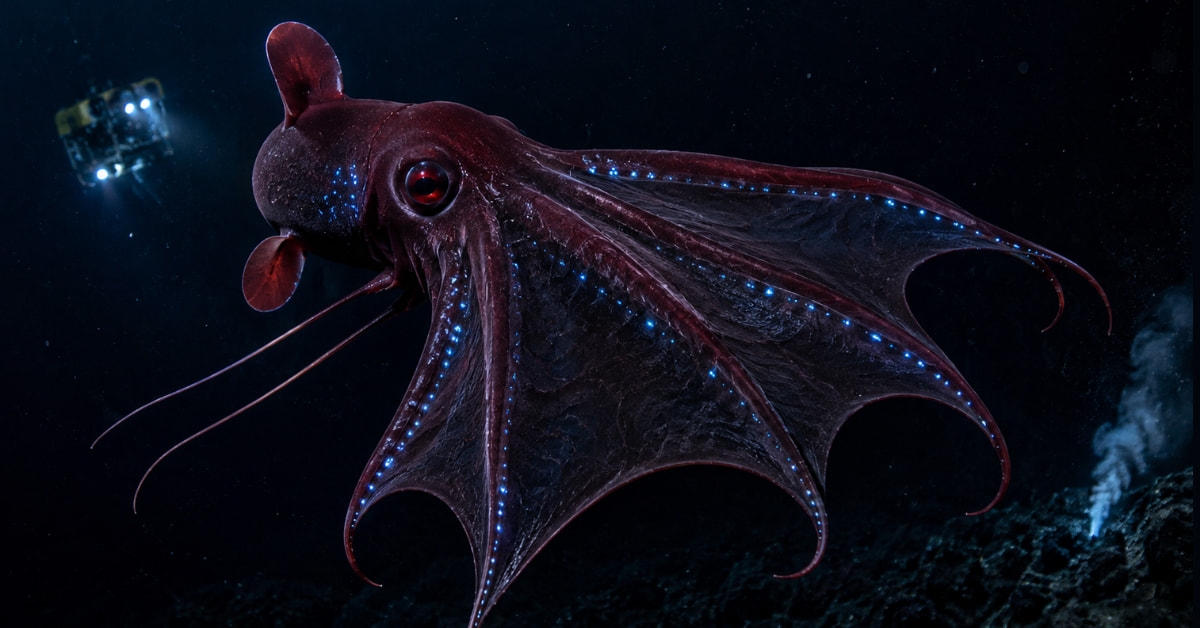
Research into deep-water disguises is similarly ongoing, including how many other mesopelagic species, such as the vampire squid, share strategies with the transparent-to-red switch first documented in Japetella and Onychoteuthis, and whether great white sharks’ preliminary color-change findings hold up under more controlled study. Finally, the genetic basis of industrial melanism in the peppered moth outside Britain is still being mapped: a 2026 bioRxiv preprint, not yet peer-reviewed, reports different mutations behind the same dark coloration in continental European moth populations.
Key Takeaways
- Camouflage animals rely on several overlapping strategies, including background matching, disruptive coloration, shadow-canceling coloring, disguise, mimicry, active color change, and motion camouflage, not one single trick.
- The chameleon’s rapid color shifts are driven by tunable nanocrystals in its skin and are used mainly for social signaling, while its everyday muted tone is what actually provides concealment.
- Experimental research has found little support for the idea that zebra stripes work as anti-predator camouflage, a hypothesis debated since the era of Darwin and Wallace.
- Deep-sea camouflage often relies on red pigment because red light fades rapidly with depth and most predators there can’t detect it, though a few species, such as certain dragonfish, are notable exceptions.
- The peppered moth’s shift from pale to dark and back again, confirmed by a 2018 predation study, remains one of evolution’s most directly observed examples among all animals that use camouflage.
Related Articles
- Stonefish: The Ocean’s Silent Assassin
- Sunlight Zone Facts: Secrets of the Ocean’s Top Layer
- Glass Octopus: A Nearly Invisible Hunter of the Mesopelagic Dark
- Vampire Squid Facts: Inside the Ocean’s Strangest Fossil
- Anglerfish: The Twilight Zone’s Most Infamous Ambush Predator
- Animal Communication: The Science Behind How Species Signal Each Other
Frequently Asked Questions About Camouflage Animals
What are the best examples of camouflage animals?
Chameleons, cuttlefish, mimic octopuses, leaf-tailed geckos, snow leopards, and stonefish are among the most studied camouflage animals, each relying on a different mechanism, from active color change to static disguise.
What are the main types of camouflage?
The main types of camouflage are background matching, disruptive coloration, shadow-canceling coloring in ocean species, disguise or masquerade, mimicry, active color change, and motion camouflage, each suited to a different habitat and predator.
Why do animals use camouflage instead of other defenses like speed or armor?
Camouflage is often cheaper energetically than outrunning a predator or growing armor, and it works for both predators and prey at once, which is why so many unrelated animals that use camouflage evolved it independently.
Do zebra stripes actually work as camouflage?
Evidence suggests not. A University of California, Davis study found predators typically detect zebras by smell or sound before they are close enough to see the stripes, and later research points to the stripes deterring biting flies instead.
Why are deep-sea animals red instead of blending in some other way?
Red light fades rapidly with depth in seawater, and most deep-sea predators can’t detect the little that remains, so a red animal becomes effectively invisible in that environment through a form of deep-sea camouflage that wouldn’t work on land.
How does a chameleon change color if it isn’t mainly for hiding?
University of Geneva researchers found chameleons change color by adjusting the spacing between guanine nanocrystals in a skin layer called the iridophore, a physical process used mainly for social signaling rather than concealment.
What is countershading and which animals use it?
Countershading is a dark-above, light-below coloring pattern that cancels out an animal’s natural shadow. Dolphins and sharks, including great whites, both use it to stay harder to see from above and below at the same time.
Is camouflage the same as mimicry?
Not exactly. Camouflage generally works by reducing detection or recognition, while mimicry means resembling another organism, object, or signal. The two frequently overlap, as with the mimic octopus, but not all mimicry is about hiding: some mimics rely on being seen and misidentified rather than missed entirely.
Why did the peppered moth change color during the Industrial Revolution?
Soot pollution darkened tree bark, and a naturally occurring dark form of the moth survived better than the pale form because it was harder for birds to spot, a documented case of industrial melanism and natural selection.
About the Author
Evan Brooks is a science and history writer for Strangehappen.com, specializing in archaeology, space exploration, ancient civilizations, and emerging scientific discoveries. His work focuses on translating complex research into engaging, evidence-based stories that help readers understand the mysteries of our world and beyond.
SOURCE REFERENCES
- University of Geneva — “The chameleon reorganizes its nanocrystals to change colors”
- PMC (NIH) — “Photonic crystals cause active colour change in chameleons,” Nature Communications
- Smithsonian Ocean — “Camouflaged Octopus Blends In”
- Live Science — “How do octopuses change color?”
- National Geographic — “Mimic Octopus Facts”
- Australian Museum — “Reef Stonefish, Synanceia verrucosa“
- Oxford University Museum of Natural History — “Peppered Moth natural selection experiments”
- Springer Nature Research Communities — “The peppered moth and industrial melanism”
- PMC (NIH) — “The peppered moth and industrial melanism: evolution of a natural selection case study,” Heredity
- bioRxiv — “Parallel evolution of industrial melanism in the peppered moth: one locus, many alleles” (preprint, not peer-reviewed)
- Snow Leopard Trust — “Snow Leopards: Masters of Disguise”
- UC Davis — “Zebra stripes not for camouflage, new study finds”
- Duke Today — “Mid-Ocean Creatures Control Light to Avoid Becoming Snacks”
- ScienceDirect / Current Biology — “Counterillumination reduces bites by Great White sharks”
- National Geographic — “Great white sharks may change their color to sneak up on prey”
- Oxford Academic, Behavioral Ecology — “The swaying behavior of Extatosoma tiaratum: motion camouflage in a stick insect?”
- NOAA JetStream — “Layers of the Ocean”
- University of California — “Zebra stripes not for camouflage, new study finds”