
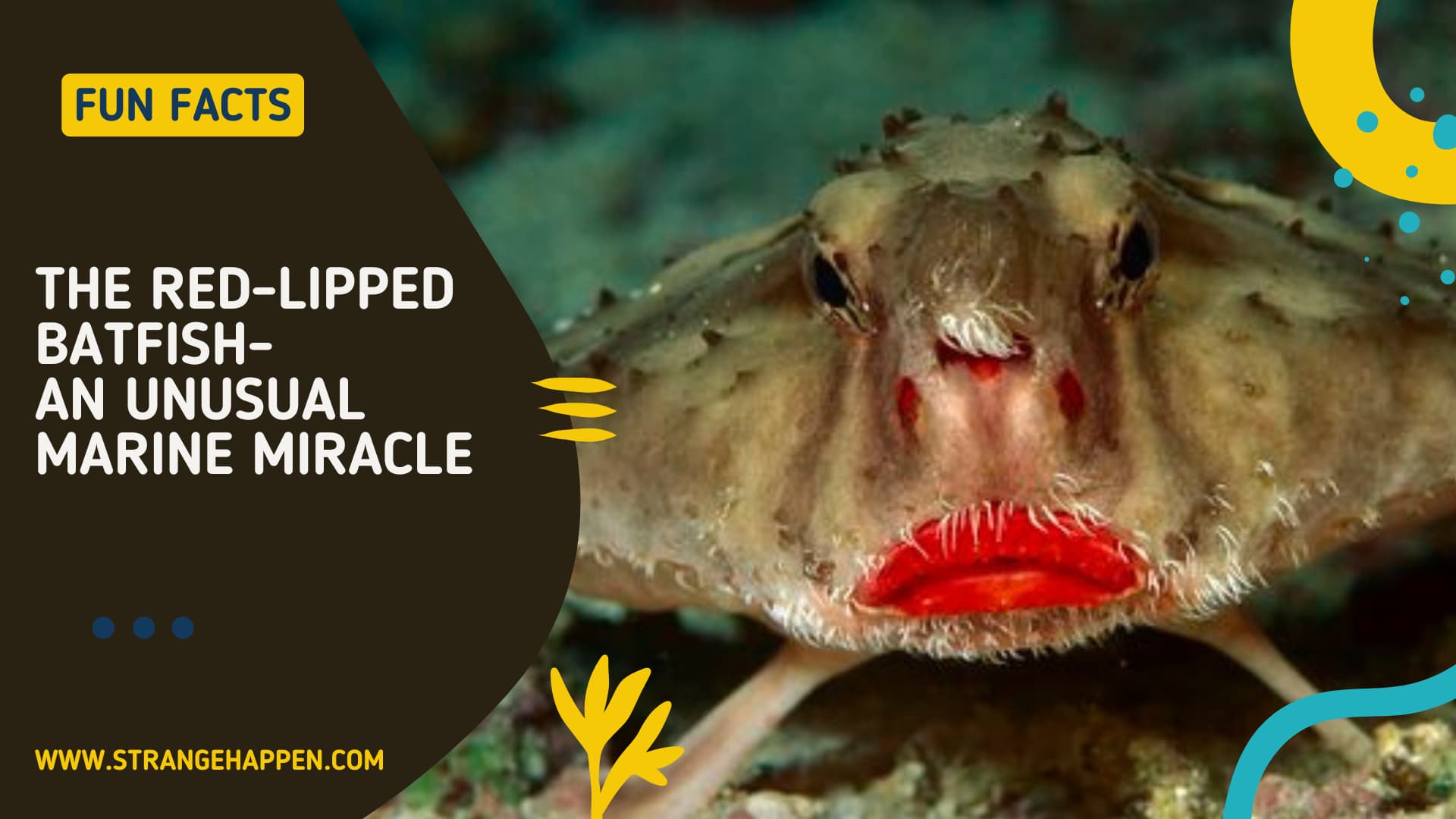
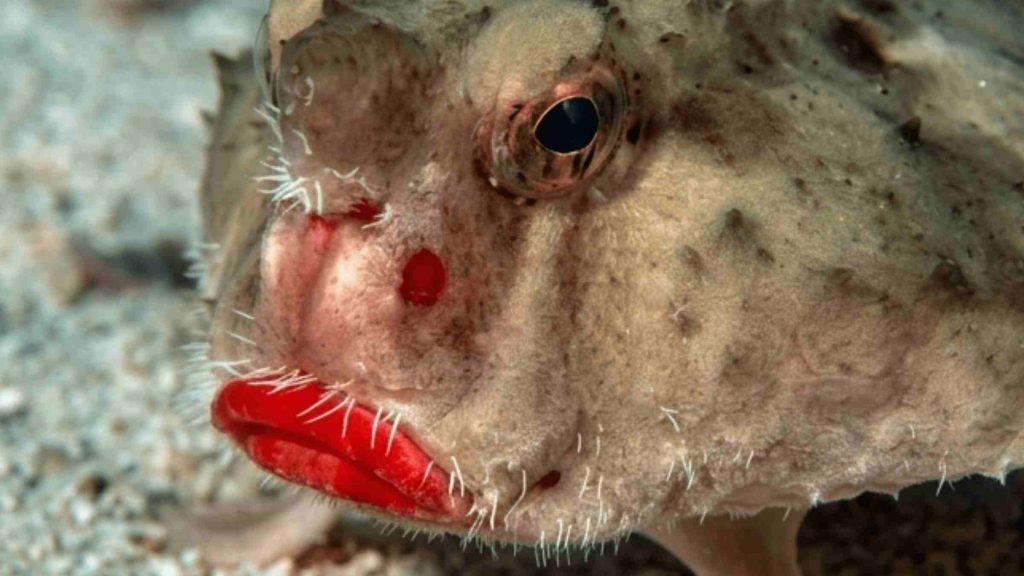
Off the volcanic coastline of the Galápagos Islands lives a fish that looks like it borrowed its look from a glam rock frontman. The red-lipped batfish (Ogcocephalus darwini) drags itself across the sandy seafloor on four fin-turned-limbs, its fluorescent red mouth standing out against a body built for camouflage. It swims poorly, hunts with a built-in fishing rod on its forehead, and has spent decades leaving marine biologists without a confirmed answer for why its lips look the way they do.
Here is what’s actually confirmed about how the red-lipped batfish lives, moves, eats, and survives, along with what remains genuine scientific mystery.
Fast Facts: Red-Lipped Batfish at a Glance
| Attribute | Details |
|---|---|
| Scientific name | Ogcocephalus darwini |
| Common names | Red-lipped batfish, Galápagos batfish |
| Family / Order | Ogcocephalidae / Lophiiformes (the anglerfish family) |
| First described | 1958, by ichthyologist Carl Leavitt Hubbs |
| Size | Up to 40 cm (16 in) |
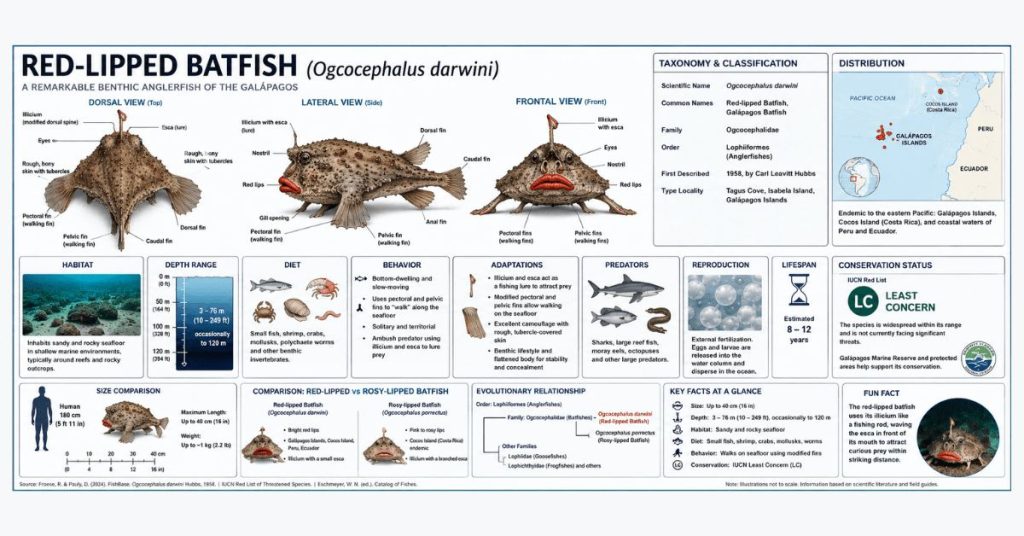
| Depth range | 3 to 76 m (10 to 249 ft), occasionally to 120 m |
| Habitat | Sandy and rocky seafloor around the Galápagos Islands and off Peru and Ecuador |
| Diet | Small fish, shrimp, crabs, mollusks, and worms |
| Lifespan | Roughly 12 years in the wild |
| Conservation status | Least Concern (IUCN Red List, 2023 assessment) |
| Closest relative | Rosy-lipped batfish (Ogcocephalus porrectus) |
What Is a Red-Lipped Batfish?
The red-lipped batfish belongs to Ogcocephalidae, a family of bottom-dwelling anglerfish known collectively as batfish for their flattened, disc-shaped bodies. Its order, Lophiiformes, includes roughly 350 species of anglerfish worldwide, most of which share the same basic trick: a modified fin spine used to lure prey.
What sets Ogcocephalus darwini apart even within that odd family is its face. Where most batfish are drab and forgettable, this species carries a pair of lips so vividly red they look painted on, a trait strong enough that it named the species in nearly every language it’s been described in, including its Spanish name, pez murciélago labio rojo.
Discovery and the Story Behind Its Scientific Name
The red-lipped batfish was formally described in 1958 by American ichthyologist Carl Leavitt Hubbs, who published the species in the journal Copeia (Hubbs, 1958) after collecting a specimen at Tagus Cove on Isabela Island in the Galápagos. Hubbs gave it the species name darwini, a direct tribute to Charles Darwin, whose 1835 visit to the archipelago helped lay the groundwork for the theory of evolution.
The Charles Darwin Foundation, a research institution still active in the islands today, maintains the species in its official Galápagos database, tying the fish’s name permanently to the naturalist who made the islands famous. It’s a fitting connection: few animals illustrate evolutionary specialization as plainly as a fish that gave up swimming for walking.
Red-Lipped Batfish Habitat: Where They Live
Red-lipped batfish habitat centers almost entirely on the Galápagos Islands, with a smaller range extending to shallow coastal waters off Peru and Ecuador. They favor sandy or rubble-strewn seafloor near reef edges, typically between 3 and 76 meters (10 to 249 feet) down, though individuals have occasionally been recorded as deep as 120 meters.
Isolated, unconfirmed sightings far outside this range, including reports off California, do turn up from time to time. Marine biologists treat these as strays rather than evidence of a wider natural range, since the species has never been established as breeding anywhere outside the Eastern Pacific.
Red-Lipped Batfish Anatomy and Adaptations
Red-lipped batfish anatomy is built almost entirely for sitting still, not swimming. Its disc-shaped, dorsoventrally flattened form and mottled brown-and-grey coloring make it one of the ocean’s most effective camouflage artists, letting it blend almost perfectly into sand and volcanic rubble, while its underside stays pale for countershading against light from above.
The most consequential adaptation is what happened to its fins. The pectoral, pelvic, and anal fins have shifted position and structure until they function less like fins and more like a set of jointed limbs, a transformation unique enough among fish that it gave the entire batfish family its common name.
Red-Lipped Batfish Walking: How It Moves, and Whether It Can Still Swim
Red-lipped batfish walking is the species’ defining behavior on the seafloor. Rather than swimming to get around, it pushes itself along on its modified fins in a slow, deliberate gait often compared to a toad’s waddle. This isn’t a backup behavior; it’s the fish’s default and most efficient way to travel across its sandy habitat.
That doesn’t mean it has lost the ability to swim entirely. According to BBC Science Focus, the batfish can tuck its pectoral fins beneath its body and use its muscular tail to push through short bursts of open water when it needs extra speed, such as when startled. It’s simply an awkward, inefficient swimmer compared to almost any other fish, which is exactly why walking became its preferred method of getting around.
Red-Lipped Batfish Illicium, Esca, and Diet
The red-lipped batfish illicium and esca are its signature hunting tools, a trait shared with every member of the anglerfish order. As it reaches adulthood, its dorsal fin condenses into a single spine-like projection called an illicium, tipped with a fleshy, light-emitting structure called an esca.
The batfish doesn’t chase prey; it waits. Sitting motionless on the seafloor, it uses the esca to draw curious small fish and invertebrates close enough to strike, relying on quick reflexes rather than speed once prey is within range. The red-lipped batfish diet consists mainly of small fish, along with shrimp, crabs, mollusks, and marine worms picked off the sand and rubble around reef edges.
Red-Lipped Batfish Reproduction and Life Cycle
Red-lipped batfish reproduction is oviparous: females release eggs that are fertilized and develop outside the body rather than as live young. Like most Ogcocephalidae, the fertilized eggs hatch into planktonic larvae that drift with ocean currents before settling onto the seafloor and beginning the transition into the adult, walking body plan.
Juveniles lack the exaggerated red lips and prominent illicium of adults; both develop as the fish matures, with the illicium forming from the dorsal fin only once the batfish reaches adulthood. Detailed data on spawning season and courtship behavior remains limited, since the species’ remote, deep-shelf habitat makes sustained field observation difficult. Red-lipped batfish lifespan in the wild is estimated at around 12 years.
Why Are Its Lips Red? The Unsolved Mystery
This is a question every source on the red-lipped batfish gets asked, and none of them can fully answer. The leading hypothesis, favored by researchers at the Galápagos Conservation Trust and elsewhere, is that the vivid coloration helps individuals recognize members of their own species in the dim, visually cluttered environment of the seafloor, particularly during spawning.
A related theory suggests the color may also play a role in attracting mates, since especially vivid lips could signal reproductive fitness. Neither hypothesis has been confirmed through controlled study, and there’s a genuine wrinkle in the mate-attraction theory: juveniles display red lips well before they reach sexual maturity, which is hard to square with a trait that exists purely for breeding season. The honest answer, more than sixty years after the species was first described, is that nobody has proven it yet.
Red-Lipped Batfish Predators and Defense: Is It Dangerous?
To humans, no. The red-lipped batfish has no teeth, spines, or venom capable of harming a person, and divers regularly photograph them at close range without incident, a sharp contrast to a genuinely dangerous seafloor dweller like the stonefish, which relies on camouflage of its own but carries venomous spines capable of seriously injuring anyone who steps on it.
In the water, red-lipped batfish predators are effectively undocumented. No confirmed natural predator has been identified for this species, likely a combination of its effective camouflage, its remote depth range, and simple lack of research attention. Its main defense is passive: staying still, staying camouflaged, and relying on the fact that almost nothing goes looking for it.
A claim that occasionally surfaces online is that the red-lipped batfish’s flesh is toxic or unpalatable, functioning as a chemical defense against predators. This isn’t confirmed by any primary marine biology source, IUCN documentation, or published research on Ogcocephalus darwini specifically. No toxin has been identified or studied in this species, and it’s worth treating that claim as unverified rather than established fact until an actual study says otherwise.
Red-Lipped Batfish Conservation Status: Is It Endangered?
The red-lipped batfish conservation status is currently Least Concern on the IUCN Red List, based on a 2023 assessment that found no evidence of a declining population or immediate extinction risk.
That status comes with a caveat worth taking seriously. The species’ entire known range is limited to a small stretch of the Eastern Pacific, and the Galápagos Conservation Trust specifically names rising sea temperatures, coral bleaching, incidental bycatch from fishing activity, and the exotic pet trade as potential pressures, even though no dedicated conservation program currently targets this species alone. Most of its protection currently comes indirectly, through its presence inside the Galápagos Marine Reserve.
Meet the Relatives: Rosy-Lipped Batfish and the Wider Batfish Family
The red-lipped batfish isn’t alone in its color-coded naming convention. Its closest relative, the rosy-lipped batfish (Ogcocephalus porrectus), lives roughly 1,000 kilometers away near Cocos Island off the Pacific coast of Costa Rica and shares the same flattened body and walking fins, just with pinker lips and a slightly different range.
Both species sit within the roughly 60-strong batfish family found across the Atlantic and Pacific, most of which share the same basic body plan without the same striking coloration. The red-lipped batfish’s fame, in other words, comes almost entirely from one feature that its closest relatives don’t fully share.
Not the Only Fish That Walks: Convergent Evolution on the Seafloor
The red-lipped batfish’s walking fins look unique, but they aren’t evolution’s only attempt at the idea. Closer to shore, mudskippers solve a similar problem in a completely different environment, using muscular pectoral fins to haul themselves across mudflats and even climb out of the water entirely at low tide.
Sea robins offer a third variation on the same theme. In sea robins, several of the lower pectoral fin rays have separated into independent, leg-like structures the fish uses to walk across the seafloor and probe the sand for buried prey, a solution that reaches roughly the same outcome as the batfish’s fins, arrived at through a completely separate evolutionary path.
Neither fish inherited this trait from a shared ancestor. Researchers describe cases like this as convergent evolution, where unrelated species independently arrive at similar adaptations because they’re solving the same underlying problem: getting around efficiently in a place where swimming isn’t the best option.
A comparable case shows up on the other side of the world too, off Tasmania, Australia’s red handfish and spotted handfish independently evolved fin-based walking, a case CSIRO, Australia’s national science agency, studies closely as part of ongoing conservation work with the wider handfish family. For benthic, ambush-feeding fish with little need for open-water speed, walking fins turn out to be a solution evolution has landed on independently at least four separate times, in four unrelated fish families.
Frequently Asked Questions About the Red-Lipped Batfish
Why does the red-lipped batfish have red lips?
Scientists believe the coloration most likely helps individuals recognize their own species in low-visibility water, possibly also aiding mate attraction during spawning. Neither theory has been confirmed, and the exact reason remains an open question in marine biology.
Can the red-lipped batfish swim?
Yes, though poorly. It typically walks across the seafloor on modified fins, but it can swim in short bursts by tucking its pectoral fins and using its tail, usually when startled or needing extra speed.
Is the red-lipped batfish endangered?
No. It’s currently classified as Least Concern on the IUCN Red List. Its narrow geographic range still makes it potentially vulnerable to rising sea temperatures and coral reef degradation over the long term.
What does the red-lipped batfish eat?
It feeds on small fish, shrimp, crabs, mollusks, and marine worms found on the seafloor, using a glowing lure called an esca to draw prey close before striking.
How long do red-lipped batfish live?
Red-lipped batfish lifespan is estimated at around 12 years in the wild, based on data from related batfish species, since long-term tracking of this specific species remains limited.
Is the red-lipped batfish dangerous to humans?
No. It has no teeth, venom, or spines capable of harming people, and is regularly photographed by divers at close range without any reported incidents.
Where can you see a red-lipped batfish in the wild?
Almost exclusively around the Galápagos Islands, typically on sandy seafloor near reef edges at depths of 3 to 76 meters, with occasional sightings off the coasts of Peru and Ecuador.
What is the difference between a red-lipped batfish and a rosy-lipped batfish?
They’re closely related species with the same body plan and walking fins, but the rosy-lipped batfish (Ogcocephalus porrectus) lives near Cocos Island, Costa Rica, roughly 1,000 km from the Galápagos, and has pinker rather than fluorescent red lips.
Is the red-lipped batfish related to anglerfish?
Yes. It belongs to Lophiiformes, the anglerfish order, and shares the family’s signature trait: a modified fin spine (illicium) tipped with a lure (esca) used to attract prey.
Key Takeaways
- The red-lipped batfish (Ogcocephalus darwini) walks across the Galápagos seafloor on modified fins instead of swimming, though it can still swim short distances when needed.
- It was first described in 1958 by Carl Leavitt Hubbs and named after Charles Darwin.
- Its bright red lips likely aid species recognition and possibly mate attraction, but the exact reason has never been scientifically confirmed.
- It’s classified as Least Concern by the IUCN, though its narrow Galápagos range leaves it exposed to climate-driven habitat change.
- Its closest relative, the rosy-lipped batfish, lives near Costa Rica, and its walking adaptation shows up independently in mudskippers, sea robins, and Australia’s red and spotted handfish.
You May Also Like
- Red-Lipped Batfish: Facts, Figures & Quick Reference
- Anglerfish: The Deep Sea’s Original Lure-Fishers
- Blobfish: The Ocean’s Most Misunderstood Face
- Mudskippers: The Fish That Walks on Land
- Stonefish: The World’s Most Venomous Fish, Hiding in Plain Sight
- Barreleye Fish: The Fish With a See-Through Head
- Camouflage Animals: Nature’s Masters of Disguise
Source References
- IUCN Red List of Threatened Species. Ogcocephalus darwini assessment, 2023. https://www.iucnredlist.org/species/pdf/217631260
- Hubbs, C.L. (1958). “Ogcocephalus darwini, a new batfish endemic at the Galápagos Islands.” Copeia, 1958(3): 161-170. https://doi.org/10.2307/1440581
- Charles Darwin Foundation. Galápagos Species Database, Ogcocephalus darwini. https://datazone.darwinfoundation.org/en/checklist/?species=7663
- Galápagos Conservation Trust. “Red-lipped batfish” species profile. https://galapagosconservation.org.uk/species/red-lipped-batfish/
- BBC Science Focus. “What is a red-lipped batfish?” https://www.sciencefocus.com/nature/what-is-a-red-lipped-batfish
- CSIRO. “Spotted Handfish: walking towards recovery.” https://www.csiro.au/en/research/animals/marine-life/spotted-handfish
About the Author
Mubashir Razzaq is a science and history writer for Strangehappen.com, specializing in archaeology, space exploration, wildlife and marine biology, and emerging scientific discoveries. His work focuses on translating complex research into engaging, evidence-based stories that help readers understand the mysteries of our world and beyond.