

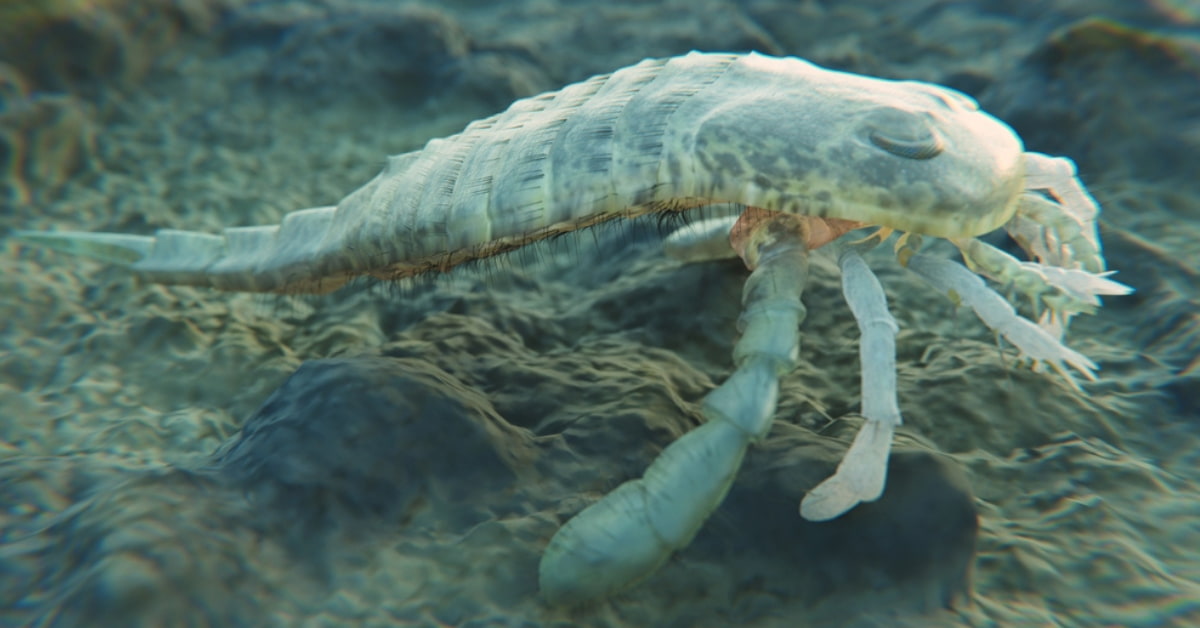
In November 2007, a fossil hunter splitting rock in a German quarry near Prüm uncovered a claw nearly half a meter long. It belonged to a giant sea scorpion later named Jaekelopterus rhenaniae, and it remains the largest known arthropod. Call it a scorpion, though, and you would only be half right.
The name ‘giant sea scorpion’ is misleading because these animals were not true scorpions at all. They were eurypterids, an extinct branch of Chelicerata, the same broad arthropod lineage that includes modern scorpions, spiders, and horseshoe crabs, and for more than 200 million years of the Paleozoic Era they ranked among the largest predators the ocean had ever produced. Then, in June 2026, researchers at the Natural History Museum in London confirmed something genuinely new: the largest fossil scorpion yet identified, from a completely different animal that had sat unidentified in a museum drawer since the 1870s.
Table of Contents
What Is a Giant Sea Scorpion, Really?
Giant sea scorpions were not true scorpions, but extinct eurypterids related to modern scorpions. These ancient arthropods evolved diverse body forms, with some species reaching extraordinary sizes.
What Are Eurypterids?
Eurypterids belong to Chelicerata, according to the Yale Peabody Museum’s collection notes, the same lineage that also produced horseshoe crabs, mites, and ticks. People often assume a giant sea scorpion must be a direct ancestor of modern scorpions, but the relationship is closer to a family resemblance. True scorpions belong to Arachnida, the class within Chelicerata that also holds spiders, mites, and ticks; eurypterids sit outside that class entirely, in their own extinct order, Eurypterida, which is part of why calling them “sea scorpions” is a bit of a misnomer.
How Were They Related to True Scorpions?
The original 2007 description of Jaekelopterus in Biology Letters describes these animals as the probable aquatic sister group of true scorpions, sharing a common ancestor rather than one descending from the other, arriving at a similar armored, tailed body plan independently, in the water, while true scorpions eventually moved onto land. Eurypterid anatomy followed a fairly consistent pattern: a segmented exoskeleton, paddle-shaped swimming legs, large compound eyes, and a pointed rear segment called a telson. The biggest species also carried enormous grasping claws, called chelicerae, built for seizing prey rather than stinging it.
What Did Eurypterids Look Like?
Most were modest in size, but a handful of oversized lineages, known as pterygotids, evolved into the giant eurypterids people picture when they hear the term “giant sea scorpion.” Few animal lineages persist for 200 million years relatively unchanged; the seafloor holds other long-running survivors too, including ancient marine organisms such as glass sponges, whose reef-building relatives still filter seawater today much as their Paleozoic ancestors did. On land, the Chinese giant salamander is another remarkable survivor from an ancient lineage, its body plan barely changed in roughly 170 million years.
How Big Did Giant Sea Scorpions Get?
The record holder is Jaekelopterus rhenaniae, a Devonian sea scorpion whose 46-centimeter Jaekelopterus claw, found near the Willwerath Lagerstätte close to Prüm, let researchers Simon Braddy of the University of Bristol and Markus Poschmann estimate a total body length of about 2.5 meters, or roughly 8 feet, almost half a meter longer than any previous estimate for the group. Published in Biology Letters in November 2007, it made Jaekelopterus the largest known arthropod, edging out even the millipede-like Arthropleura.
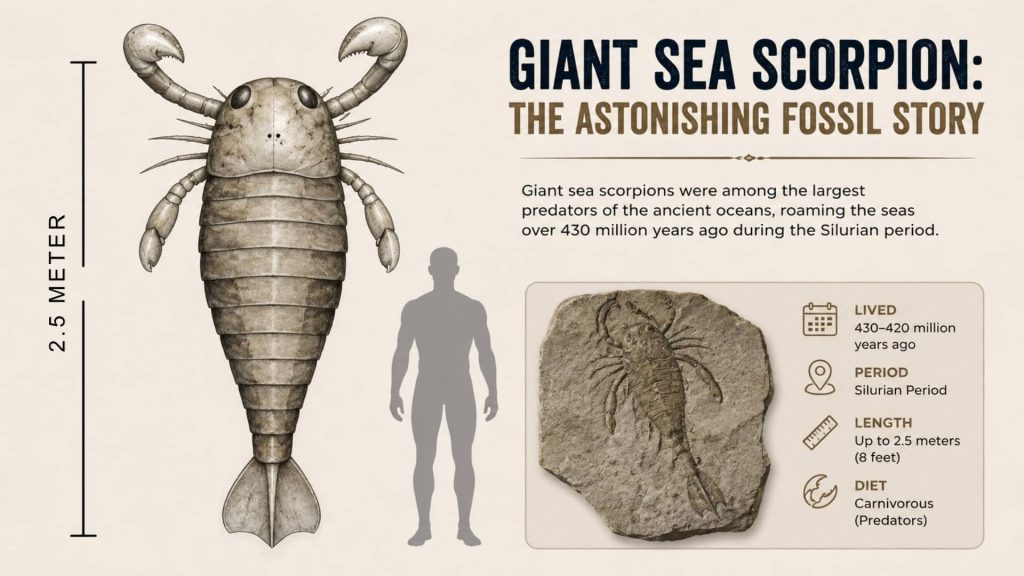
That size record does not make it the oldest, though. In 2015, a team led by James Lamsdell of Yale University described Pentecopterus decorahensis in BMC Evolutionary Biology, an Ordovician sea scorpion recovered from the Winneshiek Lagerstätte, a fossil-rich deposit preserved inside an ancient meteorite-impact structure beneath the Upper Iowa River near Decorah, Iowa. At roughly 1.7 meters long, Pentecopterus decorahensis pushed the documented range of eurypterid size and origin back some 9 million years earlier than any previously known species, and its armored head shield and grasping limbs earned it a name borrowed from an ancient Greek warship known for speed and aggression.
A second contender for the size crown, Pterygotus, a common Silurian sea scorpion, rounds out the trio of true giants, though most specimens fall short of Jaekelopterus.
How the giants compare:
| Animal | Length | Era | Where found |
|---|---|---|---|
| Jaekelopterus rhenaniae | ~2.5 m (8 ft) | Early Devonian, ~390 million years ago | Prüm, Germany |
| Pentecopterus decorahensis | ~1.7 m (5.6 ft) | Middle Ordovician, ~467 million years ago | Decorah, Iowa, USA |
| Average adult human | ~1.7 m (5.6 ft) | Present day | Worldwide |
| Modern emperor scorpion | ~20 cm (8 in) | Present day | West Africa |
The Newest Giant: Praearcturus Gigas, the Largest Fossil Scorpion Yet Identified
About 415 million years ago, a huge scorpion called Praearcturus gigas lived across what is now Britain.
With pincers around 16 centimeters long and a body estimated at more than a meter, it was an astonishing size for such an early scorpion.
A Mystery Preserved for More Than a Century
Here is where most existing coverage stops short. Fossil fragments held in the Natural History Museum’s collection since the 1870s had puzzled paleontologists for more than a century, lacking a tail and other diagnostic features that would let anyone confidently say what kind of animal they belonged to.
The 2026 Identification of Praearcturus Gigas
That changed in June 2026, when Dr. Richie Howard, the museum’s Curator of Fossil Arthropods, led a study published in the journal Palaeontology confirming the fossils belonged to Praearcturus gigas, a genuine member of the true scorpion order Scorpiones. With 16-centimeter pincers and an estimated body length of over a meter, the animal lived roughly 415 million years ago in what is now England and Wales, towering over Early Devonian floodplains.
How Scientists Confirmed the Species
The proof came through how scientists identify and name a new species: anatomical comparison against a better-preserved fossil scorpion called Eramoscorpius, described in PeerJ in 2015. Both animals share a distinctive triangular sternum on the underside of the body, a structure unique to true scorpions, and that shared feature is what finally confirmed the identification. Howard notes the find is striking because Praearcturus appears to predate other famous giant land arthropods, such as Arthropleura, by tens of millions of years, back when life had barely begun colonizing land.
Why Did Praearcturus Become So Large?
This matters beyond taxonomy. Researchers have long assumed Paleozoic gigantism was mostly about oxygen levels in the air and water. The Praearcturus study points to a different explanation here: because true scorpions had almost no other large land predators to compete with at the time, ecological opportunity may have let this one grow so large. Howard and co-author Dr. Greg Edgecombe also note that Praearcturus likely still hunted in water for larger prey, since land ecosystems of the period weren’t yet complex enough to sustain an animal that size on terrestrial food alone.
Praearcturus vs. the Giant Sea Scorpions
The distinction is worth stating plainly, since it resolves a question that has confused casual readers for years: a giant sea scorpion in the informal sense and a true fossil scorpion are two different animals from two different evolutionary branches that happened to look broadly similar and lived in overlapping time periods. Jaekelopterus was never a true scorpion. Praearcturus gigas actually is one, and as of mid-2026, it is the largest fossil scorpion yet identified.
What These Predators Ate, and Sometimes Each Other
Eurypterid diet centered on active hunting, not scavenging for scraps. According to the Yale Peabody Museum, the pterygotid group used binocular vision and powerful claws to slice into prey such as primitive fish. What fossilized dung can reveal about ancient animals applies here too: coprolites recovered alongside their remains have helped confirm which prey these predators actually targeted, rather than relying on anatomy alone.
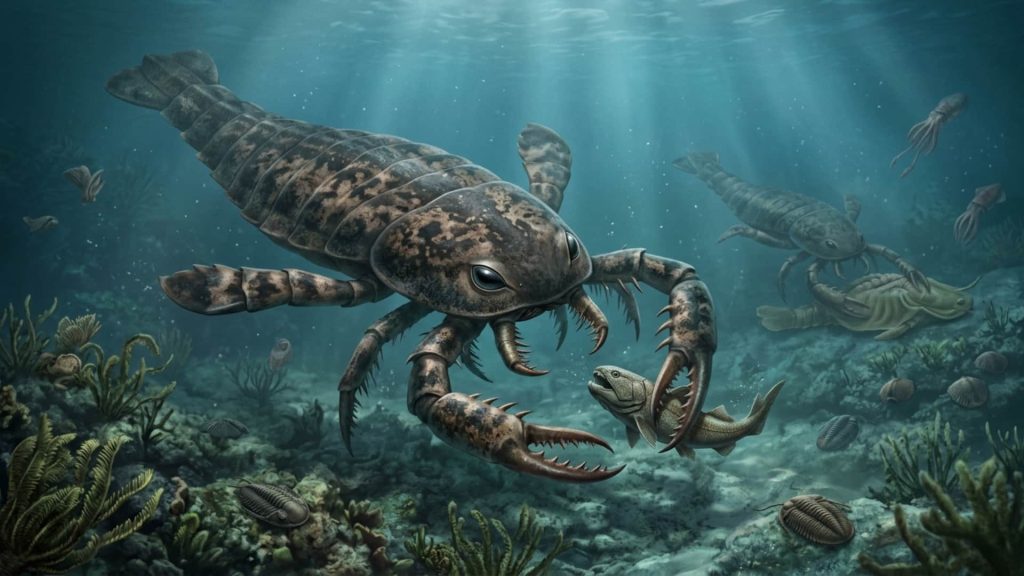
By most accounts, they were also cannibals, at least some of the time. Some evidence suggests that eurypterids may have cannibalized members of their own kind, particularly around vulnerable molting periods. Fossil beds dominated by individuals of similar size are thought to represent breeding or molting congregations, and Simon Braddy has described these gatherings as chaotic events where a freshly molted, soft-shelled individual could easily become a meal for its neighbor.
Distant Travelers? The 2024 Discovery That Expanded Their Known Range
For most of the twentieth century, fossils of this group turned up almost entirely in the Northern Hemisphere, leaving a gap in the Southern Hemisphere record of these prehistoric oceans. That changed in 2024, when a team led by Russell Bicknell, then of the American Museum of Natural History, described new eurypterid fossil material from the Wallace Shale and Merrimerriwa Formation in New South Wales, Australia, in Gondwana Research.
The team was deliberately conservative, assigning the isolated material to the genera Pterygotus and Jaekelopterus without claiming species-level certainty, and using the specimens mainly to discuss the pterygotids’ surprisingly wide global distribution. Taken with earlier finds from China and elsewhere in Gondwana, the discoveries suggest some eurypterids were capable of dispersing across substantial marine distances between Gondwana and Laurussia, which is plausible, the Yale Peabody Museum notes, since pterygotids appear to have been the branch of the group best adapted for sustained open-ocean swimming. The Gondwana Research paper itself frames the find as pushing the limits of what scientists believed arthropods this size could achieve.
Even after the 2024 study, most of what’s known about Gondwanan specimens still comes from fragments, a reminder of how much of Earth’s ocean remains unexplored even today.
Why Did the Giants Disappear?
Eurypterid extinction unfolded across two different timelines, and conflating them is a common mistake in existing coverage. The pterygotid giants disappear from the currently known fossil record after roughly 393 million years ago, based on the Australian specimens Bicknell’s team examined, though the group’s documented diversity spans roughly 428 to 391 million years ago according to the original Biology Letters description. The order Eurypterida as a whole persisted tens of millions of years longer, surviving until the end-Permian mass extinction roughly 252 million years ago, according to the Yale Peabody Museum.
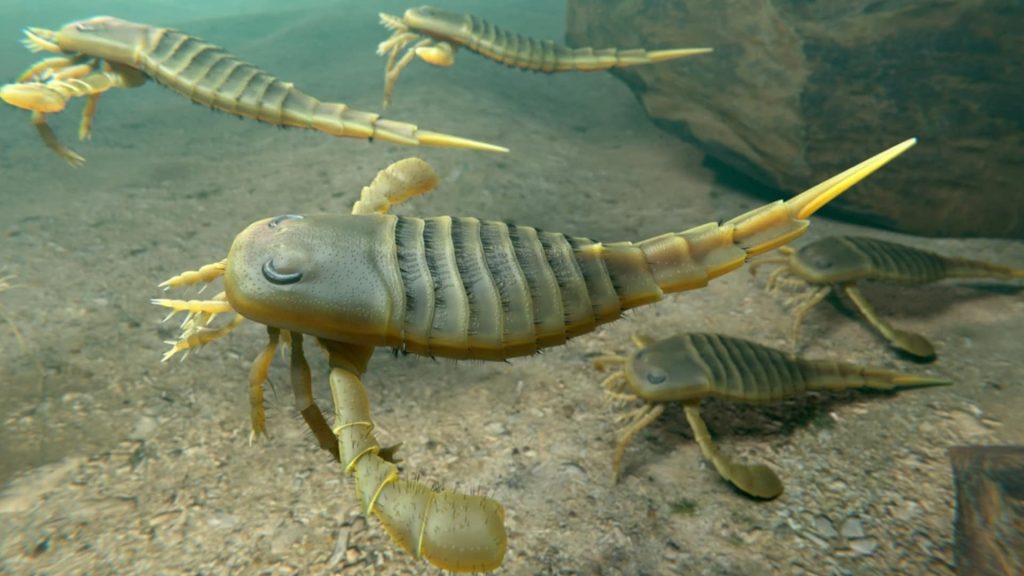
Why the giants disappeared first is still genuinely unresolved. Researchers have suggested two competing explanations: increasing competition from early jawed fish, or the possibility that the largest species simply pushed their own body size past a sustainable limit. Neither is confirmed, and researchers describe it as an open question rather than settled fact.
Could a Giant Sea Scorpion Hurt You Today?
If Jaekelopterus rhenaniae, one of the best-known prehistoric sea scorpions, somehow existed in modern waters, the danger would most likely come from its size and crushing claws rather than venom. There is no evidence that eurypterids possessed the venom-delivery sting characteristic of modern scorpions; their telson was a terminal structure rather than a scorpion-style venom apparatus.
Jaekelopterus was also probably not a true open-ocean predator for most of its life. The rock layers where its fossils turn up point to freshwater or brackish river environments rather than open seas, despite the name, though its wider pterygotid group included species capable of marine dispersal. A true fossil scorpion like Praearcturus gigas, by contrast, was primarily a land animal that likely still hunted in water for larger prey. Modern scorpion venom research suggests even today’s largest living species pose a real but rarely fatal threat to healthy adults.
Future Research: What We Still Don’t Know
Several genuine gaps remain open. Praearcturus gigas is known only from fragmentary claw and body remains; a more complete specimen could confirm or revise its size and behavior. Fossils found separately in Portishead, North Somerset, are only tentatively linked to the species and, if confirmed, could extend its known survival by tens of millions of years. Bicknell’s own earlier survey of Australian material found just a handful of substantially complete specimens, meaning most of what’s known there still comes from partial fragments. And the exact mechanism behind the pterygotid giants’ early decline, competition versus a self-limiting growth strategy, remains an open question rather than a settled one.
Related Topics
- How Scientists Identify and Name New Species. The same painstaking anatomical comparison used to confirm Praearcturus gigas as a true scorpion is standard practice across paleontology.
- Dinosaur Dung: The Mystery Behind Barnum, the World’s Largest Carnivore Dinosaur Poop. Proof that some of paleontology’s biggest breakthroughs come from unglamorous fossil evidence, not just bones and claws.
- Chinese Giant Salamander. A living animal whose lineage has barely changed in 170 million years, another remarkable survivor from an ancient family tree.
- How Much of the Ocean Has Been Explored? Numbers Explained. Context for how much of the planet’s fossil-bearing seafloor remains genuinely unmapped.
- Glass Sponges: Ancient Architects of the Deep Sea. Another marine lineage that has quietly persisted across hundreds of millions of years.
- Vampire Squid Facts: Inside the Ocean’s Strangest Fossil. A deep-sea “living fossil” whose true biology took decades to untangle from its intimidating reputation.
- The Deep-Sea Mystery of the Anglerfish. A very different ocean predator, shaped by an equally extreme environment.
Key Takeaways
- Jaekelopterus rhenaniae holds the title of largest known arthropod, at roughly 2.5 meters, the upper limit of confirmed eurypterid size, based on a single 46-centimeter claw discovered near Prüm, Germany, in 2007.
- Pentecopterus decorahensis, described from Iowa in 2015, is the oldest confirmed member of the group, pushing its documented origin back roughly 9 million years.
- Eurypterids were not true scorpions; they were the probable sister group of scorpions within Chelicerata, evolving a similar body plan independently in the water.
- In June 2026, the Natural History Museum confirmed Praearcturus gigas as the largest fossil scorpion yet identified, a true fossil scorpion that appears to have lived primarily on land roughly 415 million years ago.
- Some evidence suggests these animals cannibalized their own kind, particularly around vulnerable molting periods.
- A 2024 study found new fossils in Australia, suggesting some pterygotid species were capable of dispersing across substantial marine distances.
- The pterygotid giants disappear from the currently known fossil record by around 393 million years ago, but the broader order survived until the end-Permian extinction roughly 252 million years ago.
Frequently Asked Questions About Giant Sea Scorpions
How big did giant sea scorpions get?
Jaekelopterus rhenaniae is the largest known eurypterid, with an estimated body length of about 2.5 meters (8 feet), based on a 46-centimeter fossil claw discovered in Germany in 2007.
Are sea scorpions related to modern scorpions?
Closely, but not directly. Eurypterids are the probable sister group of true scorpions within the broader chelicerate lineage that also includes spiders and horseshoe crabs. A true fossil scorpion, like Praearcturus gigas, comes from a separate branch of that family tree.
What is the largest fossil scorpion identified so far?
Praearcturus gigas, confirmed in June 2026 by the Natural History Museum, is a genuine member of the scorpion order Scorpiones. It lived around 415 million years ago and currently holds the record.
What did these ancient predators eat?
Evidence from eurypterid anatomy, gut contents and coprolites indicates that some species preyed on fish, trilobites and other arthropods, with possible evidence of cannibalism in some cases.
When did giant sea scorpions go extinct, and why?
The largest pterygotid species disappear from the currently known fossil record by around 393 million years ago, while the broader order Eurypterida survived until the end-Permian mass extinction roughly 252 million years ago. The exact cause of the earlier decline is still debated.
Could a giant sea scorpion hurt a human?
There’s no fossil evidence these animals were venomous; any danger would have come from size and crushing claws rather than a sting. Many species likely lived in rivers and lakes rather than the open ocean.
Did these ancient predators live on land?
Most eurypterid evidence points to freshwater and marine habitats. Praearcturus gigas, the true fossil scorpion, was primarily a land animal, though it likely still hunted in water.
Where have giant sea scorpion fossils been found?
Major sites include Germany, New York State, and Iowa, with additional specimens confirmed in New South Wales, Australia, in a 2024 study that expanded the group’s known range. New York’s own official state fossil, Eurypterus remipes, belongs to the same order but was far smaller, typically just a few inches long, and remains one of the most commonly collected eurypterid fossils in the world, according to the New York State Museum.
Were they cannibals?
Some evidence points that way. Dense fossil beds of similarly sized individuals are thought to represent molting or breeding congregations, where freshly molted individuals may have been vulnerable to their own kind.
What is the largest known arthropod?
Jaekelopterus rhenaniae holds the title of largest known arthropod at roughly 2.5 meters, based on the 2007 claw discovery in Germany, larger than any known insect, crustacean, or true scorpion.
Source References
- University of Bristol: “2007: Fossil sea scorpion” (Jaekelopterus rhenaniae claw discovery, November 2007)
- Braddy, Poschmann & Tetlie, Biology Letters: “Giant claw reveals the largest ever arthropod” (original Jaekelopterus rhenaniae description, November 2007)
- Natural History Museum, London: “World’s largest scorpion revealed by 415-million-year-old fossils” (Praearcturus gigas confirmation, June 2026)
- Howard, Edgecombe et al., Palaeontology: Praearcturus gigas description (June 2026)
- Dunlop & Garwood, PeerJ: Eramoscorpius description, the key comparative proof cited by the Natural History Museum (2015)
- Yale Peabody Museum: “Eurypterids, Giant Ancient Sea Scorpions” (collection overview)
Author Bio
Evan Brooks, author at StrangeHappen.com, writes about strange events, unexplained mysteries, unusual wildlife, ancient discoveries, and the science behind stories that seem almost too strange to be true. He enjoys digging through old reports, forgotten cases, and unusual claims to uncover what really happened.
His work looks beyond the mystery without taking away the sense of wonder. From eerie encounters and unexplained phenomena to bizarre creatures and ancient secrets, he separates documented facts from rumors, legends, and internet fiction.