
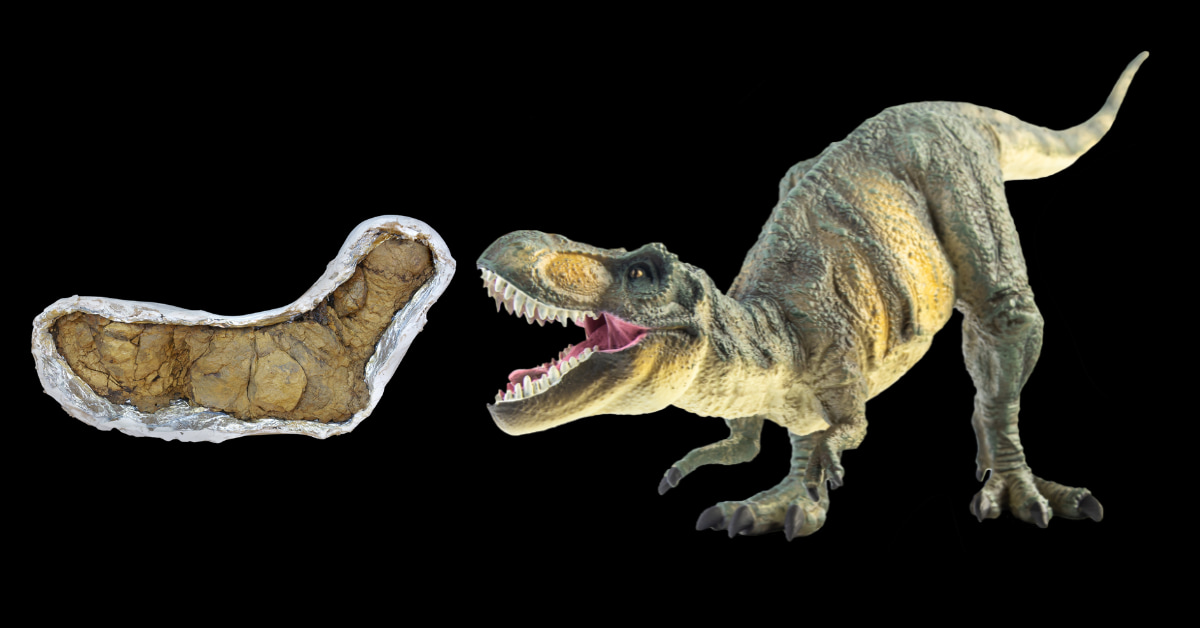
In the summer of 2019, on a private ranch near Buffalo, South Dakota, someone found a lump of rock that turned out to be one of the strangest trophies in paleontology: 67.5 centimeters of solidified dinosaur waste. Scientists identified it as a giant carnivore coprolite very likely a T. rex coprolite and Guinness World Records certified it as the largest coprolite ever found from a carnivore. Its owners named it Barnum.
That single specimen did more than earn a record. It reopened a decades-old question about what this giant dinosaur predator of the Cretaceous likely ate, and how paleontologists tell a genuine fossil from an oddly shaped rock.
What Is a Dinosaur Coprolite, and Why Does It Matter?
A dinosaur coprolite is fossilized dung. Over millions of years, minerals such as calcium phosphate replace the original organic material, turning waste into stone while preserving its shape and, often, its contents. A coprolite is a trace fossil, meaning it preserves evidence of an animal’s activity rather than its body closer in kind to a footprint than to a bone. Paleontologists prize a well-preserved specimen like this because, unlike skeletal dinosaur fossils, it can answer certain questions bones alone can’t what an animal actually swallowed, how it processed food, or what shared an ecosystem with it.
Carnivore coprolites are rarer than herbivore ones. Plant-based droppings tend to fall apart before they can fossilize, while the high mineral content in a meat-eater’s waste largely from digested bone helps it survive intact. That scarcity is part of why a well-preserved specimen like this carries so much scientific weight; there simply aren’t many candidates to compare it against, and even fewer that qualify as a true fossilized dinosaur poop specimen with intact inclusions.
How Does Dinosaur Poop Become a Fossil?
Turning dung into stone takes a precise sequence of geological luck, not just time. The basic path looks like this:
- An animal deposits dung in or near a place where sediment will bury it quickly a riverbank, floodplain, or lakebed.
- The dung is buried before scavengers, insects, or weather can break it apart.
- Mineral-rich groundwater, often carrying calcium phosphate, infiltrates the buried material.
- Those minerals gradually replace the original organic matter, a process geologists call permineralization.
- The soft tissue disappears, but the mineral replacement locks in the original shape, texture, and often the exact position of anything the animal ate and failed to digest.
- What’s left, millions of years later, is a coprolite.
It’s a narrow window most dung never fossilizes which is part of why a specimen the size of Barnum is scientifically valuable regardless of which species produced it.
The 1998 Saskatchewan Theropod Coprolite
Before Barnum, the benchmark specimen came from southwestern Saskatchewan, Canada. Paleontologist Karen Chin and colleagues described a 44-centimeter, bone-packed dinosaur coprolite in a 1998 paper in Nature titled “A king-sized theropod coprolite.” The team determined the mass was more than twice the size of any previously documented carnivore coprolite, and that its location and era pointed to a large tyrannosaur as the likely source with Tyrannosaurus rex considered the strongest candidate, though not confirmed.
That Saskatchewan piece now housed at the Royal Saskatchewan Museum held the title of largest carnivore coprolite on record for two decades. Bone fragments made up between 30 and 50 percent of its volume, evidence that the animal that produced this piece of fossilized dinosaur poop crushed bone before swallowing rather than gulping meat whole.
The Discovery That Beat the Record: The Barnum Coprolite
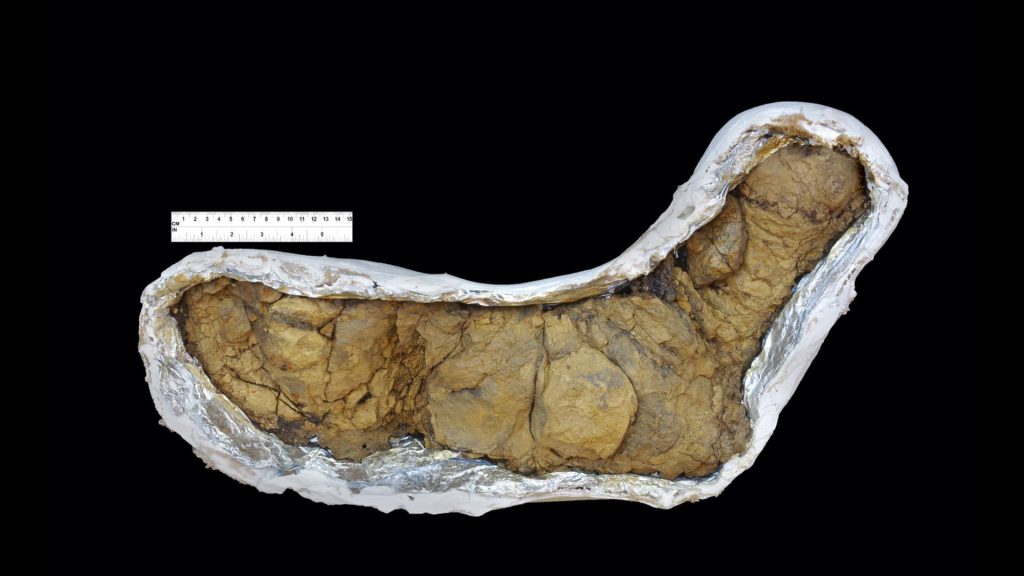
Barnum changed the picture. Fossil collector George Frandsen acquired the South Dakota specimen in 2020, and it didn’t take long for Guinness World Records to recognize Barnum as the new champion. According to the official Guinness World Records listing, it measures 67.5 centimeters along its central curve and up to 15.7 centimeters wide, weighing roughly 9.28 kilograms. That’s more than half again as long as the 1998 Saskatchewan specimen, and it comfortably surpasses every other dinosaur coprolite ever assigned to a meat-eater making it the record holder by a wide margin.
The specimen takes its name from Barnum Brown, the paleontologist credited with discovering the first Tyrannosaurus rex remains in 1902. It’s a fitting tribute: no other predator known from the Hell Creek Formation, where Barnum was found, was large enough to have produced it.
How Big Is the Largest Coprolite Ever Found, Compared to Earlier Records?
It’s worth putting the numbers side by side. The Saskatchewan specimen, the previous record holder, measured 44 centimeters. Barnum measures 67.5 centimeters along its central curve roughly 50 percent longer and weighs over 9 kilograms, nearly four times heavier by most published estimates of the earlier find. Few other candidates come close on either dimension, which is why Barnum’s discovery drew attention well beyond paleontology circles.
Could Barnum Really Have Come From a T. Rex?
Barnum’s likely identity as a T. rex coprolite rests on circumstantial evidence, not a signature only T. rex could have left behind. Coprolites carry no DNA and no fingerprint nothing in the fossil itself names its producer. Researchers instead narrow the field of suspects using geography, size, and diet.
Barnum was found in the Hell Creek Formation, a Late Cretaceous rock unit that has produced the remains of only one truly giant meat-eating dinosaur: Tyrannosaurus rex. The specimen’s size and the volume of crushed bone packed inside it point to an animal capable of enormous bite force and bone-crushing digestion a profile that fits an apex predator, not a smaller scavenger. T. rex is also known to have lived in this exact environment at this exact time, which makes it the strongest candidate by a wide margin.
None of that amounts to proof. No other predator large enough to have produced Barnum is currently known from Hell Creek, but the fossil record is incomplete, and a coprolite like this cannot be tied to a single species with absolute certainty. That’s why researchers describe Barnum as a giant carnivore coprolite most likely produced by a T. rex not a confirmed T. rex coprolite outright.
How Do Scientists Know a Coprolite Is Real?
A question that trails every large dinosaur coprolite find is obvious: how do scientists know a coprolite is real and not just an oddly shaped stone? For Barnum, the answer came from an independent lab test. According to Guinness World Records, X-ray fluorescence analysis conducted by the Geoarchaeological XRF Laboratory in Albuquerque, New Mexico, revealed elevated levels of phosphorus and calcium a chemical signature consistent with other confirmed carnivore droppings.
Beyond the chemistry, Poozeum’s own analysis points to physical clues: the coprolite has a cylindrical shape with a rounded top and flattened underside, plus a slight bend consistent with hitting the ground after falling. Crushed bone fragments are visible throughout, showing that the animal crushed and partially digested substantial amounts of bone. Together, the chemistry, shape and bone inclusions support its identification as a genuine coprolite rather than an ordinary mineral concretion.
What Does a Coprolite Tell Scientists About Dinosaur Diet?
Here is where the science earns its keep. What does a coprolite tell scientists about dinosaur diet that bones alone cannot? The American Museum of Natural History notes that analysis of the 1998 Saskatchewan dinosaur coprolite found roughly 30 to 50 percent of its volume was bone much of it from a young animal, with fragments still angular rather than smoothed by stomach acid. That suggests the prey didn’t sit in the predator’s gut long before the remains were expelled, a clue to how quickly a T. rex could process a meal.
Inclusions like these are why researchers treat every large coprolite as a direct record of behavior rather than guesswork. A skeleton shows what an animal looked like. This kind of fossil shows what it actually did which is the real answer to what a coprolite tells scientists about dinosaur diet.
Barnum’s New Home: The Poozeum
Barnum now belongs to the world’s largest fossil-dung collection. Frandsen began collecting fossilized dinosaur poop at 18 after visiting a rock shop in Moab, Utah, and opened the Poozeum in Williams, Arizona in 2024. The museum holds thousands of specimens from multiple continents, with Barnum as its centerpiece. Frandsen had already held a separate Guinness World Record since 2015 for owning the largest private collection of dinosaur coprolite in the world Barnum simply added a second title to the shelf.
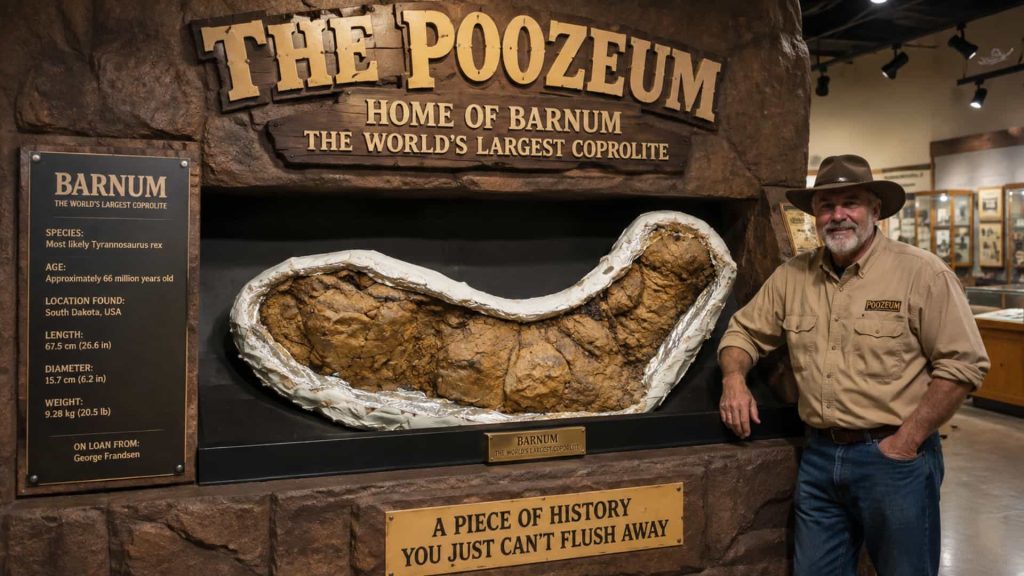
Seeing it in person doesn’t require imagining the whole animal, either. The specimen is kept in a protective jacket most of the time, removed periodically only for measurement and research, according to Guinness World Records.
Frandsen’s collection also reflects a broader shift in how museums treat dinosaur trace fossils once dismissed as curiosities, now recognized as evidence that can answer questions skeletons alone cannot.
Why This Discovery Matters
A single fossil rewriting a record might sound like trivia, but this discovery matters for a bigger reason: it’s direct physical evidence of predator behavior from 66 to 70 million years ago, preserved in a form skeletons can’t provide. Every inclusion bone density, digestion state, mineral content adds a data point to how the Cretaceous era’s dominant predator actually lived, hunted, and fed.
It also illustrates something else: paleontology’s most informative fossils aren’t always the most dramatic-looking ones. A tooth tells you what an animal was capable of; a coprolite reveals actual dinosaur behavior what it did with that capability on one ordinary day, tens of millions of years ago.
Future Research on Fossilized Dinosaur Poop
Coprolite science is still a young field compared to skeletal paleontology, and the Barnum coprolite hasn’t been fully mined for information yet. Researchers who study specimens like this continue to look for microscopic plant material, parasite eggs, and trace minerals that can reveal details about digestion, health, and even the surrounding ecosystem at the moment of deposition. Whether Barnum holds any of those secrets is an open question one that future lab work, not size records, will eventually answer.
Key Takeaways
- Barnum, discovered in South Dakota in 2019, is the current Guinness World Records holder for the largest coprolite ever found from a carnivore likely a T. rex coprolite, measuring 67.5 cm long, 15.7 cm wide, and 9.28 kg.
- The Barnum coprolite surpassed the previous record holder: a 44 cm Saskatchewan dinosaur coprolite described by Karen Chin’s team in a 1998 Nature paper.
- Scientists confirmed the fossilized dinosaur poop was genuine through X-ray fluorescence chemistry testing and physical shape analysis, not appearance alone.
- Bone content inside a coprolite like this one shows the animal crushed and partially digested substantial amounts of bone, offering direct evidence of feeding behavior.
- The Barnum coprolite is now the centerpiece of the Poozeum in Williams, Arizona, the world’s largest coprolite collection.
Related Topics
- Lokiceratops Rangiformis: The Bizarre Horned Dinosaur With Blade-Like Spikes another Late Cretaceous dinosaur discovery, this one a newly described horned herbivore from Montana.
- The Great Pyramid another case of scientists reading an ancient physical structure to reconstruct how it was built and used.
- Nazca Lines trace evidence on a landscape scale, left behind for researchers to interpret millennia later.
- Top 10 Ancient Egyptian Symbols for readers drawn to how physical artifacts encode hidden history.
- Zombie Ant Fungus: Nature’s Most Terrifying Mind Control another case where trace evidence, not the animal itself, tells the real story.
- Humanity Near Extinction: The Shocking DNA Bottleneck Truth another story of scientists reconstructing a deep-time event from a handful of physical clues.
- 15,000-Year-Old Healing Secrets of Taforalt Cave trace evidence of ancient behavior recovered from a single physical site, the same evidentiary logic used here.
Frequently Asked Questions About T. Rex Coprolite
What is a T. rex coprolite?
A T. rex coprolite is a fossilized dinosaur dropping believed to have been produced by a Tyrannosaurus rex. Minerals replace the original organic waste over millions of years, preserving its shape and often its contents, including undigested bone.
How big is the largest carnivore coprolite ever found?
The current record holder, nicknamed Barnum, measures 67.5 centimeters long and 15.7 centimeters wide, weighing about 9.28 kilograms. It was certified by Guinness World Records in 2020 as the largest coprolite ever found from a carnivore.
How do scientists know a coprolite is real and not just a rock?
Researchers use X-ray fluorescence testing to detect phosphorus and calcium levels typical of digested bone, combined with physical clues like shape, crushed bone inclusions, and surface texture consistent with how the material would have fallen and settled. That combination is how scientists know a coprolite is real rather than a natural rock formation.
Where was the Barnum coprolite found?
It was discovered on a private ranch near Buffalo, South Dakota, in the Hell Creek Formation, in the summer of 2019.
Why is it called Barnum?
The specimen is named after Barnum Brown, the paleontologist who discovered the first Tyrannosaurus rex remains in 1902 a fitting tribute given that T. rex is considered the most likely producer.
What can a coprolite tell scientists about dinosaur diet?
A dinosaur coprolite preserves direct evidence of what an animal ate and how it digested it, including bone fragments, their size, and how worn they are details that reveal feeding speed and digestive strength that bones alone cannot show. This is the core of what a coprolite tells scientists about dinosaur diet.
Was there a carnivore coprolite before Barnum?
Yes. A 44-centimeter dinosaur coprolite found in Saskatchewan, Canada, and described in a 1998 Nature paper by Karen Chin and colleagues held the previous world record, before Barnum surpassed it in 2020.
Where can I see the T. rex coprolite in person?
The Barnum coprolite is on display at the Poozeum in Williams, Arizona, the world’s largest collection of fossilized dinosaur poop, founded by George Frandsen.
Source References
- Guinness World Records “Largest coprolite from a carnivore,” confirmed 2 March 2020. https://www.guinnessworldrecords.com/world-records/78871-largest-coprolite-fossilised-excrement-from-a-carnivore
- Chin, K., Tokaryk, T.T., Erickson, G.M., Calk, L.C. “A king-sized theropod coprolite,” Nature 393, 680–682 (1998). https://www.nature.com/articles/31461
- Poozeum “Barnum, The T. Rex Poop – The World’s Largest Coprolite.” https://poozeum.com/t-rex-coprolite
- Smithsonian Magazine “Admire the World’s Largest Collection of Fossilized Poop at the New ‘Poozeum’ in Arizona,” October 22, 2024. https://www.smithsonianmag.com/smart-news/admire-the-worlds-largest-collection-of-fossilized-poop-at-the-new-poozeum-in-arizona-180985309/
- American Museum of Natural History “Fossilized Scat Provides Clues About T. rex’s Diet,” June 14, 2019. https://www.amnh.org/explore/news-blogs/fossilized-scat-t-rex-diet
- CBC News “Replica of rare Sask. dino poo headed to Smithsonian,” June 12, 2013. https://www.cbc.ca/news/canada/saskatchewan/replica-of-rare-sask-dino-poo-headed-to-smithsonian-1.1403682
Author Bio
Author Mubashir Razzaq is a science and history writer for Strangehappen.com, specializing in archaeology, space exploration, ancient civilizations, and emerging scientific discoveries. His work focuses on translating complex research into engaging, evidence-based stories that help readers understand the mysteries of our world and beyond.