
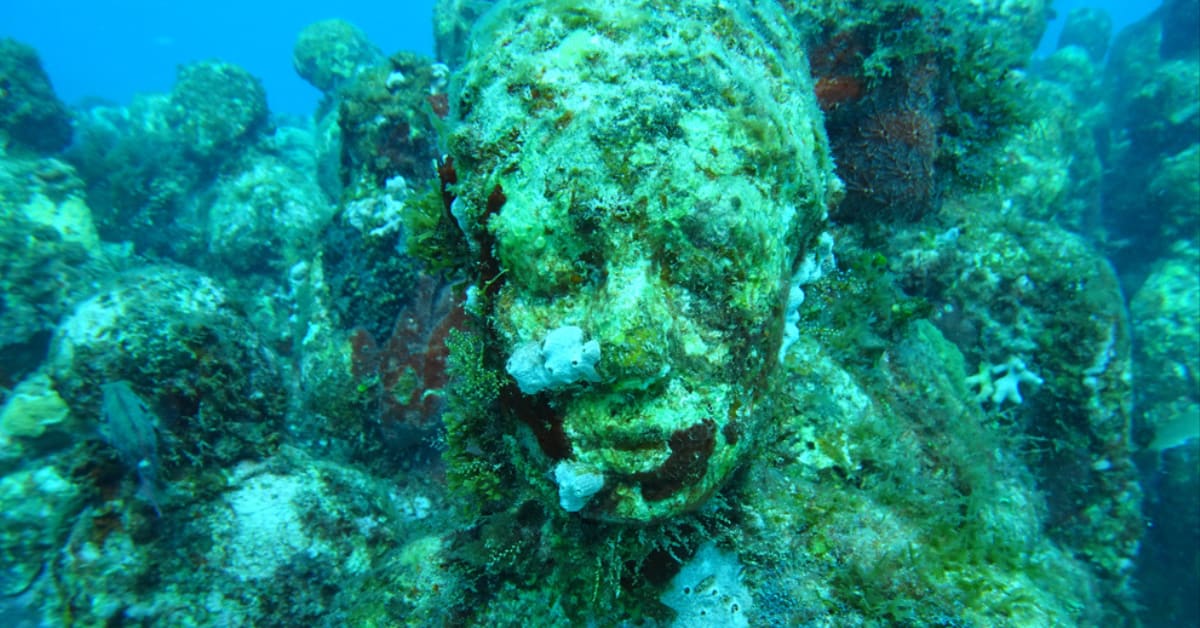
In 2005, Hurricane Wilma tore into the reefs off Cancún and Isla Mujeres, and out of that damage came one of the strangest experiments in marine conservation anywhere in the world. A government marine biologist, a nautical association president, and a British sculptor who used to be a dive instructor decided the best way to save a reef was to build one out of statues. Today more than 500 of those statues sit on the seafloor of the Mexican Caribbean, and the ocean has quietly turned several of them into something nobody planned for: a hidden research station, a secret art gallery within the art gallery, and, entirely by accident, a lesson in who actually cleans a reef.
This is MUSA, the Museo Subacuático de Arte, and its real story is stranger than the postcard version.
Why Cancún Needed a Museum Underwater
Before MUSA existed, the reefs of the Costa Occidental de Isla Mujeres, Punta Cancún y Punta Nizuc National Park were already carrying an enormous load. This stretch of Mexican Caribbean coastline draws roughly a million visitors a year to a protected area that covers over 8,600 hectares of reef, seagrass, and coastal habitat, according to Mexico’s National Commission of Natural Protected Areas (CONANP). Then Hurricane Wilma hit.
By- Adam Radcliffe
CONANP’s own account of the park’s history names hurricanes as the most visible source of reef damage over the decades, on top of nautical-recreational pressure, wastewater pollution, and poorly planned coastal development. Wilma’s damage in 2005 was severe enough that shutting sections of the reef down entirely was on the table. Dr. Jaime González Cano, a marine biologist working with Mexico’s national parks authority, proposed something different: build an artificial reef designed specifically to pull divers and snorkelers away from the wounded natural reef while it recovered.
He brought the idea to Roberto Díaz Abraham, then president of the Cancún Nautical Association. Díaz Abraham worked on it, stepped away around 2008 believing it would take too long to become a real attraction, then later returned and has remained involved ever since. González Cano kept pushing the concept forward through the Nautical Tourism Subcommittee, and the plan grew from “artificial reef” into something more ambitious: an underwater art installation engineered to become a living reef.
An Environmental Impact Assessment, prepared by park staff, González Cano, and Díaz Abraham, gave the project its legal foundation. It approved a long-term plan for up to 1,412 sculptures spread across 10 underwater galleries over the next 50 years. Even today, only part of that vision has been brought to life, making MUSA an evolving project rather than a completed museum. Those figures are supported by Jason deCaires Taylor’s official project records as well as other publicly available documentation. They also highlight just how much of the original plan still remains unfinished. Looking for someone who could combine artistic vision with an understanding of the marine environment, González Cano turned to Jason deCaires Taylor, a British sculptor and former dive instructor who had already pioneered underwater sculpture reefs in Grenada.
What’s Actually Down There
MUSA is not one dive site. It is three separate galleries, each with a different depth, a different purpose, and a different feel, all of them sitting inside the same shallow band of ocean known as the sunlight zone, the only layer of the sea that gets enough light for the coral and algae MUSA depends on to actually grow.
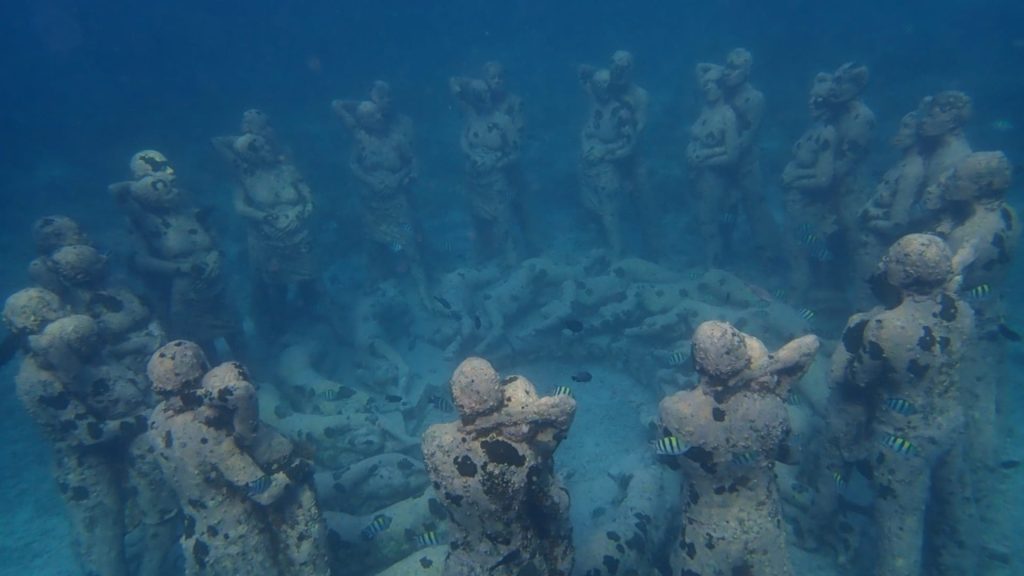
Taylor completed the first four statues, submerged in November 2009. The centerpiece came a year later: The Silent Evolution, a field of more than 450 life-sized human figures cast largely from local Isla Mujeres residents and fishermen, arranged in the shape of an eye that faces oncoming hurricanes to reduce the energy storms spend on the piece. Building it took Taylor roughly 18 months and around 120 hours of underwater work, using sandbags, cranes, and a 40-ton rig ferried over on the Isla-to-Punta Sam car ferry to position the statues one by one. MUSA officially opened on November 27, 2010, two days before world leaders arrived in the same city for the 2010 UN Climate Change Conference (COP16).
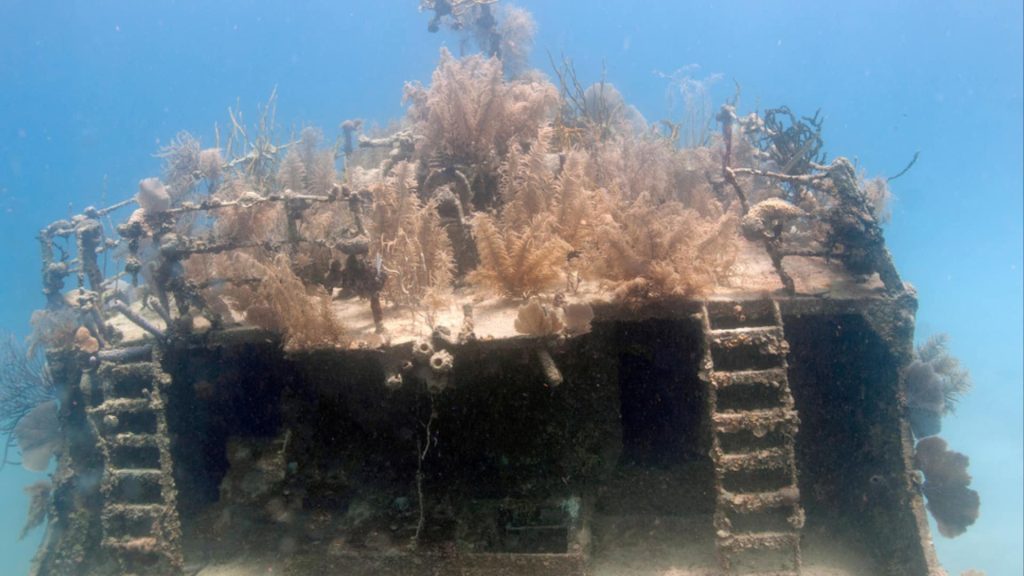
The statues are cast in pH-neutral, marine-grade cement, reinforced with inert fiberglass rebar and free of the metals that would poison surrounding marine life. Some incorporate broken coral fragments or deliberately textured, pitted surfaces designed to give coral larvae something to grip onto. Deployment is timed, where possible, to coincide with lunar-driven coral spawning events, so the statues get a head start on colonization before faster-growing algae can take over. It’s a reminder that reefs don’t have to be built from coral at all; deep in the cold Pacific, entire reef structures grow out of silica instead, formed by glass sponges rather than cement.
The Sculptors Behind MUSA
Taylor is the founding artist, but MUSA is not a one-man project. A second wave of Mexican sculptors added their own work through 2011 and 2012: Karen Salinas Martínez created Seascapes, Rodrigo Quiñones Reyes created Biomap, and Salvador Quiroz Ennis created Bacab, all installed in the Manchones gallery. Roberto Díaz Abraham himself contributed The Ocean Muse to the Nizuc gallery, and Elier Amado Gil has continued working on new pieces alongside Díaz Abraham. Taylor’s own later works at MUSA carry titles that read like a running commentary on modern life underwater: The Bankers, Anthropocene, Time Bomb, The Dream Catcher, and The Man on Fire, the last of which has fire coral deliberately implanted into the figure’s form.
The Listener: A Sculpture That Records the Ocean
Hidden within the Nizuc gallery is a sculpture that many visitors unknowingly swim right past. Called The Listener, it looks like an ordinary bust until you know what’s hidden inside: a NOAA-designed hydrophone that automatically records 30 seconds of underwater sound every 15 minutes, continuously. The project is the work of marine bioacoustics researcher Heather Spence, developed in collaboration with Taylor as an ongoing study of the reef’s soundscape, from snapping shrimp to boat traffic to fish choruses. It’s a rare case of an artwork functioning as an actual, continuously running scientific instrument, and Science Friday has covered it as exactly that: a sculpture that eavesdrops on the sea.
The Cleaning Crew Nobody Knew Was There
MUSA’s most genuinely strange discovery happened by accident. Not long after The Silent Evolution went in, park staff started fielding complaints that thick algae growth was obscuring the statues’ faces and features. To fix it, researchers ran an unplanned experiment: they scrubbed the algae off half the statues and left the other half untouched. Three weeks later, the pattern had flipped. The cleaned statues were coated in algae again, worse than before, while the untouched half had largely cleared itself.
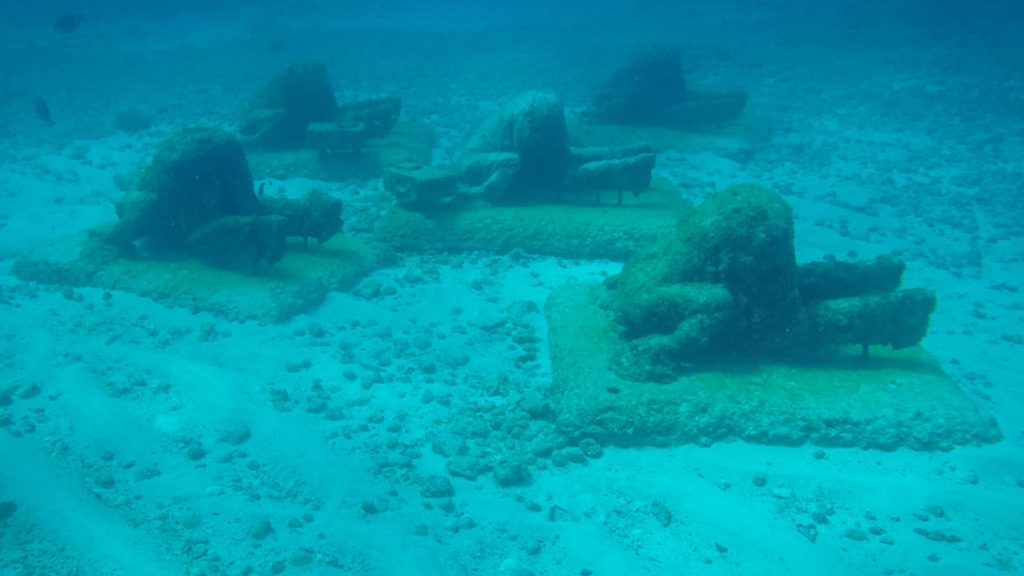
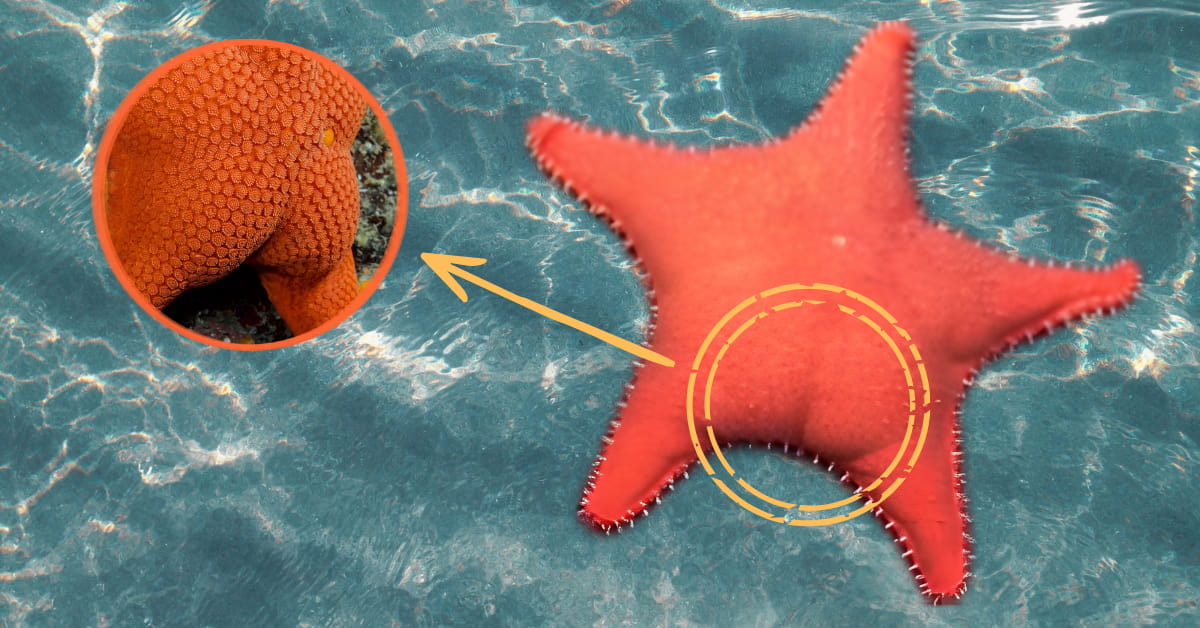
The explanation turned out to live underneath the statues. A large, previously unnoticed colony of sea urchins had been sheltering beneath the sculptures and emerging at night to graze. When their usual algae supply was scrubbed away, they simply relocated to the untouched statues and got to work there instead, doing a more thorough cleaning job than the human intervention had. Sea urchins are echinoderms, the same strange body plan family as starfish, animals built almost entirely without a conventional head or body. It was an accidental demonstration of a basic reef principle that grazers, not scrub brushes, keep a healthy reef in balance, and that human “help” can backfire if it skips the ecology already doing the job.
The Hidden Space Invader Tiles
There’s one more secret built into MUSA, and it has nothing to do with marine biology. In 2012, the French street artist known as Invader, famous for gluing pixel-art mosaics of 1970s and ’80s video game characters onto buildings worldwide, reached out to Taylor after learning they were represented by the same gallery. The result: three small ceramic “space invader” tiles quietly installed among MUSA’s statues, an underwater version of the same urban mosaics found scattered across dozens of cities. Two sit within the Manchones gallery and one is mounted at MUSA’s headquarters on land. They are easy to miss and are not marked on any official map, which is more or less the point.
Why It’s More Than a Photo Opportunity
MUSA was never meant to be purely decorative, and CONANP-adjacent research and reporting back that up. By absorbing a meaningful share of beginner divers and snorkelers, MUSA takes direct pressure off the fragile natural reef nearby, giving new divers a place to build buoyancy skills before they’re anywhere near living coral that a clumsy fin kick could damage. It has also become an unplanned biology field station: researchers have been able to watch, in real time, how a barren patch of seafloor turns into a functioning reef ecosystem, complete with its own grazers, its own algae cycles, and its own soundscape recorded by The Listener around the clock.
None of that erases the underlying threat. CONANP’s own summary of the park’s history lists hurricanes, coral bleaching, and disease as ongoing pressures on both the natural and artificial reef systems here, which is a reminder that MUSA was built as a response to a real and recurring problem, not a one-time fix. It’s part of a broader pattern of deliberate, hands-on intervention saving a species or ecosystem that would otherwise be left to decline on its own, the same logic behind captive-breeding programs for animals like the Chinese giant salamander. It also sits opposite a very different kind of ocean-floor intervention: where MUSA adds structure to the seabed to help it recover, deep-sea mining strips structure away, and marine biologists are still working out what that tradeoff costs.
Visiting MUSA: What to Expect
MUSA is split across three galleries, and where you go depends on whether you’re snorkeling or diving.
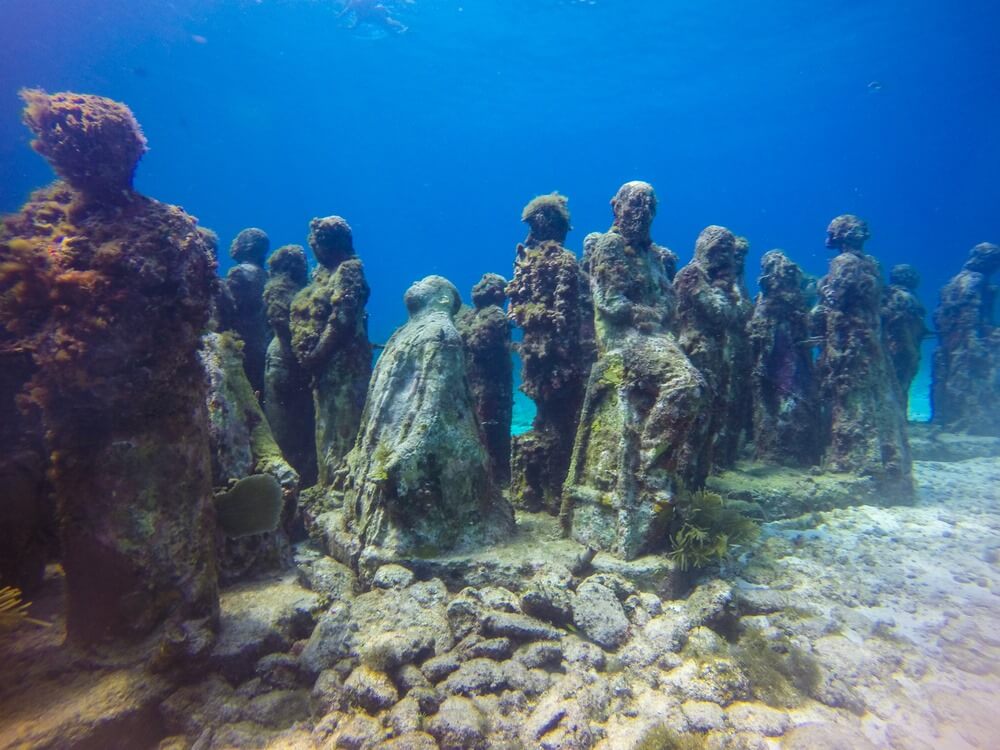
Salón Manchones sits deepest, generally cited between roughly 8 and 10 meters (26–33 feet), and is where The Silent Evolution lives. It’s suitable for both certified divers and confident snorkelers, protected somewhat from storm surge by the natural Manchones reef system nearby. Salón Nizuc, home to The Listener and several of Taylor’s later works, sits shallower at around 4 meters (13 feet) and is snorkel-only. Punta Sam, the newest and shallowest gallery at roughly 3.5 meters (11 feet), is also snorkel-only.
Visibility around MUSA typically runs 20 to 30 meters, water temperature hovers near 28°C (82°F), and admission is collected through the national marine park itself, usually bundled into the price of a licensed tour. Snorkeling trips generally require life jackets, cap group sizes, and prohibit non-biodegradable sunscreen, rules worth checking before booking, since only operators with proper Parque Nacional permits should be taking visitors here.
What’s Still Unresolved
Of the ten galleries the original 2009 Environmental Impact Assessment permits, and the 1,412 total sculptures it allows, only three have been built after roughly a decade and a half. That leaves an open question nobody involved with MUSA has fully answered publicly: whether the remaining seven galleries will ever be constructed, and if so, on what timeline. The Listener‘s hydrophone keeps recording new audio every 15 minutes, which means there’s a growing, largely unpublished dataset of how the reef’s soundscape has shifted since 2012 as coral cover, fish populations, and boat traffic have all changed. And the sea urchin discovery raises its own unanswered question about scale: nobody has fully mapped how urchin grazing patterns are shaping which of MUSA’s statues develop into dense coral habitat and which stay comparatively bare.
Related Topics
If MUSA’s mix of art, science, and strange ocean life caught your attention, these go further into the same waters:
- Red-Lipped Batfish Facts, a reef-edge fish that “walks” the seafloor on modified fins in the same kind of shallow tropical water MUSA’s galleries occupy.
- Vampire Squid Facts and Yeti Crab, two of the ocean’s stranger residents and a reminder of just how different life gets once you leave MUSA’s shallow galleries behind.
- Sagami Bay Creature, another case of the ocean floor hiding something nobody expected, this time a still-unexplained shape caught on ROV footage.
- Glass Octopus and Stonefish, two more reef-dwelling animals built around the same trick MUSA’s statues rely on: hiding in plain sight until something grows over them.
- Two Oceans Meeting, for anyone who wants one more genuinely strange, well-documented ocean phenomenon after this one.
Key Takeaways
- MUSA exists because Hurricane Wilma damaged Cancún’s natural reefs in 2005, prompting marine biologist Dr. Jaime González Cano to propose an artificial reef built from statues instead of concrete blocks.
- The museum officially opened November 27, 2010, two days before COP16 convened in the same city.
- MUSA’s permit allows for 1,412 sculptures across 10 galleries over 50 years; only around 500 statues across 3 galleries have been built so far.
- The Listener, a working hydrophone hidden inside a sculpture, has been recording the reef’s soundscape automatically since 2012.
- A sea urchin colony living beneath the statues was discovered by accident, when researchers found the urchins were doing a better job of algae control than manual cleaning.
- Three small ceramic tiles by street artist Invader are hidden among the statues, unmarked on any official map.
Frequently Asked Questions About MUSA Underwater Museum
How deep is the MUSA underwater museum?
Depth depends on the gallery. Salón Manchones sits at roughly 8 to 10 meters (26–33 feet) and suits both diving and snorkeling. Salón Nizuc is around 4 meters (13 feet), and Punta Sam is about 3.5 meters (11 feet); both of the latter are snorkel-only.
How many statues are in the Cancún underwater museum?
More than 500 statues have been installed since 2009, with roughly 477 in the Manchones gallery and the rest split between Nizuc and Punta Sam. The full permit allows for 1,412 sculptures across 10 galleries, so what’s currently underwater is only a portion of what was legally approved.
Who created MUSA and why?
Marine biologist Dr. Jaime González Cano proposed it after Hurricane Wilma damaged local reefs in 2005, working with Roberto Díaz Abraham of the Cancún Nautical Association. British sculptor Jason deCaires Taylor was brought on to design and build the statues, later joined by Mexican sculptors including Karen Salinas Martínez, Rodrigo Quiñones Reyes, and Salvador Quiroz Ennis.
Is MUSA underwater museum worth visiting?
For divers and snorkelers already headed to Cancún or Isla Mujeres, MUSA offers something a natural reef dive can’t: statues at a scale and density found almost nowhere else, plus a legitimate conservation story behind them. It’s a shallow, low-current site, which also makes it approachable for less experienced swimmers.
Snorkeling vs. diving MUSA, which is better?
Diving gets you closer to The Silent Evolution in the deeper Manchones gallery and lets you spend more time at eye level with individual statues. Snorkeling is the only option at the shallower Nizuc and Punta Sam galleries, and still offers good visibility of the statues from the surface given MUSA’s shallow depths overall.
When did MUSA open?
MUSA officially opened on November 27, 2010, though the first four statues were submerged in November 2009 and additional galleries have been added in the years since.
What is The Silent Evolution?
It’s MUSA’s largest single installation: more than 450 life-sized figures, many cast from local Isla Mujeres residents, arranged in an eye shape designed to reduce hurricane impact on the piece. It took Jason deCaires Taylor about 18 months to complete.
Are there hidden or secret sculptures at MUSA?
Yes. Three small ceramic tiles by the street artist Invader are installed among the statues, two in the Manchones gallery and one at MUSA’s land headquarters. They aren’t marked on official maps.
How do the sculptures help coral reefs grow?
The statues are cast in pH-neutral marine cement with textured, porous surfaces that give coral larvae something to attach to. Placement is timed around lunar coral-spawning cycles, and some pieces include broken coral fragments to jump-start colonization.
What is the story behind The Listener?
The Listener is a sculpture at MUSA’s Nizuc gallery with a hidden NOAA-designed hydrophone inside, built by marine bioacoustics researcher Heather Spence in collaboration with Jason deCaires Taylor. It has been automatically recording 30 seconds of ocean sound every 15 minutes since 2012.
Sources
- Mexico’s National Commission of Natural Protected Areas (CONANP): official park page: https://www.gob.mx/conanp/documentos/costa-occidental-de-isla-mujeres-punta-cancun-y-punta-nizuc
- CONANP: “El Parque Nacional Costa Occidental de Isla Mujeres celebra 26 años” (2022): https://www.gob.mx/conanp/articulos/el-parque-nacional-costa-occidental-de-isla-mujeres-celebra-26-anos
- Jason deCaires Taylor’s official studio site, MUSA project page: https://www.underwatersculpture.com/projects/musa-mexico/ and https://www.underwatersculpture.com/works/the-silent-evolution/
- Science Friday: “A Sculpture Eavesdrops Underwater” (Oct. 2015): https://www.sciencefriday.com/articles/a-sculpture-eavesdrops-underwater/
- Heather Spence, marine bioacoustics researcher: The Listener Project (primary source): https://heatherspence.net/the-listener-project/
- Wikipedia: “Cancún Underwater Museum,” cross-checked against the above primary sources for dates and figures: https://en.wikipedia.org/wiki/Canc%C3%BAn_Underwater_Museum
- Invader (street artist): official account of the MUSA collaboration: https://space-invaders.com/post/subinvasion/
- 2010 United Nations Climate Change Conference (COP16) dates, for the timing detail: https://en.wikipedia.org/wiki/2010_United_Nations_Climate_Change_Conference
Author Bio
Author Mubashir Razzaq is a science and history writer for Strangehappen.com, specializing in marine science, ocean conservation, and underwater discoveries. His work focuses on translating complex research into engaging, evidence-based stories that help readers understand the mysteries of our world and beyond.