


MWC 758 c Protoplanet is a noteworthy exoplanet disclosure that has offered space experts significant understanding into planetary development. This youthful monster protoplanet, situated inside the protoplanetary disk of the star MWC 758, is as yet framing and effectively molding its current circumstance. By making striking twisting arms inside the residue of its host star’s plate, MWC 758 c Protoplanet assists us with figuring out the mind-boggling elements among planets and their natal plates. This blog jumps into the subtleties of this remarkable divine article, its qualities, and its logical importance.
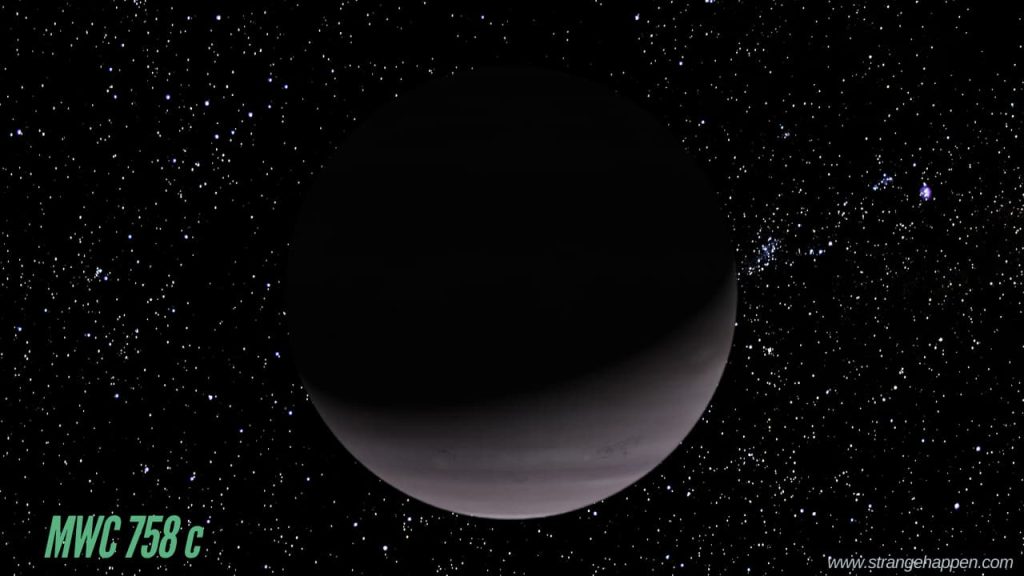
1. Overview of MWC 758 c Exoplanet
- Star Name: MWC 758
- Distance: ~500 light-years from Earth
- Area: Heavenly body Auriga
- Star Type: Herbig Ae star (a youthful star encompassed by a plate of gas and residue)
- Plate Organization: Wealthy in gas and residue, ideal for planet arrangement
The protoplanetary disk around MWC 758 is an urgent region for concentrating on how planets structure and connect with their environmental factors.
2. What is MWC 758 c Protoplanet?
MWC 758 c is a protoplanet, meaning it is still during the time spent shaping. In contrast to full-fledged planets, protoplanets are implanted inside the gas and residue of their star’s protoplanetary circle. MWC 758 c is especially fascinating because of its:
- Monster Size: Accepted to be a gas Goliath like Jupiter or bigger.
- Arrangement Stage: Actually gathering mass through the encompassing circle material.
- Influence on Circle: It applies gravitational impact, making winding examples in the plate.
3. MWC 758 c Protoplanet Formation and Discovery
3.1. The Protoplanetary Disk
Protoplanetary circles are the origin of planets. They contain:
As these materials impact and combine north of millions of years, they structure planets. MWC 758’s plate shows unmistakable winding arms, which were pivotal in distinguishing MWC 758 c.
3.2. MWC 758 c Protoplanet Discovery Methods
MWC 758 c Protoplanet was found utilizing progressed telescopes and perception methods:
- Infrared Imaging: To catch the weak intensity signals discharged by the planet.
- Energized Light Imaging: To distinguish structures inside the circle.
- ALMA (Atacama Huge Millimeter Exhibit): Aided map the circle’s residue designs.
4. Unique Features of MWC 758 c Protoplanet
4.1. Spiral Arm Formation
One of the most astonishing parts of MWC 758 c Protoplanet is its job in forming winding arms inside the protoplanetary disk. These arms:
- Are brought about by the planet’s gravitational impact on encompassing gas and residue.
- Show the planet’s situation and mass.
- Give proof of planet-circle connections continuously.
4.2. Early Stage of Formation
MWC 758 c Protoplanet is as yet aggregating material, meaning:
- The planet has not yet arrived at its last mass.
- It offers understanding into how gas monsters like Jupiter structure.
5. Scientific Significance
5.1. Understanding Planet Formation
MWC 758 c Protoplanet offers space experts a once in a lifetime opportunity to notice planet development in real life. By concentrating on this protoplanet, researchers can:
- Refine models of planet development.
- Comprehend the timescales associated with framing gas Goliath.
- Notice planet-circle connections and their consequences for plate structure.
5.2. Comparative Planetology
Contrasting MWC 758 c Protoplanet with planets in our Solar system makes a difference:
- Comprehend how Jupiter and Saturn might have shaped.
- Distinguish normal cycles in planet development across various star frameworks.
6. Key Insights from Observations
- Gravitational Chiseling: The winding arms in the MWC 758 c Protoplanet circle affirm that gravitational collaborations between a framing protoplanet and its plate can shape and shape the general climate in any event, during early development stages. This supports the hypothesis that planets fundamentally impact circle morphology during their development.
- Fast Planet Arrangement: The period of MWC 758 (~4 million years) shows that planetary frameworks start to shape rapidly after a star’s introduction to the world. Inside only two or three million years, protoplanets can arise and change their plate structure.
- Plate Designs as Signs: Plate deviations and winding arm examples can show the presence of framing planets. Regardless of whether direct imaging of a protoplanet is testing, its gravitational impact on the circle offers a strong technique for identification.
- Significance of Direct Imaging: MWC 758 c Protoplanet was seen through direct imaging, a method that permits stargazers to catch point by point information about youthful planets actually implanted in their plates. This strategy is significant for figuring out the beginning phases of planet arrangement.
- Job of Protoplanets in Clearing Holes: Protoplanets like MWC 758 c Protoplanet are fit for clearing holes or paths in the plate by accumulating close by material. This peculiarity further builds up their part in impacting circle advancement and planetary design.
- Warm and Residue Discharges: Perceptions of infrared emanations and residue fixations around MWC 758 give pieces of information about the structure and elements of protoplanets. These emanations help separate between framing planets and foundation plate structures.
- Propelling Planet Development Models: The identification of MWC 758 c Protoplanet difficulties and refines existing models of planet arrangement by giving true proof of how protoplanets associate with their current circumstance. This information is critical to understanding the progress from protoplanet to full fledged exoplanet.
- Future Perceptions with Cutting edge Telescopes: Instruments like the James Webb Space Telescope (JWST) and the forthcoming Nancy Effortlessness Roman Space Telescope will additionally improve the investigation of protoplanetary frameworks by giving higher goal imaging and spectroscopic information.
These bits of knowledge on the whole improve how we might interpret how planets structure and develop inside their star frameworks, offering a window into the unique cycles molding youthful planetary conditions.
7. Future Research Directions
- Itemized Imaging: Using cutting edge telescopes like the James Webb Space Telescope (JWST), Very Enormous Telescope (ELT), and Thirty Meter Telescope (TMT) to acquire high-goal pictures of MWC 758 c Protoplanet and its encompassing plate. These pictures will assist imagine planet-circle cooperations with uncommon lucidity
- Spectroscopic Examination: Utilizing infrared and optical spectroscopy to concentrate on the protoplanet’s air and compound organization. This examination can uncover key components like hydrogen, water fume, carbon dioxide, and natural atoms, offering experiences into the planet’s advancement and potential for tenability
- Long haul Checking: Constant perception of MWC 758’s protoplanetary circle to follow changes in twisting arm designs, holes, and residue elements. This will give information on the protoplanet’s development, orbital development, and mass gradual addition rates after some time
- Multi-Frequency Studies: Consolidating information from radio, infrared, and noticeable frequencies to fabricate a more far-reaching image of the framework. Instruments like ALMA (Atacama Enormous Millimeter/submillimeter Cluster) can distinguish cold residue and gas, supplementing information from optical and infrared telescopes.
- Attractive Field Examinations: Concentrating because of attractive fields on the protoplanetary plate. Understanding how these fields associate with MWC 758 c Protoplanet arrangement could reveal insight into the job of attraction in early planetary turn of events
- Relative Planetary Arrangement: Examining other youthful frameworks like MWC 758 to look at how protoplanets shape their surroundings. This can assist with refining speculations about the variety of planetary framework models and development timetables
- Reproductions and Demonstrating: Creating progressed virtual experiences to show the associations between MWC 758 c Protoplanet and its plate. These recreations can test theories about plate development, winding arm arrangement, and hole clearing systems
By chasing after these exploration roads, researchers expect to acquire a more profound comprehension of the perplexing cycles overseeing planet development and the early advancement of planetary frameworks.
Conclusion
All in all, the investigation of MWC 758 c Protoplanet and comparable youthful protoplanets marks a huge forward-moving step in how we might interpret planetary development. These disclosures offer important bits of knowledge into the cycles that shape planetary frameworks and the circumstances that might uphold life on far off universes. As we keep investigating exoplanets like K2-25b, TOI-700 d, and KELT-9b, we draw nearer to addressing key inquiries regarding the starting points of our Solar system and the potential for life past Earth.
Furthermore, bodies like Miranda, a moon of Uranus, give novel points of view on planetary and moon development, uncovering the perplexing cycles at play in the advancement of heavenly bodies. Proceeded with examination into these far off objects grows our insight and motivates future investigation. Every revelation carries us nearer to understanding the huge, powerful universe we occupy, supporting the significance of logical request and investigation in uncovering the secrets of planetary advancement.
Quick Facts Recap
- Star: MWC 758
- Distance: 500 light-years
- Planet Type: Giant protoplanet
- Key Feature: Sculpting spiral arms in the protoplanetary disk
- Significance: Real-time planet formation observation