

Most amphibians spend their whole life trying to grow up. The axolotl never bothers. It hatches in the water, keeps its feathery gills for life, and if it loses a limb, it can regenerate a remarkably complete replacement with little visible scarring. Conservation International cites an estimate of roughly 50 to 1,000 axolotls remaining in the wild, with the surviving population concentrated in the canals and wetlands of Xochimilco near Mexico City.
That combination, a creature almost too strange to be real and almost gone before most people learned it existed, is why the axolotl keeps showing up in biology labs, kids’ cartoons, and now, on Mexican currency, much like another sea-dwelling species whose viral reputation doesn’t match the science. Here’s what’s actually known about it, what’s still theory, and why scientists are racing to understand it before it disappears from the wild for good.
What Is an Axolotl?
An axolotl is a remarkable aquatic salamander famous for its permanent youthful appearance and extraordinary ability to regenerate lost body parts. Native to Mexico, it remains underwater throughout its life instead of undergoing the typical metamorphosis seen in most salamanders.
Is an Axolotl a Fish or a Salamander?
The axolotl (scientific name Ambystoma mexicanum, commonly called the Mexican axolotl or Mexican salamander) is a type of salamander, not a fish, despite the “Mexican walking fish” nickname that gets attached to it constantly online. It belongs to the mole salamander family, Ambystomatidae, alongside dozens of other Ambystoma species found across North America, and its closest wild relative is the tiger salamander.
Why Do Axolotls Stay Young?
What makes it strange among amphibians is a trait called neoteny. Most salamanders hatch in water, then metamorphose into land-dwelling adults with lungs and no gills. These salamanders skip that step entirely. They keep their aquatic larval form (external gills, tail fin, and underwater lifestyle) into sexual maturity and adulthood, with metamorphosis being extremely rare under natural conditions. Rather than a flaw, neoteny functions as a genuine adaptation: it lets them stay in a stable, resource-rich aquatic niche instead of risking the transition to land that most of their amphibian relatives make.
In laboratory experiments, metamorphosis can be induced by manipulating thyroid-hormone pathways, including through iodine exposure, but it is extremely rare under natural conditions. Left alone, the salamander will live its entire life exactly as it hatched: aquatic, gilled, and permanently young-looking. It’s this trait, more than anything else, that earns the “Peter Pan of salamanders” comparison researchers reach for. And like every other salamander, it’s an amphibian, not a reptile or fish, a distinction worth stating plainly, since online confusion about it runs surprisingly deep.
Where Does the Name Axolotl Come From?
The name itself comes from Classical Nahuatl, the language of the Aztec Empire, and is tied to Xolotl, the Aztec god of fire, lightning, and the underworld. According to the legend, Xolotl transformed himself into a salamander to escape being sacrificed by the other gods, a myth the Natural History Museum, London still references when explaining why the animal is treated as a cultural icon in Mexico, not just a lab specimen.
Where Do Axolotls Live?
The remaining wild population is concentrated in the canals and wetlands of Xochimilco near Mexico City; a population once found in neighboring Lake Chalco is considered extinct.
The canals are part of a chinampa system: artificial agricultural islands and raised fields built in shallow lake environments more than a thousand years ago by the Xochimilca people, long before the Aztec Empire existed. It’s also the clearest answer to where the species originally comes from: this engineered wetland has been its only home for centuries, which is part of why losing it would mean losing the species in the wild entirely.
Their natural habitat has been shrinking for decades. Urban sprawl, water diversion for Mexico City’s 20-plus million residents, and pollution have all cut into the canals, while introduced fish like carp and tilapia prey on their eggs and young. The species prefers cool, still freshwater, generally in the 58 to 70°F range, and their environment doesn’t tolerate the warmer, murkier conditions urban runoff tends to create.
How Big Are Axolotls, and What Do They Look Like?
An adult typically reaches about 9 inches long, with some individuals growing up to 12 inches. Females tend to run slightly heavier than males (roughly 170 to 180 grams versus 125 to 130 grams, according to San Diego Zoo Wildlife Alliance’s published fact sheet), which works out to something close to the weight of a deck of playing cards.
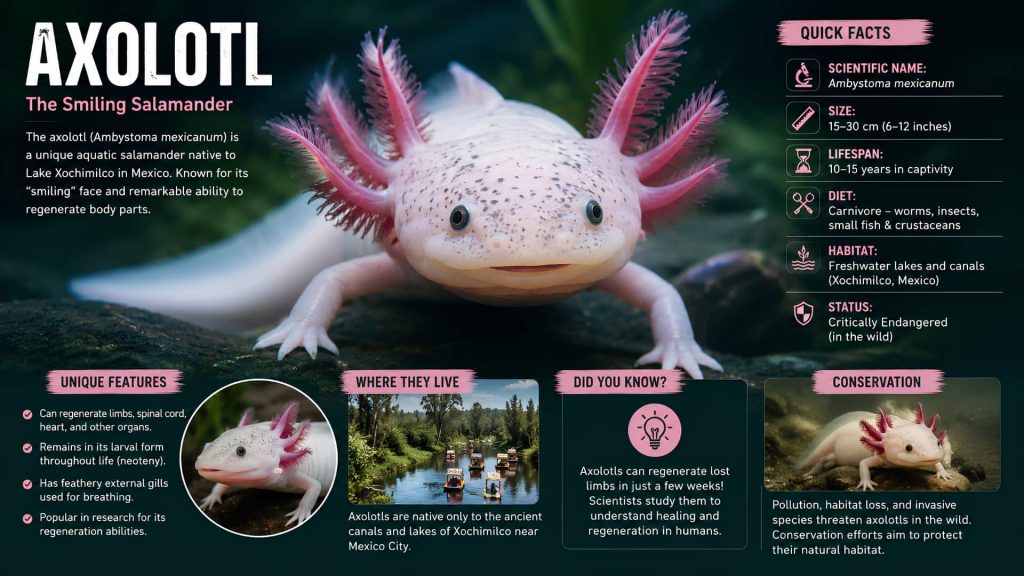
The body is broad and flat, with a wide head, small lidless eyes, and a mouth that curves into what most people describe as a permanent, faint smile. Wild axolotls are usually mottled brown or olive for camouflage, but captive breeding has produced leucistic (pale pink with dark eyes), golden albino, black melanistic, and even blue-tinted color morphs, which is most of what people are picturing when they search for a “cute” or “pink” salamander online.
Despite the slow, almost lazy way these salamanders drift along a lake bottom, they aren’t actually slow animals. When startled, they can burst-swim at close to 10 miles per hour by whipping their tail in an eel-like motion, a speed most people wouldn’t guess from watching one sit still in a tank.
Axolotl Diet: What Do They Eat, and What Eats Them?
These salamanders are carnivores, feeding on small fish, worms, mollusks, tadpoles, and aquatic insects. The salamanders don’t chase prey down. Instead, they rely on suction feeding: snapping their jaws open fast enough to create a vacuum that pulls prey straight into their mouth.
Their teeth are tiny, blunt, and arranged in a single row, built for gripping rather than chewing, according to San Diego Zoo Wildlife Alliance’s physical characteristics data. Gravel may also be swallowed accidentally with food and can help grind it in the stomach.
The species sits fairly high in its local food web, but they’re not without predators. Their main predators today are introduced fish such as carp and tilapia, which prey heavily on eggs and juveniles; they have also been documented cannibalizing each other, particularly in crowded captive conditions where competition for food and space runs higher than it would in an open lake.
How Long Do Axolotls Live?
In managed care, axolotls typically live 10 to 15 years, occasionally longer with consistent water quality and temperature. Wild lifespans are generally shorter and harder to track precisely, given how few individuals remain to study.
They reach sexual maturity around six months of age. Breeding season runs from March through June, timed to Mexico’s temperate spring water conditions. Courtship involves a distinctive circular “waltz” between male and female, after which the male deposits a spermatophore that the female collects to fertilize her eggs internally.
A single female can lay 300 to 1,000 eggs per clutch, placing them individually on plants or rocks rather than in a single mass, a strategy that spreads the eggs out and reduces the odds a predator finds them all at once. The eggs hatch in about two weeks, and hatchlings receive no parental care; they’re independent, swimming, and hunting almost immediately.
The Axolotl Life Cycle and Its Regeneration Superpower
From egg to fully grown adult, the life cycle stays remarkably consistent: hatchlings already resemble miniature versions of the adult, keeping the same gills and aquatic body plan the whole way through rather than passing through the dramatic land-adult stage typical of most salamanders. That lifelong consistency is also what makes the species’ most famous trait possible.
These salamanders can regrow far more than most animals: entire limbs, portions of the tail, sections of the spinal cord, parts of the heart and lungs, and even portions of the brain and eye, according to San Diego Zoo Wildlife Alliance. A full limb typically regrows in a matter of weeks, complete with skin, bone, cartilage, and muscle; researchers report the regenerated limb carries no visible scarring.
The mechanism starts with a mass of dividing cells called a blastema, which forms at the site of the injury within days. Cells around the wound don’t just patch it over; they partially reprogram, migrate to the blastema, and rebuild the missing structure from scratch, guided by signaling genes that researchers are still actively mapping. It’s not the only animal rewriting the rules of biological time either. Another species can reverse its own aging process entirely, effectively cycling backward through its life stages instead of dying.
That research got a major boost once the species’ genome was fully sequenced. At roughly 32 billion base pairs, the axolotl genome is about ten times larger than the human genome, making it one of the largest vertebrate genomes ever sequenced. Locating individual genes inside that much repetitive DNA is difficult, but scientists have already identified specific genes tied to blastema formation, work they hope could eventually inform human tissue-repair research.
The regenerative ability doesn’t stop at limbs. Researchers have also reported that axolotls show significantly higher cancer resistance than mammals (over 1,000 times more resistant, per San Diego Zoo Wildlife Alliance), which is part of why these salamanders remain important to biomedical research.
Are Axolotls Endangered? The Numbers Behind the Headline
The axolotl is Critically Endangered, with its wild population reduced to only a tiny fraction of its former numbers. Here’s how pollution, habitat loss, invasive fish, and conservation efforts are shaping its fight for survival.
How Many Axolotls Are Left in the Wild?
Yes, and the decline has been steep. The IUCN Red List has classified the axolotl as Critically Endangered since 2006, its most severe threat category short of extinction in the wild. It’s a fate shared by another giant amphibian sliding toward the same critical status, the world’s largest living amphibian, native to China’s rivers. The most recent assessment estimates that as few as 50 to just over 1,000 adult Ambystoma mexicanum remain, according to Conservation International’s published axolotl facts page.
The Collapse of the Wild Axolotl Population
The drop is documented in hard numbers, not just a general sense of decline. A peer-reviewed survey published in BioScience recorded roughly 6,000 axolotls per square kilometer in Lake Xochimilco in 1998, falling to around 100 per square kilometer by 2008 and as low as 35 per square kilometer by 2017, a collapse driven by water pollution, habitat loss, and invasive predatory fish, not any single event.
Why Are Millions of Axolotls Still Alive in Captivity?
There’s an odd contradiction at the heart of the axolotl’s conservation story: it’s simultaneously one of the most endangered amphibians on Earth and one of the most common animals in captivity. Millions of these salamanders live in home aquariums, university labs, and zoos worldwide, and nearly all of them trace back to a single event. In the 1860s, French naturalists brought 34 live axolotls from Mexico to Paris; those animals thrived and were bred across European labs and zoos, and most captive animals alive today are descendants of that original group, per Conservation International.
Are Axolotls Legally Protected?
The species also carries formal legal protection on paper. The species is listed under CITES Appendix II, which regulates international trade, and are classified under Mexico’s own endangered-species framework (NOM-059-SEMARNAT), according to Earth.org’s reporting on the species’ conservation status.
Can Conservation Efforts Save the Axolotl?
There’s genuine reason for cautious optimism, though. A 2025 study reported by Mongabay tracked 18 captive-bred axolotls released into restored chinampa wetlands. The researchers found that the animals were able to survive and forage in the wild, although two axolotls released into Lake Xochimilco were later eaten by great egrets. The results provide an encouraging early sign that carefully restored habitat could support reintroduced axolotls.
Saving the Axolotl Means Saving Xochimilco
Dr. Luis Zambrano, a biologist at Mexico’s National Autonomous University (UNAM) who has studied axolotls for over a decade, has become one of the most visible voices connecting the species’ fate to the health of Xochimilco itself, describing the animal, in an interview for NPR’s Short Wave, in terms closer to a small, gilled dragon than a typical salamander. His broader point, echoed across the research, is that saving the axolotl means saving the wetland it depends on, not just breeding more animals in captivity.
Culture, Currency, and Why the Axolotl Became a National Symbol
The axolotl’s cultural weight in Mexico goes well beyond folklore. In October 2021, the Bank of Mexico released a new 50-peso banknote featuring an axolotl, an animal many Mexicans associate with Gorda, a resident axolotl at the Museo del Ajolote in Mexico City, though the bank itself has not confirmed her as the actual model, according to reporting from the Global Press Journal. The note went on to win Banknote of the Year from the International Bank Note Society.
That level of visibility has done something conservation campaigns alone often struggle to do: it’s made ordinary Mexicans, many of whom had never encountered the species, aware that a critically endangered animal is living in their own backyard. Researchers like Zambrano have reported a noticeable uptick in public interest since the banknote’s release, proof that a currency design decision can double as a conservation tool.
Are Axolotls Good Pets?
The Mexican axolotl is widely bred in captivity and popular in the pet trade, although ownership rules vary by location, and legality aside, that’s a separate question from whether keeping one is straightforward or advisable for a casual buyer. They need consistently cool water, roughly the same 58 to 70°F range they’d have in the wild, along with stable water chemistry and tank conditions that don’t tolerate much error; they’re prone to stress-related illness when those conditions slip.
It’s also worth being clear-eyed about where captive-bred axolotls come from: virtually none sold as pets are wild-caught, since the wild population is already down to as few as 50 to 1,000 individuals and simply isn’t a viable source. That distinction matters for anyone weighing the ethics of ownership: buying a captive-bred axolotl doesn’t draw down the wild population, but it also doesn’t do anything to help it recover.
Related Topics
- Blobfish: The Deep-Sea Animal Everyone Gets Wrong, another species whose viral reputation doesn’t match the science
- Stonefish: The Most Venomous Fish in the World, extreme aquatic adaptations beyond regeneration
- Hammerhead Bats and Nature’s Strangest Survival Adaptations, bizarre biology built for survival
- Chinese Giant Salamander: The Axolotl’s Critically Endangered Cousin, another amphibian sliding toward extinction
- Camouflage Animals: Nature’s Masters of Disguise, more animals built for survival against the odds
- The Immortal Jellyfish: The Species That Can Reverse Its Own Aging, another animal that defies the normal rules of biology
- The Indestructible Tardigrade: How Water Bears Survive Almost Anything, extreme survival at the microscopic scale
Key Takeaways
- These animals (Ambystoma mexicanum) are salamanders, not fish, and they keep their juvenile, gilled form for life through a trait called neoteny.
- Wild populations exist in only one place: the Lake Xochimilco canal system near Mexico City.
- They can regrow limbs, spinal cord tissue, and parts of the heart, brain, and eyes, a process built around specialized cells called a blastema.
- The IUCN Red List estimates as few as 50 to just over 1,000 wild adults remain, making the axolotl Critically Endangered, and the species is also listed under CITES Appendix II.
- Nearly all captive specimens worldwide descend from 34 animals brought to Paris in the 1860s.
- A 2025 field study found captive-bred specimens released into a restored wetland refuge all survived, a hopeful, if early, conservation signal.
Frequently Asked Questions About Axolotls
Is an axolotl a fish or a salamander?
An axolotl is a salamander, specifically a type of mole salamander, not a fish. The confusion comes from its fully aquatic lifestyle and the nickname “Mexican walking fish,” but it’s an amphibian through and through.
Where do axolotls live in the wild?
Wild axolotls live only in the remaining canals of Lake Xochimilco near Mexico City, part of an ancient agricultural waterway system called chinampas. No other wild population exists anywhere else on Earth.
How long do axolotls live?
In captivity, axolotls typically live 10 to 15 years with stable water conditions. Wild lifespans tend to be shorter and are harder to measure given how few individuals remain to study.
Why are axolotls endangered?
Habitat loss, water pollution, and invasive fish species like carp and tilapia have driven a steep decline in Lake Xochimilco. A peer-reviewed survey recorded a drop from roughly 6,000 individuals per square kilometer in 1998 to around 35 by 2017.
How many axolotls are left in the world?
The IUCN Red List estimates as few as 50 to just over 1,000 wild adult axolotls remain, making the species Critically Endangered. Millions more exist in captivity worldwide, almost all descended from a group brought to Paris in the 1860s.
Can axolotls regrow their whole body?
Not their whole body, but close: axolotls can regenerate limbs, portions of the spinal cord, sections of the heart and lungs, and parts of the brain and eyes. The process centers on a cluster of cells called a blastema that forms at the injury site and rebuilds the missing tissue.
Can an axolotl turn into a regular salamander?
Rarely, and almost never on its own in the wild. Exposure to iodine or certain hormones can trigger metamorphosis into a land-dwelling adult, but left alone, axolotls keep their aquatic larval form for life.
Are axolotls good pets?
Axolotls are widely bred for the pet trade, though ownership rules vary by location, and they need stable, cool water and consistent care; they’re not a low-maintenance starter pet. Virtually all pet specimens are captive-bred, not taken from the wild.
Source References
- Conservation International, “Facts about axolotls,”
- Mongabay, “Hope for endangered axolotls as captive-bred group survives in wild” (May 2025)
- Natural History Museum, London, “Axolotls: Meet the amphibians that never grow up,”
- San Diego Zoo Wildlife Alliance, Axolotl animal profile.
- NPR Short Wave, “A Lotl Love For The Axolotl” (interview with Dr. Luis Zambrano, UNAM)
- Smithsonian Magazine, “Complete Axolotl Genome Could Reveal the Secret of Regenerating Tissues”
- Oxford Academic, BioScience, “Tale of Two Axolotls” (peer-reviewed, source for the 1998 to 2017 density decline figures)
- Earth.org, “All You Need to Know About the Endangered Axolotl” (source for CITES Appendix II and Mexico’s NOM-059-SEMARNAT protection status)
- Global Press Journal, “Meet the Surprising Star of Mexico’s New Bank Note” (source for the Gorda/banknote story, including the museum’s own caveat that she is not officially confirmed as the model)
About the Author
Evan Brooks is a science and history writer for Strangehappen.com, specializing in archaeology, space exploration, ancient civilizations, and emerging scientific discoveries. His work focuses on translating complex research into engaging, evidence-based stories that help readers understand the mysteries of our world and beyond.