

Drop a rock off the tallest cliff on Miranda moon and, depending on which estimate you trust, you would have anywhere from about eight to twelve minutes to think about your decision before it hit the ground. Even the low end of that range is hard to picture. Verona Rupes, the scarp cut into this small Uranian moon, is so tall and the gravity so weak that a falling object drifts almost lazily toward the bottom, reaching speeds a race car could match rather than the deadly velocity a cliff that size would produce on Earth.
Miranda moon is the smallest of Uranus’s five major moons, yet it carries some of the strangest geology found on any world this size: a fault scarp taller than anything on Earth, three vast fields of parallel ridges called coronae, and a surface record of ancient internal heating violent enough to reshape the moon from the inside out. For decades Miranda was treated as a minor curiosity, a battered little rock orbiting a planet nobody paid much attention to. That started to change with a 2024 study modeling a possible ancient subsurface ocean, and a separate reanalysis of Voyager 2’s 1986 data that removed one of the main reasons scientists had assumed Miranda was simply dry, though neither finding confirms water exists there now. Together with a newly proposed Uranus Orbiter and Probe mission, those findings have quietly turned this once-overlooked moon into one of the more scientifically interesting small worlds in the outer solar system.
What Is Miranda? (Quick Facts)
Here is what to know about Miranda moon at a glance:
- Diameter: roughly 470 to 480 kilometers, about one seventh the width of Earth’s Moon
- Discovered: February 16, 1948, by astronomer Gerard Kuiper
- Orbital period: about 34 hours, tidally locked to Uranus
- Composition: mostly water ice mixed with silicate rock and some organic material
- Home to Verona Rupes, among the tallest known cliffs in the solar system
- Subject of a 2024 study suggesting it may have held a subsurface ocean, one of the smallest subsurface ocean candidates found anywhere
- A proposed Uranus Orbiter and Probe mission could reach the moon in the mid-2040s
Discovery: How Gerard Kuiper Found Uranus’s Fifth Moon
Miranda was found almost by accident. Gerard Kuiper was scanning telescopic plates of the Uranian system through the 82 inch Otto Struve Telescope at Texas’s McDonald Observatory when he spotted a faint object tracking alongside the planet. He confirmed its orbit on March 1, 1948, just two weeks after the first sighting.
Kuiper named the new moon after Miranda, the human daughter of Prospero in Shakespeare’s The Tempest. The four Uranian moons known before it, Ariel, Umbriel, Titania, and Oberon, had all been named for fairies drawn from Shakespeare and Alexander Pope. Miranda broke that pattern, and every Uranian moon discovered afterward has kept the literary naming tradition going.
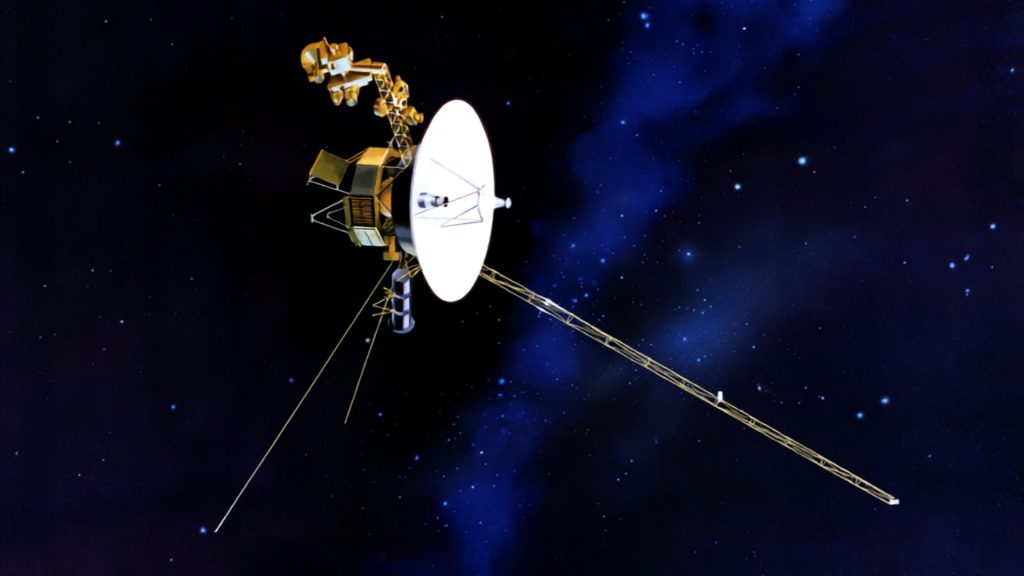
It would take almost forty years before anyone got a real look at the moon. NASA’s Voyager 2 made the only close flyby of Miranda on January 24, 1986, and even then it only imaged the southern hemisphere. The northern half of Miranda has never been photographed up close, a gap not unlike how much of Earth’s own ocean floor remains unmapped.
Orbit, Size, and Why Miranda Is Tidally Locked to Uranus
At roughly 470 kilometers across, Miranda is the smallest and innermost of Uranus’s five round satellites. It circles Uranus once every 1.4 days at a distance of about 129,000 kilometers, closer to the planet than any of the other major moons.
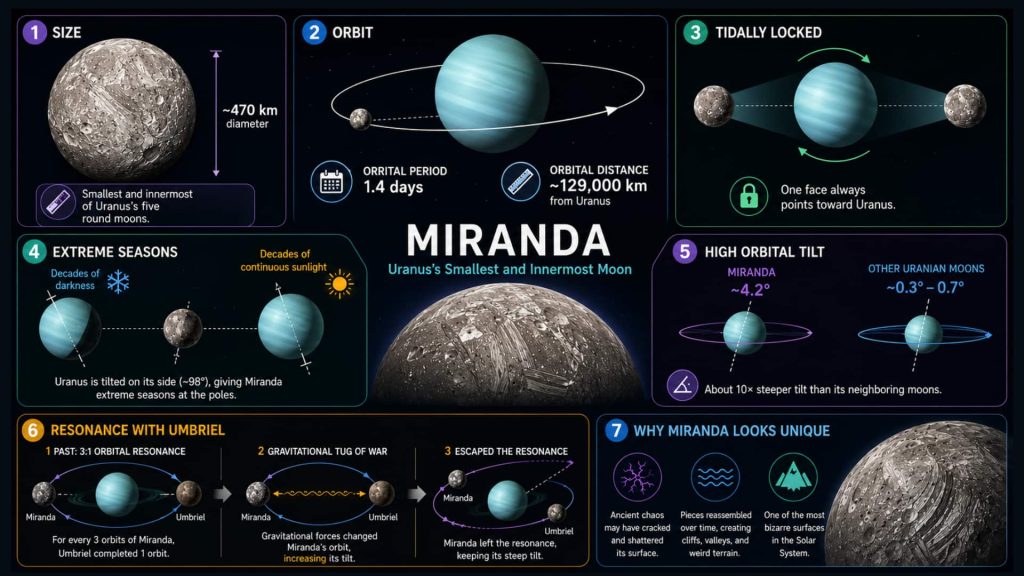
Like Earth’s own Moon, Miranda is tidally locked. One face always points toward Uranus, the same way one face of our Moon always points toward Earth. Because Uranus itself orbits the sun tipped almost completely on its side, Miranda inherits that planet’s extreme seasonal cycle, with decades of darkness followed by decades of continuous sunlight on each pole.
Miranda’s orbital tilt is unusually steep for a moon that sits so close to its planet, roughly ten times steeper than its neighboring moons, at an inclination of about 4.2 degrees to Uranus’s equator according to Wikipedia’s orbital data summary for the moon. Scientists suspect this happened because Miranda once passed through a 3:1 orbital resonance with Umbriel, a gravitational tug of war that nudged Miranda’s orbit out of alignment before it eventually escaped the resonance (Earth’s own Moon quakes for a different reason entirely, gradual interior shrinking rather than tidal flexing). That same resonance is central to explaining why Miranda’s surface looks the way it does.
Verona Rupes on Miranda: How Tall Is the Giant Cliff?
Nothing about Miranda gets more attention than Verona Rupes, a single fault scarp that dwarfs anything comparable on Earth. Named for the Italian city where Shakespeare set Romeo and Juliet, it was discovered in the Voyager 2 images and formally adopted as an official feature name by the International Astronomical Union in 1988, according to the USGS Gazetteer of Planetary Nomenclature, the official government registry of approved names for surface features across the solar system.
How Tall Is It, Really? (The 5 km to 20 km Discrepancy)
Most sources describe Verona Rupes as roughly 20 kilometers tall, more than ten times deeper than the Grand Canyon, a comparison Guinness World Records uses in its own entry on the tallest cliffs in the solar system. That figure comes from early Voyager 2 measurements and is the number most commonly repeated. Wikipedia’s dedicated Verona Rupes entry documents the full range of estimates directly from the cited literature, narrowing some analyses to a smaller range, closer to 5 to 10 kilometers, depending on exactly how the cliff face and the surrounding graben are measured.
Even NASA’s own numbers do not fully agree with each other. NASA’s Science page describes a rock falling from the top taking a full ten minutes to reach bottom, NASA Space Place, a separate NASA education site aimed at explaining the physics to a general audience, puts the same fall at a full eight minutes, while several other sources, including Britannica and NASA’s own Astronomy Picture of the Day archive, put the fall closer to twelve minutes. All of these estimates trace back to the same source, images and altimetry from a single Voyager 2 flyby in 1986, so the spread reflects genuine measurement uncertainty rather than any real disagreement over new data. There is no peer-reviewed consensus figure for Verona Rupes’ height or fall time, so treat any single number you come across elsewhere as an estimate, not a settled fact.
What a Fall From the Edge Would Actually Look Like
Because Miranda’s gravity is barely one percent of Earth’s, an object dropped from Verona Rupes accelerates slowly and never builds up the speed a fall of that height would produce on Earth. By the time it reaches the bottom, it would be moving at roughly 200 kilometers per hour, comparable to a race car, not the lethal terminal velocity a cliff that size would produce here.
That combination, extreme height and weak gravity, is what makes it such a strange feature: a fall from Verona Rupes would look nothing like a fall of that size on Earth, less a sudden drop than a long, slow glide toward the surface.
Miranda’s Coronae: The Moon’s Strangest Terrain
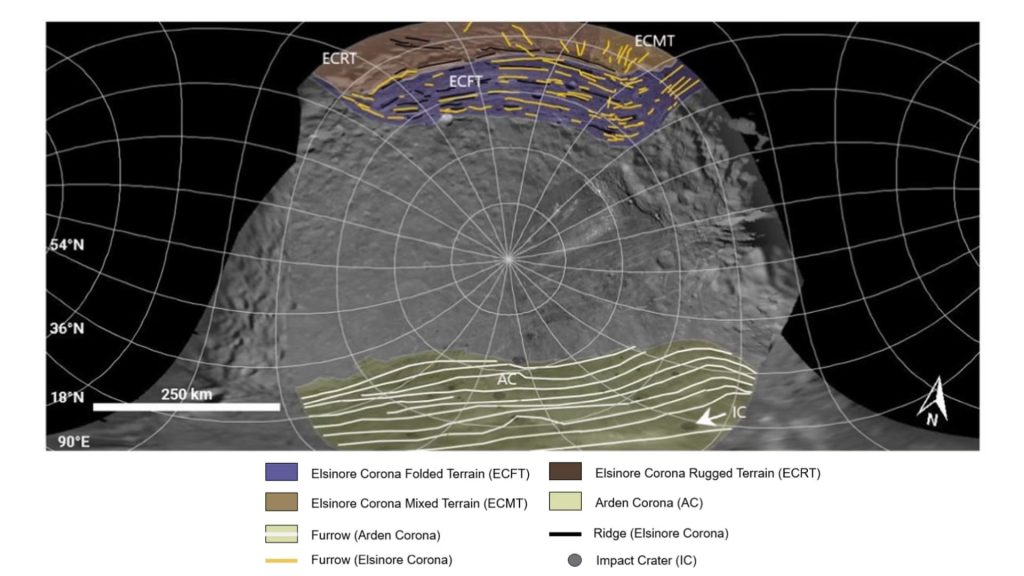
This scarp gets the headlines, but Miranda moon’s coronae are arguably the more scientifically important feature. Coronae are large, oval shaped regions of parallel ridges and grooves that look almost engineered. Miranda is one of only a few icy moons where terrain like this has been documented in such an extreme form.
Arden, Inverness, and Elsinore Corona
Miranda’s three named coronae are Arden Corona, Inverness Corona, and Elsinore Corona, each named for a location in Shakespeare’s plays. Inverness Corona sits near the south pole and shows the fewest impact craters of the three, which tells researchers it is the youngest of Miranda’s major surface features. Arden and Elsinore sit on opposite hemispheres of the moon and appear to have formed during roughly the same geological period, based on how densely cratered each region is.
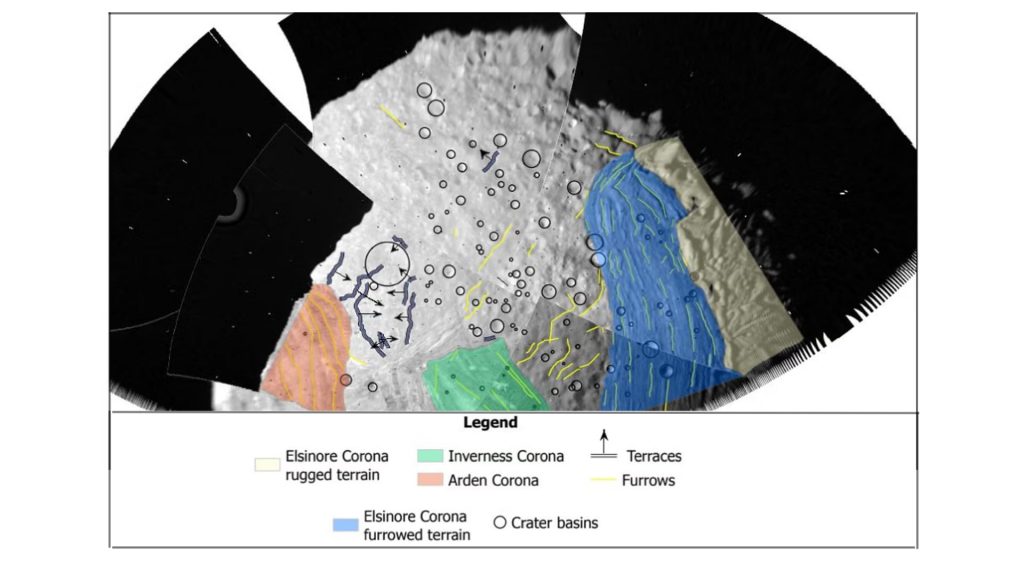
Every one of these coronae is bordered by sharp fault lines that separate the young, lightly cratered terrain inside from the older, heavily cratered plains around it, almost like patches sewn onto an older coat.
How Scientists Think the Coronae Formed
The leading explanation for Miranda’s coronae, and for its dramatic geology in general, goes back to that 3:1 orbital resonance with Umbriel mentioned earlier. As Miranda’s orbit stretched into a more elongated shape during the resonance, the changing pull of Uranus’s gravity flexed the moon’s interior over and over, generating internal heat the same way repeatedly bending a paperclip heats the metal.
That heat is thought to have partially melted Miranda’s icy interior, letting slushy material rise toward the surface and reshape it into what became Miranda’s coronae. Once Miranda’s orbit escaped the resonance, the heat source faded and the moon began cooling into the frozen, inert state Voyager 2 photographed in 1986. Researchers still are not certain exactly how a body as small as Miranda held onto enough internal energy to produce geology this extreme, and it remains one of the open questions in planetary science.
Does Miranda Moon Have a Hidden Ocean?
So does Miranda moon have an ocean? For most of the time since Voyager 2’s flyby, the answer seemed obvious. Miranda was treated as a dead, frozen world with no subsurface ocean and no meaningful internal activity left. Two recent pieces of research have started to complicate that picture, and neither one gets much attention on its own.
The 2024 Study That Changed the Picture
In October 2024, planetary scientists Caleb Strom and Tom Nordheim, working with colleagues at the Johns Hopkins Applied Physics Laboratory, published a study in The Planetary Science Journal that modeled Miranda’s interior against the stress patterns visible on its surface. Their best fitting model pointed to a subsurface ocean roughly 100 kilometers deep, sitting beneath an ice shell no more than about 30 kilometers thick, sometime between 100 and 500 million years ago.
Given that Miranda’s whole radius is only about 235 kilometers, an ocean of that scale would have filled nearly half the moon’s interior. Nordheim, who co-authored the study, described finding evidence of an ocean inside a body this small as genuinely surprising, and noted it adds to a growing list of small, distant moons that may qualify as ocean worlds. The team was careful to frame this as a past ocean their model best explains, not confirmed proof of water existing on Miranda today, though they left open the possibility that a thin remnant layer could still exist.
What the New Voyager 2 Data Reveals About Uranus’s ‘Missing’ Water
The second piece of the puzzle came from an unrelated angle entirely. In November 2024, NASA JPL researcher Jamie Jasinski led a study, published in Nature Astronomy and announced via a JPL press release, that reanalyzed Voyager 2’s original 1986 measurements and found that the spacecraft had arrived at Uranus during an unusual solar wind event, one that only occurs a small fraction of the time. That event temporarily compressed Uranus’s magnetosphere and appears to have hidden the water ions that would normally be expected if the Uranian moons, Miranda included, were releasing water into space.
In other words, Voyager 2’s failure to detect water around Uranus back in 1986 may say more about unlucky timing than about whether the moons actually have any. On August 21, 2026, BBC Sky at Night Magazine connected this reanalysis back to Miranda’s ocean question directly, framing the two studies together as reason to take the subsurface ocean possibility more seriously than the original 1986 data ever allowed.
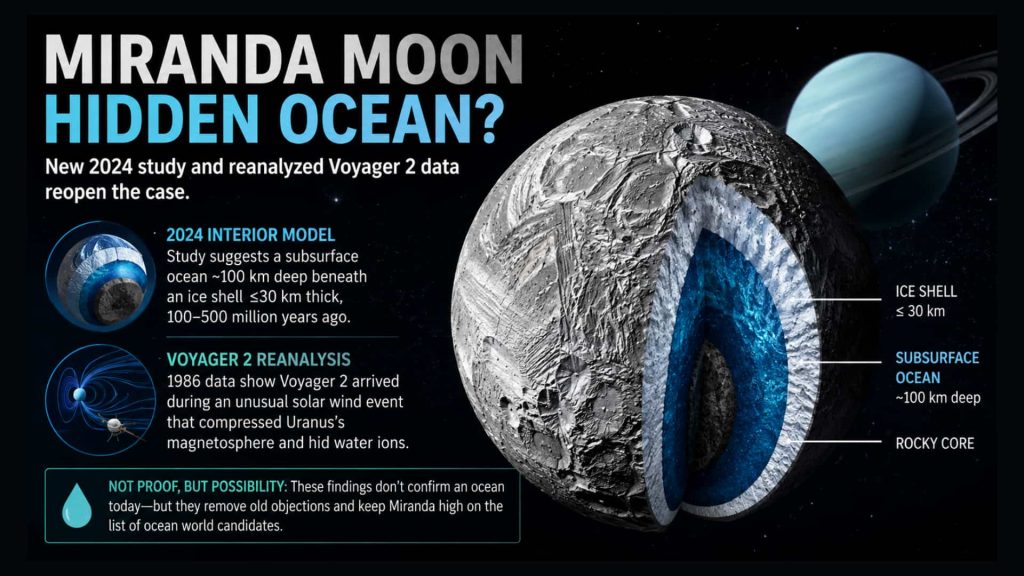
The important point is to understand exactly what the evidence tells us. The magnetosphere finding isn’t a detection of water, and it isn’t evidence that Miranda has an ocean. What it does is remove one of the main reasons scientists assumed Miranda was dry in the first place: a non-detection made during an unusually compressed magnetosphere carries a lot less weight than a non-detection under normal conditions would. The case for a past ocean still rests entirely on the 2024 modeling study described above; the Voyager 2 reanalysis just clears away an old objection to it, rather than adding new evidence for it. Together, the two studies are why Miranda is drawing renewed scientific interest, not proof that an ocean is actually there.
Could Miranda Support Life?
This is where it is easy to get ahead of the evidence. No instrument has ever directly detected liquid water on Miranda, and no mission has been built specifically to look for it. What exists is a computer model that best explains the moon’s surface stress patterns under the assumption that a subsurface ocean was once present, plus a plausible reason why earlier data may have missed signs of water. Whether any of that ocean survives today is still an open question.
Nordheim has cautioned against jumping from a possible past ocean to the potential for life, pointing out how little is actually known about the Uranian moons compared with better studied ocean worlds like Europa or Enceladus. If Miranda does retain liquid water today, conditions at that depth, sealed beneath tens of kilometers of ice, would resemble the hydrothermal vents where Earth’s own extremophiles, like the yeti crab, farm bacteria in total darkness thousands of meters down, an illustration of what a habitable environment could look like, not evidence that one exists on Miranda. No confirmed habitable environment exists there today, and no life has been detected.
Is NASA Planning to Go Back? The Uranus Orbiter and Probe Mission
The 2022 Planetary Science and Astrobiology Decadal Survey, the National Academies of Sciences report that guides NASA’s mission priorities for the coming decade, names the Uranus Orbiter and Probe as its single highest priority new flagship mission for the 2023 to 2032 period, ahead of every other large planetary mission under consideration. The Planetary Society has estimated the mission’s cost at roughly 4.2 billion dollars, with a possible launch window in 2031 or 2032 and arrival at Uranus sometime in the mid-2040s.
That timeline and cost estimate date back to 2022, so they should be treated as directional rather than fixed. NASA’s planetary science budget and mission priorities can shift from year to year, and nothing about the Uranus Orbiter and Probe is locked in yet. If it does launch, one of its stated goals is finally imaging Miranda’s unseen northern hemisphere, something no spacecraft has managed since Voyager 2 caught only half the story in 1986. A future mission could also settle open questions a single 1986 flyby never could, like the true height of Verona Rupes or whether Miranda’s coronae extend into the hemisphere nobody has seen, and whether the subsurface ocean the 2024 study modeled left any trace behind.
Until then, everything known about Miranda moon comes from a single flyby nearly forty years old, reanalyzed with modern tools but still limited by what one spacecraft happened to see during one 45 hour pass through the Uranian system.
Related Articles You May Like
- Planet Nine: the hypothesized giant world some astronomers think is lurking even farther out than Uranus, still unproven after a decade of searching
- TOI 700 d: NASA’s Earth-Sized Exoplanet in the Livable Zone: an Earth-sized world 100 light-years away sitting in its star’s habitable zone, and why that makes it a strong candidate for liquid water
- Moonquakes: The Secret Shakes of the Lunar Scene: why Earth’s own Moon is slowly shrinking and quaking, through a completely different mechanism than what shaped Miranda
- Why Did a SpaceX Rocket Crash Into the Moon?: the story behind a 2026 impact near Einstein Crater and what it reveals about lunar debris tracking
- How Much of the Ocean Has Been Explored? Numbers Explained: the surprising fraction of Earth’s own ocean floor that remains unmapped, a useful comparison for Miranda’s unseen northern hemisphere
- Yeti Crab: The Hidden Marvels of the Ocean’s Dark Depths: the hydrothermal-vent crustacean that farms its own bacteria in total darkness, the closest real-world example of what life sealed beneath an icy moon’s ocean might look like
Key Takeaways
- Miranda moon is the smallest of Uranus’s five major moons, discovered by Gerard Kuiper in 1948 and named after a character in Shakespeare’s The Tempest.
- Verona Rupes, its most famous feature, is among the tallest known cliffs in the solar system, though Verona Rupes’ exact height and the fall time from its edge vary depending on the source.
- Miranda’s coronae, Arden, Inverness, and Elsinore, are unusual geological formations rarely documented elsewhere, likely caused by tidal heating from a past orbital resonance with Umbriel.
- A 2024 study suggests Miranda may have held a subsurface ocean roughly 100 kilometers deep within the last 500 million years, based on modeling of its surface stress patterns.
- A separate 2024 reanalysis found Voyager 2 flew past Uranus during a rare space weather event that may have hidden evidence of water, undercutting the old assumption that Miranda is simply dry.
- No mission has returned to Uranus since 1986, though a Uranus Orbiter and Probe has been recommended by NASA’s 2022 Decadal Survey for a possible 2031 or 2032 launch, with the exact timeline still not finalized.
Frequently Asked Questions About Miranda Moon
Does Miranda moon have an ocean?
Not confirmed, and no instrument has ever directly detected water on Miranda. A 2024 study modeled Miranda’s surface stress patterns and found they best match a scenario where a roughly 100 kilometer deep subsurface ocean existed 100 to 500 million years ago. Whether any of that water remains today is still unknown, and only a dedicated mission like the proposed Uranus Orbiter and Probe could realistically settle the question.
How tall is Verona Rupes?
Most sources cite around 20 kilometers, though later estimates range closer to 5 to 10 kilometers depending on measurement method. It is generally described as among the tallest known cliffs in the solar system.
How long would it take to fall from Verona Rupes?
Estimates vary between about 10 and 12 minutes for a fall from Verona Rupes, since Miranda’s gravity is roughly one percent of Earth’s. A falling object would reach about 200 kilometers per hour by the time it landed.
Could Miranda support life?
No life has ever been detected on Miranda, and nothing there has been confirmed as habitable. If a subsurface ocean does exist, the conditions at that depth could theoretically support extremophile life, similar to organisms found at Earth’s deep-sea vents, but researchers involved in the 2024 study have explicitly cautioned against treating that as anything more than a possibility.
What are Miranda’s coronae?
Miranda’s coronae are large, oval shaped regions of ridges and grooves, an unusual terrain type rarely documented on other icy moons in this exact form. The three are named Arden Corona, Inverness Corona, and Elsinore Corona, likely formed by tidal heating reshaping the icy crust.
When was Miranda discovered?
Gerard Kuiper discovered Miranda on February 16, 1948, using the McDonald Observatory’s Otto Struve Telescope in Texas, confirming its orbit two weeks later.
Why is Miranda tidally locked to Uranus?
Like most close-orbiting moons, gravitational forces from Uranus slowed Miranda’s rotation over time until it matched its orbital period, so the same face always points toward the planet.
Will NASA send another mission to Miranda?
Possibly. NASA’s 2022 Decadal Survey recommended a Uranus Orbiter and Probe mission, with a potential launch in 2031 or 2032 and arrival in the mid-2040s. Funding is not yet finalized, so the timeline could still shift.
Source References
All 12 sources below are cited inline in the article body and were verified live by direct search or fetch on August 27, 2026.
- Johns Hopkins Applied Physics Laboratory, “Uranus’ Moon Miranda May Have an Ocean Beneath Its Surface,” October 28, 2024
- Strom, C., Nordheim, T., et al., “Constraining the Thickness of Miranda’s Ice Shell and Subsurface Ocean,” The Planetary Science Journal, October 2024
- Jasinski, J., et al., study on Voyager 2’s 1986 Uranus flyby and a rare solar wind compression event, published in Nature Astronomy, November 2024, announced via NASA JPL press release “Mining Old Data From NASA’s Voyager 2 Solves Several Uranus Mysteries”
- NASA Science, “Miranda,” ongoing reference page.
- National Academies of Sciences, Engineering, and Medicine, “Uranus Orbiter and Probe” chapter, Origins, Worlds, and Life: A Decadal Strategy for Planetary Science and Astrobiology 2023-2032, 2022.
- The Planetary Society, “Uranus’ Mysterious Moons: Why NASA Wants to Explore Ariel and Miranda,” August 16, 2022
- BBC Sky at Night Magazine, “Does Uranus’s Moon Miranda Have an Ocean?”, August 21, 2026
- Wikipedia, “Miranda (moon),” orbital and physical characteristics data
- Wikipedia, “Verona Rupes,” measurement range and IAU naming history
- USGS Astrogeology Science Center, Gazetteer of Planetary Nomenclature, “Verona Rupes” feature entry, official 1988 IAU naming record
- Encyclopaedia Britannica, “Miranda,” astronomy entry reviewed by Andrew P. Ingersoll, Professor of Planetary Science at Caltech and member of the Voyager Imaging Team
- NASA Space Place, “Jumping the Tallest Cliff in the Solar System,” NASA education/outreach page
Author Bio
Evan Brooks is a science and history writer for Strangehappen.com, specializing in archaeology, space exploration, ancient civilizations, and emerging scientific discoveries. His work focuses on translating complex research into engaging, evidence-based stories that help readers understand the mysteries of our world and beyond.