Deep in one of Africa’s last unmapped wilderness regions, a spider sits motionless on a leaf. Under normal light, it looks unremarkable. Shine an ultraviolet beam on it and something extraordinary happens: it blazes electric blue. The glowing blue spider may represent a species never before documented by science.
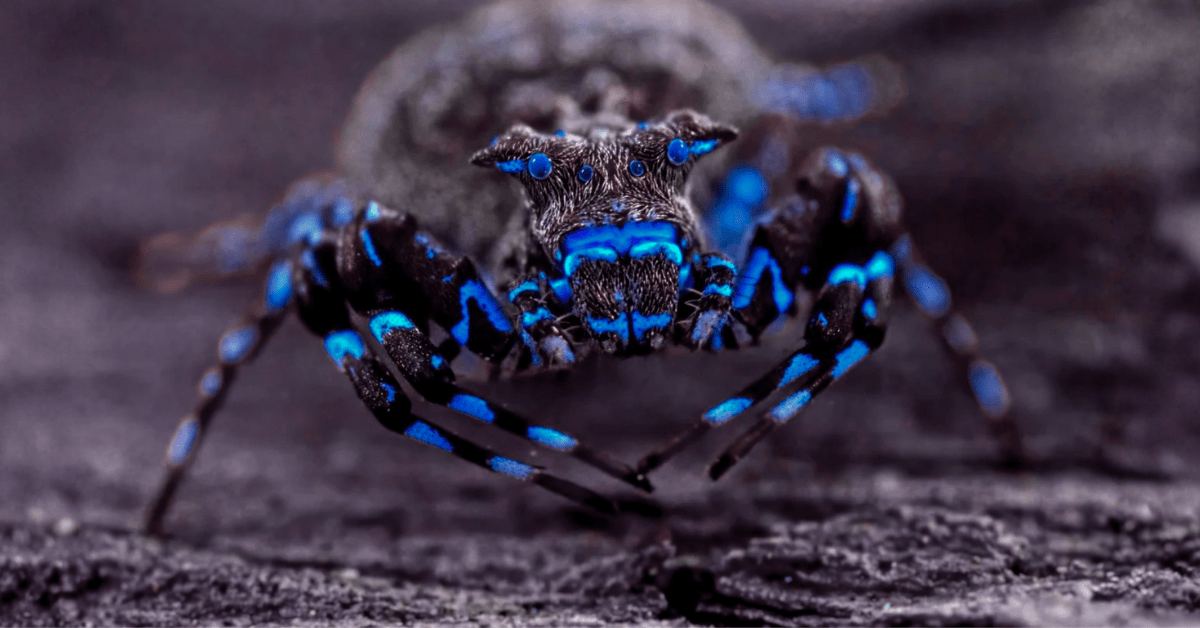
This crowned crab spider, collected during a February 2026 expedition to Angola’s remote Lisima Plateau, may be a species that science has never formally recorded. Researchers from The Wilderness Project photographed it glowing under UV light and still cannot fully explain why it produces that glow. The unusual blue spider has quickly become the most talked-about discovery from the expedition.
It was not the only surprise. The expedition also produced dozens of new species discovered across multiple groups of animals and insects. The same expedition documented over 70 potentially new species from a landscape that had been scientifically invisible for decades. New dragonflies, moths, crickets, reptiles, bats, and a second spider that disguises itself as a toxic beetle. All from one survey.
Table of Contents
Why This Discovery Matters
A potentially new fluorescent spider species was the headline find, but the broader picture is even more significant. Several of the new species discovered may exist nowhere else on Earth. Researchers documented 8 new dragonfly species, up to 60 new moth and butterfly species, 3 new cricket and grasshopper species, and new bats, reptiles, and amphibians from a single wet season survey. The Lisima Plateau feeds four of Africa’s greatest river systems and had never been systematically studied. It now faces growing threats from mining and deforestation, making this documentation urgent for conservation.
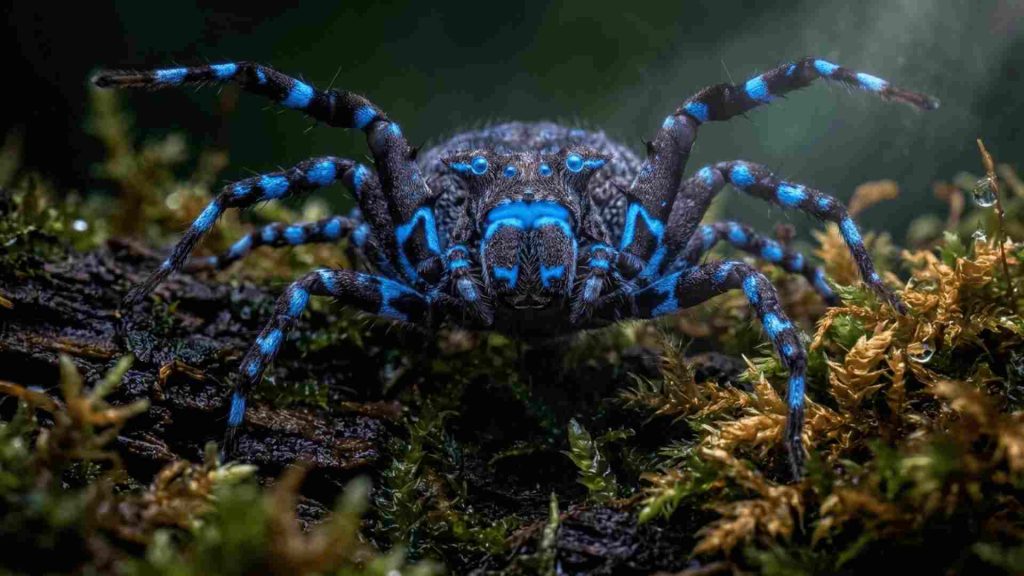
Illustrative depiction of a glowing blue spider showing vivid electric-blue coloration and intricate body patterns in a mossy forest habitat. AI-generated illustration for educational and informational purposes.
For most of its modern history, the plateau was completely unreachable. Angola’s civil war, which ran from 1975 to 2002, left the landscape seeded with landmines. Scientific expeditions stayed out. The HALO Trust, a humanitarian demining organization, has been clearing ordnance in Moxico Province for years, and those clearances made the 2026 expedition logistically possible for the first time.
The Cassai Life Atlas, the biodiversity survey behind these discoveries, was the most ambitious scientific effort ever attempted in the region. What it found suggests that an entire ecosystem had been evolving in isolation, leaving much of its wildlife unobserved by modern science.
What Scientists Found
The Glowing Blue Crowned Crab Spider
This is the find that drew global attention. A crowned crab spider, photographed under UV light, glows an unmistakable electric blue. Researchers believe it is an undescribed species with no prior record in scientific literature. It has no official name yet. The glowing blue spider has attracted international attention from scientists and wildlife enthusiasts alike.
Why does it glow? The honest answer is that nobody knows for certain. But the broader science of UV fluorescence in spiders provides useful context.
Research published in Biology Letters (Royal Society Publishing, 2007) found that all spiders contain fluorescent compounds called fluorophores in their hemolymph, the fluid functioning as their blood. In a survey of 19 spider families, at least one species from each showed external fluorescence, suggesting the trait has evolved independently across the spider family tree multiple times.
Portland State University researcher Susan Masta found that in many species, these fluorophores migrate from the hemolymph into the outer cuticle or body hairs, producing the visible external glow. A separate study in the Journal of Experimental Biology (Heiling et al., 2005) on Australian crab spiders found that UV-reflecting individuals positioned on flower petals attracted significantly more bee pollinators than non-reflecting individuals, pointing toward fluorescence as a prey luring strategy in at least some species.
For this Angolan crowned crab spider, no explanation has been confirmed. Whether its blue glow serves prey attraction, mate recognition, camouflage in UV-rich canopy environments, or something else entirely remains an open question that researchers are actively investigating.
What Is a Crowned Crab Spider?
To understand why this discovery matters, it helps to know something about the group of spiders it likely belongs to.
Crowned crab spiders are members of the family Thomisidae, one of the most widespread spider families on Earth. The family currently contains over 2,100 described species distributed across every continent except Antarctica. They are found in forests, grasslands, gardens, and tropical wetlands, and they are far more common than most people realize. Chances are you have walked past one without knowing it. Although unrelated to the famous Gooty Sapphire Tarantula, the Angolan spider demonstrates how visually remarkable arachnids can be.
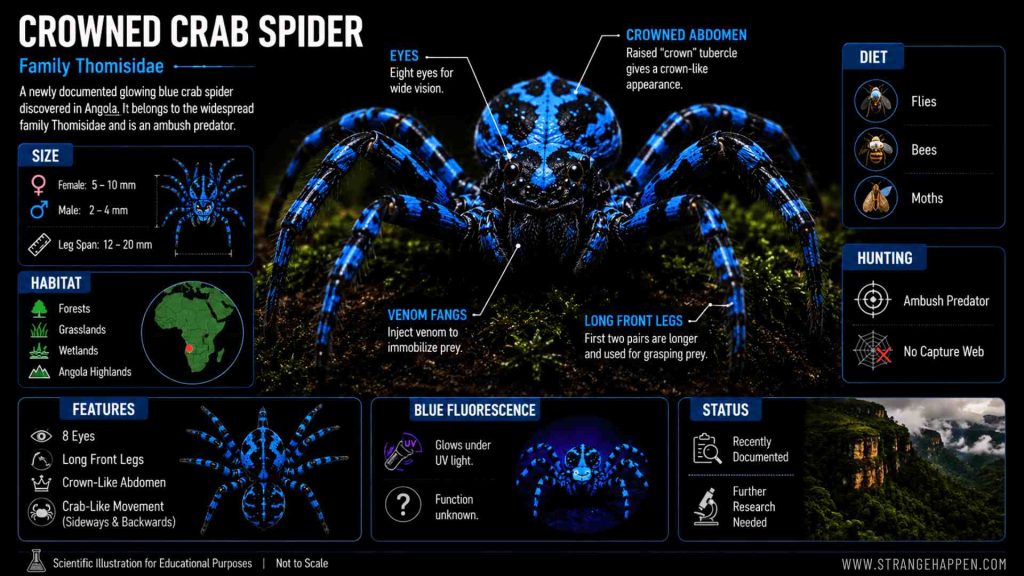
AI-generated scientific illustration created for educational and informational purposes.
Why Are They Called Crab Spiders?
The name “crab spider” comes from their posture and movement. Their front two pairs of legs are notably longer than the back two, held wide and slightly bent, giving them a distinctly crab-like silhouette. They can move sideways and backward with the same ease as forward. The term “crowned” refers to a characteristic tubercle or raised projection on the abdomen found in certain genera within the family, giving the spider a subtle crown-like profile when viewed from above.
How Do Crowned Crab Spiders Hunt?
Unlike orb weavers or funnel spiders, Thomisidae do not spin capture webs. They are ambush predators. A crowned crab spider typically selects a flower, leaf surface, or patch of bark that matches its coloration, settles in, and waits. When an insect comes close enough, usually a bee, fly, butterfly, or small moth drawn to the same flower, the spider strikes with its front legs and delivers a venomous bite that immobilizes prey rapidly. The venom works fast enough to subdue insects considerably larger than the spider itself.
How Large Are Crowned Crab Spiders?
Body size across the Thomisidae family varies by species and sex. Females tend to be significantly larger than males. In many species, females range from roughly 5 to 10 millimeters in body length. Some tropical species are larger. Males are often half that size or smaller. Exact measurements for the Angolan specimen have not been published.
What Scientists Still Do Not Know
What is not yet known about this particular spider is considerable. Scientists have not confirmed its exact body dimensions, lifespan, reproductive cycle, dietary preferences in the wild, or the specific composition of its venom. Its ecological specialization within the Lisima Plateau ecosystem is unstudied. Most importantly, the biological function of its blue fluorescence under UV light remains completely unexplained. Like the Gooty Sapphire Tarantula, it highlights how many striking spider species remain poorly studied in parts of the world.
Why This Discovery Matters
The facts are simple but extraordinary: the spider is real, it glows an electric blue under UV light, and scientists have never formally recorded anything quite like it. If it has been living on this remote plateau for thousands of years, it remained hidden from science until now. Like the Gooty Sapphire Tarantula, it highlights how Earth’s most spectacular spider species can still emerge from places that researchers have barely explored.
A Spider That Impersonates a Toxic Beetle
A second spider discovery is equally compelling. The ladybird orb-web spider found during the expedition closely mimics the appearance of a toxic ladybird beetle. This is textbook Batesian mimicry, where a harmless species evolves to resemble a dangerous one to discourage predators. It is also considered potentially new to science and is awaiting formal taxonomic description.
Eight New Dragonfly Species
Of the 103 dragonfly and damselfly species recorded, eight are believed to be completely undescribed. Among the most significant new species discovered were dragonflies found only within this freshwater system. Dr. Klaas-Douwe B. Dijkstra, a leading dragonfly specialist associated with the Naturalis Biodiversity Center in the Netherlands, explained why this matters: dragonfly diversity in a region directly reflects its water quality. Species found nowhere else on Earth are thriving here because the Lisima Plateau produces some of the cleanest freshwater on the African continent.
Dragonflies are one of ecology’s most reliable environmental indicators. They are highly sensitive to changes in water chemistry. Even minor upstream contamination from mining can collapse populations of species that exist nowhere else.
The expedition brought the region’s total dragonfly and damselfly count to 163 and added six species to Angola’s national list.
Up to 60 New Moths and Butterflies
More than 1,000 butterfly and moth specimens were collected and are still being analyzed in laboratories. Eight moth species already appear undescribed. Preliminary estimates from The Wilderness Project suggest that up to 6% of all moth species recorded from this single survey could be new to science, potentially dozens of individual species that have never been named.
The Cricket That Sprays Its Own Blood
Three new grasshopper, katydid, and cricket species were identified. The most striking is an armored cricket from the genus Enyaliopsis that expedition leader Rob Taylor described to CNN as “very cool, very fierce-looking.” When threatened, it defends itself through autohaemorrhaging: it sprays its own hemolymph onto attackers. The fluid contains compounds that deter predators, a survival mechanism documented in some katydid species but not yet specifically studied in this newly discovered one.
Reptiles, Amphibians, and Cave Bats
The survey recorded 47 reptile and amphibian taxa, capturing a significant cross-section of the region’s wildlife in a single season. Notable finds included the large-eyed green tree snake, with only four prior records from Angola; a bush viper with similarly limited documentation; and the gaboon adder, the venomous snake with the longest fangs of any snake on Earth, reaching up to 5 centimeters. Some of the new species discovered could eventually prove endemic to the plateau.
In local cave systems, researchers documented Sundevall’s roundleaf bat and Ruppell’s horseshoe bat, along with their associated bat flies and ectoparasites. It was cave ecology that was completely undocumented before this expedition.
The Glowing Spider Is Not Alone: A Hidden World Under UV Light
The crowned crab spider from Angola belongs to a broader pattern that biologists have only recently begun to fully appreciate. UV fluorescence is far more widespread across the animal kingdom than science had recognized even a decade ago.
Scorpions have been the most studied example for years. Every known scorpion species glows vivid blue-green under UV light. The biological function remains debated, with current hypotheses suggesting the cuticle itself may act as a UV-sensing organ, allowing scorpions to detect moonlight intensity before emerging from cover.
Biofluorescent frogs entered the scientific record in 2017, when a paper in Proceedings of the National Academy of Sciences described the South American polka-dot tree frog fluorescing green under blue light. It was the first confirmed case of biofluorescence in an amphibian. Dozens of frog species have since been found to share the trait.
Fluorescent fish are well established in marine biology. More than 180 species of marine fish fluoresce in red, green, and orange, particularly in reef environments where blue-shifted sunlight provides the excitation source.
Fireflies work differently. Their light comes from a chemical reaction involving luciferin and luciferase, a process called bioluminescence that generates light biochemically rather than absorbing and re-emitting existing light like fluorescence does. The distinction matters scientifically even if both produce striking visual effects.
What unites these discoveries is the technology that revealed them. UV-sensitive cameras and portable field flashlights have opened a visual dimension to ecosystems that researchers simply had no way to observe before. The glowing blue spider from Angola may be the latest creature to emerge from that newly visible world, but almost certainly not the last.
What This Means for Conservation
The findings carry real urgency. The discovery of the blue spider has helped draw global attention to the conservation value of the Lisima Plateau. The Lisima Plateau faces expanding threats: artisanal diamond mining in Moxico Province, slash-and-burn agriculture, deforestation, and encroaching woodland clearing. Species with restricted ranges or highly specific habitat requirements could disappear before science even assigns them a name. Protecting this unique wildlife has become a major conservation priority.
The Wilderness Project is using the Cassai Life Atlas data to build a formal conservation case. By 2025, it and its partners had secured protection consideration for 5.4 million hectares of the plateau. In late 2024, the Ramsar Convention designated part of the area as Lisima Lya Mwono, meaning “the Source of Life,” citing its role in sustaining more than 110,000 square kilometers of surrounding ecosystem.
“The most important outcome of this expedition is that this area is no longer a blank spot,” Taylor told Discover Wildlife. “The newly documented records, photographs, and habitat observations offer valuable information that may support future conservation efforts, environmental management, and protection strategies.”
Water from this plateau flows into ecosystems supporting hundreds of millions of people across central and southern Africa. Until February 2026, nobody had systematically documented what was living at its source.
How Much Remains Unknown
The February 2026 survey captured a snapshot, not the full picture. Beetle collections, scorpion specimens, mantis samples, and additional spider material from the expedition are still being processed in laboratories across Europe and Africa. Full taxonomic publication for many of the species found, including the glowing crowned crab spider, could take years.
Large areas of the Lisima Plateau remain insufficiently surveyed by researchers. The wet season timing of the expedition captured species that are active during that period. Dry season surveys would likely reveal an entirely different set of organisms. Deeper cave systems remain unexplored. Soil invertebrate communities have not been studied. Aquatic insect diversity beyond dragonflies and damselflies is largely uncharacterized.
For a region this size, feeding river systems of this importance, one expedition is a beginning. Researchers associated with the Cassai Life Atlas have indicated that follow-up surveys are planned. The mysterious blue spider may ultimately become one of the defining symbols of this scientific effort. What those surveys may reveal is genuinely unknown, and that is precisely what makes the Lisima Plateau one of the most scientifically significant landscapes remaining on the African continent.
Key Takeaways
A crowned crab spider glowing vivid blue under UV light was found on Angola’s Lisima Plateau in February 2026 and is believed to be an undescribed species
The spider belongs to the family Thomisidae, ambush predators that do not spin webs and are found on every continent except Antarctica
Scientists do not yet know why it fluoresces, though related research points toward prey attraction, camouflage, or mate signaling as possibilities
The same expedition documented 8 new dragonfly species, up to 60 new moth and butterfly species, 3 new cricket species, and new bats, reptiles, and amphibians
The plateau feeds four of Africa’s major river systems and was largely inaccessible to science due to Angola’s civil war and landmines
5.4 million hectares are now under formal protection review, and part of the area holds Ramsar wetland designation
Beetles, scorpions, mantises, and additional spider specimens are still being analyzed and full publication of findings could take years
Most spiders contain fluorescent compounds called fluorophores in their hemolymph. In some species, these migrate into the outer cuticle or body hairs, producing a visible glow under ultraviolet light. Research suggests the glow may attract prey, support mate recognition, or provide camouflage in UV-rich environments, though the function varies by species and has not been confirmed for the Angolan specimen.
Is the glowing blue spider from Angola poisonous?
Crab spiders produce venom to immobilize small insect prey but are not considered dangerous to humans. The specific venom composition of this newly found crowned crab spider has not yet been studied or published.
What family does the crowned crab spider belong to?
It belongs to Thomisidae, a family of over 2,100 described spider species found on every continent except Antarctica. Thomisidae are ambush hunters that do not build capture webs. They hide on plants and strike passing insects.
Where exactly was the spider found?
On the Lisima Plateau in Moxico Province, eastern Angola, a highland region that feeds the headwaters of the Congo, Okavango, Zambezi, and Cuanza river systems.
Is it confirmed as a new species?
It is believed to be an undescribed species with no prior scientific record. Formal confirmation requires laboratory analysis and peer-reviewed publication, which is still in progress.
What is the Lisima Plateau?
A vast highland landscape in eastern Angola characterized by wetlands, swamp forests, seasonal grasslands, and miombo woodlands. It is one of Africa’s most important freshwater sources and was largely unreachable for decades due to Angola’s civil war and the landmines left behind.
What other animals glow under UV light?
All scorpions glow blue-green under UV. Dozens of frog species fluoresce. More than 180 marine fish species produce fluorescent colors. Fireflies generate light through a separate chemical process called bioluminescence. UV-sensitive field equipment has expanded this known list significantly in recent years.
Who led the Angola expedition?
The expedition was led by Rob Taylor and conducted by The Wilderness Project, founded by South African explorer Steve Boyes. It was supported by Fundacao Lisima and The HALO Trust demining organization.
Could more new species still emerge from this expedition?
Very likely. Beetles, scorpions, mantises, and additional spider specimens from the February 2026 survey are still under laboratory examination. Up to 6% of all moth species recorded could be new to science. Full findings may take years to publish completely.
Mubashir Razzaq is a science and natural history writer for Strange Happenings with over seven years of experience covering emerging discoveries in biology, archaeology, and space science. He has written more than 200 articles for digital science publications, specializing in translating peer-reviewed research and field expedition findings into accurate, engaging stories for general readers. His work spans biodiversity, ancient civilizations, space exploration, and unexplained natural phenomena.