

Two thousand two hundred meters below the Pacific, near a vent spewing water hot enough to warp metal, a blind white crustacean sits with its claws held out and waves them, slowly, again and again, into the current. It isn’t threat display. It isn’t grooming. It’s farming.
That’s the yeti crab, and researchers only met one for the first time in March 2005. Since then, five confirmed yeti crab species have turned up at hydrothermal vents and cold seeps from the South Pacific to the edge of Antarctica, and a February 2025 study is still turning up surprises about how they live. Most of what gets written about this species repeats the same handful of facts. This piece goes further: real dates, named researchers, a full species breakdown, and the taxonomy correction almost nobody makes.
Table of Contents
What Is a Yeti Crab?
This deep-sea crustacean is the common name for crustaceans in the family Kiwaidae, genus Kiwa. The first and best-known species, Kiwa hirsuta, was formally described in 2005 by researchers Enrique Macpherson, Joseph Jones, and Michel Segonzac, who named the genus after Kiwa, a Polynesian deity associated with the ocean, and gave the species the Latin name hirsuta, meaning “hairy” or “bristly,” according to Woods Hole Oceanographic Institution. The informal “yeti” nickname stuck almost immediately because of the pale, dense bristles covering its claws and legs, which researchers thought resembled the fur of the mythical Himalayan snowman.
Here’s a correction most yeti crab facts pages skip entirely: This deep-sea crustacean isn’t actually a true crab. True crabs belong to a group called Brachyura. It is an anomuran, placing it in the same broad lineage as squat lobsters and hermit crabs rather than blue crabs or Dungeness crabs. MBARI describes it as a distant relative of the hermit crabs found in ordinary tide pools, not a cousin of the crabs sold at a seafood counter.
It’s a good reminder that “crustacean” covers a lot of strange ground. The parasitic tongue-eating louse, Cymothoa exigua, comes from that same sprawling family tree, and it’s arguably even harder to look at than a hairy crab.
How the Yeti Crab Was Discovered
Kiwa hirsuta turned up almost by accident. An international team including MBARI’s Robert Vrijenhoek and Joe Jones, working with Michel Segonzac of the French research institute Ifremer, was surveying hydrothermal vents near Easter Island using the deep-sea submersible DSV Alvin, operating from the research vessel Atlantis. On board, biologist Cindy Van Dover and her colleagues collected a crab none of them recognized. Once the team returned to shore, Segonzac and Jones worked with Spanish researcher Enrique Macpherson to confirm it wasn’t just a new species, but an entirely new family: the first new deep-sea crab family described since the mid-1800s, per MBARI’s own account of the discovery.
The find made headlines well beyond marine biology circles. “People loved it, and I was shocked by this,” Jones told Woods Hole researchers at the time. “I thought nobody would care except crustacean nerds.”
Yeti Crab Anatomy: Built for Total Darkness

Hairy Claws and No Eyes
Its defining feature is its setae: dense, hair-like bristles covering its claws and, in some species, its chest and legs. These aren’t just for looks. The crab’s bristles provide a perfect place for chemosynthetic bacteria to grow. Instead of hunting like most animals, it farms these bacteria and consumes them as its main food source. Yeti crab claws, called chelipeds, run roughly as long as the animal’s carapace and carry a sharp cutting edge, which researchers believe is used to tear food and, occasionally, open mussel shells, according to field observations compiled by Smithsonian Ocean.
Most species in the genus Kiwa, also lack functional eyes. Living roughly a mile or more beneath sunlight, in complete darkness, vision offers little survival value, so They rely instead on chemical and tactile sensing through their setae to locate food, mates, and the edges of the narrow warm-water zone that keeps them alive. That trade-off shows up again and again in the deep sea. The ghostfish and the glass octopus, for instance, have gone in similar directions — pale, translucent, and built around senses other than sight.
Size
Reported measurements vary by species and source, but a Kiwa hirsuta individual typically has a carapace between 3 and 9 centimeters long, an overall body length near 15 centimeters (about 6 inches), and a claw span that can reach 18 centimeters (about 7 inches), based on measurements from Harvard Museum of Natural History and field researchers who have handled live specimens.
Where Yeti Crabs Live
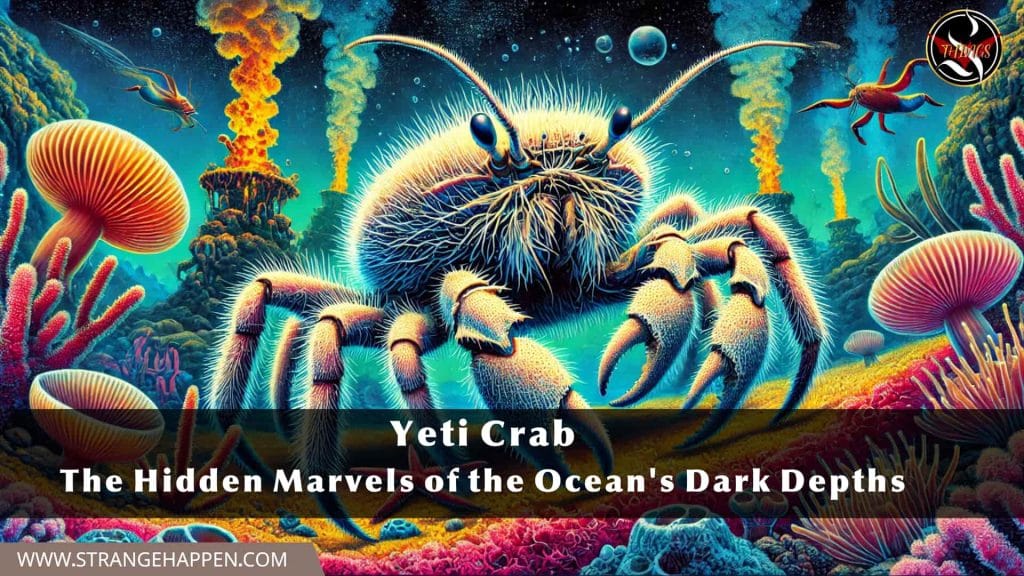
Every known species in the genus Kiwa lives at extreme ocean depths, clustered around hydrothermal vents or methane cold seeps, where mineral- and chemical-rich fluid escapes from the seafloor. These vents can discharge water exceeding 380°C (roughly 700°F), while the surrounding deep ocean sits near freezing, so they crowd into the narrow band where the two temperatures meet, according to DIVE Magazine’s reporting on vent conditions. Population density at these sites is extraordinary: researchers have recorded as many as 700 individual crabs packed into a single square meter of vent surface.
These deep-sea crustaceans aren’t the only ones that have figured out how to live in that narrow hot-cold margin. Nereidid worms turn up at some of the same vent sites, and pressure alone is its own survival test, the blobfish, often mocked online for its droopy look, owes that shape to the same deep-sea pressure yeti crabs deal with every day.
This is also where the original version of this article went wrong. Deep-sea hydrothermal vents support only a handful of specialized animal groups, and a giant crab species from the coastal shelf waters off Tasmania (a very different animal, in a very different ocean environment) has no connection to yeti crabs at all. It’s a fascinating creature in its own right, but it doesn’t belong in a yeti crab explainer.
Yeti Crab Species: Five Confirmed, One More Waiting on a Name

Five yeti crab species have been formally described since 2005, and a sixth, undescribed lineage has already been collected. Each occupies a different vent system, and no two were found in the same year.
| Species | Location | Depth | Discovered / Described | Notable Trait |
|---|---|---|---|---|
| Kiwa hirsuta | Pacific-Antarctic Ridge, near Easter Island | ~2,200 m | 2005 | The original yeti crab; type species of the genus |
| Kiwa puravida | Costa Rica methane seep | ~1,000 m | Found 2006, described 2011 | Actively “dances,” waving claws to farm bacteria |
| Kiwa tyleri (“Hoff crab”) | East Scotia Ridge, Southern Ocean | ~2,400 m | Found 2010, described 2015 | Farms bacteria on its chest, not its claws; dominant species at its vents |
| Kiwa araonae | Australian-Antarctic Ridge (Mujin vent field) | ~2,000 m | Found 2013, described 2016 | Sparser hair; most southerly yeti crab vent known |
| Kiwa sp. “GM” | Galapagos Microplate | Deep vent | Collected, not yet formally named | Awaiting formal species description |
Kiwa tyleri earned its “Hoff crab” nickname because researchers thought its densely bristled chest resembled actor David Hasselhoff, according to Harvard’s museum profile. It’s also the dominant animal at its vent sites, found in colonies exceeding 700 crabs per square meter in some surveys. The East Scotia Ridge sits deep in the Southern Ocean, the same cold, remote stretch of water where the Antarctic feather star is found — a different animal with a different feeding strategy, but the same brutal neighborhood.
Diet and the Bacteria-Farming Behavior
This species doesn’t hunt in any conventional sense. Instead, it cultivates chemosynthetic bacteria (mostly epsilon- and gamma-proteobacteria) directly on its own setae, then scrapes the bacterial mat off with comb-like mouthparts and eats it, a process confirmed through lipid and isotope analysis published in PLOS ONE by marine ecologist Andrew Thurber and colleagues in 2011.
This is also the answer to one of the most common questions about the species: why do yeti crabs wave their arms? By rhythmically waving its claws through mineral-rich vent fluid, the crab keeps fresh oxygen and sulfide moving across its bacterial garden, which speeds bacterial growth the same way stirring a pot speeds cooking. Cindy Van Dover, who has studied the crabs directly, described the motion as “extraordinary and comical” in comments to Nature. The behavior earned Kiwa puravida an informal nickname: the “dancing crab.”
Not every species farms in the same spot. Kiwa tyleri grows its bacterial mats on its chest rather than its claws, likely an adaptation to how water flows around its particular vents. Researchers haven’t ruled out some opportunistic feeding either. Yeti crabs have been photographed near opened mussel shells, suggesting they may scavenge or actively prey on small mollusks when the chance arises.
Yeti Crab Life Cycle and Reproduction
Their reproduction follows a pattern typical of decapod crustaceans: females brood fertilized eggs beneath their abdomen before releasing larvae into open water. Those larvae drift for a time as plankton, carried by deep currents until they settle near a vent system suitable for adult life. Because observing an active vent community over years is logistically difficult, precise yeti crab lifespan estimates remain uncertain, though researchers studying related deep-sea decapods place plausible estimates in the range of five to fifteen-plus years.
New Research: Why Male and Female Claws Differ
The most recent addition to yeti crab facts comes from a February 2025 study in PLOS ONE by Christopher Roterman and colleagues at the University of Portsmouth and University of Southampton. Examining 135 Kiwa tyleri specimens from the East Scotia Ridge, the team found that males grow significantly larger claws than females relative to body size, a pattern consistent with competition for mates rather than feeding needs alone.
Curiously, the same pattern doesn’t hold for Kiwa puravida, which shows no meaningful claw-size difference between sexes. Because K. puravida relies on its claws directly for bacterial farming, the researchers suggest that using the claws as a feeding organ may limit how much a species can evolve oversized “fighting” claws in males. It’s a small but genuinely new piece of yeti crab biology, published within the last two years, that most existing articles on the topic haven’t caught up with yet. It’s the kind of quiet, incremental science that rarely trends on its own but keeps reshaping the picture over time — the same pattern behind our roundup of ten newly discovered species from the past few years.
Why It Matters
These remarkable crustaceans matter beyond their strange appearance. They’re a working example of an ecosystem that runs entirely on chemosynthesis rather than sunlight, meaning the energy powering the entire food web starts with chemical reactions in vent fluid, not photosynthesis. Studying how yeti crab species diverged across separate, isolated vent systems also helps researchers map how life spreads and evolves in one of Earth’s least accessible environments, and hints at how life might persist on icy moons with subsurface oceans, such as Europa or Enceladus.
The tardigrade gets cited in that exact same conversation for the exact same reason: if something on Earth can survive conditions that should be lethal, it raises the question of what else, somewhere else, might manage the same trick. And this species has company even here on Earth, recently described deep-sea species like Ducibella camanchaca and the elven abyss tunicate are proof that the ocean floor still has more surprises than the tally sheet suggests.
Related Topics
- Antarctic Feather Star — another Southern Ocean animal built for the same cold, high-pressure conditions as the Hoff crab
- Nereidid Worm — one of the other unlikely survivors sharing hydrothermal vent habitat with yeti crabs
- Glass Octopus — a second deep-Pacific animal that gave up eyesight for other senses
- Blobfish — proof that crushing ocean pressure shapes very different animals in very similar ways
- Ducibella camanchaca — one of the ocean’s more recently confirmed new species
- Elven Abyss Tunicate — a reminder that the deep sea is still handing scientists things nobody expected
- 10 Newly Discovered Species — more recent finds reshaping what we know about life on Earth
Key Takeaways
- The yeti crab (genus Kiwa) was first discovered in 2005 near Easter Island by MBARI and Ifremer researchers using the submersible Alvin.
- Despite the name, it isn’t a true crab; it’s more closely related to squat lobsters and hermit crabs.
- Five species are formally described, plus one undescribed lineage from the Galapagos Microplate, each tied to its own hydrothermal vent or seep system.
- They farm chemosynthetic bacteria on their own bristles and wave their claws to keep the bacteria oxygenated and growing.
- A 2025 study found male Kiwa tyleri grow disproportionately larger claws than females, likely for mate competition.
Frequently Asked Questions About Yeti Crabs
Do yeti crabs still exist?
Yes. They are a living, actively studied group, not an extinct or mythical animal. Researchers have documented five confirmed species since 2005 through submersible and ROV surveys, with the most recent formal description published in 2016 and new research on the group published as recently as 2025.
Can you eat a yeti crab?
There’s no confirmed answer, because no one has documented eating one. They live thousands of meters down at hydrothermal vents far outside any commercial fishing range, so they’ve never entered any food supply, and their edibility has simply never been tested.
Why are they called yeti crabs?
The nickname comes from the dense, pale bristles covering their claws and legs, which researchers thought resembled the shaggy fur of the mythical Himalayan yeti. The formal species name, hirsuta, is Latin for “hairy,” echoing the same feature.
Why do yeti crabs wave their arms?
They’re farming. Waving their claws through vent fluid keeps fresh oxygen and chemicals flowing over the bacteria growing on their bristles, which speeds bacterial growth. The crab then scrapes off and eats the bacteria it just cultivated.
How many yeti crab species are there?
Five species have been formally described: Kiwa hirsuta, Kiwa puravida, Kiwa tyleri, and Kiwa araonae, plus a sixth undescribed lineage collected at the Galapagos Microplate that hasn’t yet received a formal species name.
Is a yeti crab actually a crab?
No, not a true crab. True crabs belong to a group called Brachyura, while yeti crabs are anomurans, the same broad lineage that includes squat lobsters and hermit crabs, making “yeti crab” a common name rather than a strict taxonomic one.
How big do yeti crabs get?
Most yeti crab species have a carapace between roughly 3 and 10 centimeters, with Kiwa hirsuta reaching a body length near 15 centimeters (6 inches) and a claw span of about 18 centimeters (7 inches).
What do yeti crabs eat?
Primarily chemosynthetic bacteria that they cultivate directly on their own claws and bodies, then scrape off and consume. Some yeti crab species may also eat small mollusks like mussels when available, adding variety to their unusual diet.
Do yeti crabs still exist?
Yes. These unusual deep-sea crustaceans are a living, actively studied group, not an extinct or mythical animal. Researchers have documented five confirmed species since their discovery in 2005, using submersible and ROV surveys at hydrothermal vents around the world. The most recent species was formally described in 2016, and new research on the group was published as recently as February 2025.
Can yeti crabs be eaten?
There’s no confirmed answer, because no one has documented eating one. Yeti crabs live thousands of meters down at hydrothermal vents, far outside any commercial fishing range, so they’ve never entered the human food supply and their edibility has never actually been tested.
Why are they called yeti crabs?
The nickname comes from the dense, pale bristles (called setae) covering their claws and legs, which researchers thought resembled the shaggy white fur of the mythical Himalayan yeti. The formal species name of the first one discovered, Kiwa hirsuta, reinforces the same idea: hirsuta is Latin for “hairy” or “bristly.”
Why do yeti crabs wave their arms?
They’re farming. They grow colonies of chemosynthetic bacteria directly on their bristles, and waving their claws through mineral-rich vent fluid keeps fresh oxygen and sulfide flowing over that bacteria, helping it grow faster. Once it’s grown, the crab scrapes the bacteria off with comb-like mouthparts and eats it. Marine biologist Cindy Van Dover, who has observed the crabs firsthand, described the waving motion as “extraordinary and comical.”
Source References
- MBARI — Discovery of the Yeti Crab
- Woods Hole Oceanographic Institution — Lurking Benignly on the Seafloor, the ‘Yeti’ Crab Is Discovered
- Smithsonian Ocean — Yeti Crab
- Harvard Museum of Natural History — Yeti Crab: What’s in a Name?
- PLOS ONE — Yeti Claws: Cheliped Sexual Dimorphism and Symmetry in Deep-Sea Yeti Crabs (Kiwaidae), Roterman et al., Feb. 2025
- PLOS ONE — Dancing for Food in the Deep Sea: Bacterial Farming by a New Species of Yeti Crab, Thurber et al., 2011
About the Author
Mubashir Razzaq is a science and history writer for Strangehappen.com, specializing in archaeology, space exploration, ancient civilizations, and emerging scientific discoveries. His work focuses on translating complex research into engaging, evidence-based stories that help readers understand the mysteries of our world and beyond.