
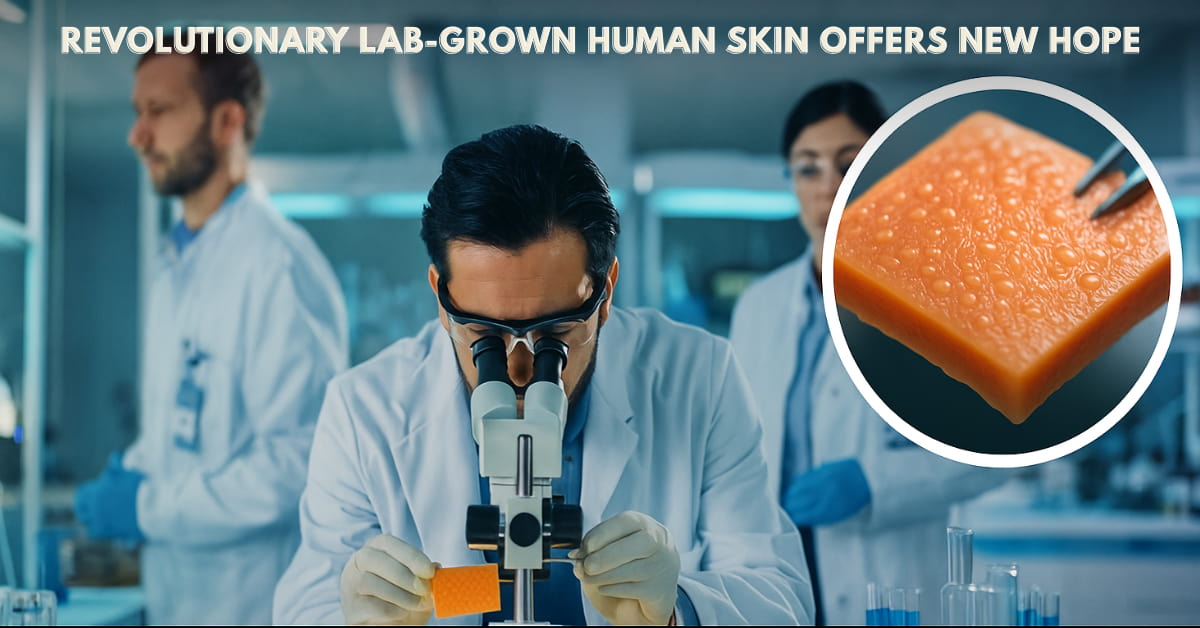
A patch of skin the size of a postage stamp. That is all doctors in Zurich needed this January to begin growing new skin, in a lab, for survivors of one of Switzerland’s worst fires in decades. Surgeons sent biopsies from the most severely burned patients straight to a biotech lab, where they were cultured, cell by cell, into personalized grafts called denovoSkin.
That is not a hypothetical anymore. It is happening in hospitals right now, and it is the sharp end of a research effort that has spent 25 years turning lab-grown human skin from a flat sheet of cells into something closer to real, living, appendage-bearing skin.
Table of Contents
What Is Lab-Grown Human Skin, Exactly?
Lab-grown human skin is an umbrella term covering several different approaches, and the distinctions between them matter. Skin organoids are three-dimensional tissues grown from stem or progenitor cells, mainly as research models, built to reproduce specific structures of real human skin. Bioengineered skin substitutes are a separate, more clinically focused category, designed primarily for wound treatment and reconstruction, and some, like the products discussed below, have already reached clinical trials or regulatory approval.
By- 7NEWS Australia
Advanced skin organoids can reproduce many features of real skin, including epidermal and dermal layers, hair follicles, sweat and sebaceous gland-like structures, and neural populations, with some experimental models now adding vascular and immune components. These systems remain primarily research tools, though, rather than fully functional replacement skin ready for routine transplantation. Older lab-grown skin, by contrast, was often just a single layer of cultured keratinocytes, useful for closing a wound but incapable of sweating, growing hair, or sensing touch.
From Flat Sheets to Living Organs: How the Science Got Here
Skin engineering did not start with organoids. Researchers have grown human skin cells outside the body for more than 40 years, but early cultures were flat, thin, and missing the structures that make real skin functional.
The 2020 Breakthrough: Hair-Bearing Skin From Stem Cells
One of the major steps toward more complex, appendage-bearing skin models came in 2020, from a team led by Dr. Karl Koehler at Boston Children’s Hospital. Using human pluripotent stem cells, coaxed through growth factors into skin tissue, the team grew a small organoid that developed both layers of skin, fat, nerve tissue, and hair follicles over four to five months in culture, according to NIH Research Matters.
When grafted onto mice, the tissue grew small, pigmented hairs within a month and developed sebaceous glands, features unique to adult human skin. Koehler noted the technique could one day generate follicles for transplantation, though he flagged immune rejection and cost as real obstacles still ahead.
2024–2025: Adding Blood Vessels and an Immune System
Four years later, a team at the University of Queensland, led by dermatologist Kiarash Khosrotehrani and stem cell biologist Abbas Shafiee, published skin organoids grown from induced pluripotent stem cells that developed hair follicles, sebaceous glands, sweat glands, and touch-sensitive Merkel cells, according to their study in the journal Small and the University of Queensland.
The same lab pushed further the following year, publishing organoids that developed their own blood vessels and, growing out of that vasculature, immune cells, a follow-on advance covered by Nature. Khosrotehrani said the team set out to understand how hair follicles form, and was surprised to find immune cell development tracked alongside it. Shafiee added that the model could eventually help grow custom skin for grafts using a patient’s own cells, alongside modeling conditions like psoriasis.
What Scientists Have Actually Achieved So Far
Growing Hair Follicles and Sweat Glands
Sweat glands have been one of the hardest structures to regenerate, since they are essential for regulating body temperature and their absence in older grafts left patients vulnerable to overheating. A 2019 study demonstrated that mouse sweat gland cells, isolated and grown in a 3D matrix, could regenerate gland-like structures after transplantation, laying groundwork later built on by human iPSC-derived organoids.
An April 2026 review in Burns & Trauma, co-authored by Shafiee, traces this progression explicitly: from flat two-dimensional cultures, to layered “skin equivalents,” to today’s organoids that begin to replicate the real diversity of cell populations found in human skin, according to Oxford Academic.
denovoSkin: Lab-Grown Skin Already Treating Real Patients
The clearest sign this science has left the lab is unfolding in Switzerland right now. On January 1, 2026, a fire at the Le Constellation bar in the Crans-Montana ski resort killed 40 people and left as many as 100 survivors with severe burns, many covering over 60 percent of their bodies.
Several of the most seriously injured were transferred to University Hospital Zurich, where surgeons have been sending skin biopsies, each about the size of a postage stamp, to the biotech company Cutiss to grow personalized skin grafts called denovoSkin, according to the University of Zurich.
DenovoSkin grew out of 25 years of research at UZH’s Tissue Biology Research Unit, led by Ernst Reichmann, and was spun off into Cutiss in 2017 by Reichmann, Daniela Marino, and colleagues. Because the graft is cultured from the patient’s own cells, Marino, now Cutiss CEO, describes it as a personalized bilayer product, designed to avoid the immune-rejection problems associated with donor-derived tissue.
The treatment is currently in a Phase 3 trial spanning 20 burn centers across eight European countries, launched in spring 2025. Cutiss can now produce multiple grafts of roughly 50 square centimeters each within four weeks, and the company has partnered with equipment maker Tecan to automate production for wider future use.
StrataGraft: A Bioengineered Skin Product Already FDA-Approved
DenovoSkin is not the only bioengineered skin in real-world use. In 2021, the FDA approved StrataGraft, made by Stratatech and Mallinckrodt, as the first donor-site-free alternative to autografting for deep partial-thickness burns in adults, according to Mallinckrodt’s announcement.
Unlike denovoSkin, StrataGraft is allogeneic, meaning it is grown from a standardized cell line rather than the patient’s own cells, and functions more as a scaffold the body’s own cells grow into over time. Its Phase 3 trial showed most patients avoided a donor-site skin harvest entirely, a meaningful marker for how close bioengineered skin already is to changing standard burn care.
How Lab-Grown Skin Differs From a Traditional Skin Graft
A traditional autograft takes a thin layer of a patient’s own healthy skin and transplants it onto the wound, which works but leaves a second wound at the donor site and often results in tight, restrictive scarring. In growing children, autografts do not stretch, which can mean repeat surgeries as the child grows.

Lab-grown skin, particularly bilayer bioengineered grafts such as denovoSkin, is designed to be elastic and to grow with the patient, closing wounds without creating a new donor-site injury. The tradeoff, for now, is production time and scale: growing a single 50-square-centimeter graft still takes about four weeks, which limits how quickly large burn areas can be covered.
Nature already solved scarless regeneration once. The axolotl can regrow entire limbs, sections of its heart, and even parts of its brain without forming scar tissue at all, which is exactly why regenerative medicine researchers study the animal so closely for clues that might eventually apply to human wound healing.
Why It Matters
For burn survivors, functional skin could eventually mean more than closed wounds. If researchers can reliably reproduce working sweat glands and nerve tissue in transplantable grafts, the benefits could extend to temperature regulation and sensation, on top of the reduced scarring and fewer follow-up surgeries bioengineered grafts already show in trials.
The hair follicle research carries a second, less life-or-death application. Koehler has pointed out the same techniques used to grow hair-bearing organoids could eventually generate follicles for treating baldness, though he was clear that cost and immune rejection remain unresolved hurdles.
Beyond direct patient care, organoid skin gives researchers a far more accurate human model for testing drugs and studying genetic skin diseases like epidermolysis bullosa, reducing reliance on animal testing and improving how predictive lab results are of real human responses.
Challenges Standing Between the Lab and Widespread Use
Scale remains the biggest obstacle. A severe burn can cover thousands of square centimeters of skin, and current production, even at Cutiss’s automated facility, measures out in tens of centimeters per graft over weeks, not the surface area a mass-casualty event demands.
Manufacturing under clinical-grade conditions is expensive and tightly regulated, and long-term questions remain open: how durable are these grafts over decades, do transplanted cells carry any tumor risk, and how will regulators in different countries evaluate a therapy this complex. Cutiss itself has said full regulatory approval depends on the Phase 3 data still being collected.
Future Research
Researchers are now working to fold immune and lymphatic components into organoid models for a more complete simulation of real skin, and to develop defined synthetic scaffolds that could replace less standardized materials like Matrigel. Automated, industrial-scale production, the kind Cutiss is now building with Tecan, is likely the single development that would matter most for burn victims at scale.
The same stem cell starting point is being pointed at entirely different tissue, too. StrangeHappen has covered Brainoware, a computer built from human brain organoids, which grows neural tissue from the same kind of induced pluripotent stem cells used in skin organoid research, just aimed at a completely different medical and computing purpose.
Whether hair-follicle organoids become a genuine baldness treatment, rather than a research tool, is still an open question years away from an answer.
Related Articles You May Like
- Axolotl: Nature’s Eternal Youth — the animal regenerative medicine researchers study most closely, capable of regrowing limbs, spinal cord, and even parts of its heart without scarring
- Brainoware: The Shocking Rise of the Living Computer — a computer built from human brain organoids, grown from the same stem cell foundation as skin organoids but pointed at a completely different purpose
- China’s Breakthrough Brain-Computer Interface Beats Neuralink — another bioengineered medical device already restoring lost bodily function in real patients, this time hand grasp after spinal cord injury
- Cyborg Beetles: The Future of Rescue Technology — living tissue merged with electronics for a very different purpose, out of the same University of Queensland research ecosystem behind the skin organoid work above
Key Takeaways
- Advanced skin organoids can now reproduce hair follicles, sweat glands, nerve tissue, and, in some experimental models, blood vessels, though most remain research tools rather than transplant-ready skin.
- A 2020 Boston Children’s Hospital study first grew hair-bearing skin from human stem cells; a 2024 University of Queensland study added glands and touch-sensitive cells, and a 2025 follow-up from the same lab added blood vessels and immune cells.
- DenovoSkin, developed at the University of Zurich, is currently treating survivors of Switzerland’s January 2026 Crans-Montana fire disaster in a 20-center Phase 3 trial.
- StrataGraft, FDA-approved since 2021, is already a real-world alternative to traditional skin grafting for burn patients.
- The biggest remaining hurdle is scale: growing enough functional skin, fast enough, to cover severe, large-area burns.
Frequently Asked Questions About Lab-Grown Human Skin
What is a skin organoid?
A skin organoid is lab-grown tissue that self-organizes from stem cells into structures resembling real skin, including hair follicles, glands, and sometimes blood vessels, unlike older flat cultured skin sheets.
Can lab-grown skin sweat?
Researchers have grown organoids with sweat gland-like structures and functional markers, and earlier studies transplanted sweat gland organoids into mice with signs of gland regeneration, though full sweat function in human grafts is still being studied.
Can lab-grown skin grow hair?
Yes. Stem cell-derived skin organoids have grown pigmented hair after being grafted onto mice, and researchers say the same approach could eventually help treat baldness, though cost and rejection remain unresolved.
Is lab-grown skin available for burn patients yet?
Yes, but only in limited, specific circumstances. StrataGraft is FDA-approved in the US for certain adult deep partial-thickness burns, while denovoSkin remains in Phase 3 clinical trials and has separately been used in a small number of compassionate-use cases.
What is denovoSkin?
DenovoSkin is a personalized, lab-grown bilayer skin graft developed at the University of Zurich and produced by Cutiss, cultured from a patient’s own small skin biopsy to help avoid immune-rejection problems.
Does lab-grown skin get rejected by the immune system?
Using a patient’s own cells is intended to avoid the immune-rejection problems associated with donor-derived tissue. DenovoSkin uses autologous cells for this reason, while StrataGraft is allogeneic, built from a standardized donor-derived cell line, and functions more as a scaffold the body’s own cells grow into over time.
How long does it take to grow skin in a lab?
Timelines vary by method. Cutiss can produce a roughly 50-square-centimeter denovoSkin graft in about four weeks, while research-stage organoids with full hair follicle development can take four to five months to mature.
Can lab-grown skin treat baldness?
It is a genuine research direction. Karl Koehler has said hair-bearing organoid techniques could one day generate follicles for transplantation, but called immune rejection and cost major unresolved hurdles.
Author Bio
Author Mubashir Razzaq is a science and history writer for Strangehappen.com, specializing in archaeology, space exploration, ancient civilizations, and emerging scientific discoveries. His work focuses on translating complex research into engaging, evidence-based stories that help readers understand the mysteries of our world and beyond.
Source References
- University of Zurich — “New Skin for Burn Victims” (Jan 2026)
- NIH Research Matters — “Hairy human skin generated from stem cells” (2020, updated Feb 2026)
- Nature — “Organoid science is more than skin deep”
- The University of Queensland — “Lifelike lab-grown skin developed from human stem cells” (March 2024)
- Oxford Academic, Burns & Trauma — “Skin organoids as a new biological standard” (Apr 2026)
- Mallinckrodt — FDA Approval Announcement for StrataGraft (2021)
- PubMed — Shafiee et al., “Development of Physiologically Relevant Skin Organoids from Human Induced Pluripotent Stem Cells,” Small (2024)