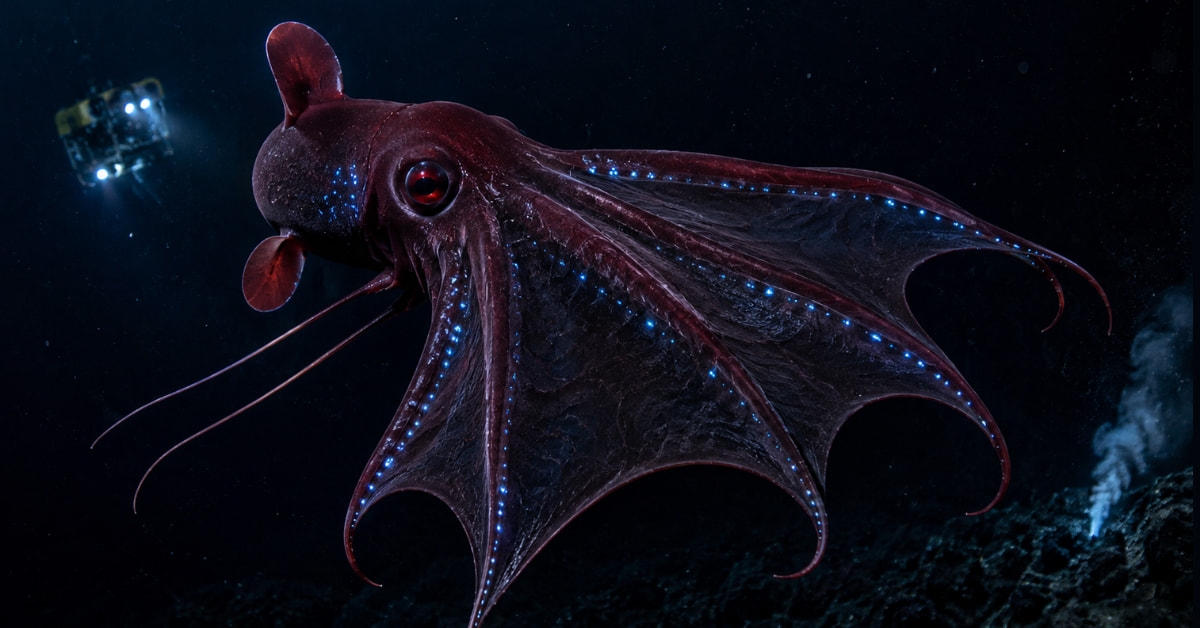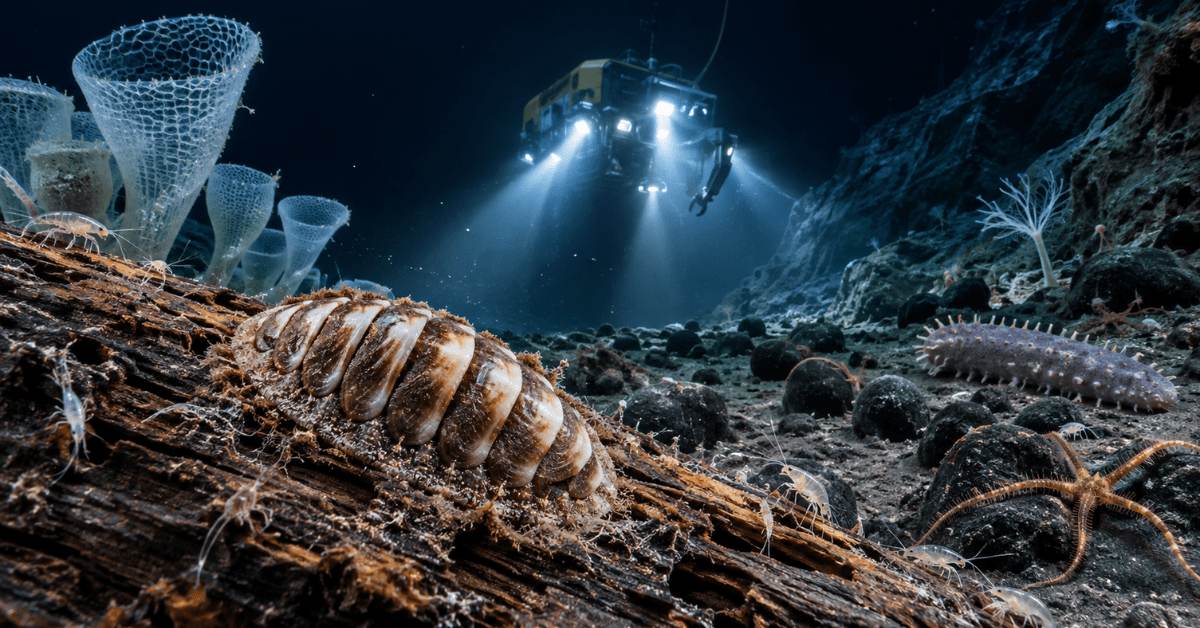

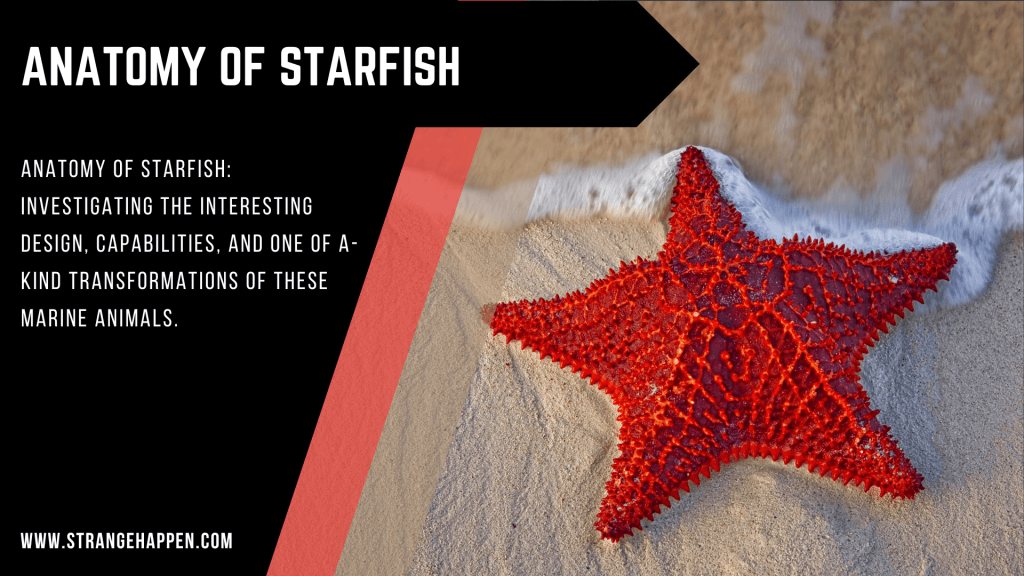
Anatomy of Starfish is far stranger than its familiar five-point shape suggests. Cut a starfish in half and one question immediately gets weird: where exactly is its head? There is no obvious front, back, or conventional torso. For centuries, that made sea star anatomy unusually difficult to map.
A 2023 gene-mapping study changed the picture. Researchers found that much of the starfish body carries genetic patterns associated with the head, while the trunk-like region found in animals such as humans is essentially absent.
So, is a starfish really just a head with arms? Not quite, but its anatomy is much stranger than the familiar five-point shape suggests. Here’s a detailed look at the anatomy of starfish, from their external body parts and water vascular system to their unusual nervous system and remarkable ability to regenerate.
What Is a Starfish, Anatomically?
Starfish, or sea stars, belong to the class Asteroidea within the phylum Echinodermata, a group that also includes sea urchins, sand dollars, and sea cucumbers. Roughly 1,600 to 2,000 living species have been described, ranging across every ocean on Earth, according to Britannica.
Their defining feature is pentaradial symmetry: five (or more) arms radiating from a central disc, with no left or right side and no fixed front or back. That radial layout is precisely what made comparing sea star anatomy to a human’s, or even to a fish’s, such a stubborn scientific puzzle for so long, and it shows up in other echinoderms too, including the feathery-armed Antarctic feather star.
Much of that diversity still lives in parts of the ocean researchers have barely mapped, since less of the seafloor has been explored than most people assume.
External Anatomy of a Starfish
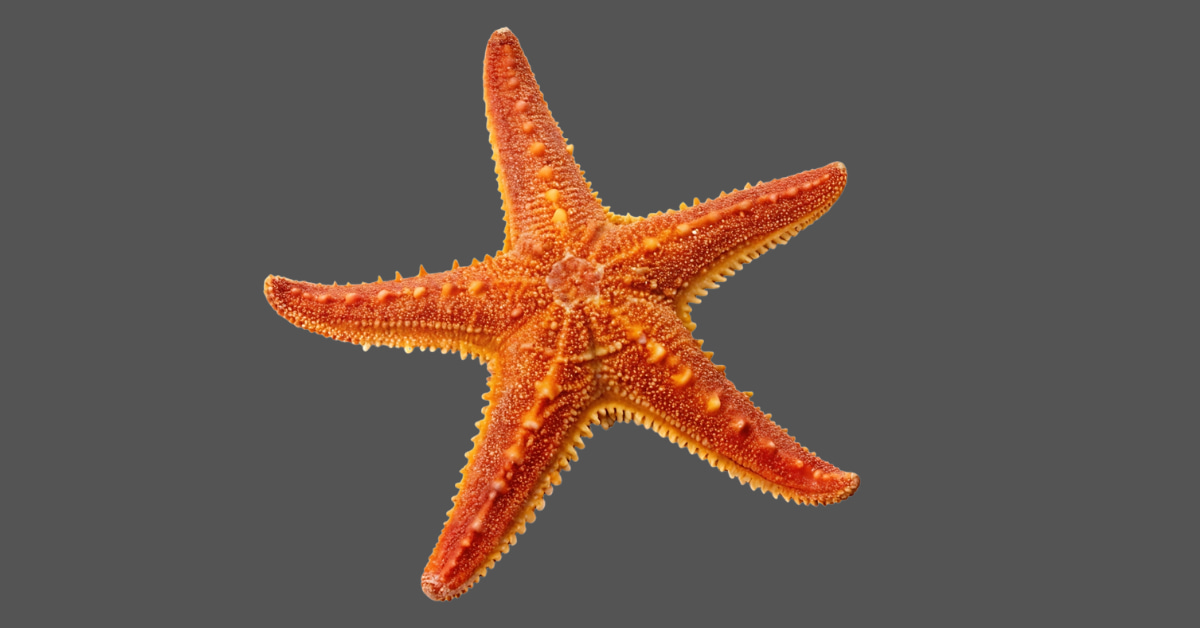
The external anatomy of a starfish is built entirely around its radial body plan. Everything visible from the outside, the arms, the central disc, the skin, and the mouth, follows the same five-point structure rather than the head-body-tail layout most animals use.
Starfish Body Parts on the Outside
- Central disc: the hub at the middle of the body, housing the mouth on the underside and the madreporite on top.
- Arms (rays): typically five, though some species have far more; each arm contains duplicated internal organs.
- Oral surface: the underside of the animal, where the mouth and ambulacral grooves sit.
- Aboral surface: the upper surface, where structures such as the madreporite, spines, and anus are found.
- Spines and pedicellariae: short projections and pincer-like structures covering the skin for defense.
The Skin, Skeleton, and Defenses
A starfish’s body wall is embedded with small calcium carbonate plates called ossicles, forming a flexible internal skeleton rather than a rigid shell or a purely external one. Short spines project from this skeleton for protection, and at the base of many spines sit pedicellariae, tiny pincer-like structures that snap at debris and small parasites trying to settle on the body surface.
Internal Anatomy of a Starfish
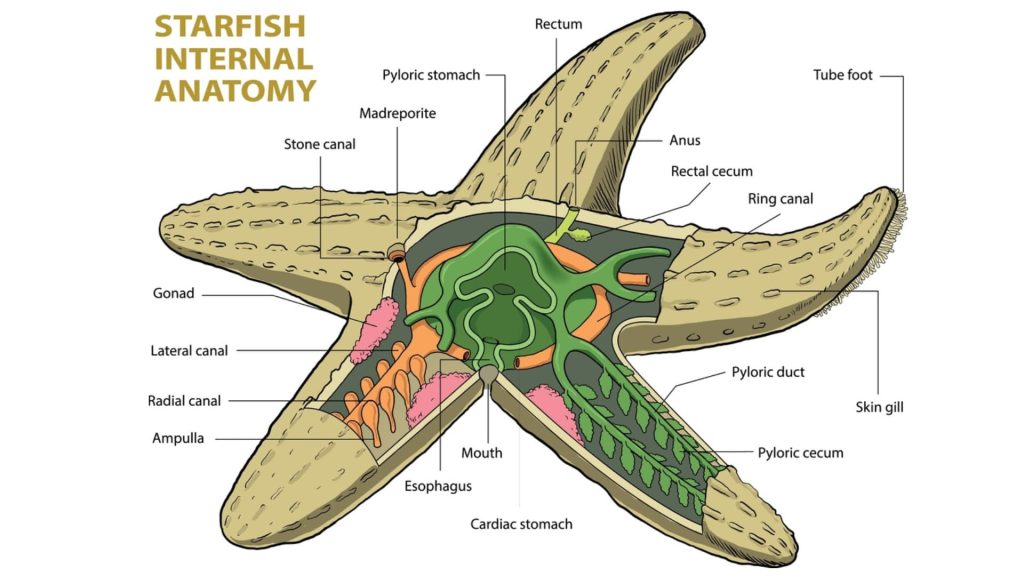
The internal anatomy of a starfish is where most of its strangest engineering lives. Beneath the skin, a network of canals, organs, and nerve tissue runs through the central disc and out into every arm, all built around the water vascular system described below.
Inside a Starfish’s Body: The Water Vascular System
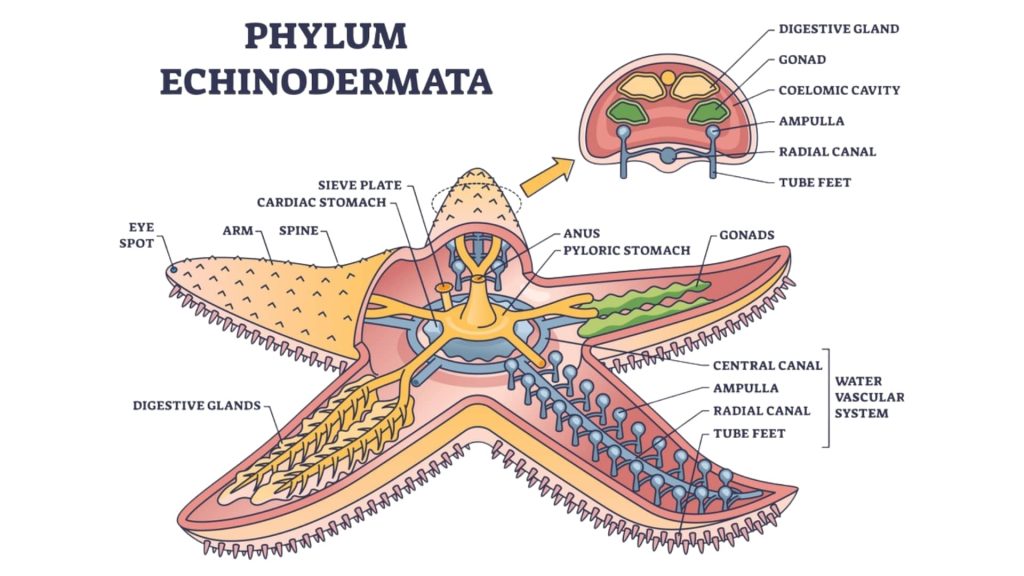
Nearly everything a starfish does, moving, eating, breathing, gripping, runs through one internal network: the water vascular system. It’s a closed loop of seawater-filled canals unique to echinoderms, and it does the mechanical work that muscles and lungs handle in most other animals.
Tube Feet and the Ambulacral Groove
On the underside of each arm sits a channel called the ambulacral groove, lined with hundreds of tiny tube feet. Each tube foot ends in a suction-cupped tip and is powered by hydraulic pressure rather than muscle contraction alone, letting the starfish creep across rock, cling to steep surfaces, and pry open the shells of prey like clams and mussels, per the Smithsonian Ocean collection.
The Madreporite, Canals, and Ampullae
Seawater enters the system through a small sieve-like plate on the upper surface called the madreporite, then travels down a stone canal to a ring canal circling the mouth. From there, radial canals run out along each arm, branching into the lateral canals that inflate and deflate the bulb-shaped ampullae attached to every tube foot, according to the Smithsonian’s overview of echinoderm anatomy.
Eyes, Nerves, and No Brain
There’s no centralized brain anywhere in a starfish. Instead, a nerve ring circles the mouth and connects to a radial nerve running down each arm, forming a decentralized network that coordinates movement without a single command center.
At the very tip of each arm sits a simple eyespot, a cluster of light-sensitive cells that can’t form images but can detect changes in light and shadow, useful for sensing a predator’s approach or finding the way back to shelter.
Digestion, Reproduction, and Regeneration
The mouth sits at the center of the underside of the disc, opening directly into a stomach split into two parts. When feeding on bivalves, many starfish push part of their stomach out through the mouth and directly into the prey’s shell, digesting the tissue externally before drawing the stomach back in. Digestive glands called pyloric caeca, one pair per arm, then help absorb the nutrients.
Reproductive organs, the gonads, also sit inside each arm rather than in a single central location. That same “everything is duplicated per arm” design is what makes a starfish’s regenerative ability possible.
If a predator bites off an arm, the starfish can typically regrow it, provided enough of the central disc survives. In some species, a single detached arm with a piece of disc attached can even regenerate an entirely new starfish, a process researchers call autotomy-driven regeneration, putting it in rare company with animals like the axolotl, which can regrow entire limbs of its own.
What Scientists Discovered: A Starfish Body Is Basically a Head
The “no body, just a head” idea isn’t a loose metaphor. It comes from a specific study published in Nature on November 1, 2023, led by Laurent Formery, a postdoctoral researcher working jointly in the labs of Christopher Lowe at Stanford University and Daniel Rokhsar at the University of California, Berkeley.
The team mapped gene activity across the body of the bat star (Patiria miniata) using a technique called RNA tomography, building a 3D atlas of which genes switch on where. In animals with a head-to-tail body plan, distinct genetic markers mark out the head, trunk, and tail regions in predictable order. Formery and his colleagues expected to find a scrambled or rearranged version of that same pattern somewhere in the starfish’s five-armed body.
Instead, they found that head-associated genes were switched on across the entire outer surface of the animal, most strongly along the midline running down each arm, while the genetic markers that specify a trunk were essentially missing altogether, as reported by the team’s full findings in Nature and summarized by Stanford’s own reporting on the study.
“The problem with starfish is there is nothing on a starfish anatomically that you can relate to a vertebrate,” Lowe said in Stanford’s coverage of the findings. “There is just nothing there. At least, nothing on the outside of a starfish.”
Genetic tail markers, meanwhile, turned up concentrated in the tube feet fringing each arm’s edge, rather than at some single trailing end of the body. Because a genuine trunk region never showed up anywhere in the gene-expression map, the researchers concluded that echinoderms most likely lost the trunk entirely at some point in their evolutionary history, keeping the head-patterning genes and redeploying them across a body that had gone fully radial.
Research supported in part by NASA’s Astrobiology Program has since highlighted the same findings as relevant to a much bigger question: how radically evolution can reshape an animal’s basic body plan, and what that might mean for recognizing life with very different body plans elsewhere, according to NASA’s Astrobiology Institute.
Why It Matters
This isn’t just a curiosity about one odd-looking sea creature. Echinoderms and vertebrates share a surprisingly close evolutionary relationship, both belonging to the larger group Deuterostomia, so understanding how a starfish rearranged its own body plan sheds light on how flexible animal development can be at a genetic level.
It also rewrites a basic assumption in comparative anatomy. Generations of biology students learned that echinoderms simply lack a head. The 2023 findings suggest the opposite: they didn’t lose a head at all. They lost everything else.
Future Research
Formery’s team has said they now want to test whether the same head-dominant genetic pattern holds true across other echinoderms, including sea urchins and sea cucumbers, to confirm the pattern extends across the whole phylum rather than being unique to sea stars. Researchers are also looking to the fossil record for early echinoderm ancestors that might still show traces of a trunk, which could help pin down when in evolutionary history it was lost.
Whether this same radical genetic reshuffling shows up in other radially symmetric animals remains an open question, and one the original research team has flagged as a natural next step.
Related Topics
- Estrella Culona: The “Big Butt” Starfish — a specific starfish species with its own strange anatomical claim to fame.
- Antarctic Feather Star — a close echinoderm relative covered in feathery arms, showing how varied the phylum’s body plans can get.
- The Indestructible Tardigrade — another invertebrate built to survive extremes most animals can’t.
- Axolotl — a vertebrate that can regrow entire limbs, a rare parallel to a starfish’s own regenerative ability.
- The Immortal Jellyfish — another marine invertebrate that rewrites the normal rules of aging and regeneration.
- 10 Heartless Creatures — other animals, like the starfish, that get by with no centralized heart at all.
- Skeleton Panda Sea Squirt — a stranger deuterostome relative hiding in plain sight in the same ocean waters.
- How Scientists Name a New Species — the process behind naming an animal like the bat star, Patiria miniata, referenced in the 2023 study above.
Key Takeaways
- The anatomy of starfish is built around pentaradial symmetry: typically five arms and a central disc, with no fixed head or tail end, all part of class Asteroidea.
- The external anatomy of a starfish, its oral and aboral surfaces, spines, and pedicellariae, and the internal anatomy of a starfish, its water vascular system, nerve ring, and duplicated organs, work as one continuous structure rather than separate systems.
- Movement, feeding, and gripping all run through the water vascular system: tube feet, the madreporite, and a network of internal canals.
- A 2023 study in Nature, led by Laurent Formery, Christopher Lowe, and Daniel Rokhsar, found that starfish gene expression closely matches head-patterning genes across the entire body, with no genetic markers for a trunk.
- Vital organs like the stomach, pyloric caeca, and gonads are duplicated in each arm, which is part of why starfish can regenerate lost limbs.
Frequently Asked Questions About Starfish Anatomy
What is the anatomy of a starfish? The anatomy of a starfish is built around pentaradial symmetry: a central disc surrounded by (usually) five arms, with no fixed head, tail, or left and right side. Externally it has an oral surface (mouth, tube feet), an aboral surface (madreporite, anus, eyespots), and a spine-covered skin; internally it runs on a water vascular system, a decentralized nerve ring, and organs duplicated in each arm.
What is the external anatomy of a starfish? The external anatomy of a starfish includes the central disc, the arms, the oral (underside) and aboral (upper) surfaces, spines, and pedicellariae. The mouth sits on the oral surface at the center of the disc, while the madreporite and eyespots sit on the aboral surface.
What is the internal anatomy of a starfish? The internal anatomy of a starfish includes the water vascular system (madreporite, stone canal, ring canal, radial canals, tube feet), a two-part stomach, pyloric caeca, gonads duplicated in each arm, and a decentralized nerve ring with no central brain.
Does a starfish have a brain? No. Starfish have no centralized brain. Instead, a ring of nerve tissue circles the mouth and connects to a nerve running down each arm, coordinating movement and response to stimuli without a single control center.
Is a starfish basically a head? Functionally, yes. A 2023 Nature study led by Stanford researcher Laurent Formery found that head-associated genes are expressed across the entire starfish body, while genetic markers for a trunk are essentially absent.
How many arms does a starfish have? Most species have five arms, but the number varies widely. Sunflower sea stars can have between 15 and 24 arms, and some species regularly exceed 40.
How do starfish regenerate lost arms? Because vital organs like the stomach, gonads, and digestive glands are duplicated in each arm rather than housed in one central body, a starfish can often regrow a lost arm as long as enough of the central disc survives the injury.
Does a starfish have blood? Not in the traditional sense. Starfish move oxygen, nutrients, and waste largely through seawater circulating in their water vascular system and body cavity rather than through a blood-filled circulatory system.
Is a starfish a fish? No. Despite the name, starfish are invertebrates in the phylum Echinodermata, not fish, which is why many scientists prefer the name “sea star.”
How does a starfish eat? Many starfish species force open the shells of prey like clams and mussels using their tube feet, then push part of their own stomach out through their mouth and into the shell to digest the prey externally before retracting it.
What is a starfish’s water vascular system? It’s a network of seawater-filled canals, running from the madreporite through the stone canal, ring canal, and radial canals, that powers the tube feet responsible for a starfish’s movement, feeding, and grip.
9. Image SEO
- Featured image alt text: “Anatomy of starfish diagram showing external and internal body parts”
- Secondary image alt texts:
- “External anatomy of a starfish showing arms, central disc, and oral surface”
- “Internal anatomy of a starfish showing the water vascular system”
- “Close-up of starfish tube feet gripping a rock surface”
- “Madreporite plate visible on the aboral surface of a sea star”
- “Sea star eyespot located at the tip of an arm”
- “Bat star Patiria miniata, the species studied in the 2023 Nature gene-mapping research”
- “Starfish regenerating a lost arm attached to its central disc”
About the Author
Author Mubashir Razzaq is a science and history writer for Strangehappen.com, specializing in archaeology, space exploration, ancient civilizations, and emerging scientific discoveries. His work focuses on translating complex research into engaging, evidence-based stories that help readers understand the mysteries of our world and beyond.
Source References
- Formery, L. et al. “Molecular evidence of anteroposterior patterning in adult echinoderms.” Nature 623, 555–561. Published November 1, 2023. https://www.nature.com/articles/s41586-023-06669-2
- Stanford Report. “Study reveals location of starfish’s head.” Published November 1, 2023. https://news.stanford.edu/stories/2023/11/study-reveals-location-starfishs-head
- NASA Astrobiology. “Where is the ‘Head’ in a Starfish?” Published January 12, 2024. https://astrobiology.nasa.gov/news/where-is-the-head-in-a-starfish/
- Smithsonian Ocean. “Echinoderms: Sea Stars, Urchins, Sand Dollars, and Relatives.” https://ocean.si.edu/ocean-life/invertebrates/sea-stars-urchins-and-relatives
- Smithsonian Ocean. “Starfish Feet.” https://ocean.si.edu/node/109607
- Britannica. “Sea star.” https://www.britannica.com/animal/sea-star