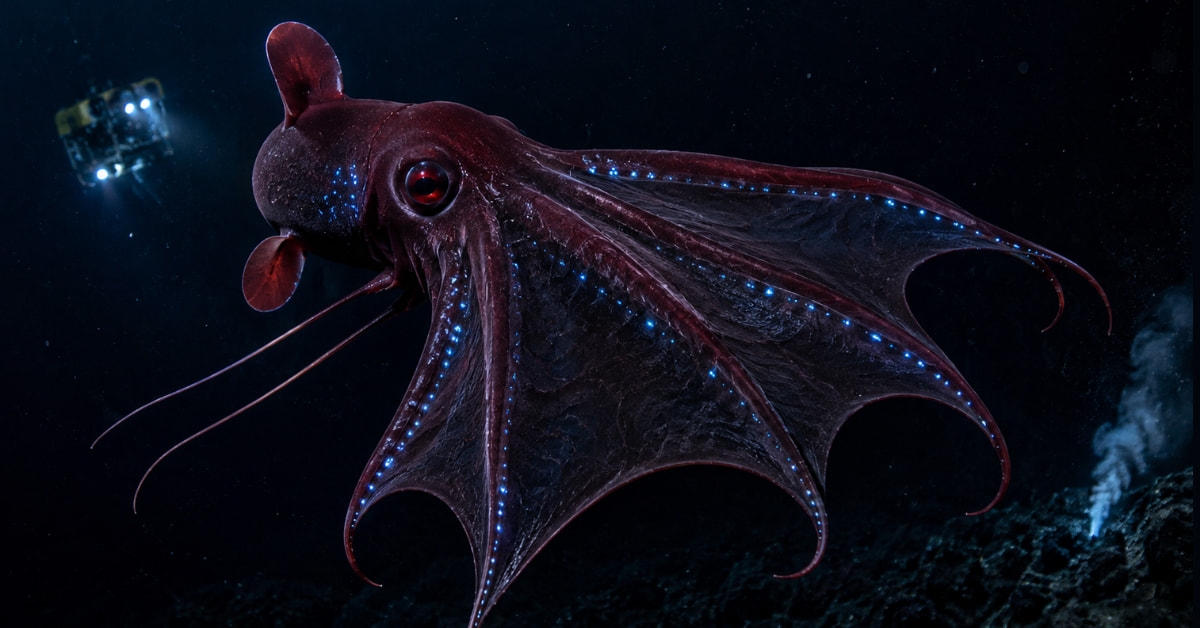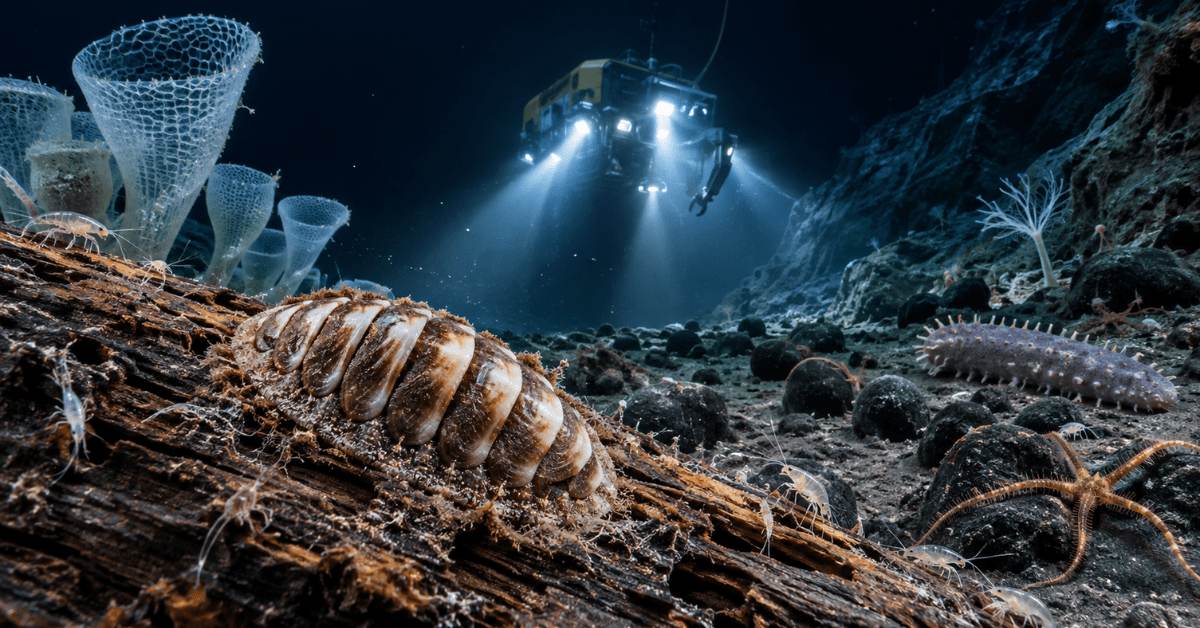

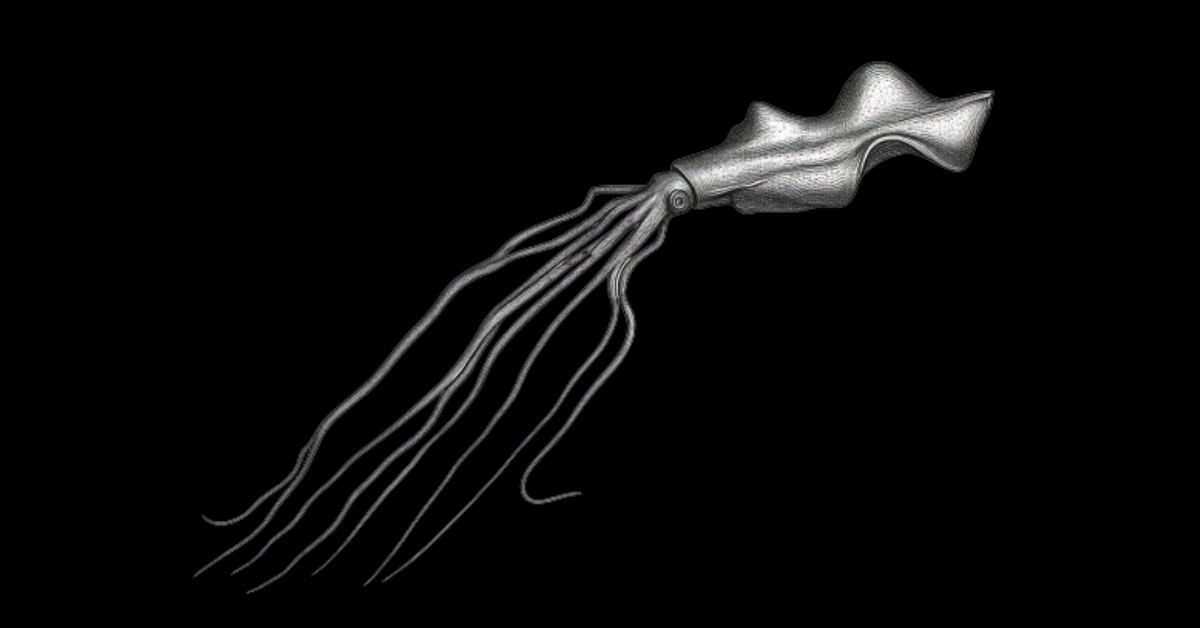
In August 2026, a robotic submersible drifting two miles beneath the Pacific stumbled onto something almost nobody has ever filmed alive: a bigfin squid. Yes, it’s a real animal, not a hoax or CGI, however alien it looks in viral clips. A 2026 global review counted just 46 individual in-situ observations of this animal, alongside 17 known physical specimens, across the entire history of ocean exploration. This one, caught on camera off the coast of central California, was the first confirmed live observation of Magnapinna anywhere in the northeastern Pacific.
The magnapinna squid, genus Magnapinna, is a deep-sea cephalopod and one of the strangest animals in the deep ocean. Long, elbow-bent arms trail beneath a torpedo-shaped body, and almost everything about how it lives remains unconfirmed. Below is what current research actually verifies, the open questions scientists still can’t answer, and the details of the newly confirmed sighting that put this creature back in the headlines.
What Is the Bigfin Squid (Magnapinna)?
The bigfin squid’s scientific name is Magnapinna, a genus in the family Magnapinnidae, part of the squid order Oegopsida within the class Cephalopoda. The family Magnapinnidae is made up of deep-sea squid known for their unusually large fins and extremely long arms and tentacles. Magnapinna is the only recognized genus in this family.
So how many species of bigfin squid are there? Researchers have formally described three species: Magnapinna pacifica, Magnapinna atlantica, and Magnapinna talismani. Two additional undescribed forms are known as Magnapinna sp. B and Magnapinna sp. C. Because many bigfin squid have only been observed from underwater video, scientists still cannot confidently identify every individual to species level.
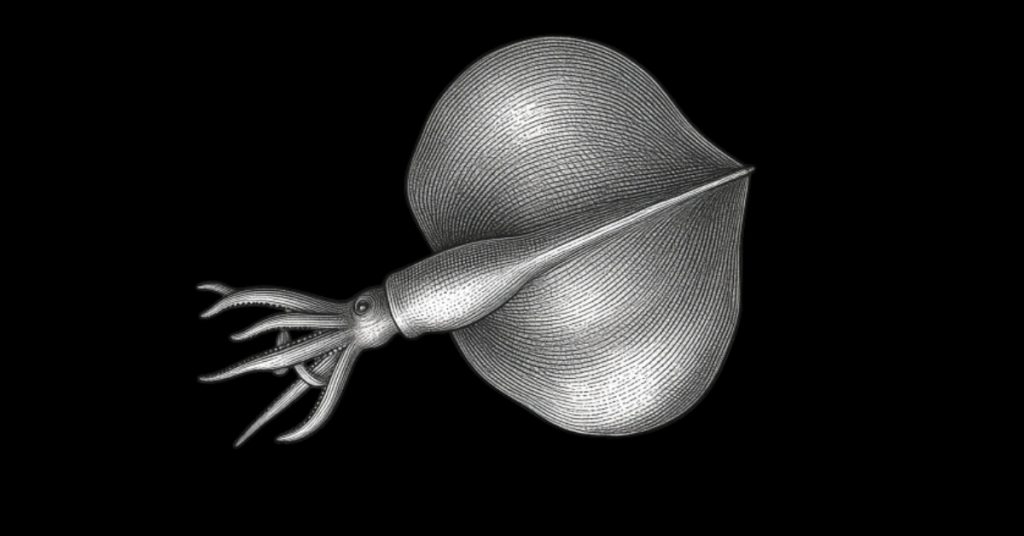
The genus name Magnapinna comes from Latin words meaning “big fin,” referring to the animal’s unusually large fins, which can extend across roughly 90% of the mantle length, according to the Monterey Bay Aquarium Research Institute (MBARI). Magnapinna was formally described by researchers Michael Vecchione and Richard Young in 1998, based on damaged juvenile specimens.
The physical specimens available to researchers are much smaller than the large animals seen in deep-sea footage. No confirmed adult Magnapinna has been recovered intact, so scientists still have an incomplete picture of how the known juvenile specimens relate to the much larger individuals observed by remotely operated vehicles and submersibles.
Scientific Classification and Species
The physical specimens available to researchers are much smaller than the large animals seen on video, and no adult has ever been brought to a lab intact. That leaves the relationship between the collected specimens and the larger video-observed animals an important unresolved question. Most of what’s known about the larger, adult-sized Magnapinna comes instead from underwater video, filmed by remotely operated vehicles (ROVs), crewed submersibles, and even oil-industry drilling cameras.
That gap between the juveniles in museum collections and the much larger animals on video is still not airtight. Researchers assume the video individuals are adults of the same genus based on shared traits like the oversized fins, but the link has never been confirmed through DNA or physical comparison.
Why It’s Called “Bigfin” and Its Other Nicknames
Beyond its common name, this deep-sea squid carries a handful of nicknames earned from its odd shape. It’s been called the long-arm squid, the long-armed squid, and even the “daddy long legs of the ocean,” a nod to how its ten limbs dangle far below its body.
For a stretch after its 2001 rediscovery on video, marine biologists simply called the magnapinna squid the “mystery squid,” because nobody could identify what they were looking at.
What Does the Bigfin Squid Look Like?
So what does the bigfin squid look like? Its anatomy is what makes the animal instantly recognizable: a small, relatively squat mantle dwarfed by two enormous undulating fins. Below that sit eight arms and two tentacles that, unlike the usual arm-versus-tentacle difference in most squid anatomy, look almost identical to each other here, both ending in extremely long, thread-like filaments. Unlike the sucker-lined arms of most other squid, these filaments carry no suckers at all, based on examinations of every physical specimen collected so far, a detail that sets Magnapinna’s arm and tentacle structure apart from nearly every other known cephalopod.
Its coloring tends toward beige or translucent, with near-white tentacles and dark eyes, based on video documented by MBARI and other research institutions. That ghostly, washed-out look is part of why footage of the magnapinna squid so reliably goes viral.
How Big Does It Get?
Curious readers searching “how big is a bigfin squid” usually land on the same figure: the largest confirmed recorded individual measured 6.4 meters, or about 21 feet, in total length, according to NOAA Ocean Exploration. Roughly 6.1 meters of that length was arms and tentacles alone, meaning the body itself makes up only a small fraction of the animal’s overall size. For a rough bigfin squid vs human size comparison, that’s roughly four times the height of an average adult.
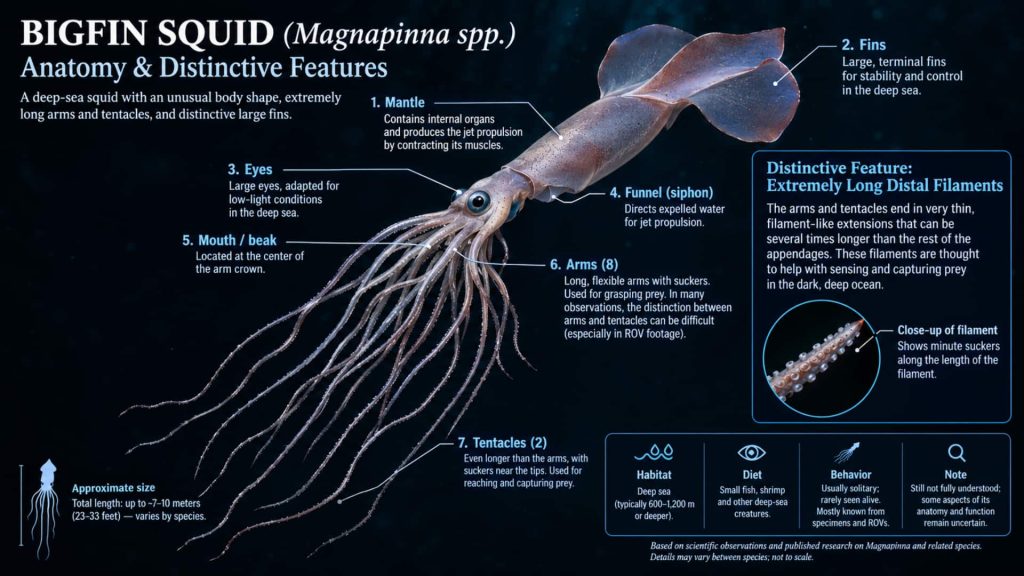
That also answers a related question: how big can a bigfin squid get, and what is the biggest bigfin squid ever recorded? Right now those have the same answer, since no larger, verified individual has been documented. Some lower-authority sites circulating online claim the long-arm squid can reach 50 feet, but that figure doesn’t trace back to any cited measurement or verified sighting. Twenty-one feet is the largest confirmed recorded individual so far, not necessarily a biological ceiling, and that number could change if a larger animal is ever documented.
Bigfin Squid Life Cycle
The life cycle of the bigfin squid remains largely unknown. Researchers have physically collected juvenile Magnapinna specimens, but no confirmed adult has ever been recovered intact. Most of what scientists know about larger individuals comes from ROV and submersible footage, making it difficult to directly connect the known juvenile specimens with the much larger animals observed in the deep ocean.
Bigfin squid are known from different life stages, but scientists have not directly documented the complete transition from juvenile to adult. Researchers also have not observed mating, egg laying, hatching, or the full reproductive cycle of Magnapinna in the wild.
The species’ growth rate and lifespan are also unknown. This leaves a major gap in our understanding of how bigfin squid develop and reproduce, particularly because the large adult-sized animals seen on deep-sea cameras have not been physically examined.
The “Elbow” Pose Explained
The single most recognizable trait of the magnapinna squid is its posture. The animal holds its arms and tentacles almost perpendicular to its body, then bends them sharply, creating what researchers call the elbow pose.
Nobody has directly observed why it adopts the elbow pose. One hypothesis, described by both MBARI and NOAA researchers, is that it keeps the long filaments spread wide and untangled while they drift through the water as a form of passive feeding. Many deep-sea squid use trailing tentacles to snag prey passively, and researchers suspect this species may do something similar as part of a passive prey capture strategy, but this bigfin squid behavior has not been directly confirmed and remains a proposed feeding theory rather than an observed hunting behavior.
The 2015-2017 Great Australian Bight sightings referenced later in this article also documented the animal coiling its distal filaments, a behavior not previously recorded in any squid, though what triggers it is still unclear.
Where in the Ocean Does It Live?
If you’re wondering where do bigfin squid live, the honest answer, based on its documented distribution, is almost everywhere deep enough. Sightings of this animal span the Atlantic, Pacific, and Indian Oceans, along with the Gulf of Mexico and the Caribbean, with individuals turning up near Australia, Hawaii, the Philippines, Micronesia, and the Cook Islands.
Most confirmed encounters cluster in the bathyal and abyssal zones, roughly 1,600 to 4,700 meters down, well below the sunlit epipelagic zone near the surface, though the true depth range runs even deeper.
Depth Range and the Hadal Zone Record
How deep do bigfin squid live? In March 2021, the crewed submersible DSV Limiting Factor recorded a juvenile Magnapinna in the Philippine Trench at 6,212 meters, or nearly four miles down, as documented in a 2021 study published in Marine Biology. That 6,212-meter observation is the deepest bigfin squid sighting on record and places the genus among the deepest-recorded squids.
That depth record is part of why researchers consider this genus unusually well adapted to extreme pressure and near-total darkness.
How Much of the Ocean Could Be Habitat for This Species?
A 2026 study published in Marine Biology by Alan Jamieson, Jennifer Day, Jose Corona, and colleagues collated the global evidence base for this genus: 46 individual in-situ observations plus 17 known physical specimens. Using the documented depth and latitudinal range from that dataset, the study modeled the biogeography of suitable habitat, effectively mapping Magnapinna’s potential global distribution, and estimated that this range could span about 62% of the world’s ocean area and 70% of its volume. That figure describes modeled potential range, not confirmed occupancy; it doesn’t mean the species has actually been found across that much of the ocean.
Of the 46 in-situ observations, only 19 came from formal scientific papers, while 27 were drawn from online video, news reports, social media, and other citizen-science-style sources. The study incorporated these observations into the broader evidence base, which says as much about how modern deep-sea discoveries reach researchers as it does about the animal itself.
That same Marine Biology study also broke the documented observations down by region:
| Region | Share of documented observations |
|---|---|
| Gulf of Mexico | 32.6% |
| Indian Ocean | 21.7% |
| Atlantic Ocean | 21.7% |
| Pacific Ocean | 19.6% |
| Caribbean Sea | 4.3% |
These percentages describe where documented sightings have occurred in the study’s dataset, not the actual population distribution of the species; a region with more research activity or ROV traffic could simply be more likely to produce a recorded observation. It’s a useful snapshot of the bigfin squid’s habitat range, even though most of that range is still unsurveyed.
Despite the wide modeled potential range, actual encounters remain scarce, suggesting the genus exists at very low population densities across its range, or that a large share of its range remains unsurveyed.
What Does It Eat and How Does It Hunt?
Nobody has ever observed the magnapinna squid actually eating. Researchers have proposed a working theory instead for how bigfin squid catch prey: it may drag its long arms and tentacles across, or just above, the seafloor in a form of passive, seafloor feeding, using its extremely thin distal filaments to encounter or capture small prey that brush against them. This remains a hypothesis about its feeding strategy, not a confirmed feeding method.
MBARI ecologist Olívia Soares Pereira, who was present for the 2026 sighting, put it plainly when she told ScienceAlert that there is “so little that we know about bigfin squid.” Diet sits near the top of that list of unknowns; researchers don’t know whether it targets zooplankton, small crustaceans, or something else entirely.
Is It Dangerous to Humans?
There is no evidence that bigfin squid pose a threat to humans. They live thousands of meters below the surface, far beyond normal human access, so the two essentially never cross paths outside of a research vehicle’s camera.
Observations from ROVs have not documented aggressive interactions. On more than one recorded dive, the animal has drifted directly into a vehicle’s path or gotten caught in its thruster wash without reacting defensively, based on footage logged by researchers studying it.
How Rare Is This Creature?
People searching how rare is the bigfin squid are often surprised by the number: a 2026 global review identified just 46 individual in-situ observations of this genus, alongside 17 known physical specimens, across the entire span of modern deep-sea exploration. That scarcity is exactly why each new Magnapinna sighting tends to make international news. Almost all confirmed encounters involve a single individual, which is part of why a July 2026 expedition stood out: Schmidt Ocean Institute’s ROV SuBastian recorded two bigfin squid together in the Atlantic’s Doldrums Fracture Zone, at a depth of roughly 3,634 meters, an unusually rare multiple-individual sighting that came just weeks before the Davidson Seamount encounter described later in this article.
Whether that number reflects genuine rarity or simply how little of the deep ocean humans have explored is still an open question, and researchers still can’t offer a reliable bigfin squid population estimate either way. The 2026 Jamieson et al. distribution study leans toward the “still mostly unexplored” explanation, describing a species that may be widespread but exists at extremely low densities, rather than one confined to a handful of hotspots.
Its conservation status remains listed as Data Deficient, meaning there isn’t enough population data yet on the magnapinna squid to classify it as threatened or stable one way or the other.
A Brief History of Its Discovery
So how was the bigfin squid discovered, and where? The first known specimen of this animal washed up damaged near the Azores in August 1883, though it wasn’t recognized as anything unusual at the time. It took until 1998 for Vecchione and Young to formally describe the family Magnapinnidae, based on juvenile specimens collected decades apart in the Atlantic and Pacific.
Adult individuals weren’t linked to that description until 2001, when footage recorded off Hawaii and in the Gulf of Mexico showed something researchers had never seen: enormous, elbow-bent squid unlike anything in the scientific record. For a while, marine biologists nicknamed the long-arm squid the “mystery squid” while they worked out what family it belonged to.
Timeline of Key Magnapinna Sightings (1883-2026)
- 1883: First damaged specimen recovered near the Azores.
- 1998: Magnapinnidae formally described from juvenile specimens.
- 2000-2001: Early adult video footage recorded in the Gulf of Mexico and off Hawaii, sparking the “mystery squid” nickname.
- 2007: A widely shared bigfin squid oil rig video, filmed at Shell’s Perdido drilling site in the Gulf of Mexico, goes viral.
- 2015-2017: Multiple Magnapinna sightings logged in Australia’s Great Australian Bight, the first confirmed records in the Southern Hemisphere, documented in PLOS ONE.
- 2018: First confirmed sighting in the Colombian Caribbean.
- 2021: A juvenile recorded at 6,212 meters in the Philippine Trench sets the hadal-zone depth record.
- 2024: A bigfin squid walking video from the Tonga Trench captures the animal appearing to “walk” its filaments across the seafloor.
- 2025: A sighting confirmed near the Cook Islands.
- 2026 (July): Schmidt Ocean Institute’s ROV SuBastian records two bigfin squid together in the Atlantic’s Doldrums Fracture Zone, an unusually rare multiple-individual sighting.
- 2026 (August): The Davidson Seamount encounter marks the first confirmed live sighting in the northeastern Pacific.
The 2026 Davidson Seamount Sighting
On August 7, 2026, a team from MBARI and NOAA was piloting the ROV Doc Ricketts near Davidson Seamount, an underwater mountain roughly 130 kilometers southwest of Monterey, California. They weren’t looking for a rare cephalopod at all. The expedition was investigating furrows on the seafloor believed to be feeding marks left by beaked whales.
At a depth of 3,277 meters, the ROV’s cameras instead captured footage of Magnapinna in a benthopelagic hover just above the muddy bottom, its fins undulating slowly. Using the vehicle’s laser measuring system, researchers estimated the animal at roughly 1.25 meters long. This particular Magnapinna sighting was only MBARI’s second encounter with the genus in more than four decades of deep-sea exploration, and the first confirmed live observation of Magnapinna anywhere in the northeastern Pacific, according to MBARI’s official announcement.
As with most video-only encounters, the sighting was identified to the genus level rather than a specific species; identification from ROV footage alone doesn’t always allow that level of precision. Distinguishing between Magnapinna species typically requires close examination of sucker and structural details on the arms and tentacles, something footage alone usually cannot resolve.
What Scientists Saw and Why It Matters
Davidson Seamount was already known among marine biologists for its ancient deep-sea coral gardens and a documented octopus nursery, making it a magnet for unusual finds. This latest sighting adds one more rare species to that growing list, and researchers suspect the seamount’s nutrient-rich currents may make it attractive to the magnapinna squid for the same reason it draws beaked whales.
The encounter also reinforces just how much unexplored seafloor remains close to a heavily studied coastline. Central California has hosted decades of MBARI research, yet this particular sighting was still a total surprise to the team that filmed it.
Giant Squid vs. Bigfin Squid: What’s the Difference?
Giant squid vs bigfin squid comparisons come up constantly, along with colossal squid, but all three belong to entirely different families and behave in very different ways.
| Feature | Bigfin Squid | Giant Squid | Colossal Squid |
|---|---|---|---|
| Family | Magnapinnidae | Architeuthidae | Cranchiidae |
| Typical size | Up to 6.4 m (mostly arms/tentacles) | Up to roughly 13 m | Up to roughly 10 m, far heavier by mass |
| Depth range | 1,600-6,212 m | Roughly 300-1,000 m | Roughly 1,000-2,200 m |
| Standout trait | Elbow-bent, near-identical arms and tentacles | Largest eyes of any animal | Rotating hooks on its tentacle clubs |
The main difference is not simply size. Magnapinna lives much deeper than either of the other two, and its arms and tentacles are nearly identical to each other, unlike a giant squid’s, which are clearly distinct. A bigfin squid vs colossal squid size comparison is even more lopsided by weight: the colossal squid is far heavier, while nearly all of Magnapinna’s length comes from its arms and tentacles rather than a bulky body. Unlike giant squid, which have occasionally been caught or landed by fishing vessels, no confirmed adult bigfin squid has been physically recovered intact.
What We Still Don’t Know
What scientists don’t know about the bigfin squid still outweighs what they do. Nearly every open question about this deep-sea squid’s behavior traces back to the same root problem: no adult has ever been physically examined. Diet, reproduction, lifespan, and true adult population size all remain unknown because researchers are working almost entirely from video for anything involving the larger, adult-sized animals.
Future expeditions equipped with better ROV sampling tools may eventually change that. Until then, each new sighting, like the ones at Davidson Seamount and the Doldrums Fracture Zone, functions as its own small research opportunity, since footage is currently the only window scientists have into how it actually lives.
Related Topics
- Vampire Squid Facts: another elusive deep-sea cephalopod whose “vampire” nickname is scarier than the actual science, much like Magnapinna’s misleading nicknames.
- Glass Octopus: a rarely-filmed, near-transparent deep-sea cephalopod sharing Magnapinna’s “ghostly and almost never seen alive” profile.
- How Much of the Ocean Has Been Explored?: the deep-sea unexplored angle that directly backs up this article’s point about Magnapinna’s modeled-but-unconfirmed 62% ocean habitat.
- Dorado Octopus: a recently documented deep-sea cephalopod identified mostly through video, the same path that led to Magnapinna’s discovery.
- Sagami Bay Creature: another unidentified deep-sea sighting that echoes Magnapinna’s own “mystery squid” origin story.
- How Scientists Name a New Species: the process behind identifying animals like Magnapinna from footage alone, without a physical specimen to confirm species-level ID.
Key Takeaways
- The bigfin squid, genus Magnapinna, is known from 17 physical specimens and 46 in-situ video observations; the relationship between the two remains an open question.
- The largest confirmed individual measured 6.4 meters (21 feet), mostly arms and tentacles.
- A 2021 sighting in the Philippine Trench, at 6,212 meters, is the deepest in-situ record of Magnapinna, placing it among the deepest-recorded squids.
- A 2026 study modeled potential (not confirmed) habitat for the magnapinna squid at up to 62% of the world’s ocean area, based on documented depth and latitude data.
- In July 2026, Schmidt Ocean Institute recorded two bigfin squid together in the Atlantic’s Doldrums Fracture Zone, an unusually rare multiple-individual sighting.
- In August 2026, MBARI and NOAA recorded the first confirmed live Magnapinna sighting in the northeastern Pacific, near Davidson Seamount.
- Diet, reproduction, and true population size remain unresolved, since no adult specimen has ever been physically studied.
Frequently Asked Questions About the Bigfin Squid (Magnapinna)
Is the bigfin squid dangerous to humans?
No. It lives thousands of meters below any depth humans reach unassisted, and no aggressive behavior has ever been recorded during ROV encounters.
How big is a bigfin squid?
The largest confirmed individual measured 6.4 meters (21 feet) in total length, though most of that was its arms and tentacles rather than its body.
Where do bigfin squid live?
The magnapinna squid has been recorded in the Atlantic, Pacific, and Indian Oceans, typically at depths between 1,600 and 6,212 meters, with a 2026 study modeling potential habitat across most of the world’s oceans based on that documented depth and latitude range.
How rare is the bigfin squid?
A 2026 global review counted just 46 individual in-situ observations plus 17 physical specimens, though researchers aren’t certain whether that reflects true rarity or simply how little of the deep ocean has been explored.
What is the elbow pose this animal is known for?
It’s the sharp, perpendicular bend in the long-arm squid’s arms and tentacles, likely used to keep its filaments spread out for passively catching prey, though this remains a working theory rather than a confirmed behavior.
Do bigfin squid have tentacles and arms?
Yes. Like most squid, it has eight arms and two tentacles, but unlike most squid, its arms and tentacles look almost identical to each other, both ending in long, thread-like filaments.
Do bigfin squid have suckers on their arms?
The long, thread-like distal filaments are extremely thin, and their detailed feeding structures are difficult to resolve clearly. Researchers think they may help the squid capture small prey, but their exact feeding function remains uncertain.
Is the bigfin squid the same as a giant squid?
No. In a giant squid vs bigfin squid comparison, the two belong to different families, Architeuthidae versus Magnapinnidae, and differ in size, depth range, and arm structure; the magnapinna squid’s arms and tentacles look nearly identical to each other, unlike a giant squid’s.
How many species of bigfin squid are there?
Three have been formally described, Magnapinna pacifica, Magnapinna atlantica, and Magnapinna talismani, plus two additional undescribed forms known only as Magnapinna sp. B and sp. C.
Has a bigfin squid ever been physically caught?
No confirmed adult bigfin squid has ever been physically caught or brought to a lab intact. Everything known about the larger, adult-sized Magnapinna comes from ROV, submersible, and drilling-camera footage, while only smaller, damaged juvenile specimens have ever been physically collected.
Has more than one bigfin squid ever been seen at the same time?
Yes, though it’s rare. In July 2026, Schmidt Ocean Institute’s ROV SuBastian recorded two bigfin squid together in the Atlantic’s Doldrums Fracture Zone at a depth of roughly 3,634 meters, one of the few documented sightings of multiple individuals in a single encounter.
What was discovered at Davidson Seamount in 2026?
On August 7, 2026, MBARI and NOAA researchers recorded the first confirmed live observation of Magnapinna in the northeastern Pacific, at a depth of 3,277 meters off central California.
Author Bio
Evan Brooks is a science and history writer for Strangehappen.com, specializing in archaeology, space exploration, ancient civilizations, and emerging scientific discoveries. His work draws on peer-reviewed papers, institutional sources, historical records, and expert reporting, with a focus on separating documented evidence from speculation, translating complex research into engaging, evidence-based stories that help readers understand the mysteries of our world and beyond.