
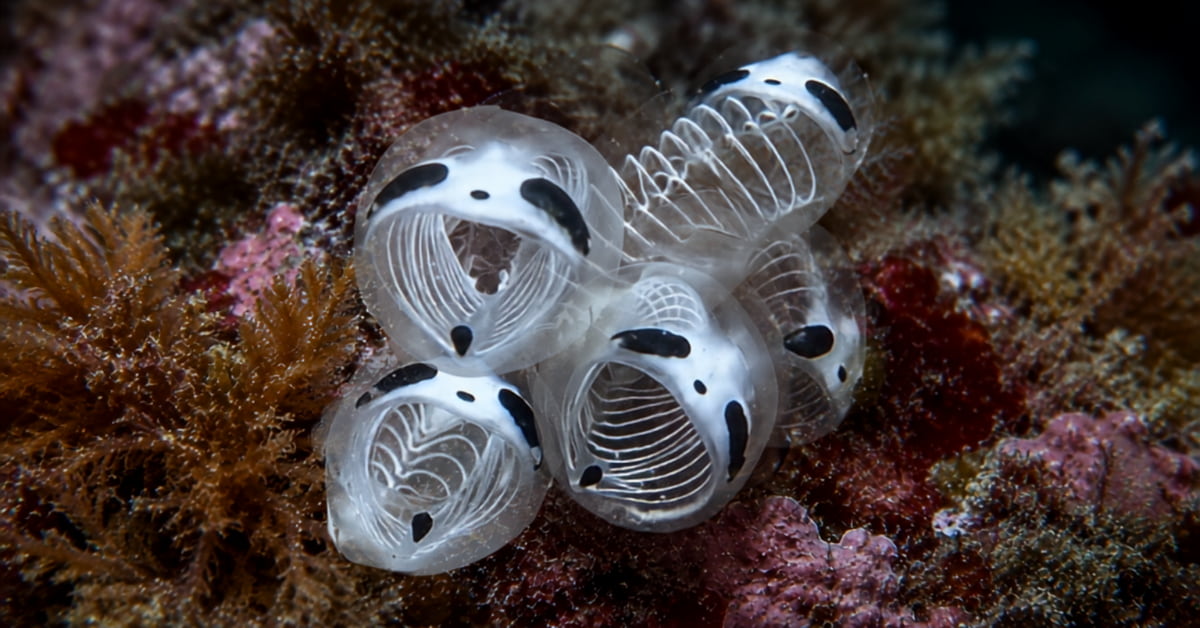
Divers off a small Japanese island once swam past what looked like a graveyard of miniature panda skulls scattered across the reef. It was not bone, and it was not a hoax someone built for social media. It was a living animal, and once the photos reached the internet, people everywhere started asking the same question: is the skeleton panda sea squirt actually real. It is, and the true story behind this animal is stranger, and far better documented, than most of what gets shared about it online.
Table of Contents
Evidence Verdict
Is the skeleton panda sea squirt real? Yes.
- Scientific name: Clavelina ossipandae
- Animal group: Colonial tunicate / ascidian
- Known location: Kume Island, Okinawa, Japan
- Formally described: 2024
- AI-generated species: No
- Black marking function: Still unknown
Verdict: The skeleton panda sea squirt is a genuine marine animal, not a fictional or AI-generated creature. Researchers formally described Clavelina ossipandae as a new species in 2024, after examining collected specimens and comparing their physical and genetic characteristics against related Clavelina species.
Skeleton Panda Sea Squirt: Quick Facts
| Fact | Detail |
|---|---|
| Scientific name | Clavelina ossipandae (WoRMS) |
| Common name | Skeleton panda sea squirt (also called the skeleton panda ascidian) |
| Japanese name | Gaikotsu-panda-hoya (ガイコツパンダホヤ) |
| Animal group | Colonial tunicate / ascidian |
| Phylum | Chordata |
| Genus | Clavelina |
| Known location | Waters around Kume Island, near the Tonbara dive site, Okinawa, Japan |
| Depth | 10–20 metres (33–66 ft) |
| Maximum zooid length | About 2 cm (0.79 in) |
| Diet | Filter feeder (plankton and suspended organic particles) |
| First photographed | Around 2017 |
| Formally described | 2024 |
| Described by | Naohiro Hasegawa and Hiroshi Kajihara |
What Is a Skeleton Panda Sea Squirt?
The skeleton panda sea squirt, or skeleton panda ascidian, is the common name for Clavelina ossipandae, a small colonial tunicate formally recognized as a new species in 2024. It belongs to the class Ascidiacea, commonly called sea squirts or ascidians, a group of soft bodied marine invertebrates that spend their adult lives fixed in one spot. It is not the only strange-looking tunicate Strange Happenings has covered either; the elven abyss tunicate is another member of the same group with its own unusual story.
In Japan, divers and the media call it gaikotsu-panda-hoya, which translates literally to “skeleton panda ascidian.” Naohiro Hasegawa and Hiroshi Kajihara, both at Hokkaido University, gave the animal its scientific description in the journal Species Diversity, published through J-STAGE. The genus name Clavelina is Latin for “little bottle,” describing the animal’s bottle shaped body, and ossipandae combines the Latin word for bone with panda, describing the pattern that made this species famous online.
Hokkaido University’s research announcement confirmed the discovery on February 1, 2024. That single detail already separates a well sourced write-up on this animal from most of what is currently online, because plenty of pages never mention the paper, the university, or the researchers who did the actual work.
Is the Skeleton Panda Sea Squirt Real or AI-Generated?
Yes. Clavelina ossipandae is a real species, formally described by researchers at Hokkaido University in 2024. Its black and white appearance is entirely natural, confirmed through direct morphological examination and DNA analysis of collected specimens. That establishes the species itself as genuine, though it does not mean every single photo shared online can automatically be assumed to be unedited; as with any viral animal, individual images are still worth a normal degree of skepticism even once the species is confirmed real.
It’s a fair question to ask, since photographs of the animal genuinely look almost too graphic to be real, with markings that contrast sharply against a transparent body. But the paper trail is solid: a peer reviewed scientific description, an official university announcement, and specimens formally deposited as a holotype and paratype in the Invertebrate Collection of the Hokkaido University Museum in Sapporo. It’s not the first time a viral animal photo has needed this kind of fact-check either, as the golden penguin discovery showed.
How Was Clavelina ossipandae Identified and Described?
The story started with local divers, not a research expedition.
2017: Photos of the animal begin circulating online after a diving shop on Kume Island, run by Shunji Terai, introduces it to visiting divers. The News International later reported on how quickly the images spread across Japanese social media and television.
2018: Tunicate specialist Naohiro Hasegawa spots the photos on Twitter (now X) and suspects the animal does not match any known ascidian species.
2021: A crowdfunded expedition led by Hasegawa collects four small colonies from the rocky outcrop of Tonbara, off Kume Island, a site reachable only in winter because of strong tidal currents.
2024: Hasegawa and Kajihara formally describe the animal as Clavelina ossipandae. Boing Boing, Times of India, NatureWorldNews, and WNCT all cover the announcement within weeks, and Japanese broadcaster FNN interviews the research team directly about what the markings might mean.
How Scientists Confirmed It Was a New Species
Researchers did not name this animal simply because it looked unusual. Hasegawa and Kajihara compared its physical characteristics against all 44 previously known species in the genus Clavelina, identifying a specific combination of features, including how the zooids are structured and arranged, that set it apart from every one of them.

They backed that up genetically. Sequencing part of the cytochrome c oxidase subunit I (COI) gene from the holotype and a paratype specimen placed the animal as the sister species of Clavelina australis within the genus. That combination of detailed morphological comparison and DNA evidence, not just a distinctive look, is what confirmed this as a previously undescribed species. It’s the same rigorous process behind every new animal name, which we break down in how scientists name a new species.
Where Do Skeleton Panda Sea Squirts Live?
The species is currently known from the waters around Kume Island, part of Okinawa’s Ryukyu Archipelago, particularly the Tonbara dive site where the research specimens were collected. It is the first ascidian species ever recorded from Kume Island, and other specimens collected from the same waters are still awaiting formal description.
Colonies anchor themselves to coral reef surfaces at depths of roughly 10 to 20 metres, about 33 to 66 feet, in spots with strong currents. That current matters. Fast moving water carries a steady supply of plankton past the animal’s siphons, exactly what a stationary filter feeder needs to survive. Diving guides such as X-Ray Mag note that the site is only safely accessible to divers at certain times of year, the same reason the original research team needed a winter expedition to reach it.
Why Does It Look Like a Panda?
The panda resemblance comes from two separate features on an otherwise transparent body. White transverse blood vessels run across each zooid, creating the look of a small ribcage beneath the skin. Near the siphons, on the front of the body, sits a black dot flanked by two black bands, a pattern that has been compared to a panda’s eyes and nose.
Hasegawa himself told Reuters, in comments carried by Live Science, that scientists do not actually know why the black pattern exists. That is a confirmed open question stated directly by the researcher who described the species, not a mystery invented for engagement.

It is also worth being clear about what this animal actually is. Nothing about it involves real bone. The entire pattern lives on the surface of a soft, transparent body just under two centimetres long.
Size, Diet, and Life Cycle
An adult zooid, the term for one individual in the colony, reaches up to about 2 centimetres, roughly three quarters of an inch. Specimens examined by researchers measured 7 to 14 millimetres, though living individuals in the wild have been reported closer to the full 2 centimetres.
Like other sea squirts, this species is a filter feeder. Seawater is drawn in through an oral siphon ringed by ten small tentacles, filtered through the pharynx to trap plankton and organic particles, and expelled through a second, atrial siphon, which is also the source of the “squirt” in its common name.
Its life cycle starts very differently from its adult form. Larvae hatch as free swimming, tadpole shaped organisms only about 1.25 millimetres long, carrying a notochord, a flexible rod like structure that also appears briefly in vertebrate embryos, including humans, before it disappears during development.
After a short swimming phase, each larva settles permanently onto a hard surface and transforms into a stationary zooid. Each keeps its own transparent outer layer, but the colony as a whole grows from a shared base, with one to four zooids linked to each other through vascular stolons. Clavelina ossipandae is hermaphroditic, capable of both sexual reproduction and asexual budding.
Is the Skeleton Panda Sea Squirt Dangerous?
There is no known evidence that Clavelina ossipandae poses a danger to humans. It is a stationary filter feeder and is not known to possess venomous or stinging structures. As with any reef organism, divers and underwater photographers should still avoid touching or removing colonies.
Skeleton Panda Sea Squirt vs Panda Nudibranch
Searches for panda nudibranch and panda sea slug regularly turn up alongside this species, and it is worth being precise about why. Nudibranchs are sea slugs, soft bodied molluscs in the order Nudibranchia, in the same broad phylum as snails and octopuses. Several nudibranch species carry bold black and white patterning of their own, which is why casual searches lump a panda nudibranch or panda sea slug together with this sea squirt.
Clavelina ossipandae is not a mollusc at all. It belongs to the phylum Chordata, a group that includes tunicates, lancelets, and vertebrates. Like other tunicates, its free swimming larva briefly develops a notochord, the flexible supporting structure also characteristic of chordate development. A panda nudibranch and a skeleton panda sea squirt might share a nickname and a color scheme, but they sit on entirely different branches of the animal kingdom.
How Clavelina Ossipandae Compares With Other Sea Squirts
The panda pattern is unusual, but not entirely unique inside the genus Clavelina. Two related species carry a similar black dot and band marking in different colors: Clavelina moluccensis, the bluebell sea squirt, in dark blue on light blue, and Clavelina viola, in blue on yellow. A separate relative, Clavelina lepadiformis, nicknamed the lightbulb sea squirt, lives on European rocky shores and shares the same transparent, bottle shaped body without any panda styled pattern at all.
Seeing these relatives side by side makes one thing clear. The look that made this species famous is a variation on a design that shows up elsewhere in the genus, not something that appeared out of nowhere on a single Japanese reef.
Why This New Species Matters
Beyond its internet fame, this is a genuinely useful animal for science. Tunicates are chordates, part of the same phylum as lancelets and every vertebrate, including humans. Their tadpole shaped larvae briefly carry a notochord and other features that make ascidians like this one valuable for studying how the chordate body plan evolved.
Like other sea squirts, it is also a filter feeder, drawing in seawater and capturing suspended food particles. That is part of why tunicate specialist Hasegawa continued investigating this animal long before it had an official scientific name.
What Scientists Still Do Not Know
Two real open questions remain, and neither one is manufactured for suspense. The function of its black facial markings is still unknown, and researchers have not ruled out that the pattern serves no adaptive purpose at all. The 2024 research also noted other ascidian specimens from the area that had not yet been formally described at the time of the study. It would not be the first time a strange find turned out to be new to science; the Ferreiraella populi deep-sea chiton is a recent example, and Strange Happenings roundup of 10 newly discovered species has more.
Public interest has not faded since 2024 either. BBC Science Focus revisited the discovery in February 2026, and outlets such as Daily Galaxy picked the story back up that same month, a sign that curiosity about this species is still active rather than a one time viral moment from 2024.
Key Takeaways
- The skeleton panda sea squirt is the common name for Clavelina ossipandae, a real, formally described tunicate, not an AI-generated image.
- It was described in 2024 by Naohiro Hasegawa and Hiroshi Kajihara of Hokkaido University, following diver photos dating back to 2017 and a 2021 crowdfunded expedition.
- It is currently known only from the waters around Kume Island, Japan, anchored to coral reefs at depths of 10 to 20 metres.
- Its white “rib” markings are transverse blood vessels; the function of its black panda-style markings is still an open scientific question.
- It was confirmed as a new species by comparing it against 44 known Clavelina species and sequencing its DNA, not by appearance alone.
- There is no known evidence it is dangerous to humans, and it is unrelated to a panda nudibranch, which belongs to a different animal group entirely.
Related Topics
- Chinese Giant Salamander: another real animal whose appearance regularly gets mistaken for a hoax or a costume.
- Glass Octopus: another transparent, hard to spot ocean animal from the same “see-through survival” family of adaptations.
- Glow Jellyfish: a Pacific Ocean species that solves the same problem, staying hidden and finding food, with a completely different trick.
- Blobfish and Stonefish: two more misunderstood ocean animals whose real biology is stranger than their internet reputation.
- Yeti Crab: a deep sea species discovered through a similarly unlikely combination of diver curiosity and later scientific confirmation.
Frequently Asked Questions About Skeleton Panda Sea Squirt
Is the skeleton panda sea squirt a real animal?
Yes. It is a real, peer reviewed species, Clavelina ossipandae, described in 2024 by researchers at Hokkaido University. The animal itself is real, and its distinctive black-and-white pattern is natural. However, individual photos shared online should be judged separately, since confirming the species does not prove that every viral image is completely unedited.
What is the scientific name of the skeleton panda sea squirt?
Clavelina ossipandae. The genus name Clavelina means “little bottle” in Latin, and ossipandae combines the Latin word for bone with panda.
Where do skeleton panda sea squirts live?
Skeleton panda sea squirts live only in the waters around Kume Island in Japan’s Ryukyu Archipelago, anchored to coral reefs at depths of roughly 10 to 20 metres where strong currents bring in plankton.
How big is a skeleton panda sea squirt?
An adult zooid reaches up to about 2 centimetres, roughly three quarters of an inch, making a whole colony small enough to miss on a reef unless you are looking closely.
What does the skeleton panda sea squirt eat?
It is a filter feeder. It draws seawater in through its oral siphon, filters out plankton and suspended organic particles using mucus covered gill structures, and expels the water through a second siphon.
Is the skeleton panda sea squirt dangerous?
No known evidence suggests it is. It is a stationary filter feeder and is not known to have venomous or stinging structures. As with any reef organism, it is best not to touch or remove colonies.
Why does it have a panda pattern?
Its white markings are transverse blood vessels visible through its transparent body. The black facial markings’ purpose is still unknown; even the researcher who described the species has said its function has not been determined.
Is a panda nudibranch the same animal as a skeleton panda sea squirt?
No. A panda nudibranch is a type of sea slug, a mollusc, while the skeleton panda sea squirt is a tunicate in the phylum Chordata. They share a nickname and a color scheme, not a family tree.
When was the skeleton panda sea squirt discovered?
There are really three dates. Divers first photographed and shared it online around 2017. Researcher Naohiro Hasegawa recognized it as a likely new species in 2018. It was not formally described in the scientific literature as Clavelina ossipandae until 2024, following a 2021 collecting expedition.
Can you see a skeleton panda sea squirt while diving?
Only around Kume Island, and only at certain times of year, since the strong currents the colonies depend on also make the Tonbara dive site accessible mainly in winter.
You May Also Like
- Elven Abyss Tunicate
- Ferreiraella Populi: A Deep-Sea Chiton
- How Scientists Name a New Species
- Yeti Crab
- Glass Octopus
- 10 Newly Discovered Species
- The Truth Behind the Golden Penguin Discovery
Research & Fact-Checking
This article was checked against the original 2024 taxonomic description of Clavelina ossipandae by Naohiro Hasegawa and Hiroshi Kajihara, published in Species Diversity, together with Hokkaido University’s official research announcement, the WoRMS taxonomic database entry, and subsequent reporting from established science and news outlets. Scientific names, taxonomy, habitat, measurements, discovery timeline, morphology, and genetic evidence were checked against primary research where available.
Published: July 30, 2026 Last updated: August 25, 2026 Fact-checked: August 25, 2026
About the Author
Evan Brooks is a science and history writer at StrangeHappen.com, specializing in unusual animals, unexplained phenomena, ancient history, and emerging scientific discoveries. His work focuses on researching primary sources and expert reporting, and turning complex scientific information into accessible, evidence-based stories for general readers.