


Something has been humming in the high desert around Taos, New Mexico, and nobody has ever fully explained it. Reports of the Taos Hum in New Mexico date to the early 1990s. Residents describe a low, diesel-engine rumble that starts around dusk and never quite stops. Only a small fraction of the population can hear it at all. A formal 1993 investigation involving researchers from federal laboratories and the University of New Mexico deployed acoustic, seismic, and electromagnetic monitoring but did not identify a signal that explained what Taos hearers were experiencing. This is the Taos Hum, one of the few such cases to receive a serious, federally involved scientific investigation and still remain unresolved decades later.
What Is the Taos Hum?
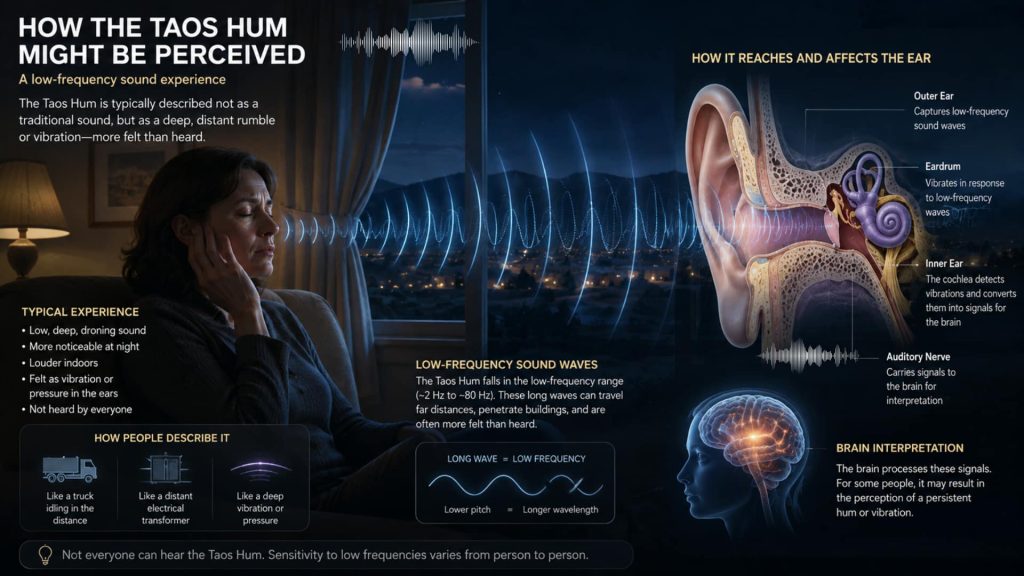
The Taos Hum is a persistent, low-frequency droning sound reported by a small percentage of people living in and around Taos, New Mexico. Hearers describe it as a truck idling somewhere out of sight, a distant transformer, or a physical pressure in the ears rather than a conventional sound. It is typically reported as louder indoors and worse at night.

Complaints in the Taos area date to the early 1990s. By 1992 and 1993, enough residents had reported the sound that New Mexico’s congressional delegation got involved, leading to a formal investigation the following year involving researchers from federal laboratories and the University of New Mexico.
Who Investigated the Taos Hum, and What Did They Find?
The investigation was led by Joe Mullins, an engineering professor at the University of New Mexico, working alongside James Kelly, a hearing research scientist with the university’s Health Sciences Center. The team drew roughly a dozen researchers from Los Alamos National Laboratory, Sandia National Laboratories, and the U.S. Air Force’s Phillips Laboratory, which conducted directed-energy and space-technology research.
Investigators deployed acoustic, seismic, and electromagnetic monitoring equipment throughout Taos, then surveyed 1,440 local residents directly; roughly 2 percent (161 respondents) identified themselves as hearers. A subset of confirmed hearers was tested with sample tones to identify the frequencies they were actually perceiving. Hearers skewed toward middle age (most between 30 and 59), split close to evenly between men and women, and a notable share, roughly one in five in one contemporary account of the survey, reported perceiving the sound more than 50 miles from Taos itself.
What the 1993 Investigation Found
| Monitoring type | What was examined | Result |
|---|---|---|
| Acoustic monitoring | Low-frequency sound in the environment | No matching external source identified |
| Seismic monitoring | Ground vibration | No explanatory signal found |
| Electromagnetic monitoring | Electromagnetic activity, including near power lines | Measurements recorded; no electromagnetic source established for the Hum |
| Hearer testing | Perceived frequencies among confirmed hearers | Hearers reported the sound itself falling roughly between 30 and 80 Hz; investigators separately theorized hearers may have developed sensitivity across a broader 20–100 Hz band |
| Population survey (1,440 residents) | Prevalence in the general Taos population | Roughly 2 percent identified as hearers |
Sandia scientist Horace Poteet, who was himself a hearer, told the Associated Press at the time that the team was disappointed not to find an answer for people they had hoped to help. The investigators did not conclude that the phenomenon was imaginary. Their conclusion was narrower and more specific: available instruments failed to detect a source that matched what hearers reported.

Mullins and Kelly later published their own account of the investigation, “The Mystery of the Taos Hum,” in Echoes, the newsletter of the Acoustical Society of America, in 1995. It remains the closest thing to a primary source written by the lead investigators themselves.
What We Know vs. What We Don’t Know
Despite decades of research, there is still no definitive Taos Hum explained answer because investigators have never confirmed a single source.
What We Know
- Residents have repeatedly and consistently reported the phenomenon since the early 1990s.
- The claim received a formal, well-resourced scientific investigation involving federal laboratories, not just anecdotal dismissal.
- Investigators used acoustic, seismic, and electromagnetic monitoring simultaneously.
- Confirmed hearers reported the sound itself falling roughly between 30 and 80 Hz.
- No single external source was ever confirmed to match those reports.
What We Don’t Know
- Whether every Taos Hum report shares a single common cause.
- Whether Taos has one source at all, or several unrelated phenomena grouped under one name.
- Why only a small percentage of the population perceives it.
- Whether some cases involve an internal auditory mechanism rather than an external sound.
- Whether modern low-frequency and infrasound recording equipment, decades more advanced than what was available in 1993, would detect something the original instruments missed.
Taos Hum Timeline
- Early 1990s — Residents in the Taos area begin reporting a persistent low-frequency sound.
- 1992–1993 — Complaints grow enough that New Mexico’s congressional delegation becomes involved.
- 1993 — A multi-institution team conducts acoustic, seismic, and electromagnetic monitoring and surveys local residents; no confirmed external source is identified.
- 1995 — Lead investigators Joe Mullins and James Kelly publish their account of the study in the Acoustical Society of America’s Echoes newsletter.
- 2004 — Geophysicist David Deming publishes a peer-reviewed analysis, “The Hum: An Anomalous Sound Heard Around the World,” in the Journal of Scientific Exploration, situating Taos within a broader global pattern and arguing the Hum does not appear to be a straightforward form of tinnitus.
- 2012 — Canadian researcher Glen MacPherson launches The World Hum Map and Database Project to crowdsource hum reports worldwide.
- 2010s — A separate investigation in Windsor, Ontario traces a comparable hum to industrial activity on Michigan’s Zug Island, one of the few hum cases with a confirmed source.
- Today — No universally accepted explanation exists for the Taos Hum specifically.
Leading Theories Behind the Taos Hum
No single theory has been confirmed, and researchers openly disagree about which explanation is most likely. It’s worth separating what has real evidence behind it from what is plausible but unproven, and from what is largely speculative.
Environmental and Industrial Noise (Evidence-Supported, Elsewhere)
Some hum reports around the world genuinely trace back to identifiable machinery. Industrial equipment on Zug Island, near Windsor, Ontario, is a confirmed example: researchers there measured a matching acoustic signature, and the hum there largely stopped when the relevant blast furnace operations shut down in 2020, according to NPR’s reporting on the case. In Taos, however, the 1993 investigation never identified a matching industrial source, so this explanation is confirmed elsewhere but unestablished locally.
Internal Auditory Mechanisms (Plausible, Unconfirmed)
A second line of theory looks inward rather than outward. The human cochlea naturally produces faint sounds of its own, known as otoacoustic emissions, as a byproduct of how it amplifies incoming sound; a meaningful share of people with normal hearing generate them without noticing. The late David Baguley, formerly head of audiology at Addenbrooke’s Hospital in Cambridge and later a tinnitus researcher at the University of Nottingham until his death in 2022, proposed that some Hum hearers may have unusually sensitive low-frequency perception, sometimes described loosely as a form of “super hearing” in a narrow band, and that focused attention on a faint tone can create a feedback loop that makes it seem louder over time. The original Taos investigators specifically considered otoacoustic emissions as a possible mechanism and were unable to confirm it, so the theory remains open rather than either proven or ruled out.
Tinnitus-Like Mechanisms (Genuinely Contested)
The Taos Hum and tinnitus share an obvious surface similarity: both involve perceiving a sound that isn’t present for anyone else. The comparison, though, is more nuanced than a simple match. A 2022 peer-reviewed study of tinnitus patients with normal hearing, published in Frontiers and indexed on PubMed Central, found an average matched tinnitus pitch around 4,870 Hz, with the large majority of patients reporting tones above 3,000 Hz. A smaller subset, roughly one in ten patients in that study, matched their tinnitus to frequencies at or below 500 Hz.
Taos Hum hearers have generally reported far lower perceived frequencies still, roughly 30 to 80 Hz according to accounts of the original investigation, below even that low-frequency tinnitus subgroup. Investigators separately theorized that hearers may have developed sensitivity across a broader band, roughly 20 to 100 Hz, which is a distinct claim from the narrower range of the reported sound itself and shouldn’t be conflated with it. The reported Taos frequencies are substantially lower than the frequencies reported by most participants in modern tinnitus studies, but frequency alone cannot establish whether the two phenomena are biologically unrelated. That gap is part of why David Deming’s 2004 peer-reviewed analysis argued the Hum does not appear to be a straightforward form of tinnitus, though a frequency mismatch is evidence for comparison, not proof of two entirely separate biological mechanisms. The question remains an active one: some researchers still suspect an internal auditory mechanism plays a role in at least some Hum cases, while others maintain that undetected external factors haven’t been fully ruled out. The Taos Hum has not been definitively classified as tinnitus, and it has not been definitively ruled out as related to an internal auditory mechanism either.
Electromagnetic Explanations (Historically Proposed, Inconclusive)
The investigation also recorded electromagnetic measurements, including measurements near power lines, but did not establish an electromagnetic source for the reported Hum. Electromagnetic sensitivity as a personal factor in why some people hear it and others don’t has been raised as a possibility in later discussion, but it was not confirmed by the original investigators and should be treated as speculative rather than established.
Could HAARP or Military Signals Explain the Taos Hum?
There is no verified evidence linking HAARP to the Taos Hum.
HAARP, the High Frequency Active Auroral Research Program, is a real research facility in Alaska that used powerful radio transmitters to study the upper atmosphere. It has become a recurring focus of online speculation about unexplained sounds worldwide, Taos included, partly because New Mexico is already home to classified research at Los Alamos, which makes government-related theories feel locally plausible.
David Deming’s 2004 peer-reviewed paper does note that hypotheses involving HAARP, LORAN, and the U.S. Navy’s TACAMO submarine-communication aircraft have been raised in discussions of hum phenomena generally. Raising a hypothesis in an academic review is not the same as confirming it, and Deming’s paper does not conclude that any of these systems caused the Taos Hum. No investigation, peer-reviewed or otherwise, has produced verified evidence connecting HAARP to what Taos hearers report.
Where the Taos Hum Fits Among the World’s Other Hums
Taos is well known, but it is not the only place this has happened. Similar low-frequency hum reports have surfaced in towns worldwide since at least the 1970s, and researchers increasingly treat them as a loose family of related, and possibly unrelated, phenomena rather than one single global event.
The Bristol Hum in England is often cited as one of the earliest documented cases: HowStuffWorks traces it to a wave of letters the British tabloid the Sunday Mirror received starting in 1977, after which “Bristol Hum” became the first outbreak linked to a specific city. The Windsor Hum in Ontario became a major cross-border story in the 2010s; a 2014 binational Canada–U.S. study concluded the most probable source was blast furnace activity on Michigan’s Zug Island, and NPR reported in 2020 that the hum largely stopped once those furnace operations were idled, making Windsor one of the rare hum cases with strong, confirmed evidence behind its cause.

The Kokomo Hum in Indiana turned out similarly to Windsor rather than similarly to Taos. After residents began reporting a persistent low-frequency noise in 1999, the city hired the acoustics firm Acentech to investigate; Indianapolis station WTHR reported that the consultant traced much of the sound to a cooling fan at a DaimlerChrysler casting plant and air-compressor units at a nearby Haynes International facility, and both companies made adjustments that reduced the noise. Even so, some Kokomo residents reportedly kept hearing the hum after the fix, which suggests more than one mechanism may have been involved, not a single tidy resolution.
Glen MacPherson began The World Hum Map and Database Project in 2012 after experiencing an unexplained hum himself, building an ongoing, crowdsourced record of reports from around the world. What sets the Taos Hum apart from Windsor’s and Kokomo’s is precisely that it has never been traced to even a partial confirmed source the way both of those largely were, despite comparably serious scientific attention.
Low-frequency hums aren’t the only unexplained sound category, either. StrangeHappen’s coverage of the skyquake phenomenon documents a related pattern: sudden booming sounds reported worldwide with no confirmed source, including some of the same HAARP and military-experiment theories that keep attaching to Taos.
Local Reports of Where the Sound Is Heard
Local accounts commonly associate the sound with the area west of town near Tres Orejas, a distinctive three-peaked landmark, and along the base of El Salto in the Sangre de Cristo range, home to a set of cascading waterfalls. These are local reports and folklore rather than findings from the 1993 investigation itself, which did not identify a specific geographic epicenter within its monitoring data. Early morning and after dark are the times hearers most often describe noticing it, roughly consistent with the evening pattern recorded in the original survey.
The association between El Salto and unusual sound actually predates the modern hum by more than a century. According to local folklore recorded by Legends of America, the 19th-century wandering healer Giovanni Maria Agostini wrote of climbing the peak and hearing what he described as seven distinct musical notes carried on the wind, decades before “the Taos Hum” was a phrase in any newspaper. That’s a folklore account, not a scientific one, and it shouldn’t be read as evidence for what modern hearers describe. It’s included here because it’s a genuine, specific piece of local history tied to the same location, not because it explains anything about the mechanism behind the Hum.
If You Think You Can Hear the Taos Hum
Hearing a sound that people around you cannot is genuinely stressful, whatever its ultimate cause. A few points come up consistently in guidance about hum-type experiences generally:
- Get a hearing evaluation. An audiologist can assess for tinnitus or other treatable auditory conditions, which is a reasonable first step regardless of whether the source ultimately turns out to be internal or external.
- Try background noise at night. Many people who report hum-type sounds find that a fan or white-noise machine makes the experience less noticeable, without necessarily removing it.
- Keep a log. Noting the time, setting, and character of what you’re hearing is useful both for a clinician and for crowdsourced projects like the World Hum Map, which relies on exactly this kind of reporting to look for patterns.
- Talk to a doctor if sleep or wellbeing is affected. Persistent, unexplained noise exposure is associated with stress and disrupted sleep in general, independent of whether a specific external source is ever identified.
This is general information, not medical advice — an audiologist or physician can give an actual diagnosis.
Why the Taos Hum Still Matters
The Taos Hum matters beyond Taos because it sits at a genuinely unresolved intersection of acoustics and auditory science. It’s one of the few widely reported “unexplained sound” cases that received a serious, well-resourced, multi-laboratory investigation, rather than being dismissed outright, and still came back without a confirmed external cause.
That combination is uncommon: real institutional science paired with a question that’s still unresolved. Most unexplained-sound stories either get a mundane explanation eventually, the way Windsor did, or never receive rigorous scientific attention in the first place. Taos got the attention and the case remains open, which is why it keeps resurfacing in acoustics and auditory-perception discussions decades later.
It isn’t the only case where a federal lab team investigated a strange, localized phenomenon and came back without a full answer, either. Newfoundland’s Bell Island Boom drew Los Alamos scientists in 1978 for the same reason: a serious, credentialed investigation that narrowed the possibilities without closing the case completely.
Future Research
Interest in hum phenomena has continued, though published research specifically focused on Taos was sparse for roughly a decade and a half after Mullins and Kelly’s 1995 account, before Deming’s 2004 paper and MacPherson’s 2012 mapping project picked the broader thread back up. MacPherson’s World Hum Map project keeps collecting fresh reports from Taos and dozens of other affected areas, building a longitudinal dataset that didn’t exist in 1993. Advances in low-frequency and infrasound recording equipment since the original study could, in principle, detect signals that 1990s-era instruments missed, though no such re-investigation of Taos specifically has been published.
The open questions haven’t been settled either way: why only a small share of any population perceives these sounds, whether Taos represents one phenomenon or several overlapping ones, and whether Taos will ever get a Windsor-style confirmed answer.
Related Topics You May Also Like
- Bell Island Boom: What Really Happened in 1978 — another unexplained local phenomenon investigated by scientists, where the evidence still left important questions unanswered.
- The Skyquake Mystery: Unexplained Booms That Shake the Earth — a related mystery involving unexplained sounds and booms, including theories about possible electromagnetic or military sources.
- Solar System Sounds: What Do Planets and Spacecraft Sound Like? — explores strange sounds recorded and converted from signals collected throughout our solar system.
- Significance of Moonquakes: Why Does the Moon Shake? — another look at mysterious low-frequency vibrations and seismic activity, this time coming from the Moon.
- Earth Magnetic Reversal: What Happens When the Poles Flip? — explores Earth’s changing magnetic field and the unusual effects scientists study when Earth’s magnetic environment shifts.
- The Mystery of the Vanishing Stars — a different kind of scientific mystery involving observations that challenge what researchers expect to see in the universe.
- The Buga Sphere Mystery — an unexplained object that has sparked competing scientific claims, investigation, and plenty of speculation.
Key Takeaways
- The Taos Hum is a low-frequency droning sound reported by roughly 2 percent of surveyed residents in and around Taos, New Mexico, since the early 1990s.
- A 1993 investigation led by Joe Mullins and James Kelly, with researchers from Los Alamos, Sandia, and Phillips Laboratory, used acoustic, seismic, and electromagnetic monitoring but never identified a source that matched what hearers described.
- Confirmed hearers reported the sound falling roughly between 30 and 80 Hz, well below the range where most tinnitus is typically reported.
- Leading theories include otoacoustic emissions and internal auditory sensitivity, undetected environmental noise, and, with far less evidentiary support, HAARP and related conspiracy theories.
- The Taos Hum remains unsolved. Comparable hum reports have surfaced worldwide, including in Bristol, Windsor, and Kokomo, with Windsor and Kokomo both being cases where a source was later at least partially confirmed.
Frequently Asked Questions About the Taos Hum
Is the Taos Hum real?
A consistent group of residents has reported the same low-frequency experience since the early 1990s, backed by a formal 1993 investigation involving researchers from federal laboratories and the University of New Mexico. No instrument has confirmed an external physical source, which is why the cause is unresolved, not the existence of the reports themselves.
What causes the Taos Hum?
No cause has been confirmed. Leading theories include otoacoustic emissions and heightened low-frequency hearing sensitivity, undetected environmental noise, and unconfirmed electromagnetic sensitivity. HAARP and similar conspiracy theories are widely discussed online but have no verified evidentiary support.
Why can only some people hear the Taos Hum?
Researchers don’t know for certain. One proposed explanation is that hearers may have unusually sensitive perception in a narrow low-frequency band, which would explain why the same environment produces no sound for most nearby residents. This remains a hypothesis, not a confirmed finding.
Has the Taos Hum been solved?
No. Despite the formal 1993 investigation involving researchers from federal laboratories and the University of New Mexico, and continued research interest since, no external source has been confirmed. It remains one of the longer-standing unresolved cases within the broader worldwide Hum phenomenon.
Is the Taos Hum the same as tinnitus?
Not clearly. Most tinnitus is reported at higher pitches, commonly above 3,000 Hz, while Taos Hum hearers report much lower frequencies, roughly 30 to 80 Hz according to accounts of the original investigation. Some researchers suspect a related internal auditory mechanism in at least some cases; others argue the Hum is distinct from typical tinnitus. It has not been definitively classified either way.
Can the Taos Hum be recorded?
Not reliably. The acoustic and seismic equipment used during the 1993 investigation did not produce a confirmed recording that explained the experience reported by Taos hearers, even while reports were active during monitoring.
Where is the Taos Hum reported?
Local accounts commonly place it west of town near Tres Orejas and around the base of El Salto, generally noticed in the early morning or after dark. These are local reports rather than findings from the original scientific investigation, which didn’t map a specific source location.
How is the Taos Hum different from the Windsor Hum?
The Windsor Hum was traced with reasonable confidence to industrial blast furnace activity on Michigan’s Zug Island, and the sound largely stopped when those operations shut down in 2020. The Taos Hum, despite comparable scientific attention decades earlier, has never been traced to a specific confirmed source.
Is HAARP responsible for the Taos Hum?
There’s no verified evidence connecting HAARP, a real Alaska-based research facility, to the Taos Hum. The theory persists partly because New Mexico already hosts classified research at Los Alamos, not because of any confirmed technical link.
Is the Taos Hum harmful?
There’s no evidence it causes physical harm. Persistent, unexplained noise perception is generally associated with stress and disrupted sleep, which is why an audiologist evaluation is a reasonable step for anyone bothered by it, not because the Hum itself is known to be dangerous.
How many people can hear the Taos Hum?
In the original 1993 survey, roughly 2 percent of respondents, 161 of 1,440 people surveyed, identified themselves as hearers.
Does the Taos Hum still exist?
Yes. Reports of the Taos Hum have continued since the original investigation in the 1990s, although no confirmed external source has been identified. The phenomenon remains part of the broader worldwide Hum phenomenon, with some people continuing to report unexplained low-frequency sounds.
What does the Taos Hum sound like?
People who report hearing the Taos Hum describe it as a deep, persistent rumble that can resemble a distant diesel engine, an idling truck, a low mechanical drone, or a distant vibrating sound. During the original investigation, reported frequencies varied among hearers, generally falling within the very low-frequency range. The exact sound can differ from one person to another.
Top 7 Sources for the Taos Hum Article
- Acoustical Society of America (ASA) – Original Taos Hum investigation and scientific measurements
Acoustical Society of America – Taos Hum research - PubMed – Peer-reviewed research on the Hum and low-frequency tinnitus
PubMed – The Hum / Taos Hum and extremely low-frequency tinnitus - Los Angeles Times – Contemporary 1993 reporting on the Taos investigation
Los Angeles Times – Taos Hum investigation - The Washington Post – Contemporary coverage of the scientific investigation and measurements
Washington Post – Taos Hum investigation - PubMed – Peer-reviewed research on low-frequency Hum experiences and tinnitus
PubMed – Low-frequency sound of unknown origin - Journal of Scientific Exploration / David Deming – Broader scientific analysis of worldwide Hum reports
David Deming – The Hum: An Anomalous Sound Heard Around the World - University of Windsor / Windsor Hum Research – Scientific investigation of the Windsor Hum and industrial-source comparison
Windsor Hum scientific research report
Author Bio
Mubashir Razzaq is the author and science writer behind StrangeHappen.com, where he explores unexplained phenomena, strange discoveries, ancient history, wildlife, space, and the science behind the world’s most fascinating mysteries. His work focuses on researching credible sources and turning complex scientific and historical information into engaging, evidence-based stories that are easy to understand.


This is pure creative genius! For music lovers, Sprunki offers an unparalleled creative experience.
Captivating read! Have you noticed how AI Tools List sparks productivity in unexpected ways?
Innovative breakdown! What excites me about Sprunki Game is its potential to create new pathways for musical exploration across generations and cultures.