

WASP-107b is a warm Neptune and one of the strangest exoplanets known: a planet with roughly twice Neptune’s mass that is almost as wide as Jupiter, giving it one of the lowest densities measured, about 0.16 grams per cubic centimetre. Scientists find it unusual because a planet this wide and light needs far more heat than its star supplies. Why is WASP-107b so puffy? WASP-107b has an unusually large atmosphere for its relatively low mass. Scientists believe energy from within the planet helps keep its gases expanded, but exactly what generates that energy remains an open question.
Quick Answer
WASP-107b’s unusually large atmosphere cannot be explained by starlight alone. Its depleted methane suggests unexpectedly hot conditions deep in the atmosphere, which may help keep the planet expanded. Scientists are still investigating the source of this energy, with tidal heating, ohmic heating and obliquity tides among the possible explanations.
WASP-107b Explained: The Basics
What is WASP-107b?
WASP-107b belongs to a group of planets called exoplanets, which orbit stars beyond our own solar system. It is a “warm Neptune” with roughly twice Neptune’s mass but almost Jupiter’s width, which makes it one of the least dense planets known.
How Was WASP-107b Discovered?
WASP-107b was discovered by a team led by D. R. Anderson using the WASP survey, and the discovery was announced in 2017. The survey spotted the star dimming slightly every 5.7 days as the planet crossed in front of it, which is the transit method. Follow-up measurements showed a planet nearly as wide as Jupiter but far lighter, which is why astronomers became interested. Hubble found helium in its atmosphere in 2018, and Webb results followed in 2023 and 2024.
Where is WASP-107b located?
Its distance from Earth is about 210 light-years, in the constellation Virgo. Its host star is WASP-107, a K-type dwarf, and its orbital period is just 5.7 days at about 0.055 astronomical units. That is roughly one-seventh of Mercury’s distance from the Sun.
How big is WASP-107b?
It is about 0.94 Jupiter radii wide, or roughly 10.5 times Earth’s radius, yet it holds only about 30 to 33 Earth masses. It is Jupiter-sized but far lighter. The full comparison is in the size section below.
How hot is WASP-107b?
The star alone would warm it to about 740 kelvin (about 470 °C). Webb observations suggest a temperature of about 460 ± 40 kelvin in the deep atmospheric region associated with methane chemistry. This estimate is not a direct measurement of the planet’s entire interior.
Why is it called a puffy planet?
Because it is wide but light: its density is about 0.16 grams per cubic centimetre, an eighth of Jupiter’s. News coverage added nicknames such as “cotton candy planet” for the same reason. The puzzle is what keeps such a light gas envelope so swollen.
WASP-107b Quick Facts
| Property | Value | Source / Note |
|---|---|---|
| Planet type | Warm Neptune; also called a super-puff | NASA; research papers |
| Discovery | Announced in 2017 | Anderson et al. |
| Host star | WASP-107, K-type dwarf | NASA Exoplanet Archive |
| Constellation | Virgo | NASA Exoplanet Archive |
| Distance | About 210 light-years | Gaia parallax |
| Orbital period | About 5.72 days | Published orbital measurements |
| Mass | About 30–33 Earth masses | Different studies vary |
| Radius | About 0.94 Jupiter radii | Yee and Vissapragada (2026) |
| Bulk density | About 0.16 g/cm³ | Depends on adopted mass and radius |
| Gravity | About 0.3 times Earth’s | Calculated estimate |
| Eccentricity | Measurements disagree | See orbital debate section |
Different studies report slightly different masses and radii, so no single set of numbers is “the” answer. This article quotes each figure with its source and does not mix parameter sets inside one calculation.
From Discovery to Webb: Why WASP-107b Became Famous
- 2017: discovered by the WASP survey
- 2018: Hubble detects helium, a first for any exoplanet
- 2024: Webb finds missing methane and a hot interior
- 2025: magnetic (ohmic) heating is proposed, and Webb maps helium tails
- 2026: new studies dispute the orbit and the source of the heat
A detailed, sourced timeline appears later in the article.
WASP-107b vs Jupiter, Neptune and Earth: Why This Planet Is So Huge Yet So Light
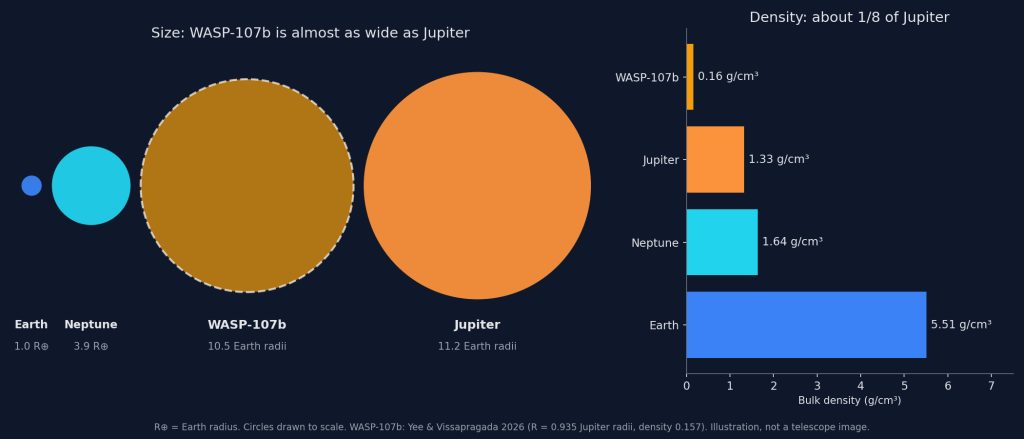
WASP-107b is almost as wide as Jupiter and, compared to Earth, more than ten times wider, yet it weighs only about 30 to 33 Earths. More than 1,000 Earths would fit inside it by volume. Compared to Neptune, it is about 2.7 times wider but only roughly twice as massive. That is why its density is only about 0.16 grams per cubic centimetre, roughly an eighth of Jupiter’s and about 35 times lower than Earth’s.
| Planet | Radius | Mass | Density |
|---|---|---|---|
| WASP-107b | About 0.94 Jupiter radii | About 30–33 Earth masses | About 0.16 g/cm³ |
| Jupiter | 1 Jupiter radius | 1 Jupiter mass | About 1.33 g/cm³ |
| Neptune | About 0.35 Jupiter radii | About 0.054 Jupiter masses | About 1.64 g/cm³ |
| Earth | 1 Earth radius | 1 Earth mass | About 5.51 g/cm³ |
WASP-107b values are from Yee and Vissapragada (2026); older parameter sets give 0.13 to 0.19 g/cm³. Jupiter, Neptune and Earth are standard reference values.
WASP-107b’s gravity at its visible cloud tops is about 0.3 times Earth’s, calculated from the mass and radius above, because there is no solid surface to stand on.
WASP-107b is nearly as wide as Jupiter but has far less mass and a much lower density. Illustration comparing relative planetary sizes and bulk density.
Yee and Vissapragada’s paper calls planets like this “popcorn planets”: Neptune-sized in mass, Jupiter-sized in radius, with densities below about 0.3. They describe the group as higher-mass relatives of the “super-puffs” that Lee and Chiang described in 2016. Many other papers, including Wu and colleagues in 2026, simply call WASP-107b a super-puff.
Why Is WASP-107b So Puffy? The Problem Before Webb
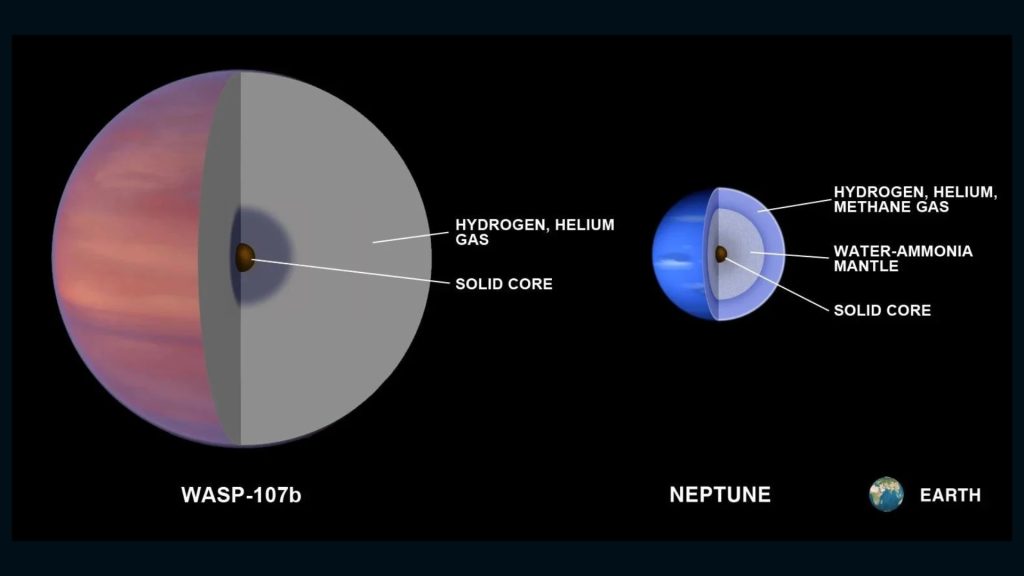
Before 2024, the planet’s low density forced an awkward choice. One option was a tiny rocky core, under about 5 Earth masses, buried in an enormous hydrogen and helium envelope. Piaulet and colleagues estimated that such an envelope would hold more than 85 percent of the planet’s mass unless the planet was somehow inflated.
That option strains core accretion theory. The leading account of planet formation says a core usually needs about 10 Earth masses before it can start a runaway grab for gas. So how could a small core collect that much gas and then stop short of Jupiter’s mass?
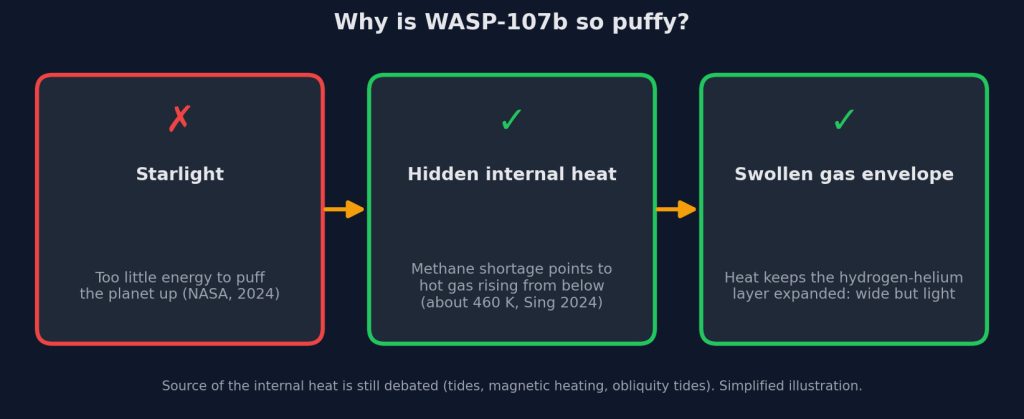
Starlight does not rescue the idea. NASA’s 2024 Webb release notes that the planet receives too little energy to be this inflated. If its core were heavier, the gas should have cooled and shrunk. Something inside had to be pushing the envelope back out.
How Webb and Hubble Read an Atmosphere They Could Not See
WASP-107b crosses in front of its star as seen from Earth. Its big radius and extended atmosphere make it a good target for transmission spectroscopy, which works in four steps:
- The telescope records the star’s light before, during and after a transit.
- During transit, a thin ring of planetary atmosphere filters a little of that light.
- Each gas absorbs particular wavelengths, leaving a chemical fingerprint.
- Comparing in-transit and out-of-transit light shows which gases are present and how much.
Hubble used this trick first. In 2018, astronomers led by Jessica Spake at the University of Exeter published a study in Nature reporting the detection of helium in WASP-107b’s atmosphere using the Hubble Space Telescope. It was the first helium ever detected on a planet outside our solar system. The signal was strong enough to show an upper atmosphere stretching tens of thousands of miles into space, and NASA reported a loss of roughly 0.1 to 4 percent of the atmosphere’s mass every billion years.
Webb then took over. On 20 May 2024, two independent teams published in Nature.
A team led by Luis Welbanks of Arizona State University combined Webb’s NIRCam and MIRI with Hubble’s WFC3 to cover 0.8 to 12.2 microns. A team led by David Sing of Johns Hopkins University used Webb’s NIRSpec for 2.7 to 5.2 microns. Between them they measured water, methane, carbon dioxide, carbon monoxide, sulfur dioxide and ammonia.
A third Webb study, led by Achrène Dyrek and reported in Nature in late 2023, used the MIRI instrument. It found sulfur dioxide and silicate clouds but no methane. The cloud particles are made of the same family of minerals as sand, so the sky of WASP-107b is, loosely, sandy.
What Is the Atmosphere of WASP-107b Made Of?
The envelope is mostly hydrogen and helium, enriched with heavier elements. Sing’s team found it carries about 43 times the heavy-element content of the Sun, with a core near 11.5 Earth masses. Welbanks’ team detected ammonia at high significance as well.
Sulfur dioxide points to photochemistry: Sing’s team found that starlight-driven chemistry is needed to account for it. Silicate clouds sit in the cooler upper layers, and a 2026 modelling study found they can form there even though the planet is warm overall. The planet has no known solid surface to stand on.
Why Is Methane on WASP-107b So Depleted?
Both Webb spectra showed methane at about one-thousandth of the level expected for the planet’s temperature, according to NASA. Sing’s team detected it at 4.2 sigma, at an abundance near 1 part per million. Methane breaks down in heat, so its scarcity points to hot gas rising from deep inside and mixing with cooler layers above.
Other carbon-bearing molecules appeared normally. This points to unusually high temperatures in the planet’s deeper atmosphere rather than a lack of carbon, since other carbon-containing gases were detected at expected levels.
How Hot Is WASP-107b?
WASP-107b has no known solid surface, so there is no surface temperature to quote. Scientists describe three different temperatures instead.
| Temperature | Value | What it means |
|---|---|---|
| Surface | None | No known solid surface |
| Equilibrium temperature | about 740 K (about 470 °C) | The heat the star alone would supply |
| Atmosphere | Changes with height | Modelled from Webb and Hubble spectra |
| Deep atmospheric temperature estimate | about 460 ± 40 K (about 187 °C) | Heat flowing up from the deep interior |
Why does this matter? Webb detected far less methane than scientists expected. This suggests that hot gas from deeper layers mixes into the upper atmosphere. Sing’s team used this evidence to estimate a temperature of 460 ± 40 kelvin for the deep atmospheric region where methane levels are set. Welbanks’ team reported a lower limit of 345 kelvin at three sigma. These are atmospheric estimates, not direct measurements of the planet’s entire interior.
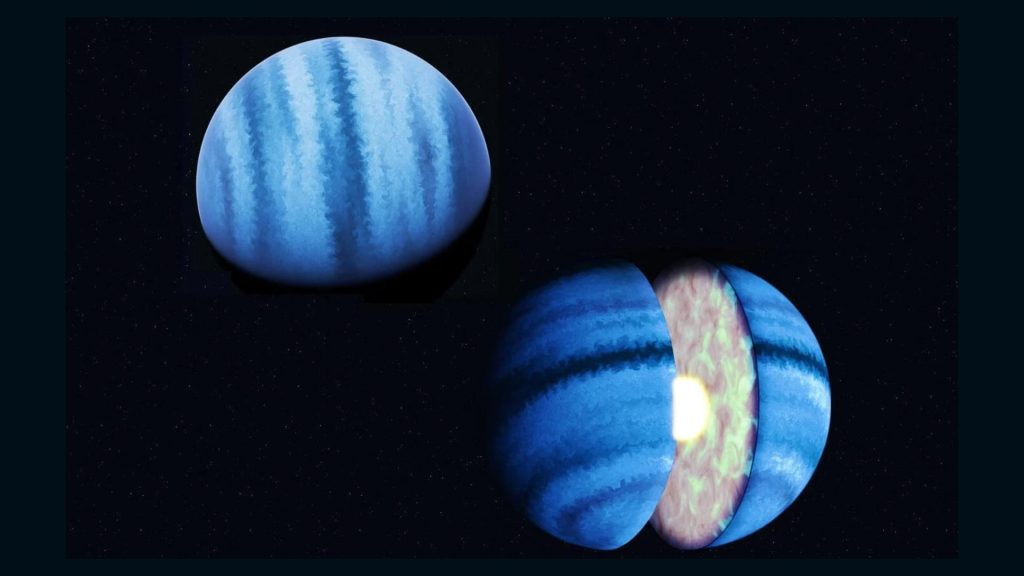
Do not confuse the two heat sources. The equilibrium temperature is what starlight provides, and it is too low to puff the planet up. The internal heat is the extra energy that Webb’s methane measurement exposed.
The methane results also prompted researchers to revisit WASP-107b’s interior structure. Models incorporating the atmospheric observations suggest a more massive core than some earlier estimates. However, the inferred core mass depends on the model assumptions, and the source of the additional heat remains unresolved. NASA says the core is at least twice as massive as first estimated, and later papers adopt a core near 12 Earth masses. A planet resembling Neptune, with lots of rock and not much gas, can then be puffed up by heat. It no longer needs an exotic formation story.
A three-step illustration showing why WASP-107b has an unusually inflated atmosphere. It explains that starlight alone cannot account for the planet’s large size, while additional internal heat may help keep its hydrogen and helium envelope expanded. The exact source of this heat remains uncertain. Simplified illustration; the source of the heat is still debated.
What Is the Source of the Extra Heat?
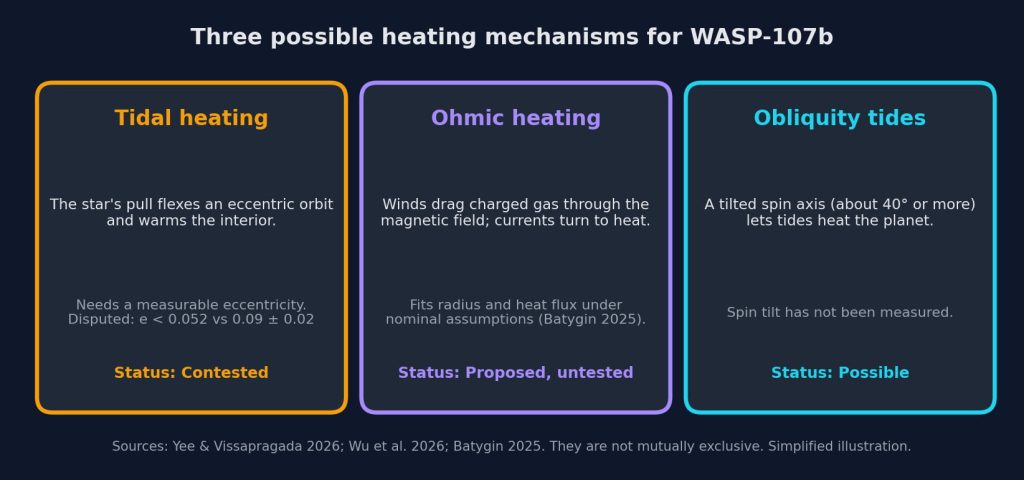
Webb showed the heat exists. It did not show where the heat comes from. Three explanations are in play, and they are not mutually exclusive.
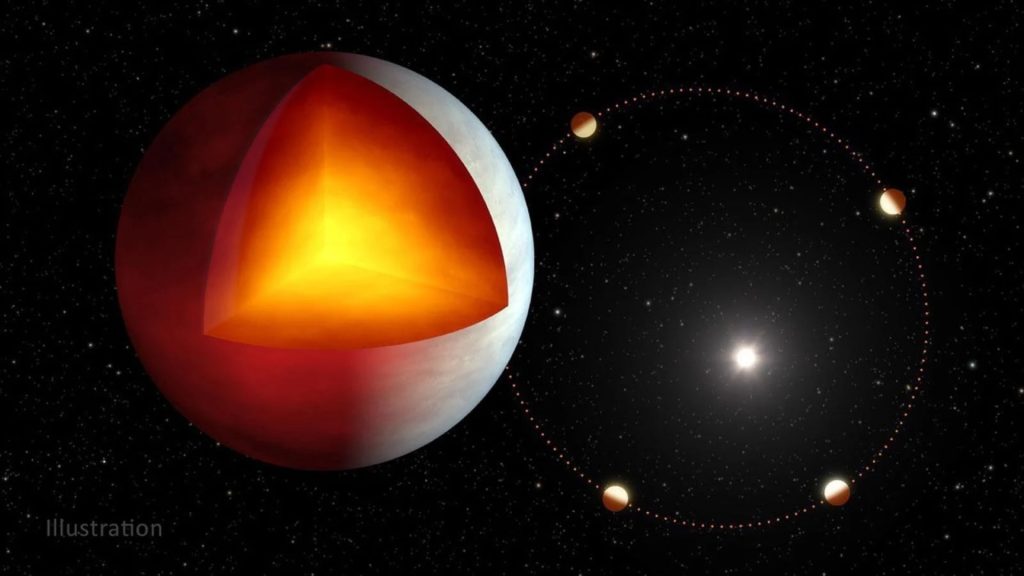
Three cards comparing tidal heating, ohmic heating and obliquity tides as possible heat sources for WASP-107b, with the status of each Three possible heating mechanisms. They are not mutually exclusive.
Tidal Heating on WASP-107b
NASA and ESA highlighted tidal heating in 2024. The planet’s orbit is slightly elliptical, so the star’s pull strengthens and weakens through each 5.7-day lap. That repeated flexing stretches the planet and warms its interior.
The idea was not new. Millholland, Petigura and Batygin argued in 2020 that tidally heated planets of this type could keep Neptune-like gas fractions. Until Webb, nothing showed that the interior was hot.
Scientists use the tidal quality factor to estimate how efficiently a planet turns orbital motion into internal heat. A lower number means more efficient heating, so a very low value is a demanding requirement.
Ohmic Heating: A Magnetic Alternative
Konstantin Batygin challenged the tidal story in a 2025 paper in The Astrophysical Journal. Matching the observed heat with tides needs an unusually low tidal quality factor, around 100. His analysis also suggested that WASP-107c, the planet’s outer companion, is unlikely to sustain WASP-107b’s orbital eccentricity against the gradual circularizing effect of tidal forces.
His alternative is ohmic heating. Zonal winds in a partially ionised atmosphere drag charged gas through the planet’s magnetic field, driving electric currents that dissipate as heat.
Under nominal assumptions for field strength, circulation and ionisation, he showed it readily accounts for the inflated radius and the high internal entropy. The catch is that those inputs are assumptions. Yee and Vissapragada stress that the result depends on them.
Obliquity Tides: A Tilted Spin
A third candidate also survives. According to Yee and Vissapragada, obliquity tides work if the planet’s spin axis is tilted by roughly 40 degrees or more relative to its orbit. Nobody has measured that tilt.
The WASP-107b Eccentricity Dispute
Whether tidal heating can explain WASP-107b’s inflated atmosphere depends largely on the shape of its orbit, which remains a subject of scientific debate. Three datasets now bear on it.
Yee and Vissapragada took 20 new radial-velocity measurements of WASP-107 with the MAROON-X spectrograph on Gemini North. They found an eccentricity below 0.052 at 95 percent confidence. With a Jupiter-like quality factor near 100,000, that small an eccentricity would deliver a heat flux more than two orders of magnitude too weak. Their paper appeared in The Astrophysical Journal Letters on 30 March 2026.
Wu and colleagues at Sun Yat-sen University reached the opposite conclusion. They combined a JWST secondary eclipse with transit times from Hubble, TESS and Webb plus radial velocities, and reported 0.09 ± 0.02. Their calculations suggest that explaining the planet’s heat through tidal friction in its core would require a tidal quality factor of around 50, a value comparable to those found in rocky planets in our solar system. They call that an order-of-magnitude estimate and say tides may supply only part of the heat.
Then a third check arrived. Drake Deming and Laura Kreidberg used four archival Spitzer eclipses and found that Spitzer confirms the eclipse timing Wu reported. They measured e cos(ω) = 0.0143 ± 0.0014, which sets a lower limit on the eccentricity. This is a short Research Note, not a full paper.
Two eclipse datasets now point to a small but nonzero eccentricity, while the radial-velocity data cannot exclude zero. How large the eccentricity really is remains unresolved.
Wu and colleagues list three possible reasons for the gap with the radial-velocity limit: stellar activity noise, a poorly constrained orbit for WASP-107c, and the assumed ratio of orbit size to stellar radius. Scientists have yet to reach a firm conclusion about what keeps WASP-107b so inflated, as the planet’s orbital properties and possible heating mechanisms remain under investigation.
What Scientists Know and What They Still Don’t Know
| Question | Short answer | Confidence and basis |
|---|---|---|
| Is WASP-107b’s density really that low? | Yes | Established: measured mass and radius |
| Is methane far below expectation? | Yes | Established: two Webb analyses plus a MIRI study |
| Is internal heat inflating the planet? | Very likely | Strong inference: methane depletion, about 460 K internal temperature |
| Is the core larger than first thought? | Probably | Model-dependent: at least twice earlier estimates (NASA) |
| Is the orbit slightly eccentric? | Probably, size unknown | Contested: Yee and Vissapragada, Wu et al., Deming and Kreidberg |
| Is tidal heating confirmed? | No | Contested: needs a low quality factor and a measurable eccentricity |
| Could magnetic (ohmic) heating explain it? | Possible | Proposed, untested: Batygin (2025) |
| Do obliquity tides contribute? | Possible | Needs a large spin tilt |
| Will JWST solve it? | Maybe | More eclipse observations are the likeliest test |
Detailed Research Timeline: 2017 to 2026
| Date | Result | Who |
|---|---|---|
| 2017 | Planet announced | Anderson et al. |
| May 2018 | First helium detected on any exoplanet | Spake et al., Hubble |
| 2021 | Mass revised to 30.5 Earth masses; outer planet WASP-107c found | Piaulet et al. |
| Nov 2023 | Sulfur dioxide and silicate clouds; no methane in MIRI data | Dyrek et al. |
| May 2024 | Depleted methane, hot interior, larger core | Welbanks et al.; Sing et al. |
| May 2025 | Ohmic heating proposed | Batygin |
| Dec 2025 | JWST maps helium tails ahead of and behind the planet | Krishnamurthy et al. |
| Jan 2026 | Eclipse timing gives 0.09 ± 0.02 (posted to arXiv) | Wu et al. |
| Mar 2026 | Radial velocities limit eccentricity to under 0.052 (published in ApJL) | Yee and Vissapragada |
| 2026 | Spitzer confirms the eclipse timing | Deming and Kreidberg |
A newer paper does not automatically overrule an older one. These studies measure different things, and the planet may be heated by more than one mechanism at once.
A Planet That Is Losing Its Atmosphere
The 2018 helium signal was only the start. In December 2025, a team led by Vigneshwaran Krishnamurthy at McGill University published JWST observations in Nature Astronomy. They saw helium absorption about 1.5 hours before the planet’s transit began, a 17-sigma detection, which means gas is streaming ahead of the planet along its orbit as well as behind it.
Their simulations suggest that the helium streams extending ahead of and behind WASP-107b can reach distances of roughly ten times the planet’s radius. A weakly bound, puffy atmosphere under steady stellar heating is exactly what you would expect to leak. The same paper reported more oxygen than a planet formed in place should carry, which supports the idea that WASP-107b formed farther out and migrated inward.
Is WASP-107b Habitable?
No, WASP-107b is not considered habitable because it has no known solid surface and very high temperatures. The planet orbits at 0.055 AU with an equilibrium temperature near 740 kelvin. Johns Hopkins University stated in 2024 that it is not considered habitable because of its closeness to its star and its lack of a solid surface. Other exoplanets raise different questions about habitability. For example, TOI-700 d is studied as a potentially habitable-world candidate, unlike the hot, gas-rich WASP-107b.
Its atmosphere also contains sulfur dioxide, hydrogen and helium, not a breathable mix. Nothing in the data suggests a place where humans or known life could survive. Its value to science is that it is a natural laboratory for planetary interiors.
Why the WASP-107b Puzzle Matters Beyond One Planet
NASA’s 2024 release said the result might explain the puffiness of dozens of low-density planets. Yee and Vissapragada tested that idea on two relatives, TOI-1173Ab and HAT-P-18b, and found all three nearly circular. If tidal heating fails for WASP-107b and for its relatives, the 2024 generalisation needs a different engine.
The stakes also reach planet formation. Without extra heat, interior models need WASP-107b to hold roughly 60 to 80 percent gas by mass, according to Yee and Vissapragada. With extra heat, 10 to 30 percent works, which fits core accretion far better. Knowing why WASP-107b is so puffy therefore tests how giant planets are built.
What Future Observations Could Settle It
Secondary eclipse observations look most promising. Internal heating changes the temperature profile at depths reachable in eclipse, so emission spectroscopy could probe the heating mechanism directly. Yee and Vissapragada’s new limits narrow the eclipse timing window to about 2.4 hours either side, which makes scheduling easier.
Wu and colleagues add three needs: more JWST eclipses, a tighter stellar-size constraint from asteroseismology, and a better orbit for WASP-107c. A measured spin tilt would also test the obliquity-tide idea.
Research and Fact Checking
Facts, measurements and disagreements in this article were checked against primary scientific sources. These include the NASA Exoplanet Archive, NASA’s Webb and Hubble mission pages, papers in Nature and Nature Astronomy, and The Astrophysical Journal and its Letters. Several preprints and a short Research Note were read through their published abstracts.
Where studies disagree, both numbers are shown. Direct observations, model-dependent inferences and open hypotheses are labelled separately. Published 13 October 2026.
Related Reading
- Planet Nine — Explore the mystery of a possible ninth planet and what it could reveal about our solar system.
- Pulsar — Learn how these rapidly rotating stellar remnants produce powerful beams of radiation.
- The Universe — Discover more about the universe, its structure, and the astronomical phenomena scientists continue to study.
- Solar System Boundary Wall — Explore questions about the outer limits and structure of our solar system.
- Solar System Sounds — Find out how scientists turn data from space into sounds that help explain planetary and solar phenomena.
Key Takeaways
- Why is WASP-107b so puffy? Webb found internal heat well above expectations, and that heat inflates its gas envelope.
- WASP-107b methane is about one-thousandth of expected levels, the clue that exposed the hidden heat.
- WASP-107b tidal heating was the 2024 headline explanation, but 2025 and 2026 studies disagree over its orbit.
- WASP-107b ohmic heating is a magnetic alternative that fits the numbers but rests on assumptions.
- The density of WASP-107b is about one-eighth of Jupiter’s, which is why the puzzle exists.
- Obliquity tides remain possible if the planet’s spin axis is tilted by roughly 40 degrees or more.
- Future eclipse observations are the likeliest way to settle the question.
7 Strange Facts About WASP-107b
- It is nearly Jupiter-sized but has only about a tenth of Jupiter’s mass.
- It is among the lowest-density planets known, at about 0.16 g/cm³.
- Its upper atmosphere is escaping, with helium tails ahead of and behind the planet.
- Its methane is about a thousand times lower than expected.
- Its clouds appear to be silicate minerals, the same family as sand.
- Scientists still disagree about what heats its interior.
- It helps scientists test how giant planets form.
Frequently Asked Questions About WASP-107b
Why is WASP-107b so puffy?
WASP-107b is so puffy because heat from its interior expands its hydrogen-helium envelope. Webb found far too little methane, which signals vigorous mixing from a hot deep layer. The source of the heat is still debated, with tides, magnetic currents and obliquity tides all proposed.
What type of planet is WASP-107b?
WASP-107b is a warm Neptune, a gas-rich planet with roughly twice Neptune’s mass but nearly Jupiter’s width. Researchers also call it a super-puff or “popcorn planet” because of its very low density. It is mostly hydrogen and helium wrapped around a heavier core.
How far away is WASP-107b?
WASP-107b is about 210 light-years from Earth, based on its Gaia parallax. That is close by galactic standards but far beyond any current probe. Light leaving the planet today would take about 210 years to reach us.
Does WASP-107b have a surface?
No solid surface is known. The planet is mostly a deep hydrogen and helium envelope, with a core of roughly 12 Earth masses buried far below. Pressure and temperature rise steadily with depth, so there is no clear ground to stand on.
Can humans live on WASP-107b?
No, humans could not live on WASP-107b, because it has no known solid surface and very high temperatures. Its equilibrium temperature is near 740 kelvin, and its atmosphere is hydrogen, helium and sulfur dioxide. Johns Hopkins University described the planet as not habitable. Nothing suggests known life could survive there.
Why is WASP-107b called a cotton candy planet?
News outlets used “cotton candy” and “marshmallow” because the planet is wide but extremely light, with a density of about 0.16 grams per cubic centimetre. The nicknames are informal, not scientific classifications. Astronomers prefer terms such as super-puff or popcorn planet.
Does WASP-107b have rings?
No rings have been detected around WASP-107b, and none of the studies used for this article reports any. Current observations focus on its atmosphere, density and internal heating.
Can we see WASP-107b from Earth?
WASP-107b cannot be seen with the naked eye, and it has not been photographed directly. Astronomers detect it by measuring how it blocks its star’s light during transit.
What color is WASP-107b?
Scientists do not know its true color, because no direct photograph of WASP-107b exists. Any color in pictures is an artist’s concept. Webb and Hubble measure which wavelengths its gases and clouds absorb, but that has not been turned into a measured color.
What is the density of WASP-107b?
The density of WASP-107b is roughly 0.16 grams per cubic centimetre in Yee and Vissapragada’s analysis. That is about one-eighth of Jupiter’s density and a tenth of Neptune’s. Older parameter sets give 0.13 to 0.19, so the WASP-107b low density holds across studies.
What did the James Webb Space Telescope find on WASP-107b?
Two Webb teams measured water, methane, carbon dioxide, carbon monoxide, sulfur dioxide and ammonia. The standout result was methane at roughly one-thousandth of the expected amount. They concluded the interior is hotter than thought and the core is at least twice as massive as first estimated.
Why is methane depleted on WASP-107b?
Hot gas from deep inside appears to mix upward, and methane does not survive high temperatures. Other carbon-bearing molecules look normal, which points to a hot interior and not a carbon shortage. Sing’s team inferred a temperature of about 460 ± 40 kelvin for the deep atmospheric region associated with methane quenching. This is an atmospheric estimate, not a direct measurement of the planet’s bulk interior.
Is tidal heating on WASP-107b proven?
No. Tidal heating on WASP-107b was the leading 2024 explanation, but a radial-velocity study found an eccentricity below 0.052, while an eclipse analysis reports 0.09 and Spitzer eclipses back the eclipse-timing result. Until the orbit is settled, tides remain one candidate among several.
What is ohmic heating on WASP-107b?
It is a proposed process in which winds move charged gas through the planet’s magnetic field, creating electric currents that turn into heat. Konstantin Batygin showed in 2025 that, under nominal assumptions, ohmic heating can explain the radius and internal heat. Observation has not confirmed it.
What is a super-puff exoplanet?
A super-puff is a planet with a very low density for its mass. The original term covers low-mass worlds, while Yee and Vissapragada call Neptune-mass relatives like WASP-107b “popcorn planets.” Many papers still label WASP-107b a super-puff, and the cotton candy planet nickname refers to the same low-density idea.
How do scientists study the atmosphere of WASP-107b?
They use transmission spectroscopy. As the planet crosses its star, a thin ring of atmosphere filters starlight, and each gas absorbs specific wavelengths. Webb and Hubble measured those patterns, producing the WASP-107b transmission spectrum, without ever seeing the planet directly.
Is WASP-107b losing its atmosphere?
Yes. Hubble found escaping helium in 2018, and JWST saw helium tails both ahead of and behind the planet in 2025. NASA estimated a loss of roughly 0.1 to 4 percent of the atmosphere’s mass per billion years, though that figure comes from the 2018 analysis.
Is the debate over why WASP-107b is so puffy finished?
Not yet. The hot interior is well supported, but its source is contested. A radial-velocity study argues against eccentricity tides, eclipse timing reports a measurable eccentricity, and ohmic heating remains unproven. Future secondary eclipse observations with Webb are the best way to decide.
WASP-107b Glossary
- Transmission spectroscopy: reading starlight filtered through a planet’s atmosphere during a transit to find which gases are present.
- Equilibrium temperature: the temperature a planet would have if starlight were its only heat source.
- Deep atmospheric temperature estimate: A temperature inferred for a deeper atmospheric region from observations and models; it is not a direct measurement of the planet’s entire interior.
- Eccentricity: how stretched an orbit is, from 0 for a circle upward.
- Tidal quality factor: A measure of how much energy a planet loses as heat when tidal forces deform it. A lower value means more energy is dissipated, making tidal heating more effective.
- Ohmic heating: heat made by electric currents flowing through a planet’s partly ionised atmosphere.
- Obliquity: the tilt of a planet’s spin axis relative to its orbit.
- Secondary eclipse: the moment a planet passes behind its star, letting astronomers measure the planet’s own light.
- Envelope: The thick layer of gas, mainly hydrogen and helium, that surrounds a planet’s core.
About the Author
Evan Brooks is a science and history writer for Strangehappen.com, specializing in archaeology, space exploration, ancient civilizations, and emerging scientific discoveries. His work focuses on translating complex research into evidence-based stories that help readers understand the mysteries of our world and beyond.
Sources and References
- NASA Science, Webb Cracks Case of Inflated Exoplanet (20 May 2024).
- ESA/Webb, Webb cracks case of inflated exoplanet (release weic2414, 20 May 2024).
- NASA Exoplanet Archive, WASP-107 overview.
- NASA Science, Hubble Detects Helium in the Atmosphere of an Exoplanet for the First Time (2 May 2018).
- Yee and Vissapragada, “Popcorn Planets” are Not Actively Inflated by Eccentricity Tides, The Astrophysical Journal Letters (2026).
- Wu et al., Evidence for a Nonzero Eccentricity Superpuff Exoplanet WASP-107 b Using JWST Occultation Observation, The Astrophysical Journal Letters (2026).