

Under a Gray Canadian Sky: Nature’s Own Power Cell
In a quiet research lab, beneath the muted light of a northern afternoon, sits an object that could change how we think about energy forever—a biodegradable battery that could vanish into the soil as if it never existed.
It’s not wrapped in toxic metals.
It doesn’t smell of chemicals.
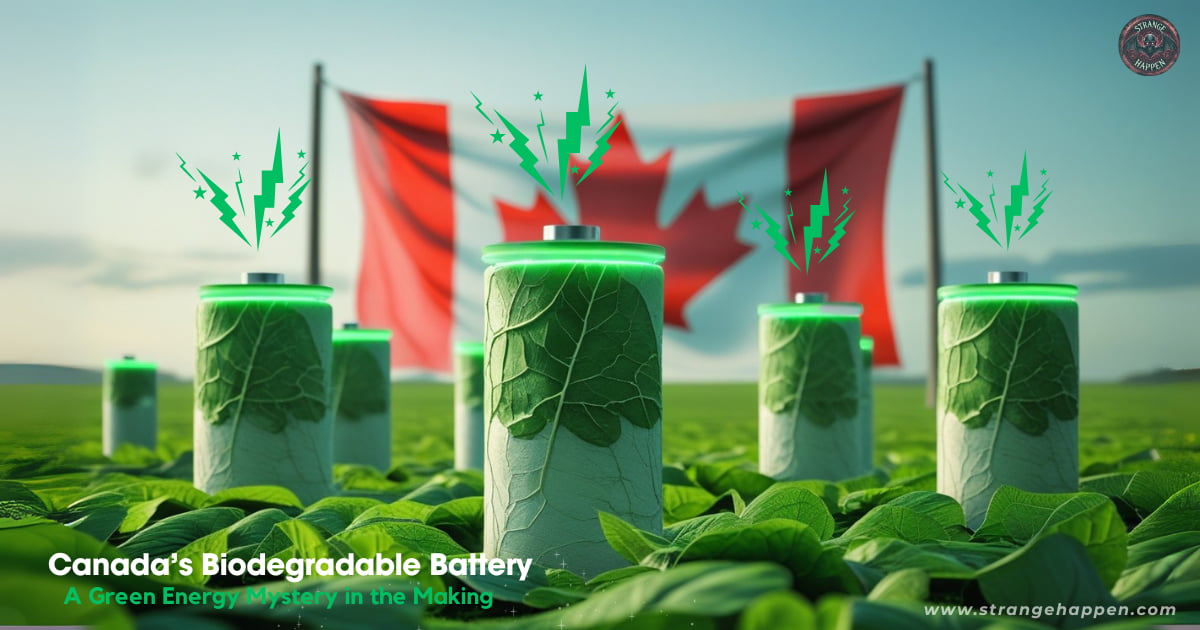
Instead, it feels alive—its casing pressed like leaves, its core drawn from the pulp of trees.
And here’s the strangest part:
When its job is done, you can bury this biodegradable battery in the soil… and it vanishes.
Social media calls it Canada’s Biodegradable Battery—a Canadian innovation that, if true, dissolves completely within sixty days. It would be one of the most remarkable environmental breakthroughs in decades and exactly the kind of story we watch at Strange Happenings.
But where are the peer-reviewed studies?
Why are major journals silent?
And is this one of those rare moments when eco-hype hides a real revolution?
Table of Contents
What Exactly Is Canada’s Biodegradable Battery?

According to circulating claims, this biodegradable battery is made from tree pulp combined with non-toxic conductive materials—possibly zinc—to store and release energy. Its biggest promise? Complete biodegradability in natural soil, leaving no toxic residue.
Tree pulp, rich in cellulose and lignin, is already being tested in experimental anodes. In theory, these organic fibers can conduct electricity when treated and are compost-friendly. This makes them ideal for medical implants, environmental sensors, or single-use electronics—applications where safe disposal is as important as performance.
But here’s the truth: while the University of British Columbia is often mentioned in online discussions, no peer-reviewed publication confirms this exact Canadian biodegradable battery design (UBC Battery Innovation Cluster).
The Science That Makes It Plausible
Why Tree Pulp Could Work in a Biodegradable Battery
Cellulose—the main component of tree pulp—is a strong, flexible, and chemically stable natural polymer. When processed, it can:
- Hold conductive carbon or metal-oxide coatings to store and transfer charge
- Act as a scaffold for ion transport within the battery
- Replace synthetic, non-biodegradable components in electrodes and separators
- Absorb electrolytes efficiently due to its porous microstructure
- Be chemically tuned for faster biodegradation in soil or water
This means a cellulose-based biodegradable battery could, in theory, deliver stable power, remain lightweight, and then degrade naturally without polluting.
Global Breakthroughs That Prove the Concept
While Canada’s exact design remains unconfirmed, other parts of the world have already made remarkable progress in similar directions:
- Binghamton University, USA—Created paper-based, biodegradable microbial batteries that naturally break down after use, ideal for low-power, disposable devices.
- Stora Enso, Finland—Engineered lignin-based anodes for sodium-ion batteries, reducing reliance on mined graphite and improving sustainability.
- Nanyang Technological University, Singapore—Developed a zinc-ion biodegradable battery built on cellulose paper that safely biodegrades in about two months, with stable output during its lifespan.
If Canada’s claimed version is real, it could merge these breakthroughs—combining biodegradability, stable performance, non-toxic materials, and scalability—into a commercially ready biodegradable battery. That leap from lab prototype to mass production is something no country has achieved yet—and it’s the kind of potential innovation we love to cover at Strange Happenings.
10 Fascinating Facts About Biodegradable Batteries
- Some biodegradable batteries dissolve completely in water, leaving no trace.
- E-waste is the fastest-growing waste stream—50+ million tons a year.
- By weight, cellulose fibers can be stronger than steel.
- Batteries cause over 70% of heavy metal pollution in landfills.
- Tree pulp anodes can be carbonized for efficient charge storage.
- Zinc-based biodegradable batteries can be compost-safe.
- Military tests have begun for dissolvable electronics.
- Medical researchers are designing implants that vanish inside the body.
- Paper biodegradable batteries can be printed like newspapers.
- If scaled, they could replace millions of disposable coin cells.
Where a Biodegradable Battery Could Change Everything
Medical Devices That Vanish
Picture a pacemaker lead or surgical sensor that functions reliably for 30–60 days, then harmlessly dissolves inside the body. For patients in rural or low-resource areas, this could eliminate risky and costly follow-up surgeries.
Pairing dissolvable circuit boards with a biodegradable battery could make truly 100% transient medical devices possible—devices that serve their purpose and then quietly vanish, leaving nothing behind.
Temporary Military Gear
In covert operations, the military already experiments with transient electronics—devices built to vanish after use. A biodegradable battery could power:
- Remote surveillance sensors
- One-time communication modules
- Self-destructing drones
Such technology wouldn’t just enhance stealth—it would also address battlefield e-waste, a hidden environmental problem.
Zero-Waste Environmental Sensors
In delicate ecosystems, researchers sometimes deploy large numbers of sensors to gather data on environmental changes.
- Wildlife
- Temperature
- Water quality
- CO₂ levels
A biodegradable battery allows these devices to operate for weeks or months, then safely decompose—protecting coral reefs, glacier fields, and other sensitive habitats.
The Controversy: Fact or Fiction?
- ❌ No peer-reviewed studies confirm this specific Canadian biodegradable battery.
- ❌ Most viral images are concept art, not lab photographs.
- ✅ Independent research worldwide has already proven such designs are possible.
Disclaimer: As of August 2025, there is no verified patent, peer-reviewed publication, or official press release confirming this exact Canadian battery design. Until verified, treat it as an unconfirmed but plausible claim.
If It’s Real, the Future Could Include:
- Reduced e-waste from watches, toys, and sensors
- Breakthroughs in medical and humanitarian tech
- Smart agriculture powered by biodegradable batteries
- Space tech with safe disposal beyond Earth
Frequently Asked Questions About Canada’s Biodegradable Battery
Q: What is Canada’s biodegradable battery made from?
Canada’s biodegradable battery research involves two major innovations. McGill University developed a stretchable battery using gelatin as a soft electrolyte combined with magnesium and molybdenum electrodes, activated using citric and lactic acids. Separately, the University of British Columbia developed a battery using cellulose nanofibers derived from tree pulp as the separator, combined with zinc electrodes that degrade naturally in soil.
Q: Who developed the biodegradable battery in Canada?
Two Canadian institutions are leading this research. McGill University’s Trottier Institute for Sustainability in Engineering and Design, led by Associate Professor Sharmistha Bhadra, published their gelatin-based stretchable battery research in Advanced Energy and Sustainability Research in August 2025. The National Research Council Canada published a peer-reviewed study on a fully printed biodegradable zinc-manganese dioxide battery in 2026.
Q: How long does a biodegradable battery take to dissolve in soil?
According to research from the University of British Columbia, their cellulose and zinc based biodegradable battery dissolves in soil within a few months after use, leaving behind no toxic residue or microplastics. This is in stark contrast to lithium-ion batteries, which can take hundreds of years to break down while leaching toxic heavy metals into surrounding soil and groundwater.
Q: Can biodegradable batteries replace lithium-ion batteries?
Not yet. Current biodegradable battery prototypes from Canadian researchers achieve approximately 85 to 90 percent of the energy efficiency of conventional lithium-ion batteries. They are currently suited for low-power applications such as wearable electronics, environmental sensors, medical implants, and disposable diagnostic devices rather than high-capacity applications like electric vehicles or grid storage.
Q: What problem does Canada’s biodegradable battery solve?
The world generates over 50 million tons of electronic waste annually. Conventional batteries contribute significantly to this crisis through toxic metals including lead, cadmium, and lithium that leach into soil and water supplies when improperly disposed of. Canada’s biodegradable battery technology offers a solution by using organic, non-toxic materials that decompose naturally, eliminating the need for specialized recycling facilities.
Q: What inspired McGill University’s biodegradable battery design?
The McGill University team drew inspiration from a classic children’s science experiment that uses a lemon and copper wire to power a small lightbulb. The acidic properties of citric and lactic acids break down the passivation layer that forms on magnesium electrodes, improving conductivity and extending the battery’s lifespan. The flexible kirigami-inspired design pattern, borrowed from the Japanese art of paper cutting, allows the battery to stretch without breaking.
Q: Where is Canada’s biodegradable battery currently being used?
Early stage applications include environmental monitoring sensors deployed in Canadian forests for wildlife tracking, disposable diagnostic medical devices, and wearable electronics research at Canadian universities. The National Research Council Canada is also developing fully printed biodegradable batteries intended for single-use electronic applications where traditional recycling is impractical.
Q: What is the National Research Council Canada’s role in biodegradable battery research?
The National Research Council Canada’s Clean Energy Innovation Research Centre in Boucherville, Quebec, published a peer-reviewed study in 2026 demonstrating a fully printed biodegradable zinc-manganese dioxide primary battery. The research was conducted across multiple NRC facilities including the Aquatic and Crop Resource Development Centre and the Automotive and Surface Transportation Research Centre, representing one of the most comprehensive government-backed biodegradable battery research programs in the world.
Conclusion
A biodegradable battery born from trees, serving its purpose before returning to the soil—it’s almost eco-poetry. Backed by early-stage research from Canadian innovators, this idea sits at the crossroads of sustainability and science fiction. Whether it matures into a market-ready solution or fades into the archives of experimental tech, it sparks vital conversations about how nature could power our future.
At Strange Happenings, we track the evolution of groundbreaking concepts—from Brainoware, the living computer redefining AI, to bio-batteries that promise to disappear without a trace. Our mission is to separate hype from evidence and explore the strange possibilities that shape tomorrow. History shows that today’s unlikely ideas often evolve into tomorrow’s world-changing realities.
Author: Mubashir Razzaq
Founder of Strange Happenings, paranormal explorer, and researcher of hidden histories and mysterious phenomena. Mubashir dives deep into forgotten places, unexplained legends, and strange happenings across the world—bringing readers stories where history and mystery collide.