
Galaxy of Horrors: NASA’s Stunning Cosmic Phenomena
When we gaze up at the night sky, we often imagine serenity—twinkling stars, a glowing moon, and peaceful cosmic beauty. But behind the scenes, space is terrifying. NASA’s observations have exposed some of the most spine-chilling and violent cosmic events imaginable. In this blog, we’ll journey through the dark side of the universe—a realm of black holes, zombie stars, cannibal galaxies, and other deadly astronomical phenomena found in NASA’s Galaxy of Horrors.
Table of Contents
🔭 What Is the Galaxy of Horrors?
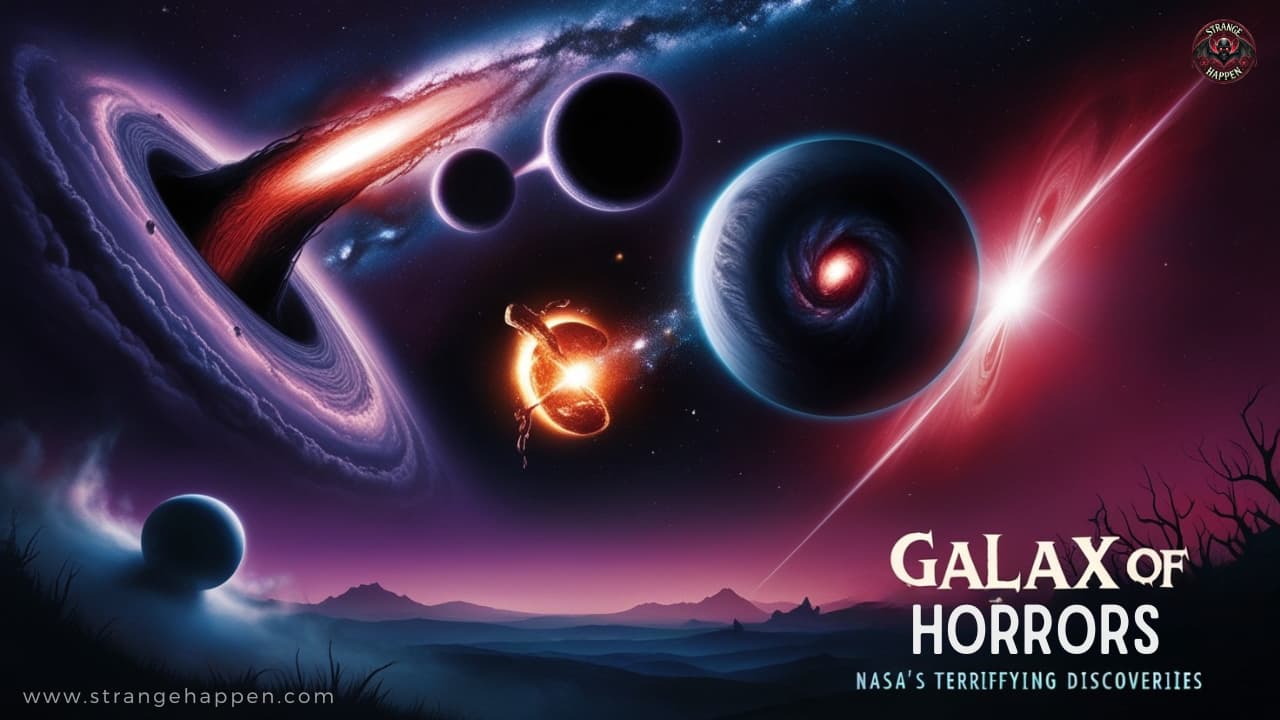
NASA’s ‘Galaxy of Horrors’ campaign presents the most terrifying cosmic phenomena through striking digital visuals. Inspired by vintage horror posters, this series features real cosmic events turned into dramatic illustrations. But beneath the artwork lie real dangers—events that truly happened or are actively occurring somewhere in the cosmos. The Galaxy of Horrors is not just about visual art; it’s about showing the terrifying power of space.
👻 1. Zombie Stars: The Dead That Feed
One of the eeriest cosmic creatures NASA has described in the Galaxy of Horrors is the zombie star. These are white dwarfs—the dense remnants of exploded stars—that feed off companion stars like parasites. Some even reignite and explode again in what’s known as a Type Ia supernova.
How Zombie Stars Work:
- A dead star (white dwarf) steals mass from a nearby living star.
- Once it gets too much mass, it detonates in a bright cosmic blast.
- This explosion can be seen billions of light-years away.
🧠 Fun Fact: Zombie stars play an important role in helping astronomers calculate the universe’s expansion rate, a key discovery within the Galaxy of Horrors.
🌀 2. Supermassive Black Holes: The Ultimate Cosmic Killers
At the heart of nearly every galaxy, including our Milky Way, lies a supermassive black hole. These giants can be millions or even billions of times more massive than our sun. These spine-chilling events are vividly showcased in NASA’s Galaxy of Horrors series, blending science with frightful visuals.
Why They’re Terrifying:
- Nothing can escape their gravity—not even light.
- They rip apart stars and devour them in a process called spaghettification.
- Some even spew radiation jets that travel across galaxies.
📍 Location Highlight: Hidden in the heart of the Milky Way lies Sagittarius A—a monstrous supermassive black hole and a haunting centerpiece of our galaxy’s dark secrets.
🌌 3. Cannibal Galaxies: When Galaxies Eat Galaxies
You read that right. Galactic cannibalism is a real phenomenon, and NASA has observed it multiple times. This event is a core part of the Galaxy of Horrors series.
What Happens:
- A larger galaxy consumes a smaller one, absorbing its stars and material.
- Such galactic collisions can alter the structure of galaxies and spark powerful bursts of star creation.
🔍 In NASA’s Galaxy of Horrors series, NGC 2623 stands out—its dramatic collision captured by the Hubble Space Telescope reveals a vivid case of galactic cannibalism.
☠️ 4. Gamma-Ray Bursts: The Most Violent Explosions in the Universe
Imagine an explosion so powerful it could fry Earth’s ozone layer from billions of light-years away. That’s a gamma-ray burst (GRB), one of the deadliest phenomena in the Galaxy of Horrors.
GRB Dangers:
- They originate from the catastrophic collapse of massive stars or the violent merging of neutron stars.
- Emit more energy in 10 seconds than our Sun will in its entire lifetime.
- Could cause mass extinction if one occurred close to Earth.
🧪 In 2008, NASA’s SWIFT satellite detected a burst 12.8 billion light-years away—one of the most distant cosmic explosions ever seen, adding to the Galaxy of Horrors.
🌍 5. Rogue Planets: Homeless Wanderers in Space
Rogue planets are planetary bodies that drift through space alone, unbound to any star. These dark nomads float in the void—frozen, isolated, and silent. These rogue planets are a mysterious element of the Galaxy of Horrors that NASA has studied.
What Makes Them Horrifying:
- Some may have once had habitability before being ejected.
- Billions may exist in our galaxy alone.
- They are nearly impossible to detect without infrared technology.
🔭 The WISE space observatory uncovered a number of lonely, planet-sized objects adrift in deep space as part of the Galaxy of Horrors research.
🧊 6. Cold Stars That Shouldn’t Exist
Not all stars are blazing balls of fire. Some of these brown dwarfs are incredibly cold—hypothetically safe enough to touch with your bare hand, yet still part of the Galaxy of Horrors phenomena.
These “Failed Stars”:
- Have surface temperatures as low as room temperature.
- They are invisible in visible light and require infrared telescopes.
- Float like ghosts, invisible to human eyes.
🌡️ NASA’s Spitzer and WISE telescopes discovered a brown dwarf only 7.2 light-years from Earth with temperatures near -13°C, part of the chilling Galaxy of Horrors series.
🪐 7. Death by Tidal Forces: The Spaghettification Effect
Approaching a black hole isn’t like falling into a hole—it’s like being stretched to death. This is called tidal disruption, and it is one of the most terrifying phenomena in the Galaxy of Horrors.
The Science of Spaghettification:
- Gravitational forces near a black hole differ so greatly from head to toe that they rip matter apart.
- Stars that venture too close are shredded into streams of hot gas.
💥 In 2020, NASA observed a real-time tidal disruption event from 215 million light-years away, contributing to the Galaxy of Horrors research.
🛸 8. Is Earth in Danger from Any of These?
While these galactic horrors are real, most are unimaginably far away. However, they teach us:
- How violent and dynamic our universe is.
- The importance of space observation.
- The potential threats Earth could face from solar storms, asteroids, or nearby gamma-ray bursts.
🛡️ Thankfully, NASA’s planetary defense programs monitor many of these risks in real time, a crucial part of understanding the Galaxy of Horrors.
🧠 Final Thoughts: Space Is Beautiful… and Terrifying
NASA’s Galaxy of Horrors gives us far more than eerie illustrations or digital wallpaper—it unveils the terrifying truths hidden across space. From ravenous stars devouring their companions to explosions capable of wiping out worlds, these cosmic events remind us that the universe is chaotic, violent, and awe-inspiring all at once.
But beyond the horror lies curiosity—and discovery.
Each of these fearsome phenomena teaches scientists how galaxies grow, how stars live and die, and how fragile existence can be in an unforgiving cosmos. The universe, it seems, is not just vast but filled with untold secrets waiting to be uncovered.
And the horrors don’t stop here.
Our own planetary neighborhood harbors mysteries just as strange:
- 🌌 The Mystery of the Vanishing Stars: Astronomers have spotted stars that seem to disappear without explanation—a haunting cosmic puzzle.
- 🌀 MWC 758 c Protoplanet: A young, ghost-like planet that defies the typical rules of planetary formation.
- 🌙 Miranda Moon: A tortured-looking moon of Uranus, torn apart and stitched back together by past cataclysms.
- 🌍 TOI 700 d: An Earth-size exoplanet in the habitable zone, orbiting a quiet red dwarf—silent, dark, and potentially life-sustaining.
- 🌑 Planet Nine: A hidden giant possibly lurking at the edge of our solar system, tugging on the orbits of distant objects.
- 🔭 Pulsars: Spinning corpses of stars that emit deadly beams of radiation like cosmic lighthouses in deep space.
Each of these strange entities and events is a piece of a larger, chilling puzzle—proof that the Galaxy of Horrors extends far beyond NASA’s posters and into the real mechanics of the cosmos.
So next time you look up at the night sky, remember: some of its beauty hides a darker truth.
Author: Mubashir Razzaq
Founder of Strange Happenings, paranormal explorer, and researcher of hidden histories and mysterious phenomena. Mubashir dives deep into forgotten places, unexplained legends, and strange happenings across the world—bringing readers stories where history and mystery collide.