



Cobra Lily Darlingtonia Californica
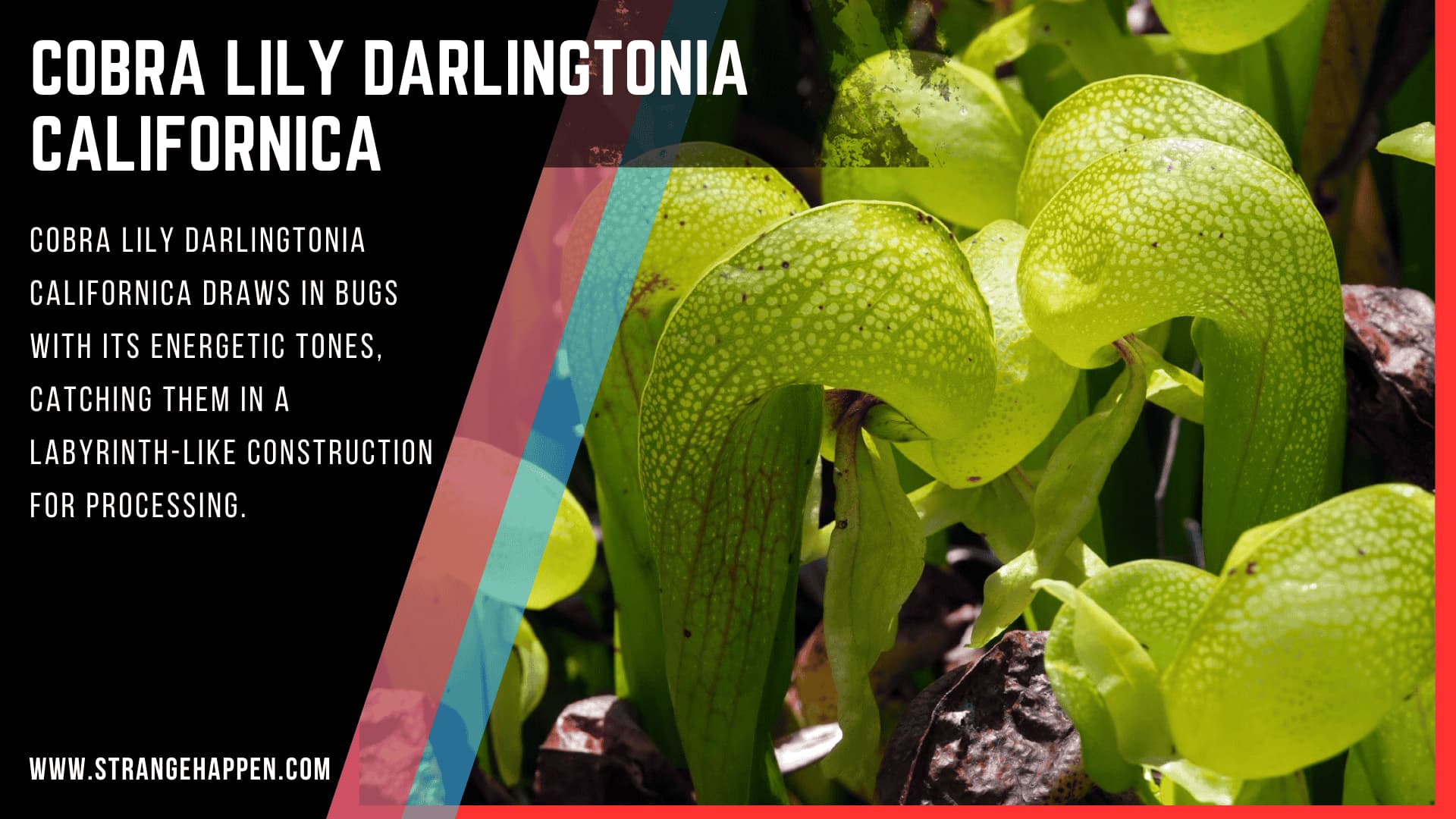
The Cobra Lily Darlingtonia Californica: A Hidden Terror of the Plant Kingdom
Cobra Lily Darlingtonia Californica, regularly known as the Cobra Lily, California Pitcher Plant, or Cobra Lily Darlingtonia Californica, is perhaps one of nature’s most captivating meat-eating plants. Endemic to Northern California and Oregon, this extraordinary plant has a place with the Sarraceniaceae family, imparting its genealogy to other American pitcher plants. In contrast to its family members, the Cobra Lily stands apart because its striking appearance and exceptionally particular transformations permit it to flourish in conditions where numerous different plants would battle to make due.
Cobra Lily Darlingtonia Californica Appearance with a Purpose
The Cobra Lily Darlingtonia Californica gets its name from its tubular leaves, which resemble a rearing cobra, complete with a forked leaf tip that resembles a serpent’s tongue. These tubular leaves are not just for show; they serve as deadly traps for unsuspecting insects. The leaves range in color from yellow to purplish-green, further enhancing their serpentine appearance.
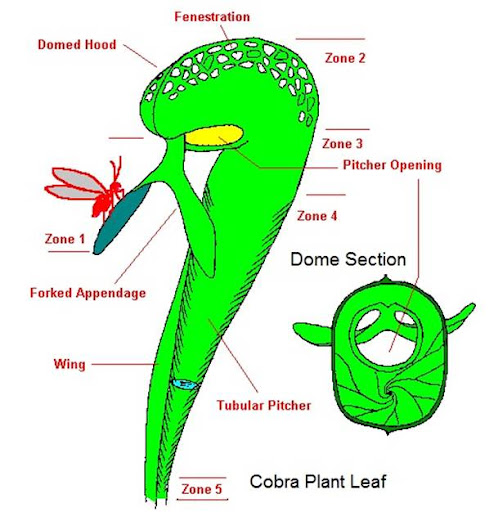
Cobra Lily Darlingtonia Appearance in Diagram
The Cobra Lily Darlingtonia Californica is an interesting flesh-eating plant known for its striking similarity to a snake, with hooded leaves that bend like a cobra ready to strike. Local to supplement unfortunate swamps and fens of Northern California and Oregon, this novel plant has developed to enhance its eating routine by drawing clueless bugs, essentially flies, into its empty, pitcher-like leaves. Drawn in by the plant’s lively varieties, clear fixes, and nectar, flies adventure inside to become confused by the Cobra Lily’s labyrinth-like design, ultimately capitulating to the plant’s stomach-related proteins. This wonderful transformation permits the Cobra Lily to flourish in conditions where different plants battle to track down fundamental supplements.
What truly sets the Cobra Lily Darlingtonia Californica apart from other carnivorous plants is its ability to manipulate the level of water within its pitcher. Unlike most pitcher plants, which rely on rainwater, the Cobra Lily regulates its internal water level through physiological processes, absorbing or releasing water from its roots.
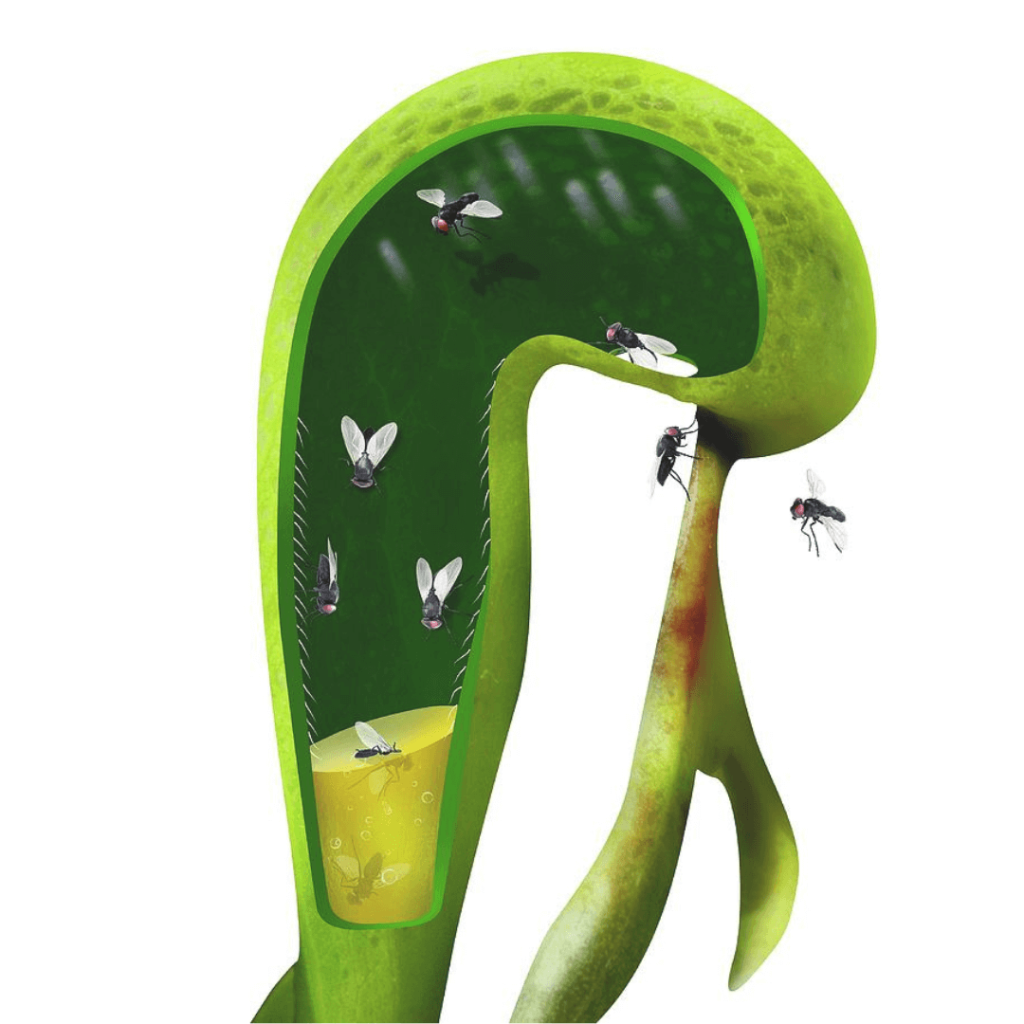
This picture delineates the inside construction of Cobra Lily Darlingtonia Californica and its perplexing bug-catching component. The plant includes a bent, cylindrical leaf that capabilities as a modern snare, drawing bugs with nectar. When inside, the bugs are deluded by misleading ways out and caught by descending pointing hairs. They ultimately fall into a fluid pool at the base where processing happens. This transformation permits the Cobra Lily to flourish in supplement unfortunate conditions by acquiring fundamental supplements from its prey.
Cobra Lily Darlingtonia Californica Discovery and Naming
Darlingtonia californica was first found during the Wilkes Endeavor in 1841 by botanist William D. Brackenridge at Mount Shasta in Northern California. The plant features a bent, cylindrical leaf that acts as a modern snare, drawing bugs with nectar. Once inside, misleading exits confuse the bugs, and descending hairs trap them. The Cobra Lily stays the main species inside this variety, underlining its remarkable developmental way.
Drosophyllum lusitanicum structures horizontal roots with lignified rhizodermis and collenchymal cells in the cortex for underlying scaffolding. The suberized endodermis encompasses the diarch focal chamber, supporting proficient water and supplement transport. This specific root structure upgrades the plant’s endurance in supplementing unfortunate conditions.
Cobra Lily Darlingtonia Californica Habitat and Survival Strategies
The Cobra Lily Darlingtonia Californica thrives in a diverse range of habitats. The Cobra Lily thrives in a diverse range of habitats. While it often grows in nutrient-poor acidic bogs and drainage slopes, it also thrives in ultramafic soils, which are alkaline and typically toxic to most plants. These unforgiving circumstances have driven the Cobra Lily Darlingtonia Californica to foster wonderful transformations, especially in its root foundation.
The underlying foundations of the Cobra Lily Darlingtonia Californica are fragile and profoundly delicate to temperature. They flourish in chilly subsurface water sources and can pass on back when presented to temperatures over 10 °C (50 °F). Researchers believe this awareness stems from the low optimal temperature for ion pumps in root cells. Strangely, populaces found in serpentine soils can endure higher temperatures, yet the purposes behind this are as yet not completely perceived.
One of the most interesting parts of the Cobra Lily’s step by step process for surviving is its capacity to recover after a fire. This is because of its broad and meandering aimlessly underground root growth, which, notwithstanding being fragile, assumes a pivotal part in the plant’s versatility.
Cobra Lily Darlingtonia Californica A Unique Trapping Mechanism
The Cobra Lily has an intriguing and profoundly productive approach to catching bugs. Not at all like other North American pitcher plants, it doesn’t depend on water filling its pitcher. All things considered, the Cobra Lily manages the water level inside the actual pitcher, establishing a controlled climate for its prey.
Drawing Bugs
The Cobra Lily draws in bugs, principally flies, with its splendid tones and sweet nectar. When inside, the bugs immediately become befuddled by the plant’s clear misleading ways out. These seem to be get away from courses, however they just perplex the caught bug further.
Escape Becomes Inconceivable
The inner walls of the Cobra Lily are slippery, and descending-pointing hairs line its pitcher. As bugs battle to move out, these highlights forestall their break. After a few worthless endeavors, the prey in the long run slides to the lower part of the pitcher.
Assimilation
Once the bug reaches the base, the plant discharges enzymes
to digest it. Ongoing examination shows that the Cobra Lily produces somewhere around one proteolytic compound, which separates proteins. This revelation goes against prior convictions that the plant depended exclusively on harmonious microorganisms and protozoa to process its prey. The Cobra Lily’s effective trapping system often leads to multiple bugs gathering inside a single pitcher.
Correlation with Sarracenia leucophylla
Notwithstanding the Cobra Lily, researchers have concentrated on comparable plants like Sarracenia leucophylla. The conceptive designs in these plants show fascinating contrasts:
- Cobra Lily (Darlingtonia californica)
- Stamen separation (male conceptive organ) happens later, close by the conclusion of the carpel (female organ).
- The stamens and petals intertwine at the foundation of the blossom.
- The plant has a clear cut vasculature framework (organization of veins) at the botanical base.
- White-Beat Pitcher Plant (Sarracenia leucophylla)
- Stamen separation starts prior.
- Stamens are organized in two gatherings, alternipetalous and antepetalous, with clear divisions.
- The vasculature at the botanical base is less plainly characterized contrasted with the Cobra Lily.
In the two plants, these primary distinctions mirror their exceptional regenerative and catching systems.
Fertilization: A Continuous Secret
The Cobra Lily’s strategy for fertilization remains to some degree a secret. The plant’s intricate blossom structure and undesirable smell propose a particular pollinator, conceivably a fly or honey bee. Ongoing perceptions of the excavator honey bee species Andrena nigrihirta propose that the plant may be melittophilous, meaning it is pollinated by honey bees. The intricacy of the Cobra Lily’s foods grown from the ground truth that hand-fertilization yields unfortunate outcomes support this hypothesis.
Strangely, even without a trace of a male pollinator, the Cobra Lily can in any case recreate, showing that self-fertilization could likewise assume a part. This double methodology just adds to the plant’s standing for solidness and flexibility.
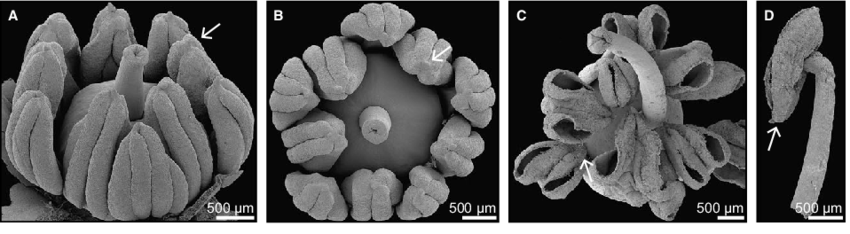
In Clematoclethra scandens, the late phases of androecium and gynoecium advancement show particular qualities. An and B) The developed, pre-anthetic flower bud is noticed. C) The anthetic flower bud, with the perianth eliminated, uncovers rearranged anthers. D) A nearby of a transformed anther is shown. Bolts highlight instances of morphological anther tips.
Development Difficulties
In spite of its versatility in the wild, developing Darlingtonia californica can challenge. The plant needs unambiguous circumstances, including cool to warm daytime temperatures, cold night temperatures, and a consistent stock of chilly, refined water. Keep the roots cooler than the remainder of the plant to forestall root rot.
Seed spread is slow and troublesome, so grounds-keepers frequently engender the Cobra Lily from its stolons, which fill in pre-spring and spring. Cut these stolons into fragments and spot them in a soggy, brilliant climate to support new plant development.
For fans, the awards of developing this plant put forth the attempt beneficial. A few cultivars are presently accessible that endure higher temperatures, permitting the development of these captivating plants in a more extensive scope of conditions.
Conclusion
Darlingtonia californica is a certifiable marvel of nature. From its striking cobra-like appearance to its especially unambiguous changes, this plant keeps on interesting botanists and plant darlings the same. Found in the rich coniferous forests of Northern California, it flourishes in supplement poor, acidic soils that make up its special environment. Whether prospering in the wild or carefully developed in a nursery, the Cobra Lily remains as a demonstration of the exceptional variety and versatility of the plant domain. Similarly as the Solar System grandstands the wonders of the universe, the Cobra Lily epitomizes the complicated associations and excellence inside our own environmental frameworks.