
Nearly five miles down, in a trench too deep for sunlight to have ever reached it, something has been hunting. Scientists just gave it a name: Dulcibella camanchaca. It’s the first large-bodied predatory amphipod documented from the Atacama Trench’s hadal depths, and it wasn’t just a new species. It turned out to be an entirely new genus, one whose own name had to be corrected after publication because a beetle got there first.
A Predator Hidden Nearly Five Miles Below the Ocean
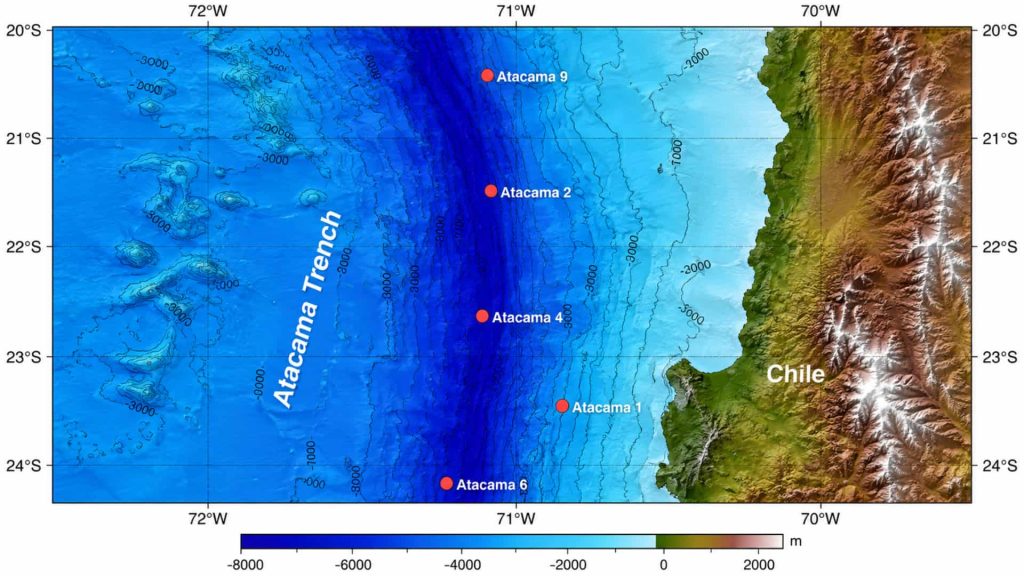
The Atacama Trench runs along the eastern Pacific off the coast of Chile and Peru, plunging past 8,000 meters in places. Researchers had surveyed hadal trenches like it before and consistently found the same story: scavengers. Amphipods that wait for something dead to drift down and eat it, because actively chasing prey in that much darkness and pressure seemed like a losing strategy.
Dulcibella camanchaca broke that pattern. Four specimens were pulled up from 7,902 meters during the 2023 Integrated Deep-Ocean Observing System (IDOOS) Expedition, aboard the research vessel R/V Abate Molina. The expedition was installing a permanent sensor network in the trench when the Woods Hole Oceanographic Institution (WHOI) team, working with Chile’s Instituto Milenio de Oceanografía (IMO), recovered something that didn’t fit any known scavenger profile.
What Is Dulcibella camanchaca?
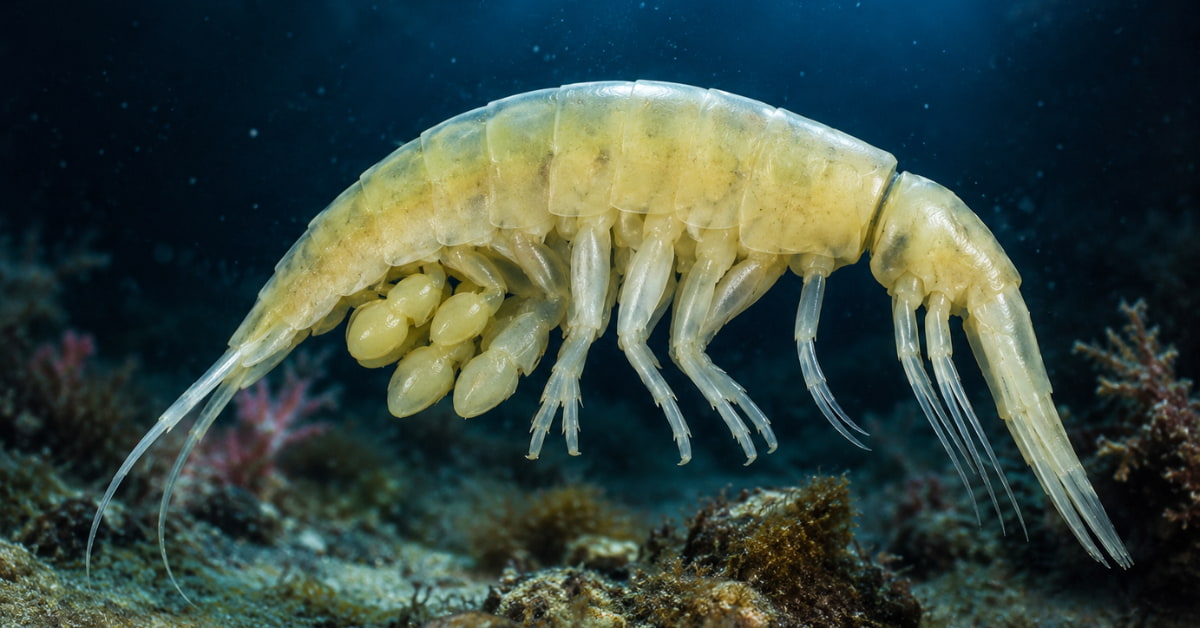
Dulcibella camanchaca is a shrimp-like crustacean in the amphipod order, and specifically a member of the family Eusiridae. Unlike the majority of hadal amphipods, which survive by scavenging whatever organic material sinks down from above, this species is an active, fast-swimming hunter. That single behavioral difference is why its discovery reshaped assumptions about who’s eating whom at the bottom of the trench.
Where Was Dulcibella camanchaca Found?
All four known specimens came from a single location: 7,902 meters deep in the Atacama Trench, also called the Peru-Chile Trench, off the northern coast of Chile. The Atacama sits beneath nutrient-rich surface waters but is geographically isolated from other hadal trenches, a combination that has made it something of an evolutionary island. Researchers describe the trench as an “island-like” ecosystem, and Dulcibella camanchaca is one of several endemic species found nowhere else.
Why Scientists Called It a New Genus
Dulcibella vs. Dorotea
The specimens’ anatomy was similar enough to an existing genus, Dorotea, that researchers had to look closely to be sure they weren’t looking at a variant of something already known. They weren’t. The differences held up under scrutiny, and the team split Dulcibella off as its own genus rather than folding it into Dorotea.
What DNA Barcoding Revealed
Morphological study alone wasn’t enough to settle the question, so the researchers ran DNA barcoding alongside their anatomical comparisons. Both lines of evidence pointed the same direction: this wasn’t just a new species, it was a new genus. That finding updated the global taxonomic key for Eusiridae to a 14th recognized genus, a genuinely rare kind of addition in a family scientists thought they had mostly mapped.
How Big Is This Deep-Sea Predator?
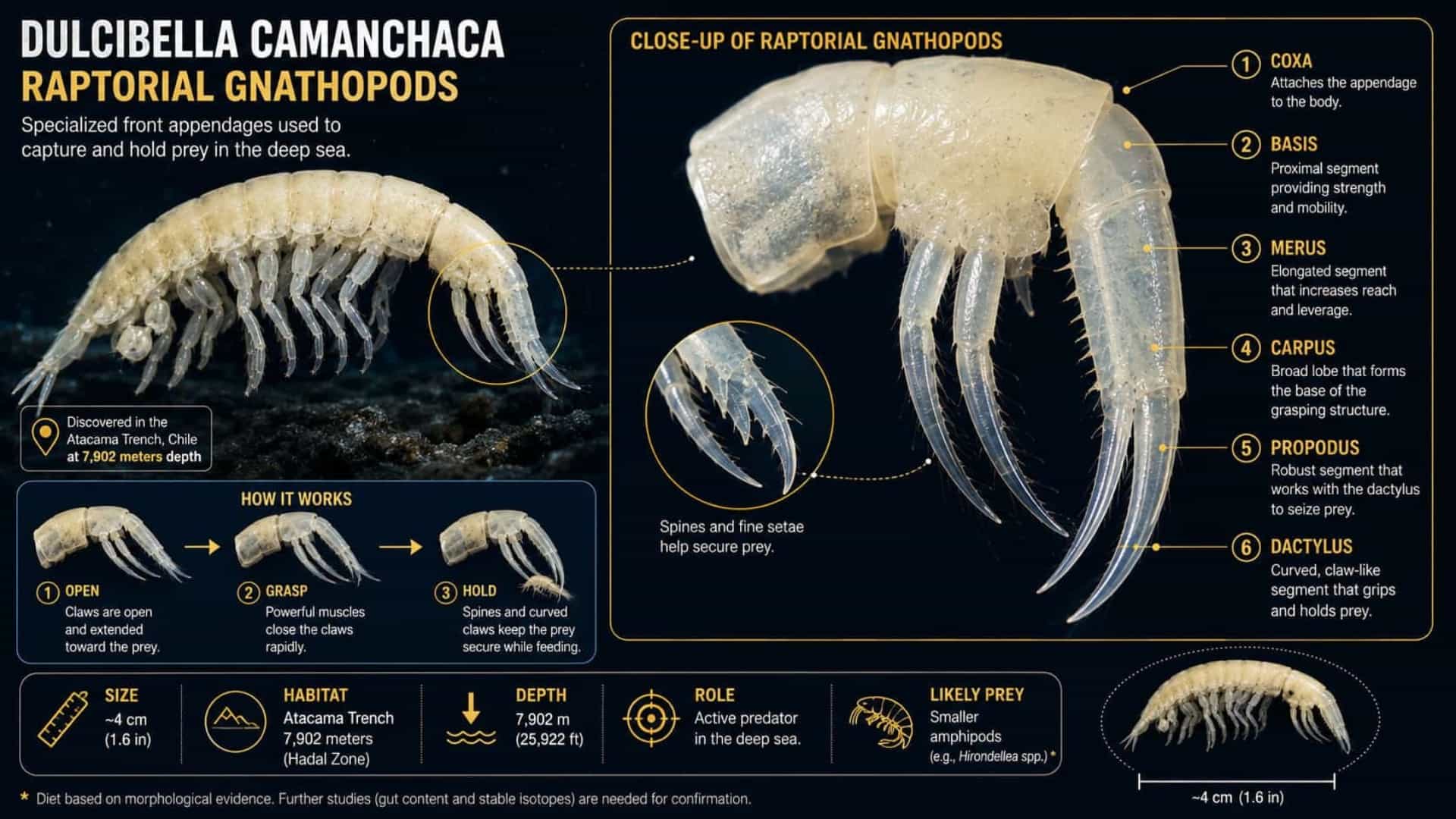
Dulcibella camanchaca measures about 4 centimeters, or 1.6 inches, nose to tail; the holotype specimen came in at 38.9 mm. That sounds modest, and in absolute terms it is. At roughly 4 centimeters, it is unusually large for an amphipod, although some other deep-sea amphipods can grow considerably larger.
Built to Hunt in the Hadal Zone
Its Raptorial Gnathopods
What sets Dulcibella camanchaca apart functionally are its gnathopods, specialized clawed front limbs built for grabbing and holding prey rather than sifting through debris. The paper describing the species notes strongly subchelate gnathopods with broad carpus lobes, essentially claws shaped for a firm grip rather than a scavenger’s shovel.
How It Lives Without Sunlight
The animal’s body is pale, almost translucent white, and it has no eyes, an adaptation shared by many organisms that spend their entire lives in permanent darkness. Without light to detect, researchers believe it likely relies on other senses, water movement, chemical cues, physical contact, to find prey rather than sight.
What Does Dulcibella camanchaca Eat?
Scientists suspect Dulcibella camanchaca preys on smaller amphipods, based on its raptorial anatomy and its placement within a predatory family, but its exact diet has not yet been confirmed. That conclusion comes from its anatomy and from the fact that specimens were recovered from baited traps alongside scavenging amphipods it appears to have targeted. The researchers themselves are careful to note that gut-content and stable-isotope work is still needed to pin down its diet and exact position in the food web with more certainty, so this remains a well-supported inference rather than a directly observed feeding record.
The Predator Below 7,200 Meters
Here’s a detail that didn’t make most of the initial coverage: in the Atacama Trench, larger predators like snailfishes and decapod crustaceans generally don’t appear below about 7,200 meters, even though the pressure there isn’t beyond what their bodies could physically tolerate. Researchers suspect other factors, possibly food availability or oxygen levels, keep them shallower. Dulcibella camanchaca was found well past that line, at 7,902 meters, making it one of the only known megafaunal predators confirmed to operate in that deeper band. That apparent depth limit is more than just a number: it hints at an ecological boundary scientists are still trying to understand.
Why the Atacama Trench Is So Biologically Strange
Part of what makes this find significant is where it happened. The Atacama Trench sits beneath some of the most productive surface waters in the Pacific, but it’s also cut off from other hadal trenches by distance and geography. That isolation, combined with a limited and unpredictable food supply at depth, has pushed its resident species down unusual evolutionary paths. Researchers increasingly treat it as an endemic hotspot, a place where isolation itself has become a driver of biodiversity rather than a barrier to it.
How Scientists Discovered It
Collecting anything at nearly 8,000 meters requires equipment built to survive pressure that would crush a submarine hull not rated for it. The team used a lander vehicle, described by WHOI as a nearly 9-foot, skyscraper-shaped platform held afloat by eight glass spheres, with a balancing arm carrying crab-like traps baited with chicken. The lander drops untethered to the seafloor, since no cable reliably survives that depth, and drifts back to the surface on its own the next day.
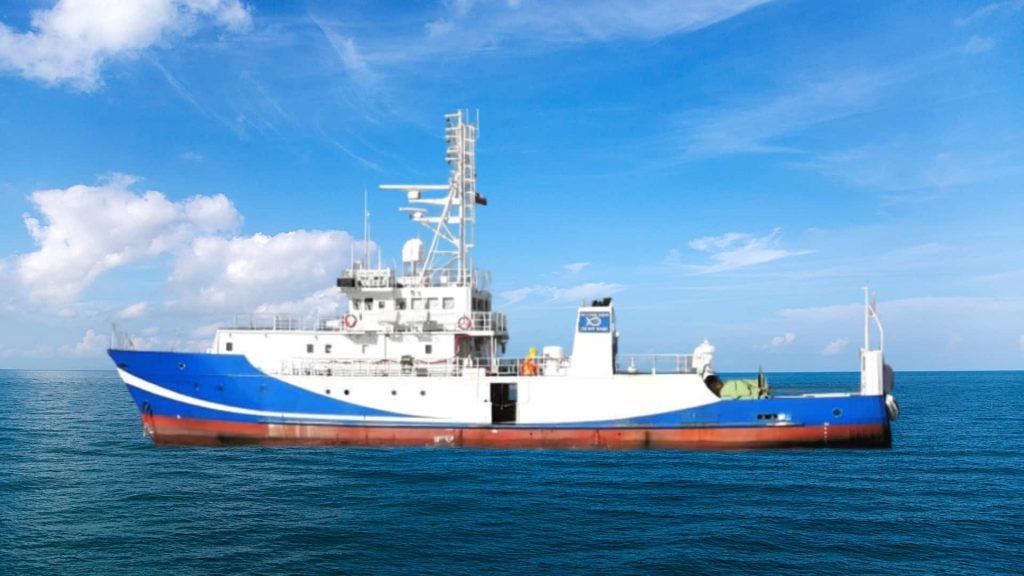
When the vehicle resurfaced, IMO co-lead researcher Carolina González was on hand to recover and preserve the specimens before they were shipped to the Universidad de Concepción for detailed morphological and genetic analysis. That combination, remote unmanned collection followed by lab-based DNA and anatomical work, is what’s known as an integrative taxonomic approach, and it’s increasingly the standard for confirming genuinely new hadal species rather than relying on appearance alone.
The Strange Story Behind the Name
The species name, camanchaca, refers to the dense coastal fog that rolls over Chile’s Atacama Desert, The species name, camanchaca, refers to the dense coastal fog associated with Chile’s Atacama Desert. The researchers also note that the word has been associated with ‘darkness’ in Andean languages, making it an especially fitting name for an animal living in perpetual darkness. Researchers chose it deliberately: darkness above the desert, and darkness at the bottom of the trench this predator calls home.
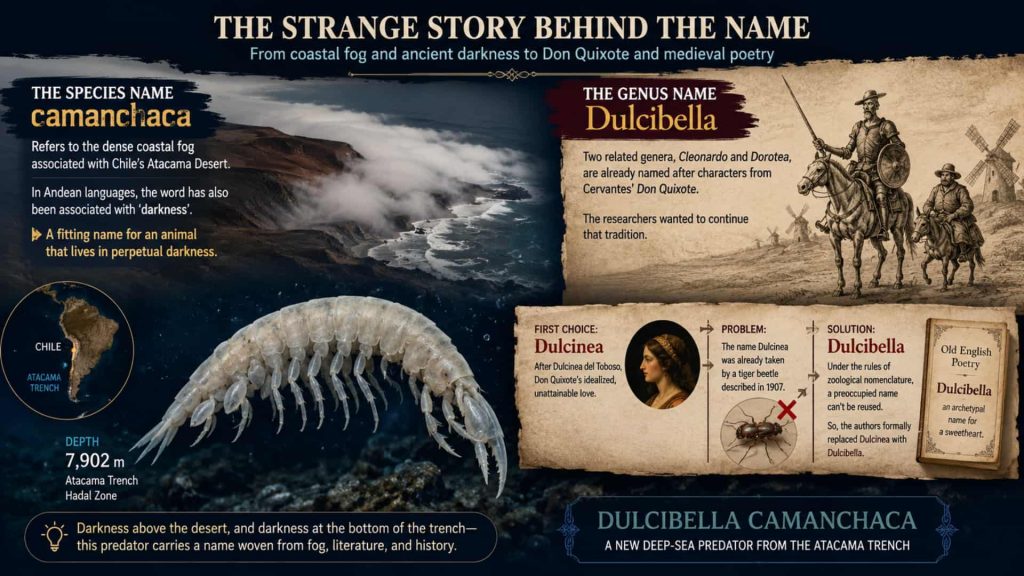
The genus name has its own, more tangled story. Two closely related amphipod genera, Cleonardo and Dorotea, are already named after characters from Cervantes’ Don Quixote, so the researchers wanted to continue that tradition. Their first choice was Dulcinea, after Dulcinea del Toboso, Don Quixote’s idealized, unattainable love. It turned out that name was already taken, by a tiger beetle described in 1907. Under the naming rules that govern zoological classification, a preoccupied name can’t be reused, so after the original paper published, the authors filed a formal correction replacing Dulcinea with Dulcibella throughout, a name that also happens to appear in medieval English poetry as an archetypal name for a sweetheart.
What Scientists Still Don’t Know
Only four specimens have ever been examined, all from one location on one expedition. Researchers don’t yet know how far Dulcibella camanchaca’s range extends within the Atacama Trench, whether related species exist in other hadal trenches nearby, or precisely how it detects prey without eyes. Its full role in the hadal food web, beyond the strong circumstantial case built so far, is still being worked out.
Why This Discovery Matters
Before this find, the working assumption in hadal ecology was that food scarcity below 6,000 meters ruled out active predators almost entirely, favoring scavengers that don’t burn energy chasing meals. A confirmed hunter operating past 7,200 meters challenges that assumption directly and forces a rethink of how the hadal food web actually functions at extreme depth. The IDOOS sensor network installed during the same expedition is designed to keep collecting data from the trench long-term, which means future missions have a real shot at answering the questions this discovery raised rather than just adding to the pile.
Related Deep-Sea Discoveries
- Buried Secrets of the Atacama — more on the region above the trench this predator calls home.
- How Scientists Name a New Species — the naming rules behind the Dulcinea-to-Dulcibella correction.
- Ferreiraella populi: A Deep-Sea Chiton — another deep-sea species named for the first time in the same window of discovery.
- Dorado Octopus — a fellow 2024 deep-ocean discovery from a different corner of the Pacific.
- 10 Newly Discovered Species — where Dulcibella camanchaca fits among the year’s other new finds.
Key Takeaways
- Dulcibella camanchaca is the first large, active predatory amphipod ever documented at hadal depths, collected at 7,902 meters in the Atacama Trench.
- It represents not just a new species but an entirely new genus, expanding the Eusiridae family to 14 known genera.
- The animal is pale, eyeless, and about 4 centimeters long, using clawed gnathopods to hunt rather than scavenge; scientists believe it preys mainly on smaller amphipods, though direct diet confirmation is still pending.
- It was found deeper than the roughly 7,200-meter boundary where larger hadal predators like snailfishes typically stop appearing, making it one of the few confirmed megafaunal predators at that depth.
- The genus’s own name had to be corrected after publication, from Dulcinea to Dulcibella, after researchers discovered a tiger beetle already held the first name.
Frequently Asked Questions About Dulcibella camanchaca
What is Dulcibella camanchaca?
Dulcibella camanchaca is a newly described predatory amphipod, a shrimp-like crustacean, discovered in Chile’s Atacama Trench. It is the first known active predator of its kind found at hadal depths, and its discovery established an entirely new genus.
Where was Dulcibella camanchaca discovered?
It was collected at 7,902 meters in the Atacama Trench off the coast of Chile, during the 2023 IDOOS Expedition aboard the research vessel R/V Abate Molina.
How big is Dulcibella camanchaca?
Dulcibella camanchaca is about 4 centimeters (1.6 inches) long. The holotype specimen measured 38.9 millimeters, making it unusually large for an amphipod.
What does Dulcibella camanchaca eat?
Scientists believe Dulcibella camanchaca preys mainly on smaller amphipods. Its specialized gnathopods are adapted for grabbing prey, although its exact diet still needs to be confirmed through gut-content and stable-isotope studies.
How deep does Dulcibella camanchaca live?
All known specimens came from 7,902 meters, well past the roughly 7,200-meter depth where larger hadal predators like snailfishes generally stop appearing in the Atacama Trench.
How big is Dulcibella camanchaca?
Dulcibella camanchaca measures roughly 4 centimeters, about 1.6 inches, in length. That’s small in absolute terms, but notably large compared to most other amphipods, which typically run just a few millimeters.
What does Dulcibella camanchaca eat?
Scientists believe Dulcibella camanchaca preys mainly on smaller amphipods, based on its anatomy and how it was collected, though direct gut-content evidence to confirm this is still pending future research.
Does Dulcibella camanchaca have eyes?
No. Dulcibella camanchaca is eyeless, like many organisms adapted to the permanent darkness of the hadal zone. It appears to rely on other sensory cues rather than sight to detect prey.
Why is Dulcibella camanchaca a new genus and not just a new species?
DNA barcoding and morphological analysis showed it was distinct enough from its closest relative, the genus Dorotea, to warrant its own genus. That reclassification updated the global key for the Eusiridae family to 14 recognized genera.
Why was the genus name changed from Dulcinea to Dulcibella?
Researchers first named the genus Dulcinea, after Don Quixote’s idealized love, continuing a naming tradition shared with related genera. After publication, they discovered the name was already used for a tiger beetle described in 1907, so they formally corrected it to Dulcibella.
How do animals survive at nearly 8,000 meters?
Hadal organisms like Dulcibella camanchaca cope with crushing pressure, near-freezing temperatures, and total darkness through adaptations like reduced or absent eyes, pale coloration, and, in this species’ case, an active hunting strategy in a zone most animals only scavenge.
Source References
- Woods Hole Oceanographic Institution, “Woods Hole Oceanographic Institution and Partners Discover New Ocean Predator in the Atacama Trench,” Dec. 9, 2024
- Weston, J.N.J., González, C.E., Escribano, R., Ulloa, O., “A New Large Predator (Amphipoda, Eusiridae) Hidden at Hadal Depths of the Atacama Trench,” Systematics and Biodiversity, Nov. 27, 2024 (corrected version Dec. 6, 2024)
- Woods Hole Oceanographic Institution, Oceanus Magazine, “Deep-Sea Amphipod Name Inspired by Medieval English Literature”
- University of Texas at Austin Marine Science Institute, “The Ghostly White New Predator,” Jan. 2025
- Sci.News, “Predatory Crustacean Species Discovered in Atacama Trench,” Dec. 10, 2024
- Live Science, “Large, Ghostly White Crab-Like Predator Discovered at the Bottom of the Atacama Trench,” Dec. 10, 2024
About the Author
Mubashir Razzaq is a science and history writer for Strangehappen.com, specializing in archaeology, space exploration, ancient civilizations, and emerging scientific discoveries. His work focuses on translating complex research into engaging, evidence-based stories that help readers understand the mysteries of our world and beyond.