
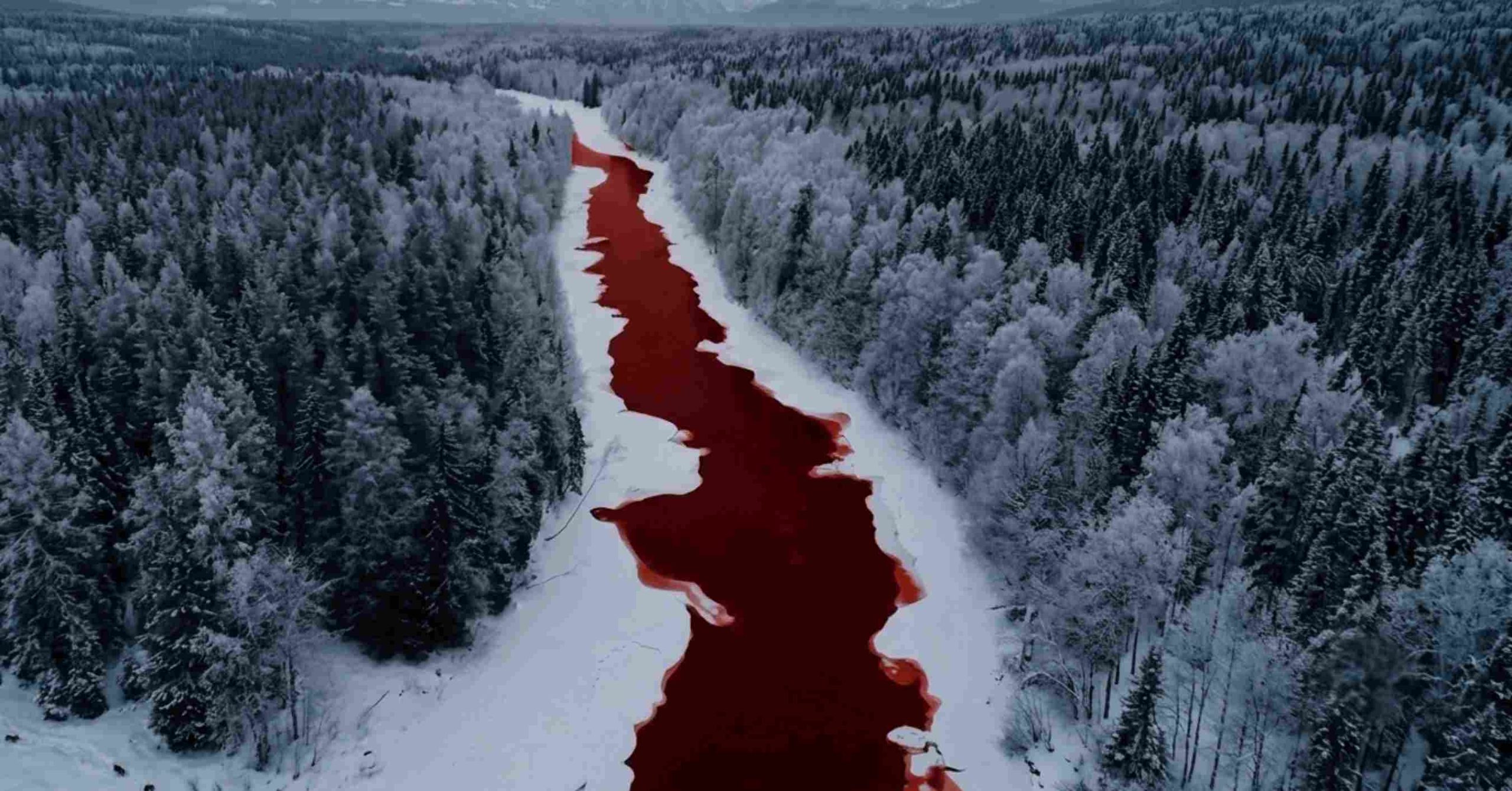
Imagine stepping outside one morning to find the river near your city running the color of blood. Not muddy brown from flooding. Not the faint orange of light mineral runoff. A thick, vivid, unmistakable crimson flowing steadily through a frozen Siberian landscape as though the earth itself had been cut open.
That is exactly what residents of Norilsk witnessed in September 2016. They photographed it. They posted it everywhere. Within hours, the blood river in Russia had reached every corner of the internet, and millions of people were searching for an explanation.
What they were looking at had a name, a cause, and a documented paper trail stretching back nearly three decades. The real story was just waiting to be found.
What Is the Blood River in Russia?
When photographs of the blood red river in Russia spread globally in September 2016, the name took hold almost immediately. Observers pointed toward a nearby metal processing facility as the likely source of the vivid discoloration, and within days the world wanted answers.
What the world called a mystery was actually the most recent visible chapter in a story researchers had been quietly documenting since the mid-1990s. The cameras were new. The problem was not.
Understanding the blood river in Russia phenomenon properly means looking not at a single incident but at a pattern of river discoloration in Siberia that had been accumulating for decades before a single viral photograph brought it to global attention.
A Timeline of the Russian River Turning Blood Red
1997 — NASA Landsat satellites record first confirmed red discoloration in Norilsk waterways.
1998 to 2015 — Repeated red discoloration events documented by Landsat 7 and Landsat 8 across multiple summer seasons.
September 5, 2016 — The Daldykan river turns vivid crimson after a filtration dam overflow. Norilsk Nickel initially denies, then admits responsibility. The river in Russia turns blood red and photographs go global within hours.
May 29, 2020 — A corroded storage tank releases 21,000 tonnes of diesel fuel into the Daldykan and Ambarnaya rivers. Russia declares a federal emergency. It becomes the largest recorded Arctic oil spill in history.
February 2021 — A Krasnoyarsk court orders Norilsk Nickel to pay nearly 2 billion US dollars for environmental damages.
2022 — Local activists document rivers still running red two years after the 2020 spill, directly contradicting official recovery claims.
Where Did the River in Russia Turn Blood Red?
The most famous case centers on a waterway most of the world had never heard of before September 2016.
The Daldykan River, Norilsk, Siberia
Photographs from Norilsk flooded the internet in September 2016, showing a scarlet-hued Daldykan. Headlines everywhere proclaimed a Russian river had mysteriously turned blood red. Yet color changes in this waterway were hardly new or anomalous. Satellite imagery shows that rivers near the Siberian city had blushed crimson long before they achieved viral fame.
NASA Landsat satellites recorded red discoloration in the waters around Norilsk on multiple documented dates including July 2015, July 2014, August 2013, July 1998, and September 1997. This was not a new problem. It was a long-documented one that had simply never been captured at a resolution the world could not scroll past.
NASA researcher Nickolay Krotkov noted that pollution around Norilsk extends far beyond its red rivers. The smelters there represent one of the largest anthropogenic sulfur dioxide sources detectable by satellites anywhere on earth. A 2008 study published in Eurasian Soil Science described the territory around Norilsk as characterized by high concentrations of heavy metals, the absence of trees, and widespread disturbance of organic matter across the soil.
The Daldykan flows through terrain defined entirely by industrial activity. For the company that had operated alongside it for decades, that crimson color was, in their own words, normal.
The Daldykan Again, May 2020
On May 29, 2020, over 20,000 tonnes of diesel leaked into the water and surrounding soil from a storage tank owned by Norilsk Nickel. The Ambarnaya River turned red almost immediately. According to official data, the Norilsk oil spill became the largest ever recorded in the polar Arctic.
A corroded tank burst and released approximately 6.5 million gallons of diesel fuel into waters that ultimately drain toward the Kara Sea. Although Norilsk Nickel initially maintained that no diesel reached the Arctic Ocean, Russia’s state fisheries science agency confirmed through testing that contamination had traveled the full 900-kilometer length of the Pyasino River, including its mouth at the Kara Sea.
President Vladimir Putin declared the event a federal emergency and publicly demanded to know why authorities had taken two full days to be informed of the disaster.
The Iskitimka River, Kemerovo, 2020
In a separate incident that same year, the Iskitimka River in the Siberian city of Kemerovo turned a deep beetroot red. Local officials attributed the discoloration to possible contamination from the city’s drainage system. Images circulated widely on social media, often misrepresented as evidence of a supernatural event rather than what the evidence clearly suggested: another industrial contamination incident in a region with a long and thoroughly documented history of such occurrences.
Why Does the Blood Red River in Russia Turn That Color?
Three distinct mechanisms have been documented by scientists, environmental investigators, and government bodies. In the Norilsk cases, all three are entangled.
Industrial Pollution: The Confirmed Cause
The world’s biggest nickel producer eventually admitted that heavy rains on September 5, 2016 caused a filtration dam at its Nadezhda plant to overflow directly into the Daldykan. The company had flatly denied responsibility when the blood river in Russia images first emerged.
According to Norilsk Nickel’s own investigation report, the company had been renovating its tailings pond and pipeline during 2015 and 2016. Filtration dams were installed at pipe intersections to prevent technical water from entering the river. However, on September 5, anomalous rainfall amounting to roughly 50 percent of the monthly average fell in a single day, causing one dam to overflow directly into the Daldykan.
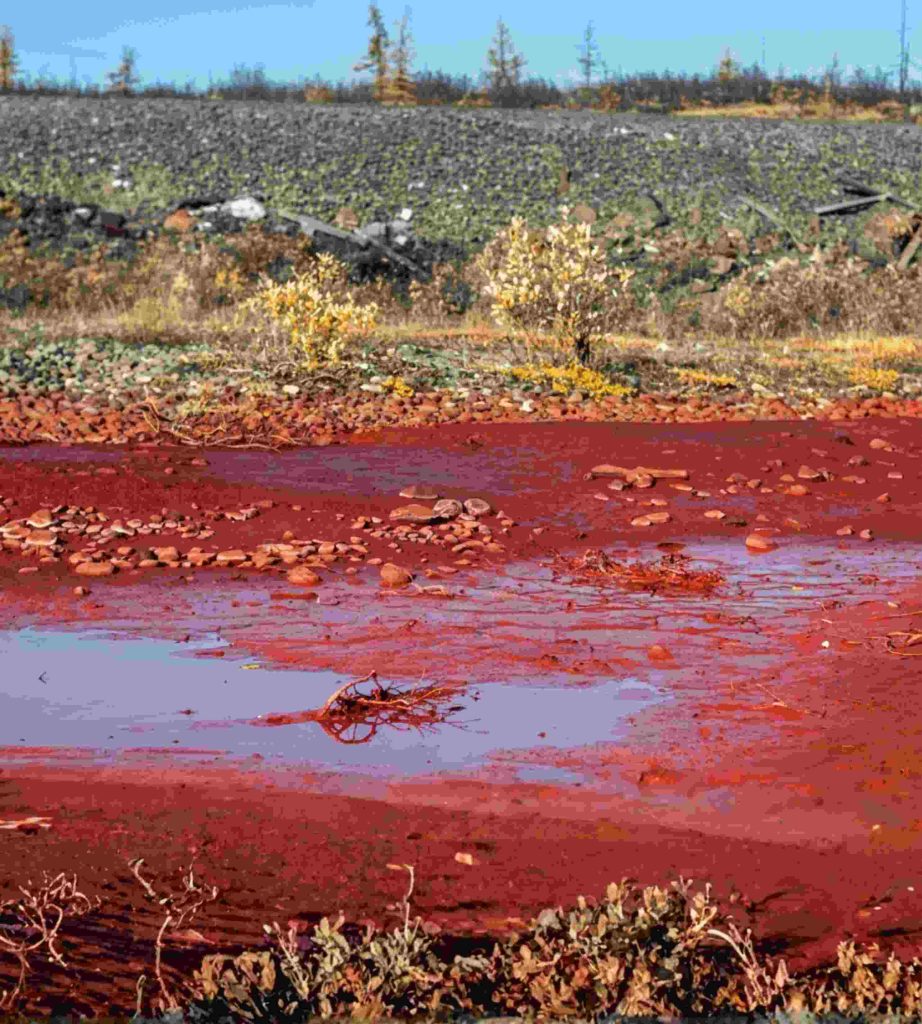
Ore processing generates vast volumes of iron-rich slurry. When containment structures fail, even briefly, that material enters the nearest waterway. At the concentrations documented in Norilsk, the resulting color is not a subtle tinge. It is the vivid crimson that millions saw in photographs shared across every platform.
Natural Mineral Oxidation
Not every incident of river discoloration in this region traces directly to a pipe failure or dam overflow. Among the theories proposed by researchers was that the river’s red hue might have been partly caused by iron oxide present in the nickel deposits of the surrounding geology. Iron oxide dissolves into water moving through iron-bearing rock and soil. After heavy rain or seasonal snowmelt, those concentrations rise sharply. In areas rich in hematite or similar minerals, rivers can shift toward red or orange tones without any containment structure having failed at all.
The complication in Norilsk is that decades of ore extraction have destabilized iron-heavy geological layers across the entire region. In any given incident, drawing a clean line between natural oxidation and industrial contamination has become genuinely difficult. The two causes have merged.
Cumulative Soil and Environmental Contamination
The 2008 Eurasian Soil Science study described land surrounding Norilsk as saturated with heavy metals and stripped of the organic processes that normally filter contaminants from soil. Nearly 500 tons each of copper and nickel oxides, along with 2 million tons of sulfur dioxide, are released annually into the air around the city. When the ground itself carries that level of saturation, every waterway flowing through it becomes a vehicle for those compounds into the broader Arctic watershed.
The blood river in Russia events documented across multiple years are not isolated accidents. They are the recurring visible symptoms of a system operating beyond what the surrounding environment can absorb.
What Is the Daldykan River?
Most people searching the blood river in Russia story in 2016 had never encountered this name before.
The Daldykan is a modest tributary river near Norilsk, flowing above the Arctic Circle through one of the most intensively contaminated industrial zones on earth. It became globally known not because of any geographic significance but because of what surrounds it and what that industrial activity has done to its water over nearly five decades.
In a September 2016 press release, managers at Norilsk Nickel stated: “As far as we know, the color of the river today is no different from usual.” That statement, issued while photographs of vivid crimson water circulated to every corner of the internet, tells the story of the Daldykan more efficiently than any environmental report. To the company that had spent decades operating next to it, a crimson river was simply business as usual.
Gareth Rees, a scientist from Cambridge University, confirmed seeing red-running rivers in Norilsk during fieldwork in the region and noted the effects were very marked and widespread, capable of being mapped using remote sensing methods from space.
The blood red river in Russia does not run red because of a mystery. It runs red because it has been absorbing the byproducts of industrial metal extraction for nearly half a century.
Is There a Blood Lake in Russia Too?
Alongside the river discoloration story, a parallel question circulates widely: is there also a blood-red lake in Russia?
The answer appears to be yes, and it sits in the same broader industrial region. A body of water in Krasnoyarsk Krai, within the Norilsk industrial zone, is widely visible in satellite imagery databases and environmental monitoring sources as appearing permanently crimson. It is reported to contain large quantities of iron oxides from mineral residues and manufacturing byproducts accumulated over decades of industrial discharge.
The blood lake Russia label circulates widely on social media and has been referenced in satellite image databases, but it has not been formally analyzed in peer-reviewed environmental literature to the same documented standard as the Daldykan river events. The visual evidence from satellite imagery is real. The specific contamination analysis of this particular water body is less thoroughly established in the scientific record.
What can be stated with confidence is that the industrial conditions that repeatedly turned the Daldykan crimson are present throughout the surrounding landscape. A body of water sitting still within that zone would concentrate the same compounds the river carries downstream. The river in Russia turns blood red and eventually moves those contaminants outward into the Arctic watershed. The lake holds them.
Can You Swim in Blood River Russia?
This question appears frequently in searches, and the answer is straightforward.
No. You should not swim in the Daldykan or any waterway in the Norilsk industrial zone.
The water contains documented concentrations of heavy metals including nickel, copper, and cobalt compounds, along with iron-rich industrial slurry. Following the 2020 spill, it also carried diesel fuel contamination across a 900-kilometer stretch of connected waterways. Environmental specialists warned that the Arctic tundra ecosystem suffers damage that is almost irreparable when contamination of this scale occurs, and that full recovery of affected flora and fauna may not happen within any foreseeable timeframe.
The blood river in Russia is not a swimming destination. It is an environmental disaster zone that has been documented by NASA, investigated by Greenpeace, and taken to federal court.
The Human Cost: What Living Here Actually Does
The red water is alarming to see. What it signals about the land surrounding it is more alarming still, because over 130,000 people actually live here.
Life expectancy for factory workers in Norilsk runs 10 years below the Russian national average. Residents are exposed to particulates and metal pollution every single day, leading to documented increases in respiratory disease, cardiovascular disease, and cancer rates.
- Lung cancer mortality in Norilsk is 1.2 to 2.5 times higher than in other Russian cities, according to research published by scientists at the Russian Academy of Sciences
- Air pollution in Norilsk is directly responsible for 37 percent of children’s morbidity rates
- Adult morbidity stands at 21.6 percent due to regional air quality
- Children living closest to the nickel plant were 1.5 times more likely to suffer from respiratory, ear, nose, or throat diseases than those living farther away
- Regional health reports confirm much higher rates of premature births compared to other Russian cities
When people search for the blood red river in Russia photographs and feel alarm, they are responding to a visual. The residents of Norilsk respond to it every day in ways no photograph can fully capture.
What Did Norilsk Nickel Pay?
The question of accountability is what separates this story from a visual curiosity.
Following the 2020 diesel spill, the Krasnoyarsk Arbitration Court ordered Norilsk Nickel to pay 146 billion rubles, approximately 2 billion US dollars, for environmental damage across the Taimyr Peninsula. Russia’s state fisheries agency filed a separate claim for 58.7 billion rubles, approximately 806 million US dollars, for damage to the region’s aquatic resources. In September 2021, Norilsk Nickel agreed to negotiate an out-of-court settlement of that additional claim.
Greenpeace compared the scale of the 2020 Norilsk incident directly to the 1989 Exxon Valdez disaster off the coast of Alaska.
The financial penalties were historic for Russia. Whether they translated into meaningful ecological recovery is a different question entirely.
“Visiting the Daldykan that night broke something in me. My heart sank the moment I saw it. The river was red with pulp and the chemical smell is still in my lungs.” — Igor Klyushin, local resident
Similar Cases Around the World
Russia is not alone in this experience. The phenomenon of rivers turning red has appeared on multiple continents, though the causes vary sharply by location.
Argentina, February 2025 — A stream near Buenos Aires turned bright red after suspected chemical waste discharge from nearby factories and tanneries. Argentina’s environmental ministry collected samples and suggested an organic dye contaminant was the likely cause.
China, Yangtze River, 2012 and 2014 — A stretch of the Yangtze near Chongqing turned red on two separate occasions. Scientists pointed to industrial pollution and flood-churned sediment as the probable causes.
Iran, Lake Urmia — The lake shifted from deep green to vivid red due to a bloom of Dunaliella algae producing protective carotenoids under conditions of high salinity and intense light. This was a natural biological event with no industrial connection.
Israel, Sea of Galilee, August 2025 — Israel’s Water Authority confirmed the red coloration was caused by a bloom of the microalgae Botryococcus braunii, which produces a natural red pigment under intense sunlight. No health risks were identified.
Alaska, 2018 to 2020 — Multiple rivers turned orange as thawing permafrost released iron-rich minerals into waterways. By 2024, salmon harvests in affected regions had dropped to record documented lows.
Each case has its own chemistry. All of them produce the same immediate human response: something is wrong, and the water is showing it.
Myth vs. Reality
Myth: A river turning red is a sign of the apocalypse.
This interpretation generates significant engagement on social media and has appeared in connection with every documented discoloration event. It does not align with what investigators found. Every major case of river discoloration in Russia has a verifiable chemical or physical explanation traceable to industrial activity or natural geology. The appearance is genuinely alarming. The cause is chemistry.
Myth: The 2016 event was sudden and unexplained.
Satellite imagery shows that the river in Russia was turning blood red long before viral photographs brought it to global attention in 2016, with documented discoloration events stretching back to September 1997. When the 2016 photographs emerged, Norilsk Nickel initially claimed the river’s color was normal. Nineteen years of satellite records confirmed that, in the most tragic sense, they were right.
The blood red river in Russia was not discovered in 2016. It was simply photographed at a resolution the world could not ignore.
Frequently Asked Questions
What is the blood river in Russia?
The blood river in Russia refers to the Daldykan, a tributary river near Norilsk, Siberia, that has repeatedly turned vivid crimson due to industrial waste overflow from nearby metallurgical plants owned by Norilsk Nickel. NASA satellite records document red discoloration events in these waterways as far back as 1997. The phrase is not an official geographic term. It emerged when viral photographs of the September 2016 discoloration event spread globally and the color described itself.
Why does the river in Russia turn blood red?
The river in Russia turns blood red primarily because iron-rich industrial slurry from ore processing facilities enters the waterway when containment structures overflow or fail. The region also contains naturally iron-bearing geology that amplifies color change after heavy rainfall. In 2020, a collapsed storage tank released 21,000 tonnes of diesel fuel into the Daldykan and Ambarnaya rivers, producing the largest recorded Arctic oil spill in history and turning connected waterways red across a 900-kilometer stretch.
Is there a blood red river in Russia that is still red today?
The factories and processing plants that turned the Daldykan crimson are still running today. Local activists in 2022 documented waterways in the Norilsk region still showing red coloration two years after the 2020 spill. Scientists also warn that permafrost thaw across Siberia is weakening aging Soviet-era storage tanks and containment systems, increasing the risk of future spills. The conditions that produced the blood river in Russia story have not been resolved. They have been fined.
Can you swim in blood river Russia?
No. Swimming in the Daldykan or any connected waterway in the Norilsk industrial zone is not safe. The water contains documented concentrations of heavy metals including nickel and copper compounds, iron-rich industrial residue, and following the 2020 spill, diesel contamination across a 900-kilometer stretch of connected waterways. Environmental specialists have described the damage to this Arctic ecosystem as almost irreparable.
What is the blood red river in Russia called?
The river most commonly associated with the blood river in Russia phenomenon is the Daldykan, a small tributary near Norilsk flowing above the Arctic Circle. The Ambarnaya River, also near Norilsk, was severely contaminated during the 2020 diesel spill. Neither river carries the official name blood river. That label emerged from viral media coverage of the September 2016 event and has remained in common usage ever since.
Why is blood river in Russia red?
The blood river in Russia is red because ore processing at Norilsk Nickel’s metallurgical plants generates iron-rich slurry that enters the Daldykan when containment structures fail or overflow. Contributing factors include naturally iron-bearing geology in the surrounding landscape and decades of cumulative heavy metal saturation in the regional soil. In 2020, diesel fuel contamination added a separate toxic layer to the existing problem.
Is there really a blood river in Russia?
Yes. The Daldykan river near Norilsk, Siberia, has turned vivid crimson on multiple documented occasions stretching back to 1997, confirmed by NASA Landsat satellite imagery and on-the-ground reporting. Court orders, federal emergency declarations, and nearly 3 billion US dollars in financial penalties confirm this is not folklore or misidentification. The blood river in Russia is a documented environmental reality.
How much did Russia fine Norilsk Nickel for the blood river disaster?
Following the 2020 oil spill, the Krasnoyarsk Arbitration Court ordered Norilsk Nickel to pay approximately 2 billion US dollars in environmental damages. Russia’s state fisheries agency filed a separate claim for approximately 806 million US dollars in aquatic resource damages. The total financial exposure from the single 2020 incident exceeded 2.8 billion US dollars, representing the largest environmental penalty in Russian legal history.
Related Articles You May Like
- The Chilling Village of Whispering Walls: A Strange Happenings Mystery”
- The Haunting Mystery of the Reappearing Villages of Siberia
- Colossus of Rhodes: A Sublime Goliath of the Old World
- Two Oceans, One Border… and a Strange Invisible Wall
- Mexican Underwater Museum MUSA
Final Thoughts
The photographs that launched a thousand searches were real. The river really did run that color. And the question millions of people asked when they first saw it, whether something had gone badly wrong, was exactly right.
What the so-called “blood river in Russia“ revealed was not a sudden disaster but something that had been building quietly for decades. In parts of the Arctic region, long-term industrial activity linked to metal extraction has affected nearby waterways through waste and heavy metal discharge.
The viral moment in 2016 was not the beginning of the story. It was the moment the story could no longer stay in the background.
The river turns blood red not because the earth is bleeding, but because the systems built around it have been under pressure for a long time. What looks shocking in a photograph is often just the surface of something much older.
Some rivers run clear because the land is clean. Others look clear simply because no one has looked closely enough yet.
And just like the strange stories of reappearing villages in Siberia, what seems mysterious at first often has a more grounded explanation when you look deeper. In both cases, the real story is not about the impossible, but about how little we usually see of the places we think we understand.
Sources and References
- NASA Earth Observatory: Siberian River Has Turned Red Before, Satellites Show (2016)
- BBC News: Russia’s Norilsk Nickel Admits Red River Responsibility (September 2016)
- Inside Climate News: How Norilsk Became One of the Most Polluted Places on Earth (December 2021)
- Greenpeace International: Remember the Norilsk Oil Spill? Well, the Polluters Will Pay (February 2021)
- Live Science: Russian River Runs Red (September 2016)
- Business and Human Rights Resource Centre: Norilsk Nickel Environmental Damage Claims
About the Author
Mubashir Razzaq is a science and history writer at StrangeHappen.com specializing in archaeology, space exploration, ancient civilizations, and emerging scientific discoveries. His work focuses on translating complex research into engaging, evidence-based stories that help readers understand the mysteries of our world and beyond. Read his full archive at StrangeHappen.com /author/mubashir.