
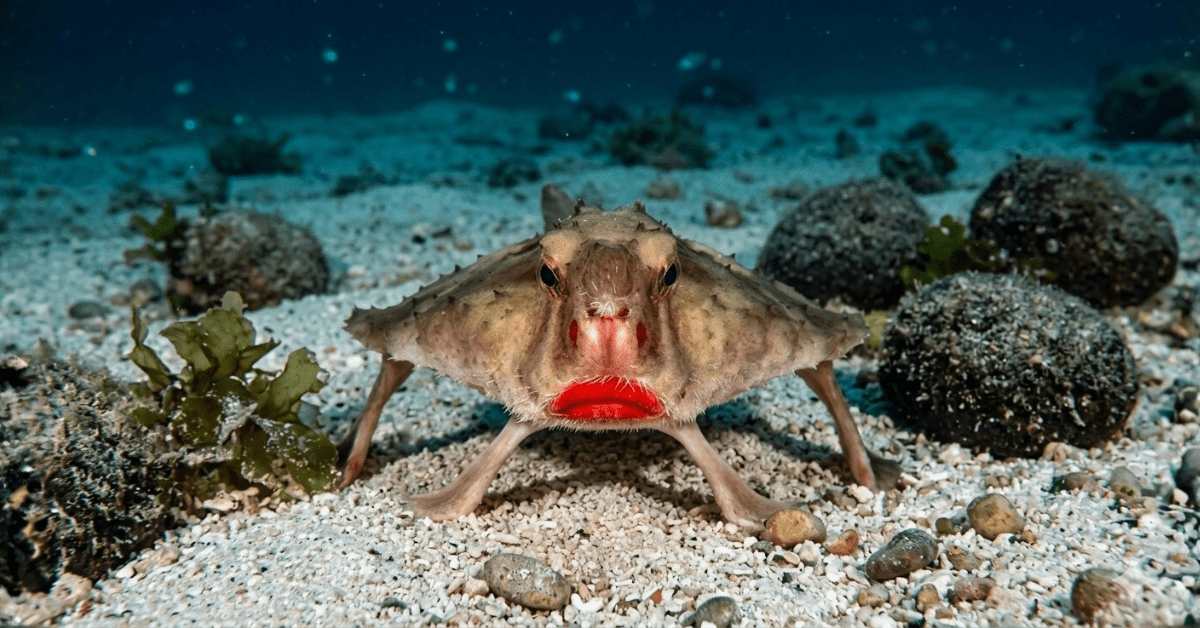
Red-Lipped Batfish Facts are some of the most fascinating in the marine world. If you’ve ever seen a photo of a fish wearing what looks like bright red lipstick and thought “that has to be fake,” you’re not alone. It’s not fake. It’s the red-lipped batfish, and once you start digging into the actual science behind it, the real facts turn out to be stranger than most of the memes floating around.
We already covered the full biology, habitat, and evolutionary story in our complete red-lipped batfish guide. This page is different. It’s a pure, no-fluff collection of facts about the red-lipped batfish, quick ones, deep ones, kid-friendly ones, and a few that surprised even us while researching this. Whether you’re researching for school or simply curious about one of the ocean’s strangest fish, you’ll find everything you need here.
Quick Facts Snapshot (10 Facts About Red-Lipped Batfish at a Glance)
The Red-Lipped Batfish Facts below are based on scientific research, marine biology references, and verified species records rather than internet myths.
| Fact | Detail |
|---|---|
| Scientific name | Ogcocephalus darwini |
| Family | Ogcocephalidae (batfishes) |
| Order | Lophiiformes (same order as anglerfish) |
| First described | 1864, by Albert Günther |
| Named after | Charles Darwin |
| Size | 20–40 cm (roughly the length of a school ruler) |
| Depth range | 3–76 meters |
| Habitat | Galápagos Islands and coastal Peru |
| Movement | Walks on modified fins instead of swimming |
| Danger to humans | None — not venomous, not toxic |
Interesting Facts About the Red-Lipped Batfish
- Its name comes from its body shape, not behavior, the flattened, disc-like body resembles a bat’s wings when viewed from above.
- It was formally described back in 1864, meaning this “new internet discovery” is actually more than 150 years old in scientific records.
- It’s named after Charles Darwin, not because he found it personally, but because it was discovered in the Galápagos Islands, the same place that shaped his theory of evolution.
- It belongs to the order Lophiiformes, making it a genuine relative of the deep-sea anglerfish, despite looking almost nothing alike.
- It lives almost exclusively around the Galápagos Islands and the Pacific coast of Peru, one of the smallest geographic ranges of any fish in that region.
- Its depth range is surprisingly shallow for such an odd-looking creature, usually 3 to 76 meters, well within scuba diving depth.
- The red-lipped batfish belongs to a family, Ogcocephalidae, that includes more than 60 species, and almost none of the others have red lips.
- Its rough, bony skin texture comes from small tubercles rather than the smooth scales most people associate with fish. Like other members of the Ogcocephalidae family, the red-lipped batfish has evolved to live almost entirely on the seafloor instead of actively swimming through open water.
Fun Facts About the Red-Lipped Batfish
These Red-Lipped Batfish Facts show why this unusual species continues to fascinate scientists and divers alike.
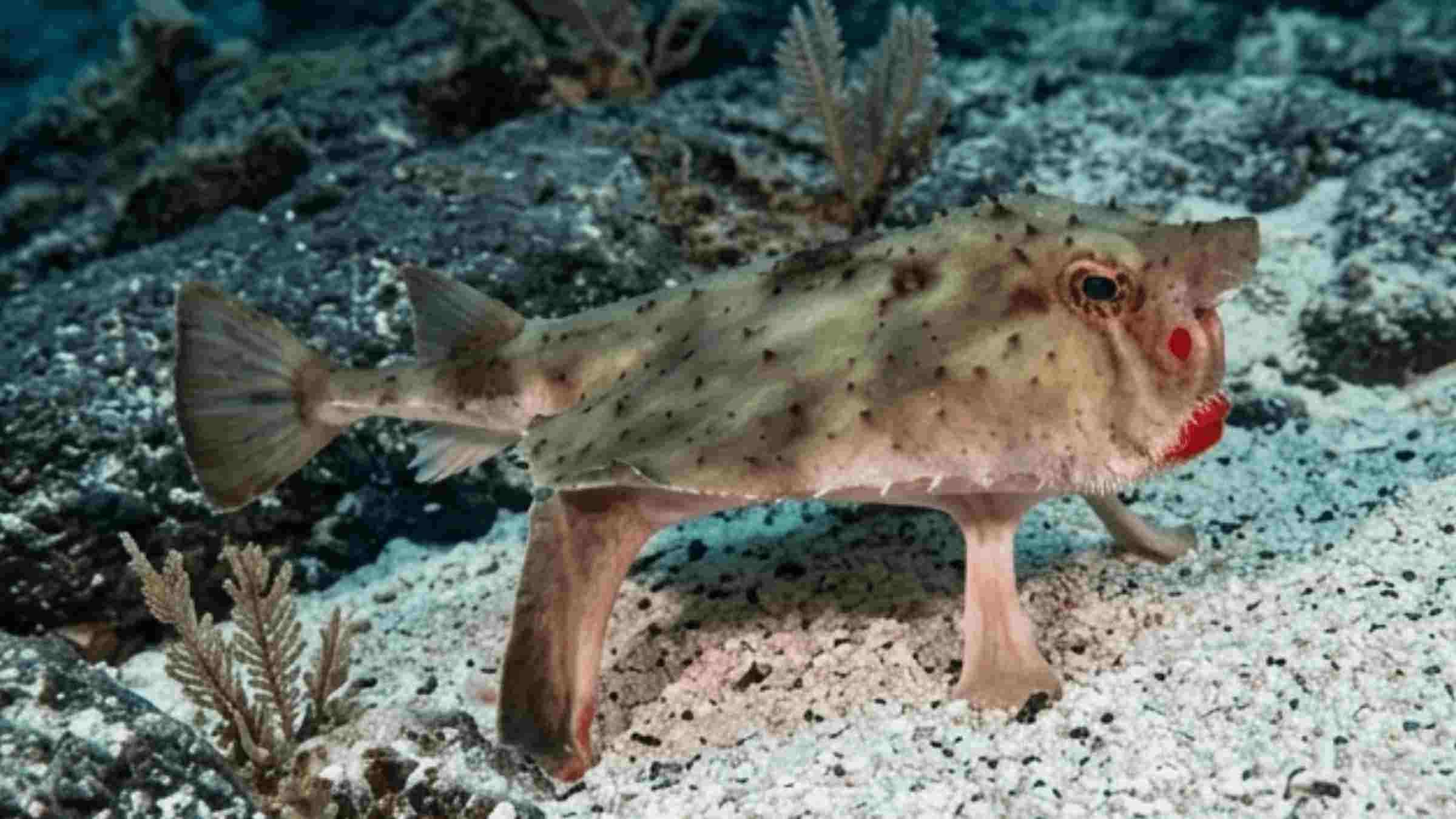
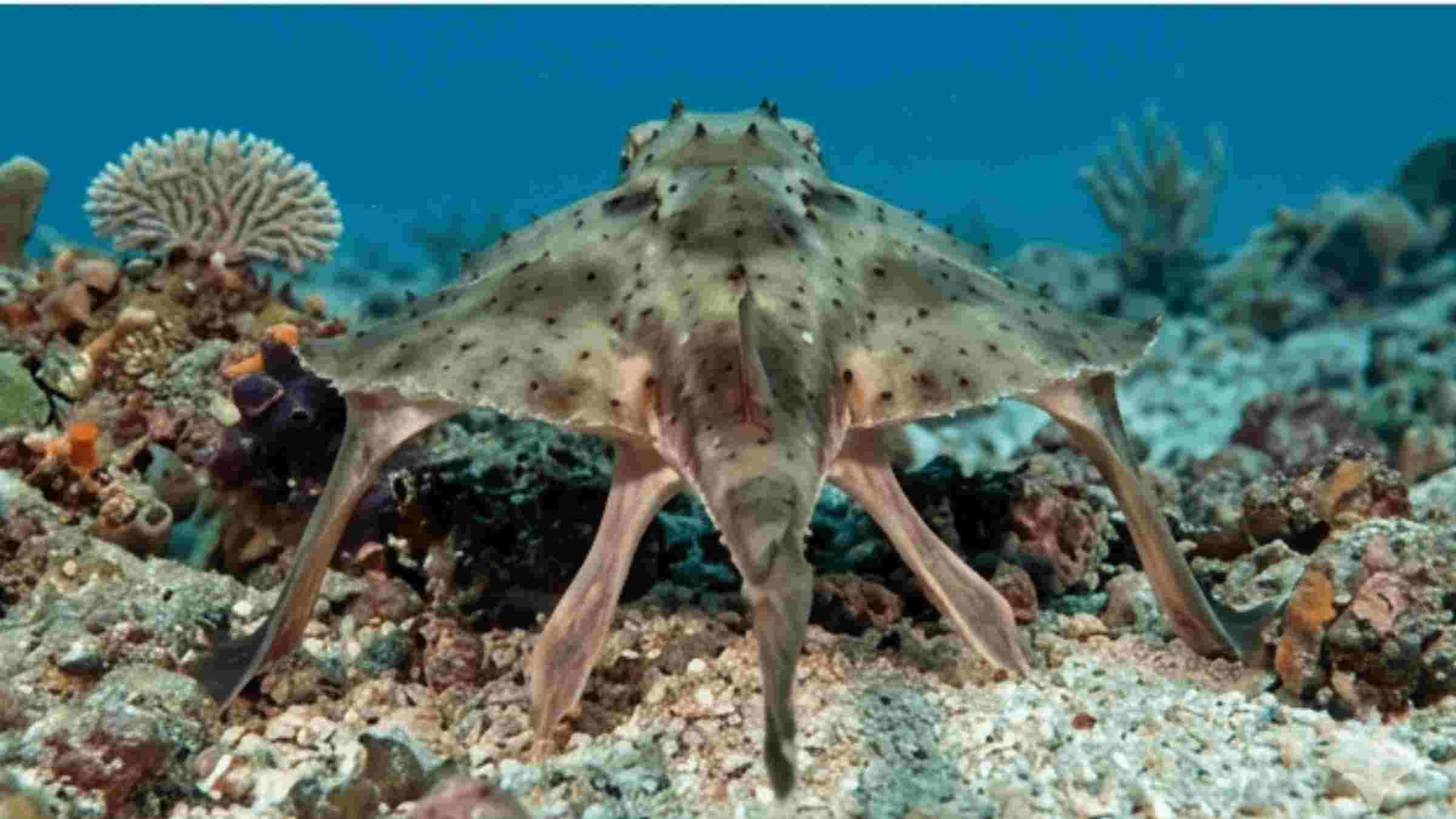
- It would rather walk than swim. It uses its modified pectoral and pelvic fins almost like legs, moving in a slow, alternating gait across the seafloor. If you want to see another fish that prefers walking to swimming, mudskippers do the exact same trick, just in a completely different environment.
- It carries its own built-in fishing rod. A modified spine on its forehead, called the illicium, has a fleshy lure at the tip used to attract prey, the same hunting trick used by the anglerfish.
- The lure is mostly a juvenile feature. Adults rely on it far less, shifting toward a more patient, ambush-style hunting method as they mature.
- It can technically swim, but only in short bursts, usually to escape a predator. Its flat body just isn’t built for sustained swimming.
- Young red-lipped batfish look very different from adults. During their larval and juvenile stages, they resemble ordinary free-swimming fish before settling on the seafloor and gradually developing their flattened bodies and distinctive walking fins.
- Despite the internet fame, it’s almost never kept in aquariums. Its very specific habitat needs make captive care extremely difficult.
- It’s a solitary animal. No schooling, no group behavior, it spends most of its life alone and motionless on the seafloor.
Cool Facts About Its Red Lips (The Part Everyone Wants to Know)
- The red coloration is real pigmentation, not a filter, not enhanced photography, confirmed repeatedly by researchers and dive photographers.
- The leading scientific theory is species recognition, the bright color may help individuals identify potential mates in low-visibility, sandy environments where subtle markings would go unnoticed.
- A weaker, less-supported theory suggests the red could function as a mild warning signal, though no toxin has ever been documented in this species.
- Camouflage has been ruled out entirely. The lips actually make the fish more visible against the sandy seafloor, not less, the opposite of hiding. If you’re curious how real camouflage works in the animal kingdom, our camouflage animals guide breaks that down separately.
- Whether the color intensity changes during breeding season is still unknown. It’s one of the genuinely open questions in current marine biology, over 150 years after the species was first described. Scientists continue studying Ogcocephalus darwini to better understand the purpose of its distinctive red lips and other unique adaptations.
- No other close relative in the batfish family displays this exact red-lip trait, which is part of what makes O. darwini stand out even among its own family.
Deep and Scientific Facts About Its Anatomy and Hunting
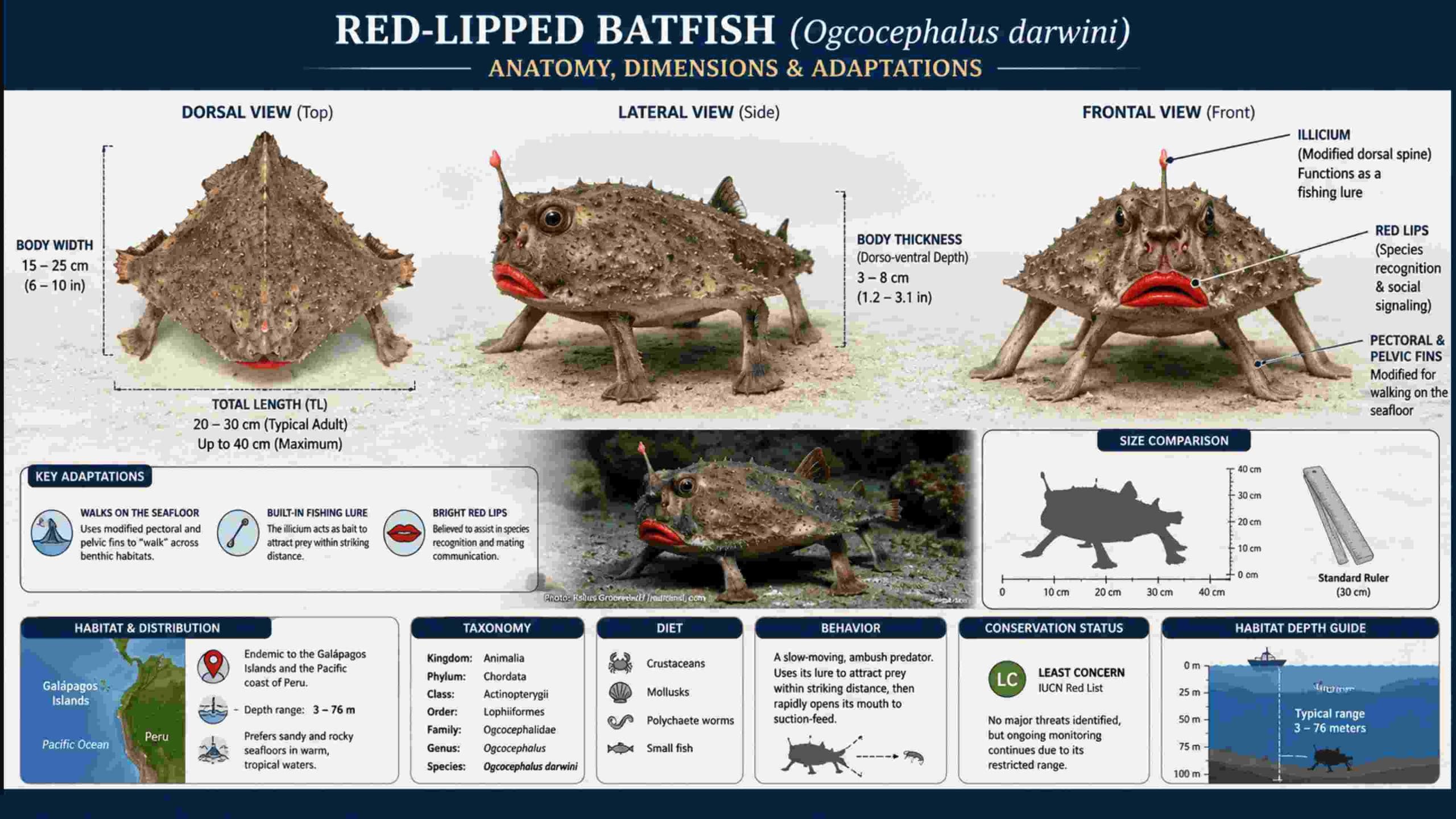
- Its body is dorsoventrally flattened, pressed flat from top to bottom, giving it a pancake-like profile that’s built for resting on the seafloor, not swimming through open water.
- The fin structures used for walking contain internal bony supports rigid enough to bear the animal’s body weight, unlike the soft, flexible fins of typical swimming fish.
- Its eyes sit high on its head and angle upward, useful for an ambush predator that spends most of its life watching for prey passing overhead.
- Its diet consists of small crustaceans, mollusks, polychaete worms, and occasionally small fish, captured through patient ambush rather than active pursuit.
- Because it barely moves, its energy demands are low. A single successful ambush can sustain it for an extended stretch without needing to hunt again. This low-energy hunting strategy is also seen in several other members of the Ogcocephalidae family that inhabit the ocean floor.
- The genus name Ogcocephalus comes from Greek roots roughly meaning “swollen head,” a nod to the bulky forehead structure that houses its lure.
- Documented natural predators are limited in scientific literature, but larger bottom-feeding fish are considered the most likely threat, given its slow movement and lack of any active defenses.
Wild Facts About Where and How It Lives
- The Galápagos region sits at the meeting point of the cold Humboldt Current and the warm Panama Current, creating nutrient-rich waters that support unusually dense marine biodiversity.
- It’s rarely spotted outside the Galápagos Marine Reserve, which makes a sighting a genuine highlight for divers rather than a routine occurrence.
- Because it’s camouflaged, sedentary, and solitary, researchers frequently rely on remotely operated vehicles (ROVs) and baited camera traps to study it without disturbing natural behavior.
- Its overall body coloration, brownish-gray with dark mottling, blends in well with sandy seafloors. The red lips are the one part of its body that isn’t trying to hide at all.
- Reproduction happens through external fertilization. Females release eggs into open water, males fertilize them externally, and no parental care has been documented afterward.
- Precise lifespan data for wild individuals doesn’t exist yet. Related Ogcocephalidae species are estimated to live 5 to 12 years, based on comparative studies rather than direct long-term tracking.
- It’s currently listed as Least Concern by the IUCN, with the Galápagos Marine Reserve providing strong protection for its core habitat.
Myth vs. Fact
| Myth | Fact |
|---|---|
| “It’s a hoax or edited photo” | It’s a genuine, scientifically described species dating back to 1864. |
| “It’s venomous or dangerous” | No venom, no toxins, and no documented harm to humans exist in the scientific record. Compare that to a truly dangerous bottom-dweller like the stonefish, which is one of the most venomous fish in the ocean. |
| “It swims normally like other fish” | It primarily walks along the seafloor and only swims in short defensive bursts. |
| “All batfish have red lips” | Only Ogcocephalus darwini has this trait; most of its 60+ relatives don’t. |
| “The red lips help it hide” | The opposite is true, the color makes it more visible, not less. |
Red-Lipped Batfish Facts for Kids
- It’s a real fish that lives at the bottom of the ocean near the Galápagos Islands.
- Instead of swimming everywhere, it walks along the sand using its fins like tiny legs.
- It has a little “fishing rod” on its head that it uses to lure smaller animals close enough to eat.
- Its lips are bright red, like it’s wearing lipstick, and scientists still aren’t 100% sure why.
- It’s completely harmless, no sting, no poison, no bite worth worrying about.
- It’s named after Charles Darwin, the scientist famous for studying animals in the same islands where this fish lives.
Frequently Asked Questions
If you’re still curious, these additional Red-Lipped Batfish Facts answer some of the most common questions people ask online.
What is one interesting fact about the red-lipped batfish?
It hunts using a built-in lure on its forehead called an illicium, the same hunting strategy used by deep-sea anglerfish, just adapted for shallow Galápagos waters.
What is a fun fact about red-lipped batfish?
It prefers walking over swimming. It uses modified fins like little legs to move across the seafloor and only swims in short bursts when threatened.
Is there a Wikipedia page for the red-lipped batfish?
Are red-lipped batfish dangerous?
No. They’re not venomous, not toxic, and have no documented history of harming humans. They’re also extremely slow-moving and non-aggressive.
Why does the red-lipped batfish have red lips?
The leading theory is species and mate recognition in low-visibility sandy environments. It’s still an open question in marine biology, and no theory has been fully confirmed.
How many red-lipped batfish facts are there really?
Dozens, honestly, from its walking fins to its forehead lure to its restricted Galápagos habitat. This page collects 50 of the most verified and interesting ones in one place.
You Might Also Like
We hope these Red-Lipped Batfish Facts helped you understand why this remarkable fish is one of the ocean’s most unusual creatures.
- Red-Lipped Batfish: Full Species Guide
- Anglerfish: Deep-Sea Hunter With a Built-In Lure
- Blobfish: Why the World’s Saddest-Looking Fish Actually Makes Sense
- Ghostfish: The Deepest Fish Ever Found on Earth
- Barreleye Fish: The Deep-Sea Creature With a Transparent Head
- Dorado Octopus: The Shape-Shifting Predator of the Pacific
- Mudskippers: The Fish That Walks on Land
Sources
- FishBase: Ogcocephalus darwini — species record, taxonomy, and distribution data
- IUCN Red List — conservation status assessment
- Galápagos Conservation Trust — habitat and marine reserve information
- NOAA Fisheries — oceanographic and benthic habitat data
- Wikipedia: Red-lipped batfish — general reference overview
About the Author
Mubashir Razzaq writes and researches for StrangeHappen.com, covering everything from marine biology and archaeology to astronomy, evolutionary science, and the occasional weird animal story. He’s not locked into one specialty. What matters to him is getting the facts right: checking peer-reviewed research and credible sources before he writes a single word. That’s the whole point of StrangeHappen.com, taking strange, fascinating discoveries from the ocean, ancient history, and space, and telling them straight, with real sourcing behind every claim.