
Imagine watching a visitor arrive from a place no human has ever seen.
Not from another planet. Not from the frozen edge of our Solar System. But from a completely different star system, somewhere deep inside the Milky Way, where different suns shine over worlds we have never named.
That is exactly what happened on July 1, 2025, when interstellar comet 3I ATLAS crossed into our cosmic neighborhood. Within hours of its discovery by the NASA funded ATLAS survey telescope in Chile, astronomers understood they were watching something extraordinary. A genuine traveler from another part of the galaxy had arrived, carrying chemistry that formed billions of years ago around a star that may no longer even exist.
As observatories around the world pointed their instruments toward the object, one question dominated public conversation and scientific circles alike. Could this mysterious visitor carry any evidence of alien tech?
The answer surprised almost everyone.
No alien tech was found. No artificial signals. No transmissions from the dark.
But what scientists did find instead was arguably more important. A historic James Webb Space Telescope discovery 2026 delivered a result that researchers had never achieved before. For the first time in the history of astronomy, methane detected interstellar object data was confirmed, providing a chemical fingerprint from a planetary system that no telescope in existence can directly observe.
The implications are still unfolding.
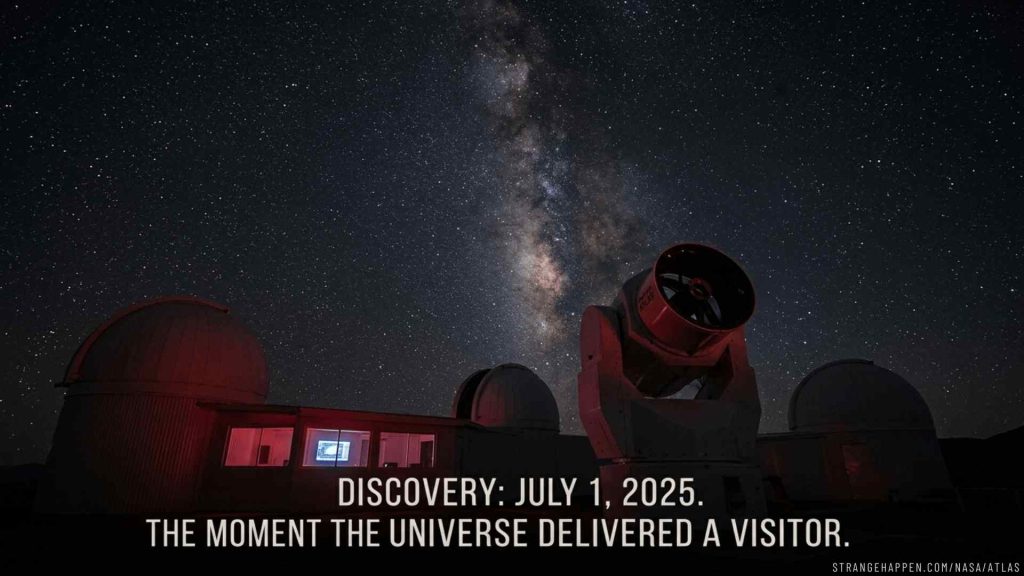
Table of Contents
What Is Interstellar Comet 3I ATLAS?
Interstellar comet 3I ATLAS is the third confirmed object ever recorded entering our Solar System from beyond its boundaries.
The name reflects that history. The first interstellar visitor, the cigar shaped 1I/Oumuamua, baffled scientists when it appeared in 2017. The second, 2I/Borisov, arrived in 2019 and proved far more cooperative, showing clearly cometary characteristics. Each arrival taught researchers something new. But interstellar comet 3I ATLAS arrived with a complexity neither predecessor could match.
According to NASA, the ATLAS survey telescope at Rio Hurtado, Chile first reported observations to the Minor Planet Center on July 1, 2025. Pre-discovery archival data later pushed the first recorded sighting back to June 14, 2025. Within days of its announcement, orbital calculations made the truth clear. Its trajectory was hyperbolic, meaning it did not originate from within our Solar System at all.
It was a comet from another star system, passing through our neighborhood on a path that had begun long before Earth formed.
NASA estimates the object is over a kilometer wide, composed of dust and ices from the far distant planetary system where it originated. According to Caltech graduate student Matthew Belyakov, lead author of the primary research paper published in The Astrophysical Journal Letters, “It has been traveling through the galaxy for at least a billion years. The high speed at which it flew past us gave just a narrow window to study it.”
That narrow window produced some of the most remarkable data in modern astronomy.
The Three Interstellar Visitors Compared
Before examining what scientists found, it helps to understand how interstellar comet 3I ATLAS fits into the brief history of confirmed interstellar visitors.
| Object | Year Discovered | Type | Key Characteristic |
|---|---|---|---|
| 1I/Oumuamua | 2017 | Uncertain | Elongated, no visible coma, unexplained acceleration |
| 2I/Borisov | 2019 | Comet | Typical cometary activity, water detected |
| 3I/ATLAS | 2025 | Comet | Methane detected, alien chemistry profile, highest scientific yield |
Oumuamua remains the most mysterious. Its unusual shape and non-gravitational acceleration generated years of debate, with some researchers speculating about artificial origin, though no consensus was reached. Borisov behaved far more like a typical comet and was studied extensively.
Interstellar comet 3I ATLAS sits in a different category entirely. Its chemical complexity, the breadth of the observation campaign it triggered, and the sheer number of NASA missions that turned their instruments toward it make this the most scientifically productive interstellar visitor ever detected.
Timeline of the 3I ATLAS Mission
Understanding the discovery requires following it through its stages.
June 14, 2025 – Pre-discovery observations captured by ATLAS telescopes, recovered from archival data.
July 1, 2025 -NASA funded ATLAS survey telescope in Chile officially discovers and reports interstellar comet 3I ATLAS to the Minor Planet Center.
July 2, 2025 – Within 23 hours of announcement, the SETI Institute’s Allen Telescope Array begins the alien tech search.
October 2025 – The comet reaches perihelion, its closest approach to the Sun, passing within 1.5 astronomical units.
December 15 to 16, 2025 – NASA’s James Webb Space Telescope conducts its first MIRI observation of the comet at approximately 329 million kilometers from the Sun.
December 27, 2025 – Webb conducts a second MIRI observation at approximately 379 million kilometers from the Sun.
Early 2026 – The comet crosses beyond Jupiter’s orbit, receding rapidly.
April 8, 2026 – The primary research paper by Belyakov and colleagues is published in The Astrophysical Journal Letters.
June 2026 — NASA and ESA jointly announce the full results of the James Webb Space Telescope discovery 2026, confirming the first ever methane detected interstellar object data in history.
Why Scientists Conducted an Alien Tech Search
The search for alien tech aboard an interstellar visitor is not as dramatic an idea as it might first appear.
The scientific reasoning is straightforward. NASA’s Voyager probes, launched in 1977, are already heading toward interstellar space. In millions of years, those spacecraft will become interstellar objects themselves, drifting through the galaxy. If an advanced civilization in a distant star system detected one of those probes, they might study it carefully before concluding it was an artificial construction.
The same logic applies in reverse.
Researchers at the SETI Institute decided to treat interstellar comet 3I ATLAS as a candidate worth examining. Using the Allen Telescope Array at the Hat Creek Radio Observatory in Northern California, the team conducted a comprehensive alien tech search across frequencies from 1 to 9 gigahertz. The observations commenced on July 2, 2025, approximately 23 hours after the initial ATLAS announcement.
The speed of that response was itself remarkable. As SETI Institute co-author Valeria Garcia Lopez of Furman University explained, the Allen Telescope Array’s rapid deployment capability was critical: “The results from 3I ATLAS show how realistic it is to detect a signal with the technology we have today. That is why it is important to keep searching for technosignatures, even from objects we might not expect to have signals.”
The alien tech search collected more than seven hours of observation data, detecting nearly 74 million narrowband frequency hits. Those hits were filtered methodically using radio frequency interference blanking and a localization algorithm called NBeamAnalysis, ultimately narrowing to 211 candidates for visual inspection.
Every single one of those 211 signals traced back to technology on Earth or Earth orbiting satellites.
No alien tech was detected. No artificial transmission. No signal that could not be explained by natural or human causes.
The alien tech search was published in The Astronomical Journal. The Breakthrough Listen program conducted a parallel alien tech search using the 100 meter Green Bank Telescope across frequencies from 1 to 12 gigahertz, also finding no detections down to the 100 milliwatt level. Multiple independent teams, using multiple instruments, arrived at the same conclusion. Interstellar comet 3I ATLAS is a completely natural object.
James Webb Space Telescope Discovery 2026: The Moment Everything Changed
While the alien tech search was underway, NASA and ESA were preparing something entirely different.
NASA mobilized an unusually broad observational campaign for interstellar comet 3I ATLAS, coordinating Webb, the Hubble Space Telescope, and the SPHEREx observatory alongside ground based networks, to characterize the comet across multiple wavelengths before it receded permanently from useful observational range.
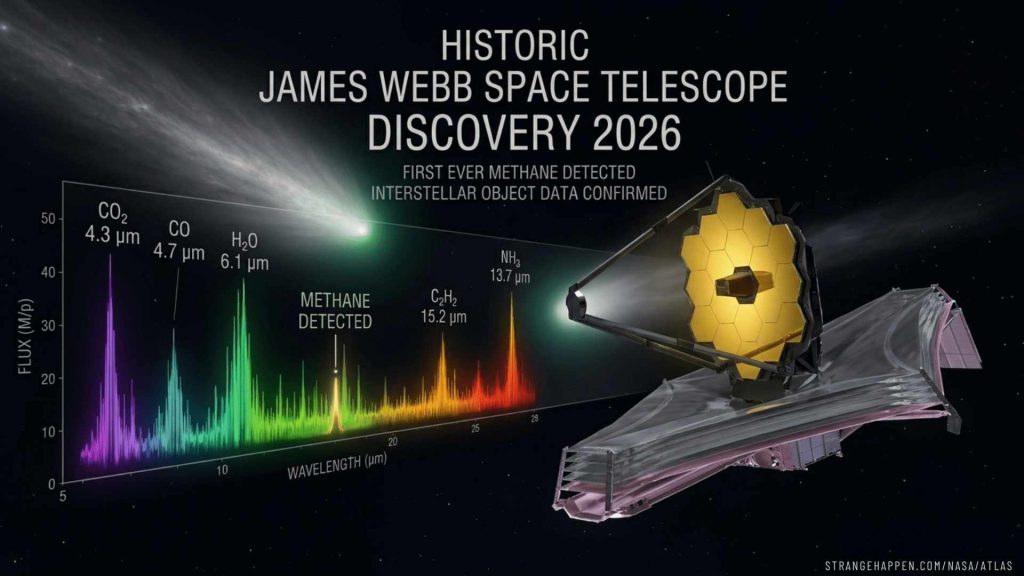
The centerpiece of that campaign was the James Webb Space Telescope discovery 2026, conducted using Webb’s Mid-Infrared Instrument, known as MIRI. Mid-infrared wavelengths, ranging from 5 to 28 micrometers, probe a different set of molecular transitions than near-infrared or visible light. MIRI can reach molecules that other instruments either miss entirely or cannot distinguish cleanly. That made it the ideal tool for reading the chemical fingerprint of a comet from another star system.
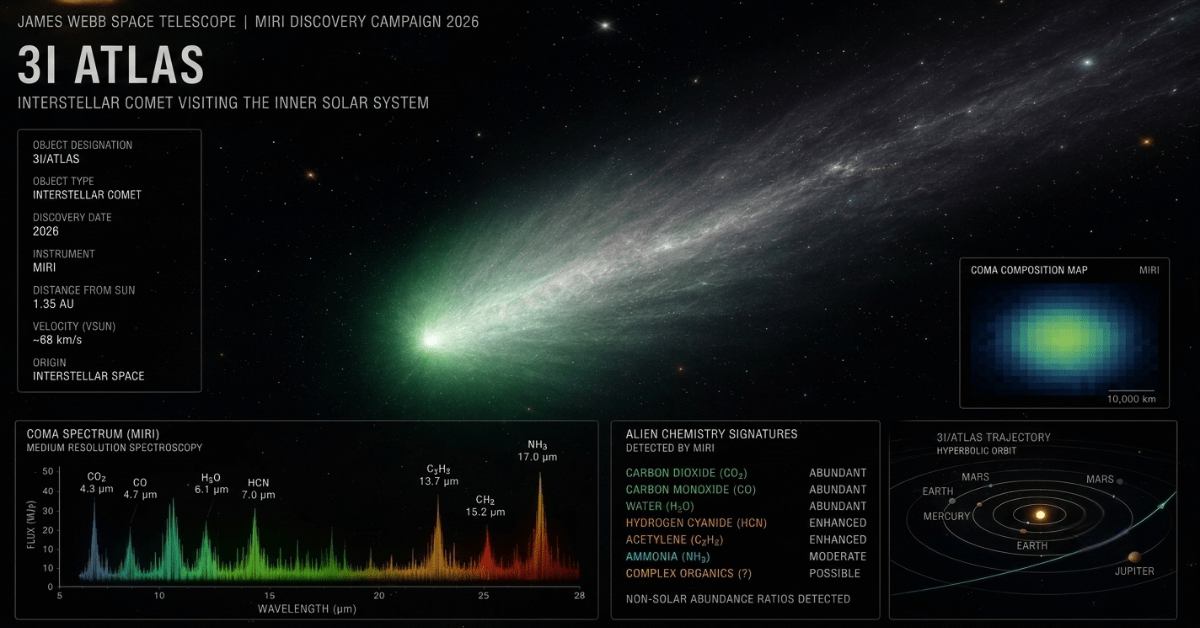
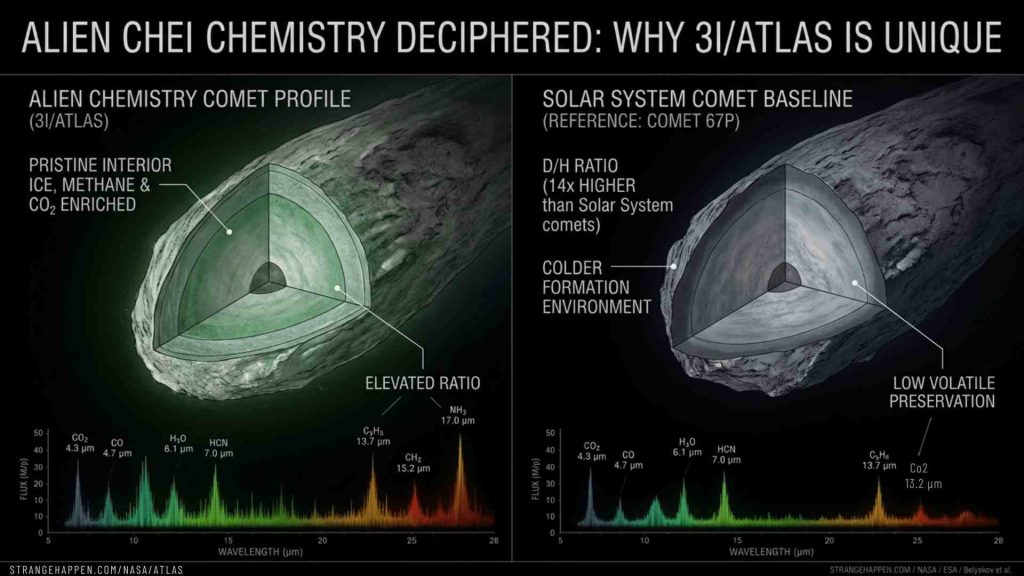
NASA and ESA announced the results together. The James Webb Space Telescope discovery 2026 produced the first mid-infrared chemical fingerprint ever obtained from any interstellar object in history. Webb detected water vapor, carbon dioxide, and methane surrounding the comet’s nucleus.
The methane result was the headline.
Methane and carbon dioxide were concentrated most densely near the comet’s nucleus, while water vapor spread far beyond it, released from icy grains throughout the coma. The spatial distribution of those gases, visible in Webb’s MIRI imagery, told scientists something important about how the comet was releasing its volatile inventory as solar heating penetrated its ancient layers.
The findings, led by Caltech graduate student Matthew Belyakov and co-first author Ian Wong of the Space Telescope Science Institute, appeared in The Astrophysical Journal Letters on April 8, 2026.
Methane Detected Interstellar Object: Why This Result Is Historic
The methane detected interstellar object confirmation is the most scientifically significant single result from the entire observation campaign.
Methane is extraordinarily volatile. Under most conditions in space, it transitions easily from solid ice into gas when exposed to even moderate heat. That instability makes it extremely difficult to preserve over long timescales. Most comets that formed within our own Solar System lost their methane reserves long ago.
The fact that researchers confirmed methane detected interstellar object material inside a body that traveled through the cold void between stars for at least a billion years tells scientists something profound. The comet spent most of its existence in a region of extraordinary cold, insulated from any meaningful stellar heating.
But there is a subtler and even more interesting layer to the methane detected interstellar object story.
As Belyakov and his team analyzed the MIRI data, they discovered something unexpected. When interstellar comet 3I ATLAS first approached the Sun, its surface was heavily irradiated by cosmic rays from its billion year journey, and its most volatile surface ices were only weakly outgassing. However, as the comet was leaving the Solar System in December 2025, after solar heating had penetrated deeper into its structure, methane emissions increased sharply.
That change indicated something remarkable. The comet had shed its ancient, radiation weathered outer layers and was now outgassing from its interior, revealing its true underlying composition for the first time.
The methane detected interstellar object data was not just a surface reading. It was a window into the pristine interior of a body that formed around a different star, preserved for billions of years, and finally opened by the brief warmth of our Sun.
Alien Chemistry Comet: A Profile Unlike Anything in Our Solar System
The term alien chemistry comet is not a casual description. It has a precise and scientifically meaningful application to interstellar comet 3I ATLAS.
When planetary scientists study comets from our own Solar System, they build up a reference database of expected chemical compositions. Most Solar System comets formed from the same vast cloud of gas and dust that eventually became our Sun and planets, so their chemistry broadly reflects that shared origin.
Interstellar comet 3I ATLAS formed somewhere entirely different, and its alien chemistry comet signature reflects that origin decisively.
According to the research published in The Astrophysical Journal Letters, the elevated methane and carbon dioxide ratios found in this alien chemistry comet indicate that its parent protoplanetary disk likely extended farther from its host star than our own did, or that the host star itself was cooler, producing a colder outer region where more volatile ices were preserved during planet formation. Both possibilities point toward a planetary system architecturally and thermally distinct from our own.
The alien chemistry comet profile also includes an unusual deuterium to hydrogen ratio in its methane, a factor of approximately 14 times higher than that measured in comet 67P/Churyumov-Gerasimenko by the European Space Agency’s Rosetta spacecraft. That elevated ratio is a natural consequence of formation in locally cold conditions within the protoplanetary disk and a prior interstellar cloud environment, conditions that are very different from those where our Sun and planets originated.
This alien chemistry comet is not merely chemically exotic. It is chemically diagnostic. Its composition constrains the architecture of an entirely alien planetary system that no telescope in existence can resolve directly.
Belyakov and colleagues described interstellar objects precisely in these terms, as “planetesimals that formed around other stars and were later ejected from their birth systems through dynamical interactions,” offering “discrete glimpses into extrasolar small-body populations and a valuable point of comparison for assessing commonalities and differences in planetesimal formation processes throughout the galaxy.”
What a Comet From Another Star System Tells Us About the Galaxy
Every comet from another star system that enters our Solar System is, in a very literal sense, a free sample delivered across interstellar distances.
Traditional astronomy works at a distance. Scientists observe exoplanets through telescopes, collect starlight that has traveled across light years, and use computational models to infer what those distant worlds might be like. That method is powerful, but it has clear limits. Chemical measurements from a comet from another star system bypass those limits entirely.
No spacecraft had to cross light years. No multi-decade mission was required. The galaxy delivered a sample to our doorstep, and humanity had the instruments to read it.
The implications extend well beyond this single comet from another star system. According to NASA, scientists estimate that an interstellar object may pass through our Solar System approximately once per year. With increasingly powerful telescopes coming online in the coming decades, detections will become more frequent.
Each new comet from another star system will add another data point to a growing comparative database. Over time, that database will allow scientists to map the chemical diversity of planetary systems across the Milky Way, not through remote observation but through direct chemical analysis of material that has physically visited us.
What Multiple NASA Missions Observed
The observation campaign for
was the broadest ever mounted for an interstellar object.
According to NASA, assets that gathered observations included the Hubble Space Telescope, Webb, TESS, Swift, SPHEREx, the Perseverance Mars rover, Mars Reconnaissance Orbiter, MAVEN, Europa Clipper, Lucy, Psyche, Parker Solar Probe, PUNCH, and ESA’s SOHO spacecraft.
The Hubble Space Telescope captured detailed imaging of the comet’s coma structure. SPHEREx contributed infrared observations in December 2025. Even NASA’s Mars fleet, including Perseverance on the Martian surface and orbiters overhead, recorded observations from their unique vantage point in the inner Solar System.
The breadth of that campaign reflects how seriously NASA treated the arrival of this comet from another star system. It was a once in a generation opportunity, and the agency mobilized accordingly.
Expert Insights: What Researchers Said
The scientists involved in studying
were direct about the significance of what they found.
Matthew Belyakov of Caltech, lead author of the methane detection paper, described the comet as “a very interesting object” that had been “traveling through the galaxy for at least a billion years,” emphasizing that the high speed of its passage left scientists with a critically narrow observational window.
SETI Institute co-author Valeria Garcia Lopez of Furman University framed the alien tech search results not as a failure but as a demonstration of capability, noting that the results showed “how realistic it is to detect a signal with the technology we have today” and why it remains important to keep searching for technosignatures even from objects not expected to show them.
The research teams from Caltech, the Space Telescope Science Institute, Auburn University, Eureka Scientific, and Johns Hopkins University who contributed to the Astrophysical Journal Letters paper collectively described interstellar objects as offering “discrete glimpses into extrasolar small-body populations,” a phrase that captures precisely what makes each new arrival scientifically irreplaceable.
Why It Matters: A Summary of the Key Discoveries
Several major findings emerged from the international observation campaign.
Researchers confirmed beyond doubt that interstellar comet 3I ATLAS originated entirely outside the Solar System, based both on its trajectory and its chemistry.
The SETI Institute’s alien tech search, conducted with the Allen Telescope Array within 23 hours of discovery and collecting over seven hours of data, found no evidence of artificial signals of any kind. Parallel searches by Breakthrough Listen using the Green Bank Telescope reached the same conclusion.
The James Webb Space Telescope discovery 2026, conducted using the MIRI instrument in December 2025 and published in The Astrophysical Journal Letters in April 2026, detected water vapor, carbon dioxide, and methane surrounding the comet.
Scientists achieved the first confirmed case of methane detected interstellar object data in the history of astronomy.
The alien chemistry comet profile identified by Webb differs fundamentally from Solar System comets, with unusually elevated methane and carbon dioxide ratios and a deuterium to hydrogen ratio approximately 14 times higher than comet 67P.
These molecular ratios point to a formation environment colder and more distant from its host star than the region where Solar System comets developed, constraining the architecture of an alien planetary system that cannot be directly observed.
What Scientists Still Do Not Know
Despite the extraordinary progress, several genuinely open questions remain.
Researchers have not yet identified the specific star system that produced this comet from another star system. Tracing its trajectory backward through space narrows the possibilities, but the Milky Way contains hundreds of billions of stars, and the comet has been traveling for so long that pinpointing its precise origin may prove impossible.
The exact age of the object remains uncertain beyond the lower bound of approximately one billion years.
The high deuterium to hydrogen ratio observed in the methane hints at a formation environment rich in interstellar cloud chemistry, but the precise conditions of that environment remain a subject of active theoretical modeling.
Some researchers wonder whether the organic chemistry within this alien chemistry comet carries any connection to the building blocks of life. That remains firmly in the territory of scientific speculation rather than evidence, but it is a question the data has legitimately placed on the table.
Future Research and What Comes Next
The scientific community has not finished with the legacy of interstellar comet 3I ATLAS, even as the object itself recedes permanently into the darkness.
As of early 2026, the comet was already past Jupiter’s orbit and becoming increasingly difficult to observe. It will not return. But the datasets it generated will sustain research for years to come, and NASA has committed those archives to public access so that scientists worldwide can continue extracting insights.
The alien tech search methodology developed for 3I ATLAS will serve as a template for future interstellar visitors. As next generation radio arrays come online with significantly greater sensitivity, future searches will be more thorough and more capable of detecting weaker signals if any exist.
The James Webb Space Telescope discovery 2026 has also renewed serious discussion within the planetary science community about the feasibility of intercepting a future interstellar visitor before it departs. Such a mission would require detecting the object earlier in its approach and launching an intercept spacecraft on a rapid trajectory. The engineering challenges are substantial. But the scientific rewards, potentially including direct sample collection from a comet from another star system, would be transformational.
Key Takeaways
Interstellar comet 3I ATLAS was discovered July 1, 2025 by the NASA funded ATLAS survey telescope in Chile and is the third confirmed interstellar visitor ever detected.
The SETI Institute’s Allen Telescope Array began an alien tech search within 23 hours of discovery, scanning over 74 million frequency hits across more than seven hours of observation, finding no artificial signals of any kind.
The James Webb Space Telescope discovery 2026, conducted using the MIRI instrument in December 2025 and published April 8, 2026 in The Astrophysical Journal Letters by researchers from Caltech and the Space Telescope Science Institute, detected water vapor, carbon dioxide, and methane surrounding the comet.
Scientists achieved the first confirmed case of methane detected interstellar object data in astronomical history.
The alien chemistry comet signature of 3I ATLAS, including elevated carbon dioxide ratios and a deuterium to hydrogen ratio approximately 14 times higher than comet 67P, indicates it formed in a colder, more distant region of an alien planetary system.
Multiple NASA missions including Hubble, Webb, TESS, SPHEREx, Perseverance, and others contributed to the broadest interstellar object observation campaign ever mounted.
FAQ
What is interstellar comet 3I ATLAS? It is the third confirmed object known to have entered our Solar System from interstellar space, discovered July 1, 2025 by the NASA funded ATLAS survey telescope in Chile. It is over a kilometer wide and has been traveling through the Milky Way for at least a billion years.
Did scientists find alien tech aboard the comet? No. The alien tech search conducted by the SETI Institute’s Allen Telescope Array, along with a parallel search by the Breakthrough Listen program using the Green Bank Telescope, found no evidence of artificial signals, transmissions, or technology of any kind.
Who led the alien tech search? Lead author Sofia Z. Sheikh of the SETI Institute led the Allen Telescope Array search, published in The Astronomical Journal. Co-author Valeria Garcia Lopez of Furman University emphasized that the results demonstrate how realistic signal detection with current technology has become.
What did the James Webb Space Telescope discover in 2026? The James Webb Space Telescope discovery 2026, led by Caltech graduate student Matthew Belyakov and published in The Astrophysical Journal Letters, produced the first mid-infrared chemical fingerprint of any interstellar object, detecting water vapor, carbon dioxide, and methane surrounding interstellar comet 3I ATLAS.
Why is methane detected interstellar object data so significant? Methane is highly volatile and difficult to preserve over billions of years. Its presence inside this comet, confirmed by the methane detected interstellar object observations, indicates the object formed in an extraordinarily cold environment far from its host star, and that solar heating during its departure from our Solar System finally exposed its pristine interior layers.
What makes the alien chemistry comet profile of 3I ATLAS unusual? Its elevated methane and carbon dioxide ratios, combined with a deuterium to hydrogen ratio roughly 14 times higher than that measured in Solar System comet 67P, indicate it formed under conditions fundamentally different from those that produced comets in our own system.
Which NASA missions observed the comet? NASA coordinated observations from Hubble, Webb, TESS, Swift, SPHEREx, Perseverance, Mars Reconnaissance Orbiter, MAVEN, Europa Clipper, Lucy, Psyche, Parker Solar Probe, PUNCH, and ESA’s SOHO, making it the broadest interstellar object campaign in history.
Is interstellar comet 3I ATLAS dangerous to Earth? No. NASA confirmed there is no threat to Earth from this object.
Will scientists be able to identify where it came from? Tracing its general trajectory through the galaxy is possible, but pinpointing a specific parent star system is extremely difficult given the duration and distance of its journey.
What happens to it next? Interstellar comet 3I ATLAS will not return. It is already past Jupiter’s orbit as of early 2026 and will eventually exit the Solar System permanently, continuing its journey through the Milky Way.
Source References
- NASA Science Webb Detects Methane on Interstellar Comet 3I/ATLAS
- The Astrophysical Journal Letters Belyakov et al. 2026 — The Volatile Inventory of 3I/ATLAS as Seen with JWST/MIRI
- The Astronomical Journal Sheikh et al. 2025 — A Search for Radio Technosignatures from Interstellar Object 3I/ATLAS with the Allen Telescope Array
- SETI Institute Signs of Technology Search in Interstellar Visitor 3I/ATLAS
- Caltech News Interstellar Comet Reveals Methane on Its Journey Through Our Solar System
- NASA Solar System Comet 3I/ATLAS Official Page
- European Space Agency ESA Joint Announcement with NASA, June 2026
About the Author
Strangehappen.com explores scientific discoveries, space exploration, ancient mysteries, archaeology, and natural phenomena. Our mission is to transform complex research into engaging, evidence-based stories that help readers understand the remarkable universe around us.