
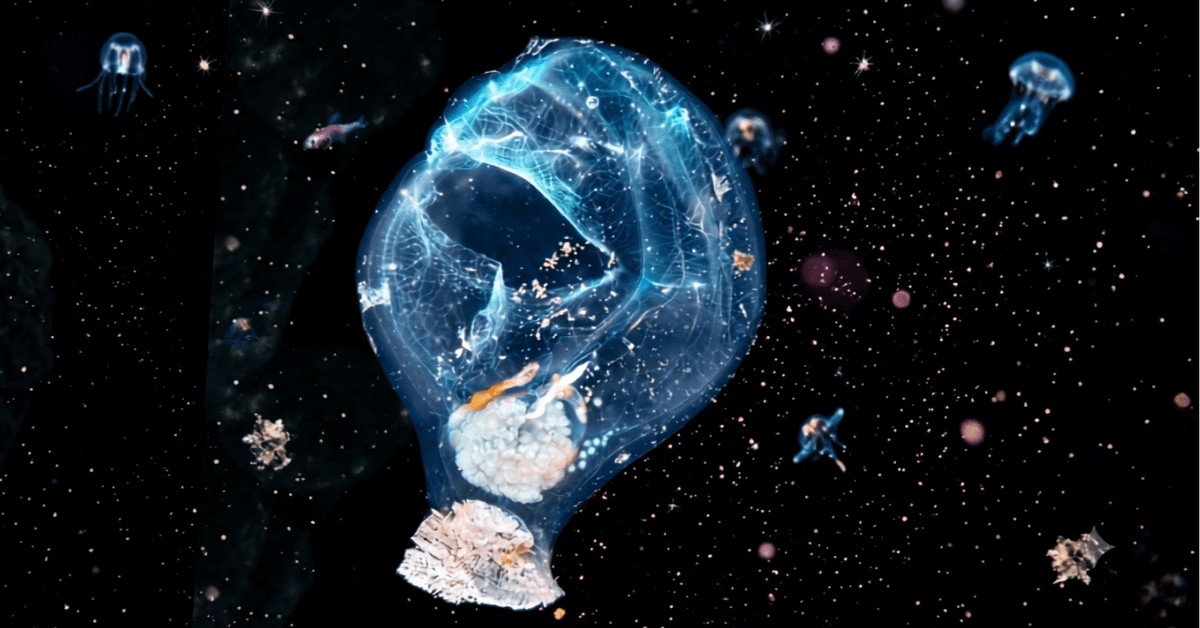
A newly discovered deep sea creature found in 2025 sits in total darkness at the bottom of the Indian Ocean, mouth permanently wide open, perfectly still, waiting. Scientists named it after Tolkien’s Elvish language. It is 100% real, peer-reviewed, and it just made the World Register of Marine Species Top 10 list.
Table of Contents
At a Glance: Key Facts
| Scientific Name | Kaikoja undume |
| Discovery Depth | 2,000 to 4,000 meters |
| Location Found | Indian Ocean, Western Australia |
| Collected | March 2020, published Dec 2025 |
| Research Vessel | R/V Falkor, Schmidt Ocean Institute |
| Lead Researcher | Peter Mandre, Scripps Institution of Oceanography |
| Name Origin | Quenya (Tolkien’s Elvish language) |
| Recognition | WoRMS Top 10 Marine Species 2025 |
| Holotype Specimen | WAM Z100624, Western Australian Museum |
Picture yourself 4,000 meters below the surface of the ocean. No sunlight. No sound. The pressure is so intense it would crush a human body in seconds. And somewhere along the rocky wall of a submarine canyon, completely still in the cold dark, something holds its mouth open. Wide. Patient. It is not chasing anything. It is not moving at all. It is simply waiting the way a trap waits.
That creature is real. It has a name. Scientists call it the Elven Abyss Tunicate, and its formal scientific description was published to the world in December 2025. Most mainstream outlets barely covered it. But this new marine species discovered in the deep waters off Western Australia is genuinely one of the strangest animals confirmed on this planet.
What Is the Elven Abyss Tunicate?
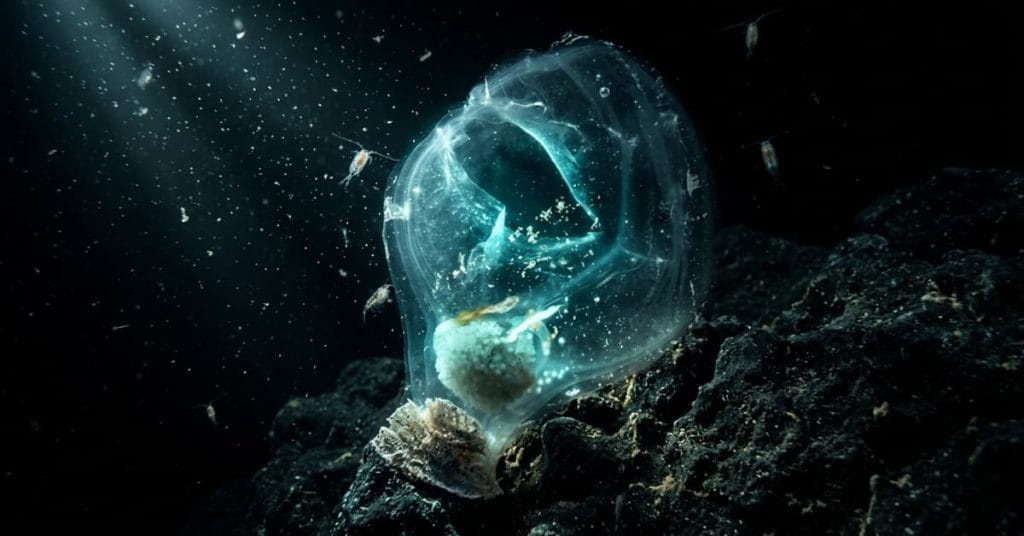
The Elven Abyss Tunicate, known scientifically as Kaikoja undume, belongs to a rare and unusual family of predatory sea animals called Octacnemidae. Tunicates like this one are more commonly known as sea squirts, or by their formal class name, ascidians. They’re shaped like a bag with two siphons, one drawing water in and one pushing it out. To understand why that matters, you need a quick look at what tunicates normally are and what makes this one so different. Kaikoja undume is one of three species in the newly created genus Kaikoja, all described in the same 2025 study. Mandre said the genus is rather weird considering how different the three species are, but shared traits across all three made the diagnosis clear.
Most Tunicates Are Passive Filter Feeders
The tunicate family is enormous and diverse. The vast majority of species filter tiny plankton by drawing water through their bodies, like the Skeleton Panda Sea Squirt, one of the more striking examples of this passive-feeding lifestyle. They are humble, quiet and largely unremarkable from a behaviour standpoint. The Elven Abyss Tunicate shares their body plan on the surface but evolved in an entirely different direction.
This One Became an Active Predator
Some researchers have taken to calling this group of animals the ocean’s carnivorous sea squirts, a fair label given what comes next. At depths between 2,000 and 4,000 meters, plankton is almost non-existent. The Elven Abyss Tunicate solved that food scarcity problem through evolution by transforming its oral siphon, normally a small water intake tube, into a massive permanently gaping trap. It works almost exactly like a Venus flytrap sea creature mechanism. The mouth stays open, oriented into the current. Small animals and copepods drift in. They do not drift back out.
Why is it called the Venus Flytrap of the Deep? The Elven Abyss Tunicate shares its hunting strategy with several completely unrelated deep sea animals. Certain eels, sea anemones, and jellies have independently evolved the same passive trap design. The deep ocean keeps reinventing this method because it works with almost zero energy expenditure.
The study was led by Peter Mandre, a graduate student at Scripps Institution of Oceanography at UC San Diego, alongside Professor Greg Rouse. It was formally published in the peer-reviewed journal Diversity in December 2025.
Where and How Was It Discovered?
The Expedition: Ningaloo Canyons, March 2020
The expedition was led by Nerida Wilson, a Scripps Visiting Scholar, aboard the R/V Falkor. The physical specimens were collected five years before the 2025 publication. In March 2020, the research vessel R/V Falkor, operated by the Schmidt Ocean Institute, was conducting a scientific expedition called “Illuminating Biodiversity of the Ningaloo Canyons” off the northern coast of Western Australia near Cape Range Canyon in the Indian Ocean.
Scientists deployed a remotely operated vehicle, ROV SuBastian, to reach depths no human could survive unprotected. During those dives, the ROV came across translucent gaping creatures attached directly to rocky canyon walls. Samples were collected using a specialized suction device. The exact recorded coordinates were 21.97°S, 113.17°E in the Indian Ocean.
Five Years in a Museum Container
This is how new marine species discovered in the modern era actually work. Collecting a specimen is the beginning, not the end. Scientists must then conduct DNA analysis, morphological comparison against every known related species, peer review, and formal taxonomic description before a creature is officially recognized. That process took five years. The full taxonomic description was published as Mandre, P. and Rouse, G.W. (2025), “Molecular Phylogeny of the Deep-Sea Predatory Octacnemidae (Ascidiacea, Tunicata, Chordata), with Seven New Species,” in the journal Diversity, 17(12): 859.
The same 2025 study described seven new species across the deep-sea family Octacnemidae in total. Kaikoja undume was one of three species in the newly erected genus, alongside four other new species described elsewhere in the family.
On March 19, 2026, which is World Taxonomist Appreciation Day, the World Register of Marine Species named the Elven Abyss Tunicate one of the Top 10 Most Remarkable New Marine Species of 2025. That honour goes to fewer than 10 species out of 2,500 or more newly identified that year.
The Lord of the Rings Connection: Why Tolkien?
The scientific name Kaikoja undume is not rooted in Latin or Greek, the traditional languages of taxonomy. It comes directly from Quenya, the fictional Elvish language invented by J.R.R. Tolkien, author of The Lord of the Rings.
The Source: Tolkien’s “Markirya Poem”
Decades before The Lord of the Rings was published, Tolkien composed a poem called “The Markirya Poem” entirely in his invented Elvish tongue. Within it, the phrase undume hácala appears, translating roughly to “abyss yawning.” Researchers felt the phrase captured this strange ocean animal with almost poetic accuracy. A creature living in the pitch-black abyss with its mouth permanently yawning open in the dark.
“I stumbled upon the poem after reading about Tolkien’s Quenya, or Elvish, language,” said Mandre, lead author of the paper. “I love Middle-earth, especially The Hobbit, and thought an Elvish species name would be wonderful, especially since the elves have this connotation of caring for the world they live in, a lifestyle we should all strive to contribute to.”
What the Full Name Means
Kaikoja comes from the Elvish word for “living,” meaning the living one. Undume derives from “abyss yawning” in Tolkien’s Quenya language. Together it means the living one who yawns in the abyss.
The researchers also added that any small creature drifting through those deep waters shall not pass, a reference every Tolkien fan recognizes immediately.
It is one of the most genuinely fitting and creative scientific names in recent memory, and it is a big part of why this discovery captured attention well beyond the marine biology community.
How Does It Hunt? The Deep Sea Venus Flytrap Explained
The Problem: Almost No Food at 4,000 Meters
The deeper you go in the ocean, the less plankton exists. At 3,000 to 4,000 meters, the water is near freezing, completely dark, and largely empty by surface standards. Filter feeding simply does not work down there. There is almost nothing to filter.
The Solution: Become a Living Trap
The Elven Abyss Tunicate permanently attaches itself to a rocky canyon surface and opens its mouth to the current. Its oral siphon has evolved into a large cavernous hood-like structure, wide open and oriented toward incoming water flow. When copepods, tiny crustaceans, or other small drifting organisms pass too close, the siphon contracts around them. The hunt requires almost no energy expenditure. It is pure efficiency.
Once anchored, the animal never needs to move again. It simply lets the current do the work.
Why Transparency? The Science Behind It
Like many deep sea creatures 2025 and beyond, the Elven Abyss Tunicate is nearly completely transparent. Peter Mandre noted genuine surprise at how visually striking and otherworldly the specimens appeared. The reason for that transparency is straightforward evolutionary logic. No sunlight means colour serves no survival purpose at 4,000 meters depth. Producing pigment costs metabolic energy the animal does not need to spend. In a near-pitch-black environment, transparency is functionally invisible to prey. This adaptation has been independently evolved in dozens of unrelated deep sea creatures.
The considerable transparency of these organisms is incredible,” said Mandre. “I know most people have a favorite color, but after working with these specimens, I can say I have a newfound appreciation for transparent and translucent animals
Habitat: Inside the Submarine Canyons of Western Australia
The Ningaloo Canyon system off Western Australia where this deep sea creature 2025 was found is a dramatic geological formation, an underwater equivalent of the Grand Canyon, carved by ancient sediment flows and geological shifts over millions of years. The canyon walls provide exactly the rocky surfaces the Elven Abyss Tunicate requires to anchor itself.
Conditions at 4,000 Meters Depth
Temperature sits just above freezing, typically 1 to 4 degrees Celsius. Pressure is approximately 400 atmospheres, which is 400 times sea-level pressure. Light is at absolute zero because no sunlight penetrates beyond 1,000 meters. Food availability is extremely scarce compared to shallow-water environments. Adult specimens are sessile, meaning they are permanently fixed to canyon walls once attached.
Sessile deep-sea life like this isn’t unique to tunicates. The Antarctic Feather Star anchors itself to the seafloor in a similar way, just in far colder waters. Specimens were mostly found individually spread across canyon walls. Small clusters appear occasionally in areas where current patterns concentrate food delivery. But this is largely a solitary creature, spread across the dark geography of the deep ocean floor.
Life Cycle: From Free-Swimming Larva to Motionless Hunter
Despite their simple adult appearance, tunicates are among the closest living invertebrate relatives of vertebrates on the evolutionary tree. Genetically, they sit nearer to humans than most other invertebrates do. Their life cycle is one of the most remarkable in the animal kingdom.
Stage 1: The Tadpole Larva
Every Elven Abyss Tunicate begins as a tiny free-swimming larva that looks almost exactly like a microscopic tadpole. For a brief window of hours to a few days, it actively swims through the water column. At this larval stage it has a notochord, the same primitive backbone-like structure found in all chordate animals including humans, along with a functional nerve cord and a muscular tail.
Stage 2: The Transformation
Once the larva finds a suitable rocky surface, it attaches head-first using specialized adhesive structures. What follows is one of biology’s more remarkable events. Within roughly 24 hours, the animal undergoes radical self-reorganization. The tail is reabsorbed into the body completely. The notochord disappears. The nervous system reduces to a single small ganglion. The body is rebuilt from scratch for stationary predatory adult life.
Stage 3: The Adult Predator
From attachment onward, the adult strange ocean animal remains fixed to its surface permanently, growing slowly in the cold and dark over years, mouth open to the current, waiting for every meal to come to it. Tunicates are hermaphroditic, meaning each individual produces both eggs and sperm, releasing them into the water column where external fertilization produces the next generation of swimming larvae.
Is the Elven Abyss Tunicate Dangerous to Humans?
No, and the reasons are worth stating clearly because this creature’s predatory reputation can mislead people.
The depth of 4,000 meters is completely inaccessible without deep-sea submersibles. Pressure alone would be instantly fatal to an unprotected human. Its prey consists of copepods and tiny crustaceans measured in fractions of a millimeter. Its trap is scaled to microscopic prey. The animal is sessile and stationary and cannot chase, pursue, or interact with anything human-scale. And it lives in deep submarine canyons in remote Indian Ocean waters, entirely outside any human habitat.
If anything, the risk runs in the opposite direction. Deep-sea mining operations and certain trawling gear can devastate canyon ecosystems. Related predatory tunicate species are known to grow extremely slowly, making them acutely vulnerable to habitat destruction. The creature that poses no threat to us may be threatened by us.
Why This Discovery Matters Beyond the Headlines
The Ocean Is Vastly Unexplored
Scientists currently estimate that between 80 and 91 percent of all marine species on Earth remain formally undescribed. The oceans cover 71 percent of this planet’s surface, reach depths of nearly 11,000 meters, and the majority of that environment has never been explored in any systematic detail. The Elven Abyss Tunicate is proof that genuinely extraordinary and completely unknown life forms are still present in places we have barely touched.
Roughly 240,000 marine species have been formally described so far, against an estimated 1 to 2 million believed to exist. Separate Ocean Census expeditions have logged over 1,100 additional candidate new species in a single recent survey year alone.
Pharmaceutical Research Potential
Tunicates as a group have drawn sustained interest from pharmaceutical researchers. Their bodies produce unusual chemical compounds, some of which have been investigated as candidates for cancer treatment and other medical applications. Every formally described new species represents a potential library of biological information with unpredictable medical value.
Evolutionary Science
Tunicates are genuine relatives of vertebrates on the evolutionary tree, a fact that surprises most people. Studying how a species like Kaikoja undume evolved active predation from filter-feeding ancestors in extreme environments gives biologists rare direct insight into how complex life adapts over millions of years.
Elven Abyss Tunicate vs. Related Deep Sea Hunters
| Feature | Elven Abyss Tunicate | Typical Tunicate | Venus Flytrap Anemone |
|---|---|---|---|
| Feeding Method | Passive trap (gaping mouth) | Filter feeding | Passive trap (tentacles) |
| Prey | Copepods, small crustaceans | Plankton, particles | Small crustaceans, fish larvae |
| Depth Range | 2,000 to 4,000 meters | Surface to 500 meters | 700 to 6,000 meters |
| Mobility | Sessile adult | Sessile or colonial | Sessile |
| Transparency | Near-complete | Variable | Partial |
The Ocean Still Has Secrets We Have Not Begun to Find
When people think about unexplained phenomena or undiscovered frontiers, the instinct is to look upward. At space. At distant planets. At galaxies billions of light-years away. But the most extraordinary unknown territory on this planet is directly beneath our feet, hidden under miles of water in a darkness that human technology only recently became capable of entering.
The Elven Abyss Tunicate is not mythology, not speculation, not a sensationalized science story. It is a verified, peer-reviewed, formally described strange ocean animal that has been sitting on a canyon wall in the Indian Ocean with its mouth open in the dark for millions of years. We found it only in 2020. We formally recognized it only in 2025.
And it is far from alone down there. The same deep-sea expeditions that brought us the Elven Abyss Tunicate have surfaced other genuinely strange discoveries. Take Ducibella camanchaca, a predatory creature found lurking in the oxygen-starved depths of the Pacific, or the Nereidid Worm, a deep-sea polychaete that rewrote what scientists thought they knew about worm evolution in extreme environments. Each one a reminder that the ocean keeps its secrets well.
It was there long before we had the machines to find it. So were they. What else is down there, still waiting?
Related Articles You May Like
- 10 Newly Discovered Species — see what else science found hiding in 2025 and 2026.
- Glass Octopus — another deep-sea animal that evolved to disappear.
- Yeti Crab — a fellow ROV-discovered deep-sea oddity.
- Lithoredo Abatanica: A Rock-Eating Worm — proof the ocean keeps inventing new ways to survive.
- Glass Sponges — more deep-sea transparency, explained.
- Ghostfish — another translucent hunter from the deep.
Frequently Asked Questions About the Elven Abyss Tunicate
What is the Elven Abyss Tunicate?
The Elven Abyss Tunicate is a newly described deep sea species named Kaikoja undume, belonging to the family Octacnemidae. It was discovered at depths of 2,000 to 4,000 meters off the coast of northern Western Australia and described in a study published in the journal Diversity in December 2025 by researchers Peter Mandre and Professor Greg Rouse of the Scripps Institution of Oceanography at UC San Diego.
Why is it called the Elven Abyss Tunicate?
The species name undume comes from the Elven language of Middle-earth created by author J.R.R. Tolkien. Decades before The Lord of the Rings was published, Tolkien wrote a poem in Elvish called The Markirya Poem, which contains the phrase undume hacala, meaning abyss yawning. Researchers chose this name because the tunicate’s oral siphon is typically found wide open, yawning in the dark abyss as it waits for prey to drift into its trap.
How deep does the Elven Abyss Tunicate live?
Specimens of Kaikoja undume were collected from depths ranging between 2,000 and 4,000 meters, equivalent to 6,500 to 13,100 feet below the ocean surface, off the coast of northern Western Australia. At these crushing depths there is zero sunlight, extreme pressure, and near-freezing temperatures. The species belongs to the deep sea family Octacnemidae whose members typically inhabit depths around 3,000 meters, approximately 2 miles below the surface.
How does the Elven Abyss Tunicate catch its food?
Unlike its shallow-water relatives that filter plankton from the water, Kaikoja undume has evolved a large Venus flytrap-like oral siphon that traps larger prey including copepods and other small deep-sea animals. The oral siphon remains open in the darkness of the abyss, waiting for unsuspecting prey to drift inside before snapping shut. This predatory adaptation is shared with other members of the Octacnemidae family and evolved as a response to the extreme scarcity of plankton at abyssal depths.
Who discovered the Elven Abyss Tunicate?
The Elven Abyss Tunicate was discovered and formally described by Peter Mandre, then a graduate student at Scripps Institution of Oceanography at UC San Diego, and Professor Greg Rouse. The specimens were originally collected in 2020 off northern Western Australia using remotely operated vehicles and preserved in the Scripps Oceanographic Collections before being formally described and published in Diversity journal in December 2025.
Why did the Elven Abyss Tunicate make the WoRMS Top 10 list?
The World Register of Marine Species selected Kaikoja undume as one of its top 10 remarkable new marine species of 2025, announced on Taxonomist Appreciation Day on March 19, 2026. WoRMS compiles its annual top 10 from more than 2,500 new marine species described each year, selecting those with the most significant scientific, biological, or cultural interest. The Elven Abyss Tunicate was chosen for its extraordinary predatory adaptation, its extreme depth habitat, and the creative Tolkien-inspired naming by Scripps researchers.
Is the Elven Abyss Tunicate related to common sea squirts?
Yes. Tunicates are commonly known as sea squirts and approximately 2,300 species exist worldwide. The Elven Abyss Tunicate belongs to the family Octacnemidae, which represents some of the most unusual members of this group. While shallow water tunicates filter microscopic plankton from the water through passive siphoning, deep sea Octacnemidae like Kaikoja undume have evolved into active predators with specialized trap-like oral structures to compensate for the near-complete absence of planktonic food at abyssal depths.
What other species were on the WoRMS Top 10 Marine Species list for 2025?
The World Register of Marine Species Top 10 list for 2025 included the Dragon Nematode Dracograllus miguelitus, the Sponge Ambusher Worm Eunice siphoninsidiator, the Golden Glow Zoantharian Corallizoanthus aureus, Iskra’s Glitter Worm Photinopolynoe iskrae, the Good Luck Flatworm Acanthobothrium goleketen, the Darth Vader Supergiant Isopod Bathynomus vaderi, the Nodule Crown Coral Deltocyathus zoemetallicus, the Atlantic Manta Ray Mobula yarae, and Poseidon’s Squid Mobydickia poseidonii alongside the Elven Abyss Tunicate Kaikoja undume.
Can you eat a tunicate?
Yes, several tunicate species are eaten as delicacies in South Korea, Japan, Chile, and parts of the Mediterranean and France. The most common is the sea pineapple, Halocynthia roretzi, served raw in Korea as meongge. Most tunicate species are not eaten though, only a handful of solitary species are wild-harvested or farmed for food.
Is a tunicate a sea squirt?
Yes, sea squirt is the common name for tunicates in the class Ascidiacea, the largest and most familiar group within the subphylum Tunicata. The name comes from their habit of squirting water through their siphons when disturbed. Not every tunicate is a sea squirt though, since the subphylum also includes free-swimming salps and larvaceans.
What are Incurrent and Excurrent siphons in Urochordata?
The incurrent siphon draws water into a tunicate’s body, where cilia move it across a mucus-coated pharynx that filters out food particles and pulls oxygen from the water. The excurrent siphon then pushes the filtered water back out. Urochordata is an older scientific name for the subphylum now more commonly called Tunicata.
How do tunicates defend themselves?
Tunicates rely mainly on a tough outer tunic, made partly of tunicin, a cellulose-like substance rare in animals, to resist predators. Some species also concentrate vanadium and other chemicals in their tissues, making their bodies acidic and unpalatable. Despite these defenses, sharks, skates, snails, and crustaceans still prey on them regularly.
Verified Sources
| Source | Direct Link |
|---|---|
| Schmidt Ocean Institute | schmidtocean.org |
| Scripps Institution of Oceanography, UC San Diego | scripps.ucsd.edu/news/two-scripps-named-marine-species-make-top-10-list |
| World Register of Marine Species (WoRMS) Top 10 List | marinespecies.org/worms-top-ten/2025 |
| WoRMS Species Entry for Kaikoja undume | marinespecies.org/aphia.php?p=taxdetails&id=1864678 |
| Schmidt Ocean Institute | schmidtocean.org |
About the Author
Mubashir Razzaq, the researcher and writer behind Strange Happenings. For the past few years I’ve covered paranormal cases, unexplained phenomena, deep-sea discoveries, and historical mysteries, working directly from primary sources: peer-reviewed studies, official expedition reports, museum records, and government archives. I don’t pad stories with speculation dressed up as fact. If a claim can’t be traced back to a document or a named researcher, it doesn’t make it into the piece. My job is to lay out what’s actually known, flag what’s still uncertain, and let you draw your own conclusions.